top 50 comments

sorted by: hot top controversial new old
[–] 83 points 2 years ago (1 child)

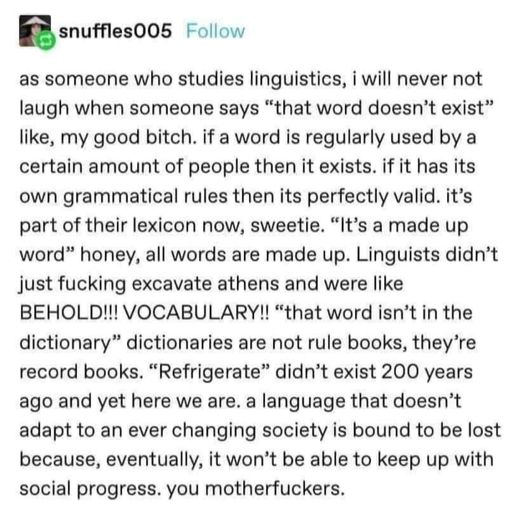
I've always said the dictionary is a follower not a leader, by the time a word gets added to the dictionary it's already established widespread usage

  • source
  • hideshow 2 child comments
  • [–] 73 points 2 years ago (4 children)

    The same rules apply to gods, according to Terry Pratchet

  • source
  • hideshow 4 child comments
  • load more comments (4 replies)
    [–] 59 points 2 years ago (3 children)

    Gonna go on Countdown with the line “Dictionaries aren’t rule books, they’re record books” and fight Susie Dent.

  • source
  • hideshow 5 child comments
  • load more comments (1 reply)
    [–] 52 points 2 years ago (5 children)

    I've always been a big advocate of the idea that the only part of communication that matters is communication. If people understand you then congrats you've successfully languaged

  • source
  • hideshow 6 child comments
  • load more comments (4 replies)
    [–] 51 points 2 years ago (8 children)

    The problem is that people frequently use this type of argument when they are unable to spell or follow the basic rules of syntax and grammar instead of simply admitting they're wrong.

    Language does change, over time and across many cultures. It doesn't mean that anything you write is automatically correct.

  • source
  • hideshow 9 child comments
  • [–] 18 points 2 years ago (10 children)

    I'm a descriptivist but that doesn't mean that there aren't rules and that we can't point out things still being wrong.

    Descriptivism still describes rules as they're used in the real world. Breaking those rules still subjects the speaker/writer to the consequences: being misunderstood, having the spoken or written sentence to simply be rejected or disregarded, etc.

    "Colour" and "color" are both correct spellings of the word, because we are able to describe entire communities who spell things that way. "Culler" is not, because anyone who does spell it that way is immediately corrected, and their written spelling is rejected by the person who receives it. We can describe these rules of that interaction as descriptivists, and still conclude that something is wrong or incorrect.

  • source
  • parent
  • hideshow 10 child comments
  • load more comments (10 replies)
  • load more comments (7 replies)
    [–] 33 points 2 years ago (1 child)

    I love militant descriptivists

  • source
  • hideshow 2 child comments
  • [–] 32 points 2 years ago

    Just going to share this little gem again...
    img

  • source
  • [–] 28 points 2 years ago* (last edited 2 years ago) (1 child)

    One thing I learned as an information technology engineer: language is a tool for communication. As long as the sender can send its message unobstructed and as long as the receiver receives and understands the message as intended, the information transmission can be considered a successs.

  • source
  • hideshow 1 child comment
  • load more comments (1 reply)
    [–] 28 points 2 years ago (1 child)

    As a l33+ |><|@z0r, I'm here to criticize your command of the English language.

  • source
  • hideshow 2 child comments
  • [–] 25 points 2 years ago (13 children)

    And still I maintain that "alot" is not a word.

  • source
  • hideshow 15 child comments
  • [–] 15 points 2 years ago (11 children)

    I've noticed a tendency of people to combine words that are frequently seen together: "alot", "aswell", "noone", etc.

    Some of these catch on, like "nevertheless" and "whatsoever". Maybe eventually "alot" and "noone" will become standard English, too.

  • source
  • parent
  • hideshow 12 child comments
  • [–] 10 points 2 years ago

    The way alot, aswell and noone are combining is expected given how many other words we don't bat an eye at went the same way. "another" is the perfect example, it's just "an other" combined.

    It's sort of the reverse of what happened to words like apron and newt.

    The division and bracketing of phrases changes over time.

    "An apron" is the modern usage of the word "napron", and a newt was originally called an eute. The grammatical need for "a" and/or "an" resulted in the root word being rebracketed and changed.

  • source
  • parent
  • load more comments (10 replies)
  • load more comments (11 replies)
    [–] 22 points 2 years ago (4 children)

    End prescriptuhvist speling! We haf nuthing to loose butt hour wigly red underlyns!

  • source
  • hideshow 5 child comments
  • load more comments (3 replies)
    [–] 20 points 2 years ago (1 child)

    I dig the variety of topics on this comm, and I super appreciate how it doesn't get STEMlordy at all.

  • source
  • hideshow 2 child comments
  • [–] 18 points 2 years ago (1 child)

    That said I feel like when people are referring to whether or not something "is a word" they're referring to whether not is has seen historical/widespread usage, not "has somebody ever just decided it meant something, somewhere, at some point"

  • source
  • hideshow 2 child comments
  • [–] 18 points 2 years ago (4 children)

    Great post, I offer my most enthusiastic contrafribularities.

  • source
  • hideshow 4 child comments
  • load more comments (4 replies)
    [–] 17 points 2 years ago* (last edited 2 years ago) (6 children)

    While that's correct and all, it still irks me when somebody uses a word that has a shorter, older variant. (Gives side-eye to orientated)

  • source
  • hideshow 6 child comments
  • load more comments (6 replies)
    [–] 13 points 2 years ago (3 children)

    "a language that doesn't adapt to an ever changing society is bound to be lost", sure, but adapt too quickly and you lose the ability to communicate between groups of people.

    There needs to be some compromise where new words are adopted, and changed words are accepted, without flooding the language with garbage. For example, English should still be taught in schools, and English teachers should still have the freedom of correcting the writing kids produce, and taking points off for "mistakes".

    Like, if you go pure descriptivist, "it's" and "its" can now mean the same thing. There is no ability to distinguish between their, they're and there. A business email describing a product as "cheugy, no cap" is perfectly acceptable and it's up to the reader to figure it out, because every word is a real word and perfectly valid, and every grammar deviation is acceptable because languages evolve.

    Even on social media, I think it's fair to push back on "mistakes" that make it hard to understand something. An error that might take a poster 1 second to fix, might cost the world minutes, as thousands of people each take a few seconds to puzzle out what the OP meant to write.

    Languages are about communication, and that can suffer whether the language police are too rigid and forbid any deviation, are too easily bribed and allow for anything.

  • source
  • hideshow 3 child comments
  • load more comments (3 replies)
    [–] 13 points 2 years ago (1 child)
  • [–] 12 points 2 years ago (1 child)
    load more comments (1 reply)
    [–] 12 points 2 years ago (5 children)

    I'm old enough to have noticed that a huge amount of language has changed in American English in the Westcoast at least. It's pretty remarkable even myself and other middle aged people I know have changed their word use and slang.

  • source
  • hideshow 5 child comments
  • load more comments (5 replies)
    [–] 11 points 2 years ago (2 children)

    Studies linguistics, but not grammar.

  • source
  • hideshow 2 child comments
  • load more comments (2 replies)
    [–] 11 points 2 years ago (1 child)

    "That's not a word" only applies to scrabble and boggle. Fuck any other context.

  • source
  • hideshow 1 child comment
  • load more comments (1 reply)
    [–] 10 points 2 years ago (2 children)
  • load more comments (1 reply)
    load more comments
    view more: next ›