1
posts
2
3
4
5
6
Police Removed Prominent Scientists from the ADA Meeting. Researchers Respond
(www.the-scientist.com)
7
370 billion crickets are farmed for food every year. Scientists have discovered they may feel pain
House Cricket (Acheta domesticus). Credit: mani_raab/iNaturalist, CC BY-NC
You're cooking dinner, distracted, and your hand brushes a hot pan. Nerve signals race to your spinal cord and back to yank your arm away in a fraction of a second, with no thought required.
Then comes the pain. A sharp, spreading sting gives way to a pulsing ache, and you cradle your hand and run it under cold water until it subsides. That felt experience is distinct from the reflex that preceded it. While the reflex moved your body out of danger, pain drives you to protect the wound, recover, and learn to avoid similar mistakes in the future.
We readily accept that other people feel pain by reading cues in their behavior, like the inspection and nursing of an injury. We extend this to some animals too—a dog licking its paw or a cat favoring a limb rightly stir our sympathies. But what happens when we turn that lens on animals far less like us?
In our new study, published in Proceedings of the Royal Society B: Biological Sciences, we searched for behavioral signs of pain in house crickets, one of the most widely farmed insects. After applying heat to an antenna, we found that crickets didn't just reflexively flinch and recover. They nursed the harm, returning again and again to groom the affected site, much as we rub a burned hand.
The frontiers of feeling
French philosopher René Descartes considered animals unfeeling biological machines, and for centuries the circle of moral concern barely extended beyond our own species.
But the boundaries have steadily crept outward. Recognition that mammals experience pain came first, followed by birds. Fish too, once assumed to lack the necessary brain structures, are now widely accepted as capable of pain-like states.
The leap into invertebrates has been greater and more contentious. Their nervous systems bear little resemblance to our own, so arguments from brain anatomy alone don't carry us far. Instead, we look to behavior. Does the animal respond to harm in ways that go beyond reflex, ways that are flexible, persistent, and sensitive to context?
Over the past decade, testable indicators for pain in non-humans have been developed and are increasingly accepted. These include learning from unpleasant events, trading off harms against rewards, and actively protecting the site of injury. Evidence meeting these criteria helped crabs and lobsters gain legal recognition as sentient under United Kingdom law in 2022.
Among insects, the evidence has been accumulating fast. Yet most of this evidence comes from bees. Bumblebees weigh the risk of harm against the richness of a food reward, and groom the site of an injury. Honeybees learn to associate particular smells with harmful stimuli and avoid them.
Far less attention has been paid to Orthoptera, the group that includes grasshoppers, locusts and crickets. That gap matters, because the house cricket (Acheta domesticus) is the world's most widely farmed insect, with more than 370 billion reared annually.
Do crickets feel pain?
We tested 40 male and 40 female crickets, each experiencing three conditions in random order: a hot probe to a single antenna (65°C, to activate damage receptors but not cause lasting injury), the same probe unheated, or no contact at all.
We filmed their behavior for ten minutes. Observers scoring the footage did not know which treatment any animal had received.
The results were clear. After the hot probe, crickets were more than twice as likely to groom the affected antenna compared to controls, and spent roughly four times longer doing so.
Could this simply reflect general disturbance rather than targeted care? Unlikely: grooming was directed specifically at the heated side, not spread evenly across both antennae as it was after gentle touch or no contact.
And the behavior wasn't a brief, reflexive reaction. It was elevated from the outset and tapered gradually over minutes, much like rubbing a burned hand as the felt sting slowly fades.
Small minds, big feelings
Subjective experience cannot be directly observed in any animal, not even humans.
But we have shown crickets respond to harm in a way that satisfies a key criterion many scientists and philosophers use to infer pain: flexible, directed self-protection. Combined with the knowledge that crickets possess damage receptors, can learn to avoid harms, and respond less to injury under morphine, the weight of evidence for an inner life is growing.
The practical stakes are real. Hundreds of billions of farmed insects are slaughtered each year by freezing, boiling and baking. Pesticides kill trillions more, optimized for lethality with no consideration of potential suffering.
If we take a precautionary approach, credible evidence of suffering should motivate proportionate protections well before we are certain.
Insects have been around for more than 400 million years and are far more behaviorally and cognitively sophisticated than once assumed. The question, then, may not be whether some insects feel, but why we ever assumed they couldn't.

8
9
10
11
12
Banner image: The short-eared dog inhabits the Amazon and prefers untouched forests. Image courtesy of Guido Ayala & María Viscarra/WCS Bolivia.
Study gathers over 4,000 photos to find Bolivia’s rarest Amazonian dog
- A study conducted for more than 20 years with camera-trap surveys in different parts of the Bolivian Amazon has recorded 594 independent events for the short-eared dog in more than 4,600 images.
- This species, popularly known in Bolivia as the ghost dog, is one of the least-known canids in the world. Its survival depends highly on the quality of its natural habitat, according to experts.
- In the Bolivian forests, it can generally be found in protected areas or Indigenous territories, which scientists say underscores the importance of these kinds of areas for biodiversity conservation.
It has a fox-like snout, webbed toes and a thick tail. It’s called the short-eared dog (Atelocynus microtis), but also the ghost dog (perro fantasma in Spanish) in Bolivia, and the Amazonian dog. It’s one of the world’s least-known canids and one of the least frequently sighted carnivores in Latin America.
Now, though, a study conducted over the course of more than two decades — from 2001 to 2024 — in Bolivia has revealed more than 4,600 camera-trap images that show how it lives, the places it inhabits, and why this species is so dependent on South America’s forests remaining intact to survive.
The research underscores that the ghost dog is very much an Amazonian species, and in particular a forest one. In Bolivia, it can be spotted in the country’s continuous Amazonian forests, in the northern portion of the department of La Paz, but also in the department of Pando, in northern and northeastern Beni, and in the far north and northeast of Santa Cruz.
It’s also found in the pre-Amazonian forests of the Andes mountain range, also called piedmont forests, at elevations up to 750 meters (2,460 feet).
Robert Wallace, a British biologist from the Wildlife Conservation Society (WCS) in Bolivia and a co-author of the new study, said the team conducted a systematic review of published and unpublished distribution records of the species in Bolivia. Throughout the 23 years, they also carried out 34 intensive camera-trap surveys in the lowland areas of the Greater Madidi-Tambopata Landscape (in northwest Bolivia) and the Llanos de Moxos Biocultural Landscape (northern Bolivia).
Popularly called the “ghost dog” (perro fantasma) in Bolivia, Atelocynus microtis is one of the world’s least-known canid species. Image courtesy of Guido Ayala & María Viscarra/WCS Bolivia.
Wallace said the short-eared dog is native to the Amazonian forests, not the Amazonian grasslands. “Our [collected] data shows that what it seeks the most is the forest itself, as it avoids transitional habitats leading to more open areas. It is a forest species,” he said.
He added that the use of hidden technology, such as camera traps, makes the mysterious dog not as hard to find as people think. Even so, Wallace said, it’s still challenging to witness the species directly: this canid is quite skittish and has a highly developed sense of smell, which allows it to avoid encounters with humans and natural predators.
“The short-eared dog is primarily diurnal, but also crepuscular, meaning it’s quite active around dawn and dusk. It can be active at night, but the vast majority of camera-trap sightings occurred during the day,” Wallace said.
He added the species’ preferred biome type is the lowland forest, “not right next to the river, but in the mature forest, further inland.”
A two-decade-long initiative
The study was backed by WCS Bolivia and included a lot of camera trapping, done every year during the dry season.
This method revealed an animal with a relatively low-slung body, short legs, small and rounded ears, a large head, and dense, dark fur ranging from blackish-gray to reddish-brown, with a dark dorsal stripe and a long bushy tail that usually drags on the ground. Its feet are partially webbed, meaning the toes are connected by a membrane — a unique trait among Amazonian canids.
The camera-trap surveys yielded a combined 4,635 photos covering 594 separate events featuring the short-eared dog.
“Camera-trap surveys provided significant information on the behavior and relative abundance of the short-eared dog, suggesting that it is more abundant than previously believed, although it remains a relatively rare medium-sized carnivore,” Wallace said.
He said it’s encouraging that the short-eared dog’s relative abundance was higher in protected areas and Indigenous territories that overlap with protected areas, emphasizing that this reinforces the importance of these kinds of areas for biodiversity conservation.
A short-eared dog approaches a veterinarian in the Bolivian Amazon. Image courtesy of Renata Leite Pitman.
“These results have important implications for conservation, as they suggest that large tracts of continuous forest, comparable in size to larger protected areas, will be necessary to uphold viable long-term populations of short-eared dogs,” Wallace said.
According to the Bolivian environmental NGO ORÉ, six species of canids are known in Bolivia, including the short-eared dog, also known in the Amazon lowlands as the bush dog (perro de monte in Spanish). ORÉ noted that the species shouldn’t be confused with the more common bush dog ( Speothos venaticus ) or the black-footed fox (Cerdocyon thous).
ORÉ collaborated on a 2024 related study with the Noel Kempff Mercado Natural History Museum, located in Santa Cruz de la Sierra, the largest city in Bolivia. The organization told Mongabay that the short-eared dog is the only species in its genus and is a solitary carnivore. It measures 70-100 centimeters (28-39 inches) in length, stands 35 cm (14 in) tall, and has a bushy black tail — except at the base — that’s long enough to touch the ground.
The short-eared dog’s survival depends on forest quality. Image courtesy of Renata Leite Pitman.
The short-eared dog’s characteristics
The dog’s head is large and more brownish than its grayish back. Its snout has a distinct black line running from the nose to the area below the eyes. The ears are small, hence the name, but emerge above the crown of the head. They’re rounded and light brown, contrasting with the head’s tone. The dog can weigh between 9 and 10 kilograms (20-22 pounds), with the females up to 30% larger than the males. The species’ diet is believed to consist of amphibians, fish and reptiles, although it also eats fruit.
Marco Greminger, a veterinary zootechnician and professor at the Autonomous University of Beni in Bolivia, told Mongabay that a ghost dog was once captured alive near the university. He said the animal was found hidden in a disused ground-level air duct.
“It was incredible how we managed to capture that ghost dog alive. They called me to help, and I did it. The [short-eared] dog came into the kennel; it was really weak. I remember giving him 350 grams [12 ounces] of chicken liver — which is rich in folic acid — chicken feet, and an oral rehydration solution. He ate all 10 pieces I gave him,” Greminger said.
He added the animal has a strong odor. “It’s stronger than that of a porcupine or a fox; it’s more sour,” he said.
The short-eared dog prefers upland forests, living far from the riverside. Image courtesy of Renata Leite Pitman.
Veterinarian and ecologist Renata Leite Pitman, a researcher at Duke University in the U.S., has studied short-eared dogs for 14 years, calling them “very elusive and hard to spot.” In that time, she’s located just five of them in the wild, in the Amazon Basin, her place of fieldwork, and fitted them with tracking collars to study their habits. “They are very shy, totally different from pets,” she said.
In 2023, Pitman was contacted by Greminger, who was seeking advice after finding the dog in the air duct. “I shared what I had been feeding it. We agreed and coordinated a few steps. She recommended papaya; I had been giving guava,” Greminger said.
This story was first published here in Spanish on May 6, 2026.


13
14
15
16
17
18
19
[CW: dead fish] Karajarri celebrate Australia’s first ‘Sea Country’ Indigenous Protected Area
(news.mongabay.com)
Banner image: An Australian flatback sea turtle (Natator depressus). Image by © Dylan Goldspink via iNaturalist (CC BY-NC 4.0).
Karajarri celebrate Australia’s first ‘Sea Country’ Indigenous Protected Area
- The Kimberley region of northwestern Australia is a biodiversity hotspot and ancestral home of the Karajarri people, who recently dedicated Karajarri Jurarr Ngurra, Australia’s first “Sea Country” Indigenous Protected Area (IPA), covering around 237,000 hectares (587,000 acres) of marine and coastal ecosystems.
- Proponents of IPAs say they can empower Indigenous Australians as decision-makers in land management, combining traditional ecological knowledge with conservation goals.
- IPAs now account for 54% of Australia’s progress toward protecting 30% of its territory by 2030.
- While research shows every $1 invested in IPAs yields up to $3.40 in social, economic and environmental returns, advocates stress that Indigenous communities still need meaningful, sustained support.
In northwestern Australia lies a remote and wildly diverse region called the Kimberley. There, the iron-red soils of the Pindan Country connect forests and the Great Sandy Desert, all bracketed by a vast stretch of Indian Ocean coastline. Its springs and wetlands host migratory birds. Offshore, sawfish, as visually striking as they are rare, ply the waters just beyond the unbroken Eighty Mile Beach, itself a nesting site for the little-known flatback turtle (Natator depressus).
The Kimberley has also long been a home to humans, as rock art more than 17,000 years old attests, and among the heirs of that legacy are the Karajarri people. Over the past 30 years, the Karajarri secured legal recognition of their claims to the land, later establishing an Indigenous Protected Area (IPA), Karajarri Pirra Ngurra, that now covers an area of land nearly the size of Rwanda in the state of Western Australia. They also developed a ranger program that draws on long-held cultural knowledge of the landscape.
In March 2026, the Karajarri people dedicated Karajarri Jurarr Ngurra, Australia’s first “Sea Country” IPA, comprising 237,489 hectares (nearly 587,000 acres) of marine and coastal ecosystems. It includes part of Malumpurr, the Karajarri word for Eighty Mile Beach. The IPA “strengthens long‑standing efforts by Karajarri Traditional Owners and Karajarri Rangers to protect the region’s biodiversity and keep Country healthy,” Malarndirri McCarthy, Australia’s minister for Indigenous Australians, said in a March 20 government statement about the Karajarri Sea Country IPA dedication.
The aim of the Karajarri IPAs is to support a mutually beneficial relationship between the land and its longtime stewards, says Jesse Ala’i, former Land and Sea Country manager for the Karajarri Traditional Lands Association.
“In order to have healthy Country, you need healthy people,” Ala’i says. Likewise, he adds, “Healthy people need healthy Country.”
Gwion Gwion rock paintings in the Kimberley region of Western Australia. Image by TimJN1/Bradshaw Art via Wikimedia Commons (CC BY-SA 2.0).
Across Australia, more than 90 IPAs dot the land. And the government recently allocated A$13 million ($9.4 million) in initial funding to add new ones. The IPAs are a critical piece of Australia’s strategy to protect 30% of the country’s territory by 2030, part of the global 30×30 goal aimed at halting biodiversity loss.
“We’re well underway to reaching that target and IPAs are providing more than half of that contribution,” Murray Watt, Australia’s environment minister, said in the government’s statement.
To date, Australia has protected nearly a quarter of its land and oceans, a spokesperson for the environment ministry told Mongabay. According to the Indigenous-governed nonprofit Country Needs People, IPAs account for 54% of that goal. But the organization’s CEO, Paddy O’Leary, says the role of Australia’s extensive IPA network goes beyond meeting those goals.
“The magic sauce in an IPA comes from creating a model that, done well, will put Traditional Owners in a much more proactive position in terms of managing their Country,” O’Leary says.
The relationship between Indigenous Australians and the land they live on is well known, he adds. “It’s historical fact and a truth.
“There’s so many advantages to making that connection more recognized, more seen and more respected,” O’Leary says.
Flatback turtles nest on, and live off, the coast of Malumpurr, also known as Eighty Mile Beach. Image by © glyall via iNaturalist (CC BY-NC 4.0).
Self-determination and conservation
From the government’s perspective, IPAs are part of the conservation puzzle for protecting the continent’s ecosystems, including those underrepresented in the country’s National Reserve System, O’Leary says. But the designation of an IPA is more than that for Australia’s Indigenous peoples, including Aboriginal groups like the Karajarri as well as distinct peoples from the Torres Strait off the country’s northern coast, he adds.
“It’s a stamp that puts a distinctive Indigenous view on how a given area should be managed,” O’Leary says. “It centers Aboriginal and Torres Strait Islander people as not just participants or people to be consulted, but decision-makers and key drivers of the management.”
The IPA tag also provides a pathway for these groups to collaborate with outsiders, he adds. “It makes visible to other stakeholders who might want to collaborate the set of priorities that local Traditional Owners want, and it combines both biodiversity and cultural values in management as well as a governance framework that is built — in a good IPA, should be built — from the ground up by the Indigenous community.”
But building that foundation takes significant time and resources, O’Leary says. This year’s federal funding is intended to be a “catalyst,” to be augmented by grants from supportive NGOs or state governments.
“[It’s] not a huge amount of money, but for small groups, it’s often a very useful amount,” he says.
A map shows the locations of Australia’s Indigenous Protected Areas and Key Biodiversity Areas. Image by Mongabay.
Role of the rangers
For the Karajarri people, the journey to their own IPA started in the mid-1990s, when a group of elders applied for “Native Title” rights. About a decade later, after government recognition, the Karajarri started their ranger program and began the consultation process for an official IPA. In 2014, the Karajarri people declared their IPA, covering almost 2.5 million hectares (6.1 million acres) of land in the Kimberley. Sustainable resource use is allowed over the vast majority of the land, while part is managed with the same protections as a national park.
The state of Western Australia supports the Karajarri Ranger program, which serves as a fundamental cog in the functioning of an IPA and a source of employment for communities, Ala’i says.
“It’s impossible to separate Indigenous ranger programs from IPAs,” he adds. Ala’i is not Karajarri; instead, he came to his work on the IPA from a background in conservation biology.
“When I heard about ranger programs, I was like, ‘Oh, that’s the thing,’” he tells Mongabay. “It’s that intersection for me of the environment and social community development, capacity building [and] mentoring.”
Matilda Murley, a marine invertebrate ecologist and research associate at the University of Western Australia, has spent nearly a decade collaborating with the Karajarri people, working with the rangers on a Karajarri-led project to monitor their shoreline ecosystem in ways that make sense for both their culture and biodiversity.
“They are the cultural custodians being paid to look after Country,” says Murley, who is not Karajarri. “They’re looking out for the community priorities.”
For Western science, the Kimberley coast has largely been a blank spot on the map, with few details about what exists there. But as Murley’s project developed through systematic data collection, as well as workshops and interviews in the Karajarri community, it became clear how much knowledge had been passed down over generations.
“They are the main scientists,” she said of the Karajarri people. “They have this amazing historical knowledge of how things have changed.”
That knowledge and working with these types of projects can be springboards for both the community and individuals, Murley says. “We’re upskilling the rangers.”
Ala’i notes that scientists have learned that a collaborative approach leads to far more successful projects, and it’s benefiting Indigenous communities in Australia, who struggle with much higher rates of poor health and poverty than the broader population. The Karajarri Rangers have co-authored scientific publications with Murley and were also part of a team to report the first adult female dwarf sawfish (Pristis clavata) ever recorded by Western science.
“We’ve got rangers that have gone off to university now,” Ala’i says.
Government agencies, too, are beginning to catch on to the power of thousands of years of experience in the landscape, particularly when it comes to fire, he adds. “You need to turn to Indigenous fire regimes if you want to deal with fire in a changing climate.”
The springs and wetlands of Pindan Country host migratory birds. Image by Robert Clemens via Unsplash (Public domain).
Malumpurr, or Eighty Mile Beach, in the Kimberley region. Image by Wendy Tempels via Unsplash (Public domain).
The Karajarri Rangers have co-authored scientific publications with ecologist Matilda Murley and were also part of a team to report the first adult female dwarf sawfish ever recorded by Western science. Image by David Morgan via IUCN Shark Specialist Group.
Rock art more than 17,000 years old in the Kimberley region. Image courtesy of Caroline Jones via Flickr (Public domain).
Costs of conservation
Globally, embracing Indigenous-led conservation is increasingly seen as an efficient path for confronting biodiversity loss, climate change and other environmental woes. Research published in 2016 tracked the impact of government and “third-party” funding on five IPAs across Australia. The authors found that every $1 invested in the IPAs and their ranger programs netted between $1.50 and $3.40 in “social, economic, cultural and environmental outcomes.”
At the same time, the Australian government provides billions of dollars to the fossil fuel industry, as well as biodiversity-damaging practices in agriculture, fisheries and forestry, according to a recent study. Around the world, governments spend some $500 billion annually on “harmful subsidies,” which the Kunming-Montreal Global Biodiversity Framework calls for reforming by 2030.
Ala’i notes that, however cost-effective IPAs might be, the communities still need meaningful support and shouldn’t be seen simply as a less expensive solution. Still, he says, “I still think it’s fundamentally the best system the government’s ever created” to address conservation and socioeconomic problems.
“It’s very self-determined, if allowed to be, which is what all the research shows is the best way to allow Indigenous people to close those inequalities,” Ala’i adds. “It just hits all the boxes.”
O’Leary of Country Needs People acknowledges the system isn’t perfect, and says successful IPAs rely on careful planning, support and engagement. But, he says, they represent a critical tool that’s being used right now.
“Yes, there are a lot of things to be improved,” he adds. “But this is happening on the ground now in real time. It’s not being theorized in academic papers or in international forums alone. It’s actually happening on the ground for people, and that is where the rubber hits the road.”
John Cannon is a staff features writer with Mongabay. Find him on Bluesky and LinkedIn.


20
Why are there so many lizards in Australia? The ancient climate holds a clue
If you travel around Australia, you will find an incredible diversity of lizards.
The three-toed snake-tooth skink (Saiphos reticulatus), for example, is a peculiarly long and stumpy legged reptile that burrows in rainforest and is covered in a brilliant orange and black-banded pattern. Alpine water skinks (Eulamprus kosciuskoi) are incredibly cold-tolerant and mottled with black and greenish yellow, like mossy rocks in mountain streams. Prickly forest skinks (Concinnia queenslandiae) are delightfully chunky-headed, spiky, armoured rainforest gems.
These lizards are all members of Australia’s largest evolutionarily related group of vertebrate animals, known as the Sphenomorphini. Their ancestors arrived in Australia some 28 million years ago, likely crossing land bridges and rafting across islands from Southeast Asia during glacial periods when sea levels were lower.
In a new paper, colleagues and I describe the most complete and detailed evolutionary tree of this group to date. This helps us to understand why there is such a mountain of species diversity within this group. A crucial clue is in the climate.
Three-toed snake-skink (Coeranoscincus reticulatus). nicgambold/iNaturalist, CC BY-NC
Building the evolutionary tree
Previous estimates in Sphenomorphini lizards concluded there were about 270 species in the group.
For our new study, we gathered more than 5,000 genetic identifiers to build a “species tree” of the entire group that reveals a total of at least 314 member species.
Our evolutionary tree shows most modern Sphenomorphini genera in Australia seem to appear in a six-million-year burst.
The timing of this burst is telling. It coincides with the Early Miocene – a climatically tumultuous period roughly 23 million to 16 million years ago, marked by the expansion of Antarctica’s ice sheets.
Australia, which by then had broken off from the southern supercontinent of Gondwana, saw a significant reduction in rainfall. As rainforest declined, the continent became more arid.
This suggests climatic changes may have driven the diversification of Sphenomorphini, with new species forming in response to the changing conditions.
This raises the question: how exactly did the new species form?
While several processes are known to drive the evolution of new species (such as sexual selection and competition), two major forces appear to be crucial to the story of the Sphenomorphini.
One is known as “allopatric speciation”. This is when a new species forms by the simple physical splitting of a population. Over millions of years, each population accumulates enough mutations via simple chance that if they were ever to meet again they would be too different to interbreed.
The second major force is known as “ecological divergence”. This is when populations of a single species develop niche traits in response to different environmental conditions. The populations now have differing selective pressures. Eventually, they stop mating with each other and enough different mutations accumulate to create an entirely new species.
The exact role of each of these forces is still unclear and will be the focus of our future research.
Alpine water skink (Eulamprus kosciuskoi). calamanthus/iNaturalist, CC BY-NC
Heeding the warnings
Lizards are a massive component of the storied history of life on this planet. Now that we are slowly unravelling the mysteries of their evolution, we should perhaps heed the warnings.
In the Sphenomorphini, the details seem to paint a picture of arrival, climatic change likely accompanied by extinction and diversification, and for some, persistence in the face of a changing environment.
But bear in mind, the climate shifts that upended the Australian rainforest domination and led the Sphenomorphini to generate such diversity were incredibly slow.
Much changed in the 12 million years between the so-called early Miocene and middle Miocene climatic events. Yet global temperatures only declined around 2°C–3°C.
An equivalent degree of warming in only a mere few centuries would likely be catastrophic for these remarkable creatures – along with so much other life on Earth.


21
22
The Dinosaur-Killing Asteroid May Have Come From a Rare Class of Meteorites
(www.discovermagazine.com)
23
cross-posted from: https://hexbear.net/post/9021894
Banner image: Awareness of leopard cats is generally low across their range, as they are small, difficult to spot, and are sometimes mistaken for domesticated cats or leopard cubs. This one was photographed in the Sundarbans mangrove forest of West Bengal state, India. Image by Soumyajit Nandy via Wikimedia Commons (CC BY-SA 4.0).

Asia’s mainland leopard cat is abundant but still cloaked in mystery
- Widespread, adaptable, and classified globally as a species of “least concern” on the IUCN Red List, the mainland leopard cat can be found across much of Asia. However, research on the species remains relatively limited.
- Despite its global status, local populations face serious threats — including habitat loss, hunting, vehicle collisions, and genetic isolation — and in some cases are considered locally critically endangered. Global assessments can mask these regional declines due to how conservation status is assessed.
- Researchers highlight knowledge gaps caused by underfunding, language and geopolitical barriers, along with unshared data. They stress that more focused studies, genetic research, and conservation initiatives that involve local communities are essential to protecting this ecologically important species.
There’s good news about Asia’s mainland leopard cat: Prionailurus bengalensis is thought to be one of the world’s most abundant, widely distributed wildcats. With a conservation assessment of “least concern” on the IUCN Red List, sightings are reported from India to the Russian Far East.
That’s partly because mainland leopard cats are highly successful generalists. With two recognized subspecies — P. b. bengalensis and P. b. euptilurus — this small cat is adaptable to multiple habitats, ranging from forest to shrublands to grasslands, and including areas altered by humans.
But this good news comes with a caution: Surprisingly little is known about this felid, say experts, and it may be less plentiful and more at risk than sightings alone indicate.
Leopard cats have been understudied, a trend common among small cat species, which garner less public interest than big cats, and a reality that translates into less funding for research and conservation. As a result, P. bengalensis population surveys have only been conducted at a handful of sites, leaving lots of blank spots on range maps.
Despite perceived abundance, researchers note that this felid also still faces conservation challenges and could benefit from more attention from funders and the public, as the species plays an important, if underappreciated, role in controlling rodent populations.

A leopard cat in the Russian Far East, where it lives alongside leopards and tigers but receives relatively little attention compared with its larger, dynamic cousins. Image courtesy of Yuriy Smityuk.
Of ‘least concern’ but at risk of local extinctions
Roughly the size of a domestic cat, Asia’s mainland leopard cat was first recognized as a distinct species in 2017, when recent molecular studies and morphological differences led scientists to list it separately from the Sunda leopard cat (Prionailurus javanensis) found on Southeast Asian islands.
The mainland leopard cat’s conservation status was most recently assessed for the IUCN Red List in 2021 by an international team of researchers, who, based on available evidence, determined that the species’ overall population and range “have remained more or less the same.”
However, country-level data on leopard cat populations, as with many smaller mammals, is spotty or generally does not exist, says Priya Singh, an India-based independent researcher and one of the IUCN assessment leaders.
“We have standalone studies, which cover small areas, and then based on those studies we have to extrapolate and make intelligent guesses about what the population of that species would be at a larger level,” Singh says.

IUCN 2022 Leopard cat (Prionailurus bengalensis) distribution map. While considered one of the most abundant widely distributed small cats, and given a “least concern” listing by the IUCN, detailed P. bengalensis population data don’t exist for many locales and the species may be at risk, or even locally extinct, in some places. Image by Embladc via Wikimedia Commons (CC BY-SA 4.0).

The design of the Red List framework can sometimes create misperceptions about actual conservation status, says Thomas Gray, tiger recovery lead at the WWF Tigers Alive Initiative, who was involved with the Red List assessment for the mainland leopard cat.
That’s because IUCN Red List assessments are based on a species’ three most recent generations, or a minimum of 10 years. “This shifting baseline means that some of the big declines in animal abundance that will have been caused by habitat loss over the past 30 years are kind of irrelevant in Red List assessments now,” Gray adds.
“You can [also] have situations where a species may be critically endangered in a place, may be extinct in [another] place, but its global conservation status remains ‘least concern’ because what we are looking at [with the Red List] is global, range-wide trends of population,” he says.
Critically endangered local leopard cat populations include those on Japan’s Tsushima and Iriomote islands, each of which hosts roughly 100 of the cats. Conservationists warn too that habitat loss and human activities have reduced leopard cat numbers in Taiwan, where fewer than 500 individuals remain, putting it perilously close to local extinction.
Alongside the 2021 Red List survey, the mainland leopard cat is also currently being assessed for the IUCN’s Green Status of Species, an additional evaluation that classifiers introduced in 2021 to measure the extent to which a species is depleted or recovered.
The Green Status is intended to address gaps in the Red List framework “by considering regional status, recovery status, and conservation impact,” explains Elliot Carlton, a species survival officer with the IUCN SSC Centre for Species Survival Cats.
He highlighted the example of the European wildcat, another small felid that was assessed to be of “least concern” for global extinction based on the Red List framework, yet whose Green Status assessment was found to be “largely depleted.”
“Hopefully, the Green Status assessment will provide insights into the differences in status, threats, and data quality across the mainland leopard cat’s range,” Carlton says. “I hope that, together with the Red List, the Green Status can highlight where further research efforts are needed and support planning for the species.”

A leopard cat in India’s West Bengal state. India’s population of leopard cats is not contiguous, with individuals in the western part of the country isolated from the rest of the leopard cat’s range. Image by Soumyajit Nandy via Wikimedia Commons (CC BY-SA 4.0).

Challenges to data gathering
Researchers, including IUCN collaborators making overall assessments, are confronted by many challenges in their attempts to study leopard cats, not least of which are the sociopolitical workings of human society that can vary widely between the 19 countries over which the cat’s range extends.
Language barriers are one factor that can hinder information sharing, with hundreds of languages spoken across the small cat’s far-flung territory, ranging from Mandarin Chinese to Russian, Hindi-Urdu to Nepali and Japanese. In addition, Northeast Asia tends to be underrepresented in Red List assessment teams, which primarily work in English, Gray says. As an example, he cites the “huge amount of very high-quality research that happens in China,” but which might not be fully incorporated into IUCN assessments.
Geopolitical tensions also create blind spots that hinder surveys and conservation planning. “Almost nothing is known about leopard cat populations in North Korea,” notes Kyungmin Kim, a postdoctoral researcher at the Research Institute of EcoScience at Ewha Womans University in South Korea.
“Recent research suggests that indiscriminate snaring is widespread across North Korea, with leopard cats reported as bycatch in this process,” she says, adding that some studies have indicated worrisome state involvement in illegal wildlife trafficking.

Anonymous Japanese illustration of a wildcat, identifiable as a leopard cat (Prionailurus bengalensis). The species also appears in India on a postage stamp. Image by Anonymous from Honzō kōmoku (Japanese edition of Jōō 2/1653) via Wikimedia Commons (Public domain).
/(34/)Bk51-fol03rC-ri-yamaneko.jpg)
The extreme case of North Korea aside, other countries in the leopard cat’s range have less-than-stellar transparency records, though it’s unlikely governments hinder the sharing of knowledge about the species, according to Gray.
“For species that are highly politically significant and/or have had lots of money invested in them, it can be extraordinarily difficult to get the data you need,” he says. “For the leopard cat, it’s not as if no one cares, but for species [of] ‘least concern’ globally, there are no political concerns.”
Another problem: Data on leopard cats garnered during studies of other species, known as bycatch data, sometimes remain unshared and unutilized, says Yadav Ghimirey, director of Friends of Nature Nepal and first author of the Red List assessment for the mainland leopard cat.
“There are some organizations that do a lot of field work but publish only on some species. But camera trapping and other surveys provide data for a lot of other [bycatch] species as well,” Ghimirey says. He notes that this bycatch data could be shared with students and researchers to help governments with conservation planning.
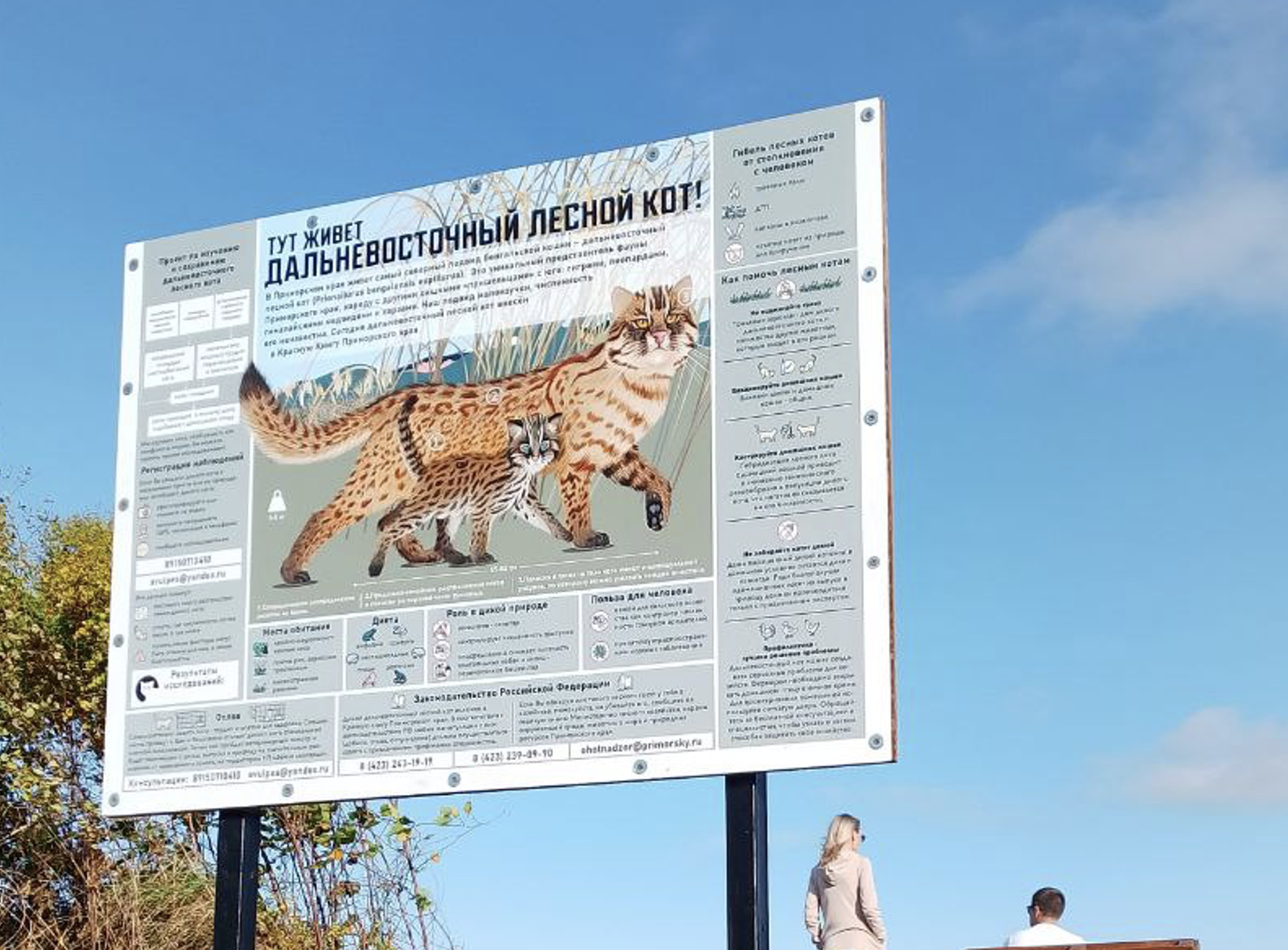
A sign placed to educate local communities in the Russian Far East about the mainland leopard cat. The more people know about this small wildcat, say researchers, the more likely they are to appreciate it and aid in its conservation, and the less likely human-cat conflict may be. Image courtesy of Ekaterina Blidchenko.
Conservation threats and opportunities
While mainland leopard cats may be far from global extinction, the species does face numerous threats.
Among the most vulnerable are “island populations,” which include cats inhabiting actual islands, and those outside the species’ contiguous range on the mainland, such as the leopard cats of India’s Western Ghats region, Singh says. She notes that these isolated populations face risks related to inbreeding. “They are the ones that could end up losing out on their actual conservation or threat status when we do this wide-scale assessment.”
Vehicle strikes are also a common issue, especially as the cats’ habitat becomes increasingly fragmented by road construction. In addition, the IUCN Red List notes that “hunting and snaring occur in most parts of [the] Mainland Leopard Cat’s range and is particularly intense in South-east Asia.” The cat is also traded or hunted for its meat and fur, as well as for illegal adoption, domestication, and hybrid breeding, in parts of its range.
Another threat: conflict with humans over poultry, which leopard cats have been known to snatch. But in the Russian Far East, conservationists are meeting with success in dealing with these human-cat conflicts, says Ekaterina Blidchenko, a senior research assistant at Kedrovaya Pad State Biosphere Nature Reserve and at Land of the Leopard National Park.

A Prionailurus bengalensis kitten in Taiwan, where only 500 leopard cats remain. Taiwan’s leopard cats are among several “island” or isolated populations facing greater local extinction threats than the species overall. Image by ourskyuamlea via Pixabay (Public domain).
Blidchenko’s team developed a signboard to educate local farmers about the leopard cat and involve them in conservation. Placed in more than 10 villages adjacent to national parks, the signs offer contact information to local people interested in cat-proofing their poultry pens or requesting humane cat relocations. “People are increasingly resorting to humane methods of capturing leopard cats visiting chicken coops,” she says.
“[T]he leopard cat very often encounters people in anthropogenic landscapes (highways, agricultural lands, poultry houses), unlike large cats such as tigers and leopards. So it is very important to work with people to highlight the importance of preserving this species of small cat and its valuable place in the ecosystems of Northeast Asia,” Blidchenko adds.
The signs her team have placed in local communities also invite individuals to submit information on leopard cat sightings, which will help researchers map the cat’s range and populations, as well as improve understanding of threats.
Involving local communities is key to conservation, particularly outside of protected areas, Singh agrees. In her experience, “anyone who sees a wild cat — whether it’s big or small — out in the wild gets excited, whether it’s tourists or people working in their fields.”

Due to its large range, transboundary collaboration is key to understanding and conserving the mainland leopard cat. The IUCN Red List and Green Status assessments are two key initiatives toward that end, although much remains unknown about this species. Image by Davidvraju via Wikimedia Commons (CC0 1.0).

Last cat standing
The leopard cat, perhaps due to its small size and adaptability, is sometimes the only non-threatened wild felid — or sometimes the only wild felid at all — left in parts of its range. This is the case in South Korea, which lost its Siberian tigers and Amur leopards in the 1920s and 1970s, respectively. There, the leopard cat, which prowls boundaries between forests and agricultural or residential areas, is under pressure from habitat fragmentation and vehicle strikes, Kim says.
“In South Korea, public awareness and interest in the leopard cat remains remarkably low relative to its ecological significance,” she says. “I believe that if more people came to know that this small and beautiful animal is Korea’s last remaining wild felid, public interest in, and commitment to, its conservation would grow quite naturally.”
Although South Korea’s case may be representative of the leopard cat’s low profile across its range, there have been notable exceptions: A leopard cat photo taken by Peking University professor Luo Shu-Jin via camera trap near the 2022 Winter Olympics ski slopes in Beijing (another locale where leopard cats are the only remaining wild felid) went viral when it was released in 2021, according to CNN.
The photo brought Beijing’s wildlife into view, Luo says. “In an age of rapid urban expansion, can humans and wildlife find a new equilibrium? The study on leopard cats in Beijing sets the stage for such a query,” she says.
China’s overall leopard cat population is estimated at 230,000 individuals, according to the IUCN, although Luo notes that detailed population surveys are still lacking across much of the country. In 2021, China designated the felid as a National Class II protected species. (For comparison, the giant panda is a Class I protected species.)
Elsewhere, “in Southeast Asia, the leopard cat is remarkably resilient and abundant,” Gray says. “It’s essentially the only wild cat left across the vast majority of Laos, Cambodia and Vietnam.”
He cited a 2022 study that found “relatively high” densities of leopard cats in three different forest types in Cambodia. The study’s authors note that leopard cats even appear to thrive in oil palm plantations due to the abundance of rodents there.

A leopard cat in South Korea. The mainland leopard cat is divided into two subspecies, Prionailurus bengalensis bengalensis and Prionailurus bengalensis euptilurus, which exhibit differences in their coats and markings. Image by Kim Hyun-tae via Korean National Institute of Biological Resources (Korea Open Government License Type 1).
Given the historical lack of research into leopard cats, Singh says she would like to see new studies designed to focus specifically on leopard cat biology — as opposed to data produced only as a byproduct of big cat studies.
Genetic mapping is also needed to better understand population connectivity and inform management within distinct conservation units, Kim says.
Despite the leopard cat’s continent-spanning range, Blidchenko emphasizes the need for local focus. “While we can’t influence global processes, we can influence some specific situations,” she says. “Through the personal stories of leopard cats that have encountered humans, we can raise awareness of this species and highlight the challenges these beautiful creatures face.”
24
cross-posted from: https://hexbear.net/post/9010515
The golden-headed lion tamarin, captured in the photo above, is a small primate species found only in the northeastern Brazilian state of Bahia.
The tamarins, Leontopithecus chrysomelas, have bright reddish-golden manes, and similarly colored paws and tails. They live among tree branches, eating fruit and the occasional bird egg or small vertebrate. They sleep huddled together with their extended family units in tree holes.
Flávia Zagury, a biologist and photographer, photographed a family of tamarins at the Primatology Center of Rio de Janeiro, a state research center with a mission to preserve Brazil’s primate heritage.
“I was so impressed by this creature, their colors are incredible,” Zagury told Mongabay in an audio message. “[The tamarins] were vocalizing a lot … I sensed a lot of curiosity coming from them.”
These tamarins are among Brazil’s most threatened primates, having faced a nearly 60% population decline in just three decades. From 1992 to 2024, agricultural and urban expansion took over more than 40% of their habitat. Now, they have just 13,000 square kilometers (5,000 square miles) of available forest, and much of it is fragmented.
A large part of the existing range of the tamarins is made up of cacao agroforestry farms called cabrucas, where the crop is grown underneath a canopy of native trees. Luckily, cacao is also one of their favorite fruits.
In recent years, coffee monocultures and livestock pastures have taken over many cacao farms, adding to the primate’s extinction risk. Locals have been working to better protect them: the city of Ilhéus in Bahia made the golden-headed lion tamarin its official mascot to raise awareness in 2024 and increase local pride for sustainable cacao farms. A rehab center was also inaugurated in March 2026 to help reintroduce tamarins found in urban spaces back into the wild.
“My next mission is to see them in the wild,” Zagury said.

Banner image: A golden-headed lion tamarin (Leontopithecus chrysomelas). Images courtesy of Flávia Zagury.
25
view more:
next ›