cross-posted from: https://hexbear.net/post/9036162

The Trump Administration’s War on Disabled People Continues to Escalate | Truthout

Janine Jackson: The Rehabilitation Act of 1973 addressed the rights of people with disabilities in their interactions with the federal government, including entities that receive certain federal contracts. Section 504 of that act prohibits organizations and employers from excluding or denying individuals with disabilities an equal opportunity to receive program benefits and services.

The hard-won Americans with Disabilities Act, passed into law in July of 1990, and specifically Title II of the ADA, emphasized disabled people’s access to civic life.

These laws have been interpreted for decades as meaning that our shared societal goal is to have disabled people live in community, with family, with friends. A new thing, a memo from the Office of Legal Counsel within the Justice Department, now says: “or maybe not.”

A professor at George Washington University — cited on NPR, one of few outlets to take this seriously — says, “It is now the position of the United States government that people with disabilities don’t have a right to be part of their communities,” adding, “I can’t overstate how significant this change in position is.”

Here to help us understand the meaning of this particular shift, and how it fits within a broader engagement, is Mia Ives-Rublee. She’s senior director of the Disability Justice Initiative at the Center for American Progress, and she joins us now by phone. Welcome to CounterSpin, Mia Ives-Rublee.

Mia Ives-Rublee: Thank you so much. I’m so glad to be here.

JJ: This is a story about law, but we all know it’s not about just what’s legal to do or to not do. After the Rehabilitation Act, after the ADA, in 1999 we have Olmstead v. L.C. This is two women suing the state of Georgia, and the Supreme Court agrees, with reference to that existing legal underpinning, that states have a legal responsibility to provide services that integrate people into communities, that that integration is the goal; it’s the best way forward.

So now this person who wrote, this deputy assistant attorney general, says, “We recognize this view of Olmstead‘s import is out of step with a common understanding of that decision with the federal courts.” So this new memo, what does it mean? What could it mean? Why is it important?

MI-R: So this memo doesn’t change the current laws, or the decision that the Supreme Court made in 1999. What it does is provide specific avenue for states to try to challenge these laws and the Supreme Court decision, in hopes of getting it overturned by the Supreme Court. So people still have basic protections that emphasize their right to live in the community, but it provides this sort of crack in the armor that will probably be utilized by certain states to try to reduce the amount of money that they’re spending on things like home- and community-based services, and long-term support services.

JJ: Yeah. I see folks hearing “it opens a window.” It doesn’t require anything, but it’s offering something that we know that a lot of folks are going to take up.

I want to say, I’m creeped out by the memo saying that Olmstead “held only that a state cannot institutionalize such patients” — they’re talking about people with disabilities — “without justification,” and then adds, “What counts as adequate justification remains an open question.” That reads like a line from a horror movie to me, frankly. Talk about who and what could be affected by this.

MI-R: I think that the two communities that I’m extremely concerned about are individuals with significant mental health issues. So individuals who may be diagnosed as bipolar, or diagnosed with schizophrenia, individuals who have significant mental health issues and are more likely to be very vulnerable. These are individuals that need significant support to continue living in the community, often. And so that’s one portion of the population.

I think the other portion of the population is individuals with developmental disabilities. So we’re looking at people who have been diagnosed as autistic. This could include individuals who have different intellectual disabilities. It includes a wide variety of people, but these are individuals that are already significantly at risk of being institutionalized.

The thing that worries me is this comes after a lot of the conversation that Secretary RFK Jr. has had about creating camps and work farms that, I’m not being over-dramatic in saying these sound similar to the “work camps” and concentration camps that happened in Nazi Germany. And the irony is that Nazi Germany got a lot of its eugenic policy ideas from the United States.

JJ: Which I think a lot of folks don’t know.

And I do think there’s popular misunderstanding. If you see someone on the street who seems to be in mental health crisis, I think, absent a coherent understanding of what could happen, what social supports might mean, there’s a feeling of, “Well, just get them away from me.” And I feel like that’s what they’re playing on, and that’s what they’re hoping will work in the popular imagination.

MI-R: Yeah. And we’ve seen support for that across the political spectrum. And so some of these things, unfortunately, are popular amongst the general public. And I think without understanding the well-researched interventions that actually help people rather than incarcerate them, I’m worried about the direction that we are taking, because we have made so much progress towards ensuring disabled people have similar rights that nondisabled people have. To see it getting reversed is really, really concerning. And to tell you the truth, as a person with a disability, it’s kind of scary to me.

JJ: I want to bring it into some broader context because, as I stated, this particular memo is not getting much attention, and it’s now almost a week old, so now it’s an “old story.”

It’s unclear what’s going to happen, but you wrote with Casey Doherty an overarching account of the Trump administration’s war on disability. So I would ask you to talk about how this newest thing really just fits; it’s not an aberration. It fits with an all-out war on disabled people, and on the laws that have been created to address and encourage the ability of people with disabilities to live in community. So what else do folks need to know? It’s not just this Trump administration, it’s a coherent attack.

MI-R: Yeah. You can go all the way back to Project 2025, right, where they literally lay out what they plan to do, and they are being quite successful in making progress on that plan. So there is this need, which you look at a lot of the quotes and memos from people like Stephen Miller, there is this push from this administration to get rid of anybody that they do not like, or do not want to be in society. And so that means cutting rights and services to some of the most vulnerable populations in the country, and that, in particular, includes disabled people, particularly disabled people of color.

We see that through a number of actions that have been taken, whether it’s attacks on DEIA, saying that we shouldn’t try to ensure that laws that were created to disenfranchise and discriminate against specific populations don’t get addressed in particular. And then we look at things like the OBBBA, which strips things like SNAP and strips Medicaid. These are all programs that, in particular, disabled people are disproportionately reliant on.

And what I found interesting, because I went to a couple of the hearings around some of these issues in the Senate and the House, was the continual statement by representatives and senators saying that this would not impact disabled people, but it was very clear that it would impact disabled people. It would impact everybody, but disproportionately, it would impact disabled people.

What I say in my piece around the “war on disability” is that Medicaid provides so much support for all communities, and is one of the pillars of our current healthcare system, and covers a lot of the costs that everybody gets to benefit from, because it’s not paying one specific provider, it is paying for a group of services and supports that an individual receives, and helps to pay for things like rent of a building or land. It pays for physicians’ wages, it pays for equipment, it pays for all of these things.

And when you take out one of the pillars, or significantly decrease one of the pillars that helps pay for our healthcare system, it collapses the system, right? And so we’re looking at decreasing the support that much of the disability community relies on to be able to survive. By doing that, you cause more deaths, more fatalities, and an increase in disability, an increase in the severity of disabilities.

JJ: I always wonder about media coverage of disabled people, given that it is a community that anyone could join at any moment, and that anyone who has a child could join at any moment. It seems almost like crossing your fingers: “It’s not going to happen to me. I’m going to make policy that doesn’t involve that.” It’s weird. I’m just going to say it’s weird.

And then when media do do their occasional story about disabled people — very much reads as a “very special episode” — they think that means they cover disability. And what I hear you saying, and what we’re both saying, is disabled people are part of the story when you’re reporting on air travel, and when you’re reporting on housing costs, and when you’re reporting on college scholarships. It’s not a once a year, do a deep dive, “What do disabled people care about?” It seems to me a major failing of news reporting that they can’t somehow integrate people with disabilities into every story that they cover.

MI-R: Yeah. I think people don’t realize how much disability impacts the United States, and the world. And it’s been something that we at the Center for American Progress, and particularly the Disability Justice Initiative team, have been really trying to hammer home on, is that disability impacts every single policy that we create, and that every single policy impacts disabled people.

And one of the interesting things is that Rep. Tom Kean Jr. just recently put out a public apology on why he was absent from work, and then discusses his severe depression, which is a disability. And yet, at the same time, he voted to cut a significant amount of Medicaid. And so I think there’s this disconnect of understanding how disability impacts different policies, and how much it impacts every single one of us.

JJ: Absolutely. And there is, and you’re noting it, a kind of overarching storyline from corporate news media — and it’s an unspoken backdrop to any individual story on a number of issues — that the government is generously offering things, and some bad people take advantage, and that’s starving other worthy people of benefits, and there’s a whole problem with… It’s not a coherent argument. It’s like a zero sum thing, that some people are faking a need, and probably that’s why you’re struggling. But this still shapes media narrative around disability, that it’s somehow a grift. Somehow, if you look into it differently, it’s a grift.

And I just want to ask you what — I mean, there is good journalism. I’m not saying there isn’t, but what would be the ingredients of journalism that could shift this narrative?

MI-R: That’s a great question. I think that, one, we need more disabled journalists. We have a couple that are currently doing a wonderful job reporting on disability, but they’re few and far between. And I think that being able to train up the next generation of journalists to understand how disability impacts so many people is going to be essential.

And the thing that I try to emphasize is that the disability community is just going to continue to grow. It’s been growing exponentially since the beginning of the pandemic. And part of that is due to infectious diseases causing specific disabilities. Some of it is due to our crumbling healthcare system. And then some of it is due to the aging baby boomers.

And us not understanding the intersection of policy and disability is going to be a real problem in the near future. I mean, it’s already a problem, but it’s going to be even higher a problem coming up, because the AARP actually did a survey of folks that are coming up towards retirement, or are already retired. And their survey asked them where they would like to retire and live out the rest of their lives. A majority of them said they wanted to live in their communities.

And with that being said, we have a major crisis on our hands, because we don’t have enough caregivers to be able to support that effort. And by stating that, “Oh, states can now ignore Supreme Court legal precedents and ignore law,” it’s going to ensure that states don’t actually put money, and invest money and infrastructure, around an aging population that is going to need the support.

So what’s going to happen is a lot of folks may be languishing in hospitals; emergency rooms will continue to get significantly congested, and we’re going to see a worsening of our healthcare overall, and we will see more people either homeless or incarcerated or dead.

JJ: Which only leads me to say, finally, that I wish that media would connect issues of incarcerated people, of disabled people, of deporting Haitians who, come on, who’s taking care of your grandmother?, healthcare workers. We’re saying the failure of media to connect the dots of the social support networks that exist in this country, to me, seems like a major failing. And I’m not trying to rant at you, but if you have thoughts about that and what media could do, I’d love to hear them.

MI-R: Yeah. Part of this is due to those who hold power are very good at separating people, and pitting them against each other, and that gets reflected in media coverage as well. I think that a lot of times, it’s like, “I’m going to cover this one issue, but I don’t actually give it context.”

And I think a lot of people don’t realize that policies don’t live in a vacuum. What I often talk about, when I’m talking about policy and the work that I do, is I’m literally sitting there with a three-dimensional puzzle that I’m having to try and figure out how different things fit together, or don’t fit together, and how I can get them to actually fit together.

And one example of this would be during the height of the pandemic, when they were giving out checks to everyday citizens, what we saw was that Congress didn’t realize how that would impact disabled people who were on SSI. And that resulted in a number of people on SSI losing their eligibility status. And so they actually had to go back and write up new policies that basically stated, “Hey, you can ignore this payment and this asset for a couple years.”

JJ: Do you have any final thoughts about what we should know about this particular…. You know, it’s a memo, it’s not a law, but maybe media are going to cover it. What should they ask as they cover this particular iteration? Any thoughts?

MI-R: Yeah. I think, one, that this isn’t new, and that this is part of a general plan overall. And that it actually provides us a trajectory of where this administration is thinking on going, and will help advocates and lawyers see how the administration plans to argue around this issue. So I think them releasing this actually provides us some information that we may not have had previously. While it does open the door to states, it also provides us a roadmap in understanding what they plan to do.

JJ: We’ve been speaking with Mia Ives-Rublee. She’s senior director of the Disability Justice Initiative at the Center for American Progress. They’re online at AmericanProgress.org. Thank you, Mia Ives-Rublee, for joining us this week on CounterSpin.

MI-R: Oh, thank you so much. I really appreciate you all covering this.


cross-posted from: https://hexbear.net/post/9036162

The Trump Administration’s War on Disabled People Continues to Escalate | Truthout

Janine Jackson: The Rehabilitation Act of 1973 addressed the rights of people with disabilities in their interactions with the federal government, including entities that receive certain federal contracts. Section 504 of that act prohibits organizations and employers from excluding or denying individuals with disabilities an equal opportunity to receive program benefits and services.

The hard-won Americans with Disabilities Act, passed into law in July of 1990, and specifically Title II of the ADA, emphasized disabled people’s access to civic life.

These laws have been interpreted for decades as meaning that our shared societal goal is to have disabled people live in community, with family, with friends. A new thing, a memo from the Office of Legal Counsel within the Justice Department, now says: “or maybe not.”

A professor at George Washington University — cited on NPR, one of few outlets to take this seriously — says, “It is now the position of the United States government that people with disabilities don’t have a right to be part of their communities,” adding, “I can’t overstate how significant this change in position is.”

Here to help us understand the meaning of this particular shift, and how it fits within a broader engagement, is Mia Ives-Rublee. She’s senior director of the Disability Justice Initiative at the Center for American Progress, and she joins us now by phone. Welcome to CounterSpin, Mia Ives-Rublee.

Mia Ives-Rublee: Thank you so much. I’m so glad to be here.

JJ: This is a story about law, but we all know it’s not about just what’s legal to do or to not do. After the Rehabilitation Act, after the ADA, in 1999 we have Olmstead v. L.C. This is two women suing the state of Georgia, and the Supreme Court agrees, with reference to that existing legal underpinning, that states have a legal responsibility to provide services that integrate people into communities, that that integration is the goal; it’s the best way forward.

So now this person who wrote, this deputy assistant attorney general, says, “We recognize this view of Olmstead‘s import is out of step with a common understanding of that decision with the federal courts.” So this new memo, what does it mean? What could it mean? Why is it important?

MI-R: So this memo doesn’t change the current laws, or the decision that the Supreme Court made in 1999. What it does is provide specific avenue for states to try to challenge these laws and the Supreme Court decision, in hopes of getting it overturned by the Supreme Court. So people still have basic protections that emphasize their right to live in the community, but it provides this sort of crack in the armor that will probably be utilized by certain states to try to reduce the amount of money that they’re spending on things like home- and community-based services, and long-term support services.

JJ: Yeah. I see folks hearing “it opens a window.” It doesn’t require anything, but it’s offering something that we know that a lot of folks are going to take up.

I want to say, I’m creeped out by the memo saying that Olmstead “held only that a state cannot institutionalize such patients” — they’re talking about people with disabilities — “without justification,” and then adds, “What counts as adequate justification remains an open question.” That reads like a line from a horror movie to me, frankly. Talk about who and what could be affected by this.

MI-R: I think that the two communities that I’m extremely concerned about are individuals with significant mental health issues. So individuals who may be diagnosed as bipolar, or diagnosed with schizophrenia, individuals who have significant mental health issues and are more likely to be very vulnerable. These are individuals that need significant support to continue living in the community, often. And so that’s one portion of the population.

I think the other portion of the population is individuals with developmental disabilities. So we’re looking at people who have been diagnosed as autistic. This could include individuals who have different intellectual disabilities. It includes a wide variety of people, but these are individuals that are already significantly at risk of being institutionalized.

The thing that worries me is this comes after a lot of the conversation that Secretary RFK Jr. has had about creating camps and work farms that, I’m not being over-dramatic in saying these sound similar to the “work camps” and concentration camps that happened in Nazi Germany. And the irony is that Nazi Germany got a lot of its eugenic policy ideas from the United States.

JJ: Which I think a lot of folks don’t know.

And I do think there’s popular misunderstanding. If you see someone on the street who seems to be in mental health crisis, I think, absent a coherent understanding of what could happen, what social supports might mean, there’s a feeling of, “Well, just get them away from me.” And I feel like that’s what they’re playing on, and that’s what they’re hoping will work in the popular imagination.

MI-R: Yeah. And we’ve seen support for that across the political spectrum. And so some of these things, unfortunately, are popular amongst the general public. And I think without understanding the well-researched interventions that actually help people rather than incarcerate them, I’m worried about the direction that we are taking, because we have made so much progress towards ensuring disabled people have similar rights that nondisabled people have. To see it getting reversed is really, really concerning. And to tell you the truth, as a person with a disability, it’s kind of scary to me.

JJ: I want to bring it into some broader context because, as I stated, this particular memo is not getting much attention, and it’s now almost a week old, so now it’s an “old story.”

It’s unclear what’s going to happen, but you wrote with Casey Doherty an overarching account of the Trump administration’s war on disability. So I would ask you to talk about how this newest thing really just fits; it’s not an aberration. It fits with an all-out war on disabled people, and on the laws that have been created to address and encourage the ability of people with disabilities to live in community. So what else do folks need to know? It’s not just this Trump administration, it’s a coherent attack.

MI-R: Yeah. You can go all the way back to Project 2025, right, where they literally lay out what they plan to do, and they are being quite successful in making progress on that plan. So there is this need, which you look at a lot of the quotes and memos from people like Stephen Miller, there is this push from this administration to get rid of anybody that they do not like, or do not want to be in society. And so that means cutting rights and services to some of the most vulnerable populations in the country, and that, in particular, includes disabled people, particularly disabled people of color.

We see that through a number of actions that have been taken, whether it’s attacks on DEIA, saying that we shouldn’t try to ensure that laws that were created to disenfranchise and discriminate against specific populations don’t get addressed in particular. And then we look at things like the OBBBA, which strips things like SNAP and strips Medicaid. These are all programs that, in particular, disabled people are disproportionately reliant on.

And what I found interesting, because I went to a couple of the hearings around some of these issues in the Senate and the House, was the continual statement by representatives and senators saying that this would not impact disabled people, but it was very clear that it would impact disabled people. It would impact everybody, but disproportionately, it would impact disabled people.

What I say in my piece around the “war on disability” is that Medicaid provides so much support for all communities, and is one of the pillars of our current healthcare system, and covers a lot of the costs that everybody gets to benefit from, because it’s not paying one specific provider, it is paying for a group of services and supports that an individual receives, and helps to pay for things like rent of a building or land. It pays for physicians’ wages, it pays for equipment, it pays for all of these things.

And when you take out one of the pillars, or significantly decrease one of the pillars that helps pay for our healthcare system, it collapses the system, right? And so we’re looking at decreasing the support that much of the disability community relies on to be able to survive. By doing that, you cause more deaths, more fatalities, and an increase in disability, an increase in the severity of disabilities.

JJ: I always wonder about media coverage of disabled people, given that it is a community that anyone could join at any moment, and that anyone who has a child could join at any moment. It seems almost like crossing your fingers: “It’s not going to happen to me. I’m going to make policy that doesn’t involve that.” It’s weird. I’m just going to say it’s weird.

And then when media do do their occasional story about disabled people — very much reads as a “very special episode” — they think that means they cover disability. And what I hear you saying, and what we’re both saying, is disabled people are part of the story when you’re reporting on air travel, and when you’re reporting on housing costs, and when you’re reporting on college scholarships. It’s not a once a year, do a deep dive, “What do disabled people care about?” It seems to me a major failing of news reporting that they can’t somehow integrate people with disabilities into every story that they cover.

MI-R: Yeah. I think people don’t realize how much disability impacts the United States, and the world. And it’s been something that we at the Center for American Progress, and particularly the Disability Justice Initiative team, have been really trying to hammer home on, is that disability impacts every single policy that we create, and that every single policy impacts disabled people.

And one of the interesting things is that Rep. Tom Kean Jr. just recently put out a public apology on why he was absent from work, and then discusses his severe depression, which is a disability. And yet, at the same time, he voted to cut a significant amount of Medicaid. And so I think there’s this disconnect of understanding how disability impacts different policies, and how much it impacts every single one of us.

JJ: Absolutely. And there is, and you’re noting it, a kind of overarching storyline from corporate news media — and it’s an unspoken backdrop to any individual story on a number of issues — that the government is generously offering things, and some bad people take advantage, and that’s starving other worthy people of benefits, and there’s a whole problem with… It’s not a coherent argument. It’s like a zero sum thing, that some people are faking a need, and probably that’s why you’re struggling. But this still shapes media narrative around disability, that it’s somehow a grift. Somehow, if you look into it differently, it’s a grift.

And I just want to ask you what — I mean, there is good journalism. I’m not saying there isn’t, but what would be the ingredients of journalism that could shift this narrative?

MI-R: That’s a great question. I think that, one, we need more disabled journalists. We have a couple that are currently doing a wonderful job reporting on disability, but they’re few and far between. And I think that being able to train up the next generation of journalists to understand how disability impacts so many people is going to be essential.

And the thing that I try to emphasize is that the disability community is just going to continue to grow. It’s been growing exponentially since the beginning of the pandemic. And part of that is due to infectious diseases causing specific disabilities. Some of it is due to our crumbling healthcare system. And then some of it is due to the aging baby boomers.

And us not understanding the intersection of policy and disability is going to be a real problem in the near future. I mean, it’s already a problem, but it’s going to be even higher a problem coming up, because the AARP actually did a survey of folks that are coming up towards retirement, or are already retired. And their survey asked them where they would like to retire and live out the rest of their lives. A majority of them said they wanted to live in their communities.

And with that being said, we have a major crisis on our hands, because we don’t have enough caregivers to be able to support that effort. And by stating that, “Oh, states can now ignore Supreme Court legal precedents and ignore law,” it’s going to ensure that states don’t actually put money, and invest money and infrastructure, around an aging population that is going to need the support.

So what’s going to happen is a lot of folks may be languishing in hospitals; emergency rooms will continue to get significantly congested, and we’re going to see a worsening of our healthcare overall, and we will see more people either homeless or incarcerated or dead.

JJ: Which only leads me to say, finally, that I wish that media would connect issues of incarcerated people, of disabled people, of deporting Haitians who, come on, who’s taking care of your grandmother?, healthcare workers. We’re saying the failure of media to connect the dots of the social support networks that exist in this country, to me, seems like a major failing. And I’m not trying to rant at you, but if you have thoughts about that and what media could do, I’d love to hear them.

MI-R: Yeah. Part of this is due to those who hold power are very good at separating people, and pitting them against each other, and that gets reflected in media coverage as well. I think that a lot of times, it’s like, “I’m going to cover this one issue, but I don’t actually give it context.”

And I think a lot of people don’t realize that policies don’t live in a vacuum. What I often talk about, when I’m talking about policy and the work that I do, is I’m literally sitting there with a three-dimensional puzzle that I’m having to try and figure out how different things fit together, or don’t fit together, and how I can get them to actually fit together.

And one example of this would be during the height of the pandemic, when they were giving out checks to everyday citizens, what we saw was that Congress didn’t realize how that would impact disabled people who were on SSI. And that resulted in a number of people on SSI losing their eligibility status. And so they actually had to go back and write up new policies that basically stated, “Hey, you can ignore this payment and this asset for a couple years.”

JJ: Do you have any final thoughts about what we should know about this particular…. You know, it’s a memo, it’s not a law, but maybe media are going to cover it. What should they ask as they cover this particular iteration? Any thoughts?

MI-R: Yeah. I think, one, that this isn’t new, and that this is part of a general plan overall. And that it actually provides us a trajectory of where this administration is thinking on going, and will help advocates and lawyers see how the administration plans to argue around this issue. So I think them releasing this actually provides us some information that we may not have had previously. While it does open the door to states, it also provides us a roadmap in understanding what they plan to do.

JJ: We’ve been speaking with Mia Ives-Rublee. She’s senior director of the Disability Justice Initiative at the Center for American Progress. They’re online at AmericanProgress.org. Thank you, Mia Ives-Rublee, for joining us this week on CounterSpin.

MI-R: Oh, thank you so much. I really appreciate you all covering this.


cross-posted from: https://hexbear.net/post/9029515

Pakistan’s Indigenous Torwali people are fighting to save the Swat River · Global Voices

Save River Swat. Image by the author. Used with permission.

Image by the author. Used with permission.

This post is part of Global Voices’ May 2026 Spotlight series, “Global crisis, local solutions.” This series will offer stories of resistance and successful climate action, insight into how communities in the Global South are fighting back against the crisis, analysis of what this might mean for future generations, and more. You can support this coverage by donating here.

For the Indigenous Torwali community living in the Swat valley, in northern Pakistan, rivers are not a “resource.” They are not just “water.” They are the heartbeat of their nation, a sacred presence, the manifestation of the goddess Dara connecting them to their ancestors. But under the justification of the “electricity crisis,” in the past few years, the Pakistani government has been pushing a new wave of hydroelectric projects that are threatening this river system, along with the ecosystems and cultural systems tied to it.

For the Torwalis, losing a river means losing history, livelihoods, identity, and imagination. This is why, since 2023, they have been leading a fierce resistance to save the Swat River and halt the construction of the 207 MW Madyan hydroelectric project, one of at least 18 schemes planned between Madyan and Kalam in the Swat District of Khyber Pakhtunkhwa, Pakistan. The project is part of the World Bank-funded Khyber Pakhtunkhwa Hydropower and Renewable Energy Development project, approved in 2021 for a total of USD 450 million.

On April 4, 2026, the movement celebrated a victory: The provincial cabinet approved its withdrawal from this project. However, it is not yet clear whether the project proponents will challenge this decision or seek equally devastating alternatives, and there have been no comments from the World Bank so far. For the Torwalis living in the valley, the struggle is not over yet.

The Torwalis know well what happens when large-scale dams interrupt the free flow of their rivers. For them, the Daral Khwar Hydropower project is a lesson written in water. The project was initially funded by the Asian Development Bank, which withdrew after public pressure. The authorities, however, sought other funding sources to advance the project, making false promises and dividing communities to silence dissent.

In the town of Bahrain in the Swat district of the province of Khyber Pakhtunkhwa, Pakistan, where the Daral merges with the Swat River, the local community used to describe their land as a paradise. In the summer, children were playing in the river’s cold pools, women were collecting fresh water from its springs, and orchards were thriving along its banks. Today, though, the powerhouse controls the river’s flow like a tap, leaving long stretches of riverbed dry. Mosquitoes breed along its banks well into autumn. Sudden water releases from the tunnel with little warning, causing a drowning hazard for children. This loss has taught the Torwali a painful truth: once a river becomes a machine, everything connected to it — culture, ecology, economy, identity — unravels.

With this memory still fresh, the Torwalis have formed the Save River Swat Movement (Darya-e Swat Bachau Tehreek) to mobilize against the Madyan project. In August 2024, they submitted a formal complaint to the World Bank, demanding a review under its environmental and social safeguard policies. They have exchanged hundreds of letters with the Bank; held meetings in Peshawar, Islamabad, and online. They also informed international bodies, including UN institutions, and engaged local authorities. Meanwhile, jirgas (a gathering of elders) were held from Madyan to Kalam. A massive demonstration took place on August 23, 2024, in the town of Bahrain; youth marched again a month later. Press conferences in Swat and Islamabad generated national attention, and even children have written petitions to the prime minister.

According to international law and the UN Declaration on the Rights of Indigenous Peoples, no project can proceed without Free, Prior, and Informed Consent (FPIC). Yet, the Torwalis have complained about rushed hearings, inaccessible documents, procedural shortcuts, and bureaucratic coercion — none of which constitute real consent.

And their opposition was clear from the start. Already in July 2023, when the Pakhtunkhwa Energy Development Organization (PEDO) and the provincial environmental authorities held the first “public hearing,” people attended in large numbers. Yet, a “No Objection Certificate” was issued, despite attendees’ protests.

There have also been a series of threats and intimidation against community members opposing the project. Local authorities and government staff have threatened activists and local village officials with possible imprisonment and surveillance of their family members. Some activists were framed and accused of working against national interests. As a result, in the affected villages, there is a climate of fear, and some are choosing to avoid voicing their concerns out of fear of being targeted.

Additionally, the World Bank has failed to recognize the indigeneity of the Torwali peoples, leading to flawed impact assessments and a lack of information disclosure in the local Torwali language. As a result of the movement’s sustained efforts, in June 2025, the World Bank commissioned a new screening to determine whether the Torwali qualify as Indigenous people under its policy, an unprecedented step in this region. Almost a year later, however, it has not shared the findings with the community.

But for the Torwalis, there can be no doubts about their indigeneity. Their identity is inseparable from the mountains they inhabit, the rivers they honor, the pastures they graze, and the ancestral systems they still practice. Their language — Indo-Aryan with some pre-Aryan and Gandharan elements — is shaped by their interaction with the landscape: there is a word for every cliff, rock, ravine, stream, meadow, and pass. Even today, Torwalis living in the cities of Karachi, Hyderabad, or Rawalpindi continue to call their region watan, a word deeper than “homeland.” A proverb expresses this bond: “tu watan ge ke bedu, watan ma wad.” It means “your body may reside elsewhere, but your heart belongs to the homeland.”

Whether or not the movement to save the Swat River will ultimately prevail, this movement has already achieved something profound: it has reaffirmed that Indigenous rights and environmental justice are inseparable; that rivers have rights because communities have relationships; and that development must be accountable to those who bear its consequences.

As the Pakistani poet Allama Iqbal reminds us, “A drop of dew is enough to make this soil fertile again.” The resistance of the Torwali people is that drop of dew: an act of dignity, unity, and courage in the face of imposed development. And as long as the Swat River flows, they will continue to defend it.


cross-posted from: https://hexbear.net/post/9021894

Banner image: Awareness of leopard cats is generally low across their range, as they are small, difficult to spot, and are sometimes mistaken for domesticated cats or leopard cubs. This one was photographed in the Sundarbans mangrove forest of West Bengal state, India. Image by Soumyajit Nandy via Wikimedia Commons (CC BY-SA 4.0).

Asia’s mainland leopard cat is abundant but still cloaked in mystery

  • Widespread, adaptable, and classified globally as a species of “least concern” on the IUCN Red List, the mainland leopard cat can be found across much of Asia. However, research on the species remains relatively limited.
  • Despite its global status, local populations face serious threats — including habitat loss, hunting, vehicle collisions, and genetic isolation — and in some cases are considered locally critically endangered. Global assessments can mask these regional declines due to how conservation status is assessed.
  • Researchers highlight knowledge gaps caused by underfunding, language and geopolitical barriers, along with unshared data. They stress that more focused studies, genetic research, and conservation initiatives that involve local communities are essential to protecting this ecologically important species.

There’s good news about Asia’s mainland leopard cat: Prionailurus bengalensis is thought to be one of the world’s most abundant, widely distributed wildcats. With a conservation assessment of “least concern” on the IUCN Red List, sightings are reported from India to the Russian Far East.

That’s partly because mainland leopard cats are highly successful generalists. With two recognized subspecies — P. b. bengalensis and P. b. euptilurus — this small cat is adaptable to multiple habitats, ranging from forest to shrublands to grasslands, and including areas altered by humans.

But this good news comes with a caution: Surprisingly little is known about this felid, say experts, and it may be less plentiful and more at risk than sightings alone indicate.

Leopard cats have been understudied, a trend common among small cat species, which garner less public interest than big cats, and a reality that translates into less funding for research and conservation. As a result, P. bengalensis population surveys have only been conducted at a handful of sites, leaving lots of blank spots on range maps.

Despite perceived abundance, researchers note that this felid also still faces conservation challenges and could benefit from more attention from funders and the public, as the species plays an important, if underappreciated, role in controlling rodent populations.

A leopard cat in the Russian Far East, where it lives alongside leopards and tigers but receives relatively little attention compared with its larger, dynamic cousins. Image courtesy of Yuriy Smityuk.

A leopard cat in the Russian Far East, where it lives alongside leopards and tigers but receives relatively little attention compared with its larger, dynamic cousins. Image courtesy of Yuriy Smityuk.

Of ‘least concern’ but at risk of local extinctions

Roughly the size of a domestic cat, Asia’s mainland leopard cat was first recognized as a distinct species in 2017, when recent molecular studies and morphological differences led scientists to list it separately from the Sunda leopard cat (Prionailurus javanensis) found on Southeast Asian islands.

The mainland leopard cat’s conservation status was most recently assessed for the IUCN Red List in 2021 by an international team of researchers, who, based on available evidence, determined that the species’ overall population and range “have remained more or less the same.”

However, country-level data on leopard cat populations, as with many smaller mammals, is spotty or generally does not exist, says Priya Singh, an India-based independent researcher and one of the IUCN assessment leaders.

“We have standalone studies, which cover small areas, and then based on those studies we have to extrapolate and make intelligent guesses about what the population of that species would be at a larger level,” Singh says.

IUCN 2022 Leopard cat (Prionailurus bengalensis) distribution map. While considered one of the most abundant widely distributed small cats, and given a “least concern” listing by the IUCN, detailed P. bengalensis population data don’t exist for many locales and the species may be at risk, or even locally extinct, in some places. Image by Embladc via Wikimedia Commons (CC BY-SA 4.0).

IUCN 2022 Leopard cat (Prionailurus bengalensis) distribution map. While considered one of the most abundant widely distributed small cats, and given a “least concern” listing by the IUCN, detailed P. bengalensis population data don’t exist for many locales and the species may be at risk, or even locally extinct, in some places. Image by Embladc via Wikimedia Commons (CC BY-SA 4.0).

The design of the Red List framework can sometimes create misperceptions about actual conservation status, says Thomas Gray, tiger recovery lead at the WWF Tigers Alive Initiative, who was involved with the Red List assessment for the mainland leopard cat.

That’s because IUCN Red List assessments are based on a species’ three most recent generations, or a minimum of 10 years. “This shifting baseline means that some of the big declines in animal abundance that will have been caused by habitat loss over the past 30 years are kind of irrelevant in Red List assessments now,” Gray adds.

“You can [also] have situations where a species may be critically endangered in a place, may be extinct in [another] place, but its global conservation status remains ‘least concern’ because what we are looking at [with the Red List] is global, range-wide trends of population,” he says.

Critically endangered local leopard cat populations include those on Japan’s Tsushima and Iriomote islands, each of which hosts roughly 100 of the cats. Conservationists warn too that habitat loss and human activities have reduced leopard cat numbers in Taiwan, where fewer than 500 individuals remain, putting it perilously close to local extinction.

Alongside the 2021 Red List survey, the mainland leopard cat is also currently being assessed for the IUCN’s Green Status of Species, an additional evaluation that classifiers introduced in 2021 to measure the extent to which a species is depleted or recovered.

The Green Status is intended to address gaps in the Red List framework “by considering regional status, recovery status, and conservation impact,” explains Elliot Carlton, a species survival officer with the IUCN SSC Centre for Species Survival Cats.

He highlighted the example of the European wildcat, another small felid that was assessed to be of “least concern” for global extinction based on the Red List framework, yet whose Green Status assessment was found to be “largely depleted.”

“Hopefully, the Green Status assessment will provide insights into the differences in status, threats, and data quality across the mainland leopard cat’s range,” Carlton says. “I hope that, together with the Red List, the Green Status can highlight where further research efforts are needed and support planning for the species.”

A leopard cat in India’s West Bengal state. India’s population of leopard cats is not contiguous, with individuals in the western part of the country isolated from the rest of the leopard cat’s range. Image by Soumyajit Nandy via Wikimedia Commons (CC BY-SA 4.0).

A leopard cat in India’s West Bengal state. India’s population of leopard cats is not contiguous, with individuals in the western part of the country isolated from the rest of the leopard cat’s range. Image by Soumyajit Nandy via Wikimedia Commons (CC BY-SA 4.0).

Challenges to data gathering

Researchers, including IUCN collaborators making overall assessments, are confronted by many challenges in their attempts to study leopard cats, not least of which are the sociopolitical workings of human society that can vary widely between the 19 countries over which the cat’s range extends.

Language barriers are one factor that can hinder information sharing, with hundreds of languages spoken across the small cat’s far-flung territory, ranging from Mandarin Chinese to Russian, Hindi-Urdu to Nepali and Japanese. In addition, Northeast Asia tends to be underrepresented in Red List assessment teams, which primarily work in English, Gray says. As an example, he cites the “huge amount of very high-quality research that happens in China,” but which might not be fully incorporated into IUCN assessments.

Geopolitical tensions also create blind spots that hinder surveys and conservation planning. “Almost nothing is known about leopard cat populations in North Korea,” notes Kyungmin Kim, a postdoctoral researcher at the Research Institute of EcoScience at Ewha Womans University in South Korea.

“Recent research suggests that indiscriminate snaring is widespread across North Korea, with leopard cats reported as bycatch in this process,” she says, adding that some studies have indicated worrisome state involvement in illegal wildlife trafficking.

Anonymous Japanese illustration of a wildcat, identifiable as a leopard cat (Prionailurus bengalensis). The species also appears in India on a postage stamp. Image by Anonymous from Honzō kōmoku (Japanese edition of Jōō 2/1653) via Wikimedia Commons (Public domain).

Anonymous Japanese illustration of a wildcat, identifiable as a leopard cat (Prionailurus bengalensis). The species also appears in India on a postage stamp. Image by Anonymous from Honzō kōmoku (Japanese edition of Jōō 2/1653) via Wikimedia Commons (Public domain).

The extreme case of North Korea aside, other countries in the leopard cat’s range have less-than-stellar transparency records, though it’s unlikely governments hinder the sharing of knowledge about the species, according to Gray.

“For species that are highly politically significant and/or have had lots of money invested in them, it can be extraordinarily difficult to get the data you need,” he says. “For the leopard cat, it’s not as if no one cares, but for species [of] ‘least concern’ globally, there are no political concerns.”

Another problem: Data on leopard cats garnered during studies of other species, known as bycatch data, sometimes remain unshared and unutilized, says Yadav Ghimirey, director of Friends of Nature Nepal and first author of the Red List assessment for the mainland leopard cat.

“There are some organizations that do a lot of field work but publish only on some species. But camera trapping and other surveys provide data for a lot of other [bycatch] species as well,” Ghimirey says. He notes that this bycatch data could be shared with students and researchers to help governments with conservation planning.

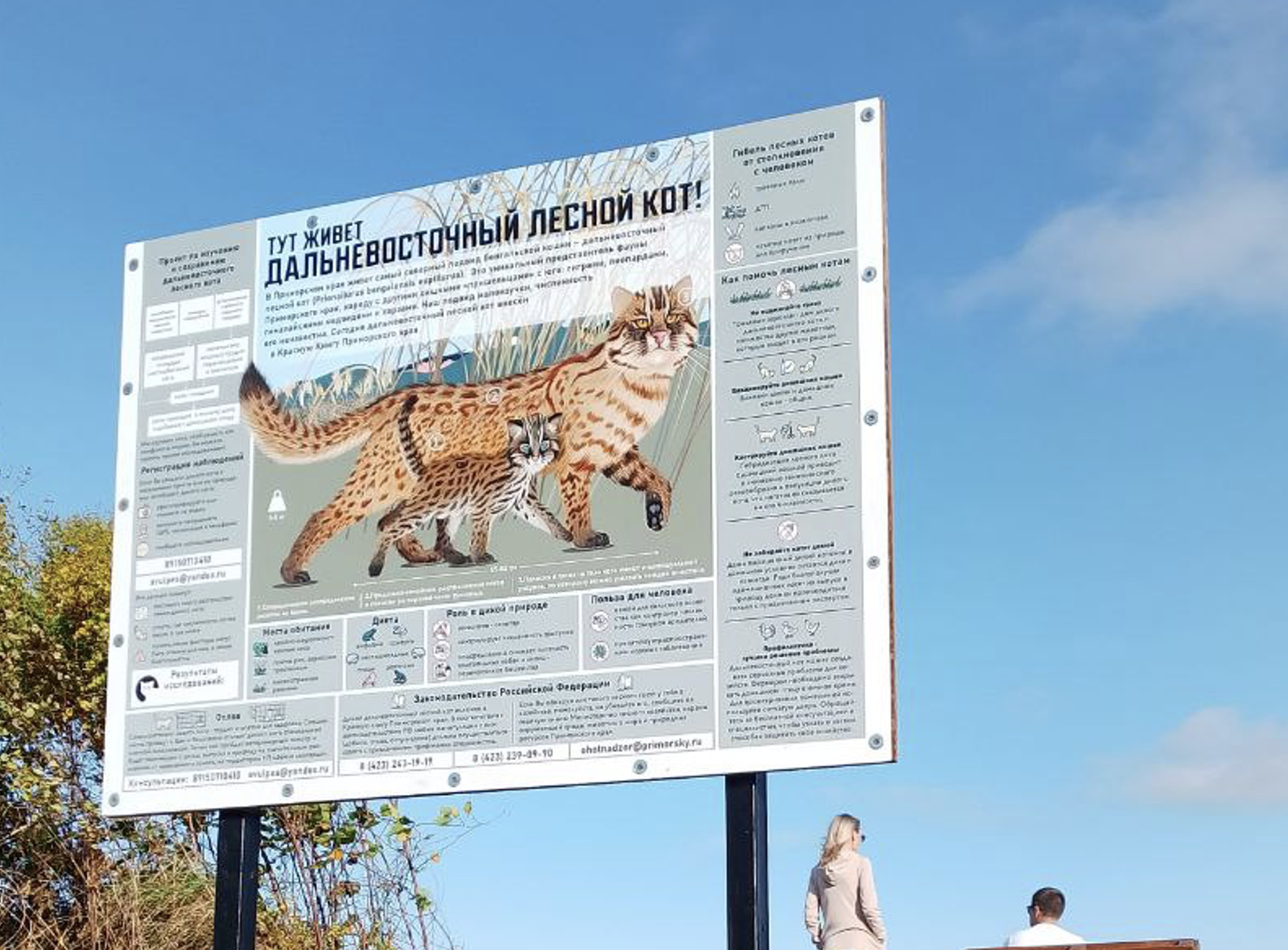
A sign placed to educate local communities in the Russian Far East about the mainland leopard cat. The more people know about this small wildcat, say researchers, the more likely they are to appreciate it and aid in its conservation, and the less likely human-cat conflict may be. Image courtesy of Ekaterina Blidchenko.

A sign placed to educate local communities in the Russian Far East about the mainland leopard cat. The more people know about this small wildcat, say researchers, the more likely they are to appreciate it and aid in its conservation, and the less likely human-cat conflict may be. Image courtesy of Ekaterina Blidchenko.

Conservation threats and opportunities

While mainland leopard cats may be far from global extinction, the species does face numerous threats.

Among the most vulnerable are “island populations,” which include cats inhabiting actual islands, and those outside the species’ contiguous range on the mainland, such as the leopard cats of India’s Western Ghats region, Singh says. She notes that these isolated populations face risks related to inbreeding. “They are the ones that could end up losing out on their actual conservation or threat status when we do this wide-scale assessment.”

Vehicle strikes are also a common issue, especially as the cats’ habitat becomes increasingly fragmented by road construction. In addition, the IUCN Red List notes that “hunting and snaring occur in most parts of [the] Mainland Leopard Cat’s range and is particularly intense in South-east Asia.” The cat is also traded or hunted for its meat and fur, as well as for illegal adoption, domestication, and hybrid breeding, in parts of its range.

Another threat: conflict with humans over poultry, which leopard cats have been known to snatch. But in the Russian Far East, conservationists are meeting with success in dealing with these human-cat conflicts, says Ekaterina Blidchenko, a senior research assistant at Kedrovaya Pad State Biosphere Nature Reserve and at Land of the Leopard National Park.

A Prionailurus bengalensis kitten in Taiwan, where only 500 leopard cats remain. Taiwan’s leopard cats are among several “island” or isolated populations facing greater local extinction threats than the species overall. Image by ourskyuamlea via Pixabay.

A Prionailurus bengalensis kitten in Taiwan, where only 500 leopard cats remain. Taiwan’s leopard cats are among several “island” or isolated populations facing greater local extinction threats than the species overall. Image by ourskyuamlea via Pixabay (Public domain).

Blidchenko’s team developed a signboard to educate local farmers about the leopard cat and involve them in conservation. Placed in more than 10 villages adjacent to national parks, the signs offer contact information to local people interested in cat-proofing their poultry pens or requesting humane cat relocations. “People are increasingly resorting to humane methods of capturing leopard cats visiting chicken coops,” she says.

“[T]he leopard cat very often encounters people in anthropogenic landscapes (highways, agricultural lands, poultry houses), unlike large cats such as tigers and leopards. So it is very important to work with people to highlight the importance of preserving this species of small cat and its valuable place in the ecosystems of Northeast Asia,” Blidchenko adds.

The signs her team have placed in local communities also invite individuals to submit information on leopard cat sightings, which will help researchers map the cat’s range and populations, as well as improve understanding of threats.

Involving local communities is key to conservation, particularly outside of protected areas, Singh agrees. In her experience, “anyone who sees a wild cat — whether it’s big or small — out in the wild gets excited, whether it’s tourists or people working in their fields.”

Due to its large range, transboundary collaboration is key to understanding and conserving the mainland leopard cat. The IUCN Red List and Green Status assessments are two key initiatives toward that end, although much remains unknown about this species. Image by Davidvraju via Wikimedia Commons (CC0 1.0).

Due to its large range, transboundary collaboration is key to understanding and conserving the mainland leopard cat. The IUCN Red List and Green Status assessments are two key initiatives toward that end, although much remains unknown about this species. Image by Davidvraju via Wikimedia Commons (CC0 1.0).

Last cat standing

The leopard cat, perhaps due to its small size and adaptability, is sometimes the only non-threatened wild felid — or sometimes the only wild felid at all — left in parts of its range. This is the case in South Korea, which lost its Siberian tigers and Amur leopards in the 1920s and 1970s, respectively. There, the leopard cat, which prowls boundaries between forests and agricultural or residential areas, is under pressure from habitat fragmentation and vehicle strikes, Kim says.

“In South Korea, public awareness and interest in the leopard cat remains remarkably low relative to its ecological significance,” she says. “I believe that if more people came to know that this small and beautiful animal is Korea’s last remaining wild felid, public interest in, and commitment to, its conservation would grow quite naturally.”

Although South Korea’s case may be representative of the leopard cat’s low profile across its range, there have been notable exceptions: A leopard cat photo taken by Peking University professor Luo Shu-Jin via camera trap near the 2022 Winter Olympics ski slopes in Beijing (another locale where leopard cats are the only remaining wild felid) went viral when it was released in 2021, according to CNN.

The photo brought Beijing’s wildlife into view, Luo says. “In an age of rapid urban expansion, can humans and wildlife find a new equilibrium? The study on leopard cats in Beijing sets the stage for such a query,” she says.

China’s overall leopard cat population is estimated at 230,000 individuals, according to the IUCN, although Luo notes that detailed population surveys are still lacking across much of the country. In 2021, China designated the felid as a National Class II protected species. (For comparison, the giant panda is a Class I protected species.)

Elsewhere, “in Southeast Asia, the leopard cat is remarkably resilient and abundant,” Gray says. “It’s essentially the only wild cat left across the vast majority of Laos, Cambodia and Vietnam.”

He cited a 2022 study that found “relatively high” densities of leopard cats in three different forest types in Cambodia. The study’s authors note that leopard cats even appear to thrive in oil palm plantations due to the abundance of rodents there.

A leopard cat in South Korea. The mainland leopard cat is divided into two subspecies, Prionailurus bengalensis bengalensis and Prionailurus bengalensis euptilurus, which exhibit differences in their coats and markings. Image by Kim Hyun-tae via Korean National Institute of Biological Resources (Korea Open Government License Type 1).

A leopard cat in South Korea. The mainland leopard cat is divided into two subspecies, Prionailurus bengalensis bengalensis and Prionailurus bengalensis euptilurus, which exhibit differences in their coats and markings. Image by Kim Hyun-tae via Korean National Institute of Biological Resources (Korea Open Government License Type 1).

Given the historical lack of research into leopard cats, Singh says she would like to see new studies designed to focus specifically on leopard cat biology — as opposed to data produced only as a byproduct of big cat studies.

Genetic mapping is also needed to better understand population connectivity and inform management within distinct conservation units, Kim says.

Despite the leopard cat’s continent-spanning range, Blidchenko emphasizes the need for local focus. “While we can’t influence global processes, we can influence some specific situations,” she says. “Through the personal stories of leopard cats that have encountered humans, we can raise awareness of this species and highlight the challenges these beautiful creatures face.”


cross-posted from: https://hexbear.net/post/9021894

Banner image: Awareness of leopard cats is generally low across their range, as they are small, difficult to spot, and are sometimes mistaken for domesticated cats or leopard cubs. This one was photographed in the Sundarbans mangrove forest of West Bengal state, India. Image by Soumyajit Nandy via Wikimedia Commons (CC BY-SA 4.0).

Asia’s mainland leopard cat is abundant but still cloaked in mystery

  • Widespread, adaptable, and classified globally as a species of “least concern” on the IUCN Red List, the mainland leopard cat can be found across much of Asia. However, research on the species remains relatively limited.
  • Despite its global status, local populations face serious threats — including habitat loss, hunting, vehicle collisions, and genetic isolation — and in some cases are considered locally critically endangered. Global assessments can mask these regional declines due to how conservation status is assessed.
  • Researchers highlight knowledge gaps caused by underfunding, language and geopolitical barriers, along with unshared data. They stress that more focused studies, genetic research, and conservation initiatives that involve local communities are essential to protecting this ecologically important species.

There’s good news about Asia’s mainland leopard cat: Prionailurus bengalensis is thought to be one of the world’s most abundant, widely distributed wildcats. With a conservation assessment of “least concern” on the IUCN Red List, sightings are reported from India to the Russian Far East.

That’s partly because mainland leopard cats are highly successful generalists. With two recognized subspecies — P. b. bengalensis and P. b. euptilurus — this small cat is adaptable to multiple habitats, ranging from forest to shrublands to grasslands, and including areas altered by humans.

But this good news comes with a caution: Surprisingly little is known about this felid, say experts, and it may be less plentiful and more at risk than sightings alone indicate.

Leopard cats have been understudied, a trend common among small cat species, which garner less public interest than big cats, and a reality that translates into less funding for research and conservation. As a result, P. bengalensis population surveys have only been conducted at a handful of sites, leaving lots of blank spots on range maps.

Despite perceived abundance, researchers note that this felid also still faces conservation challenges and could benefit from more attention from funders and the public, as the species plays an important, if underappreciated, role in controlling rodent populations.

A leopard cat in the Russian Far East, where it lives alongside leopards and tigers but receives relatively little attention compared with its larger, dynamic cousins. Image courtesy of Yuriy Smityuk.

A leopard cat in the Russian Far East, where it lives alongside leopards and tigers but receives relatively little attention compared with its larger, dynamic cousins. Image courtesy of Yuriy Smityuk.

Of ‘least concern’ but at risk of local extinctions

Roughly the size of a domestic cat, Asia’s mainland leopard cat was first recognized as a distinct species in 2017, when recent molecular studies and morphological differences led scientists to list it separately from the Sunda leopard cat (Prionailurus javanensis) found on Southeast Asian islands.

The mainland leopard cat’s conservation status was most recently assessed for the IUCN Red List in 2021 by an international team of researchers, who, based on available evidence, determined that the species’ overall population and range “have remained more or less the same.”

However, country-level data on leopard cat populations, as with many smaller mammals, is spotty or generally does not exist, says Priya Singh, an India-based independent researcher and one of the IUCN assessment leaders.

“We have standalone studies, which cover small areas, and then based on those studies we have to extrapolate and make intelligent guesses about what the population of that species would be at a larger level,” Singh says.

IUCN 2022 Leopard cat (Prionailurus bengalensis) distribution map. While considered one of the most abundant widely distributed small cats, and given a “least concern” listing by the IUCN, detailed P. bengalensis population data don’t exist for many locales and the species may be at risk, or even locally extinct, in some places. Image by Embladc via Wikimedia Commons (CC BY-SA 4.0).

IUCN 2022 Leopard cat (Prionailurus bengalensis) distribution map. While considered one of the most abundant widely distributed small cats, and given a “least concern” listing by the IUCN, detailed P. bengalensis population data don’t exist for many locales and the species may be at risk, or even locally extinct, in some places. Image by Embladc via Wikimedia Commons (CC BY-SA 4.0).

The design of the Red List framework can sometimes create misperceptions about actual conservation status, says Thomas Gray, tiger recovery lead at the WWF Tigers Alive Initiative, who was involved with the Red List assessment for the mainland leopard cat.

That’s because IUCN Red List assessments are based on a species’ three most recent generations, or a minimum of 10 years. “This shifting baseline means that some of the big declines in animal abundance that will have been caused by habitat loss over the past 30 years are kind of irrelevant in Red List assessments now,” Gray adds.

“You can [also] have situations where a species may be critically endangered in a place, may be extinct in [another] place, but its global conservation status remains ‘least concern’ because what we are looking at [with the Red List] is global, range-wide trends of population,” he says.

Critically endangered local leopard cat populations include those on Japan’s Tsushima and Iriomote islands, each of which hosts roughly 100 of the cats. Conservationists warn too that habitat loss and human activities have reduced leopard cat numbers in Taiwan, where fewer than 500 individuals remain, putting it perilously close to local extinction.

Alongside the 2021 Red List survey, the mainland leopard cat is also currently being assessed for the IUCN’s Green Status of Species, an additional evaluation that classifiers introduced in 2021 to measure the extent to which a species is depleted or recovered.

The Green Status is intended to address gaps in the Red List framework “by considering regional status, recovery status, and conservation impact,” explains Elliot Carlton, a species survival officer with the IUCN SSC Centre for Species Survival Cats.

He highlighted the example of the European wildcat, another small felid that was assessed to be of “least concern” for global extinction based on the Red List framework, yet whose Green Status assessment was found to be “largely depleted.”

“Hopefully, the Green Status assessment will provide insights into the differences in status, threats, and data quality across the mainland leopard cat’s range,” Carlton says. “I hope that, together with the Red List, the Green Status can highlight where further research efforts are needed and support planning for the species.”

A leopard cat in India’s West Bengal state. India’s population of leopard cats is not contiguous, with individuals in the western part of the country isolated from the rest of the leopard cat’s range. Image by Soumyajit Nandy via Wikimedia Commons (CC BY-SA 4.0).

A leopard cat in India’s West Bengal state. India’s population of leopard cats is not contiguous, with individuals in the western part of the country isolated from the rest of the leopard cat’s range. Image by Soumyajit Nandy via Wikimedia Commons (CC BY-SA 4.0).

Challenges to data gathering

Researchers, including IUCN collaborators making overall assessments, are confronted by many challenges in their attempts to study leopard cats, not least of which are the sociopolitical workings of human society that can vary widely between the 19 countries over which the cat’s range extends.

Language barriers are one factor that can hinder information sharing, with hundreds of languages spoken across the small cat’s far-flung territory, ranging from Mandarin Chinese to Russian, Hindi-Urdu to Nepali and Japanese. In addition, Northeast Asia tends to be underrepresented in Red List assessment teams, which primarily work in English, Gray says. As an example, he cites the “huge amount of very high-quality research that happens in China,” but which might not be fully incorporated into IUCN assessments.

Geopolitical tensions also create blind spots that hinder surveys and conservation planning. “Almost nothing is known about leopard cat populations in North Korea,” notes Kyungmin Kim, a postdoctoral researcher at the Research Institute of EcoScience at Ewha Womans University in South Korea.

“Recent research suggests that indiscriminate snaring is widespread across North Korea, with leopard cats reported as bycatch in this process,” she says, adding that some studies have indicated worrisome state involvement in illegal wildlife trafficking.

Anonymous Japanese illustration of a wildcat, identifiable as a leopard cat (Prionailurus bengalensis). The species also appears in India on a postage stamp. Image by Anonymous from Honzō kōmoku (Japanese edition of Jōō 2/1653) via Wikimedia Commons (Public domain).

Anonymous Japanese illustration of a wildcat, identifiable as a leopard cat (Prionailurus bengalensis). The species also appears in India on a postage stamp. Image by Anonymous from Honzō kōmoku (Japanese edition of Jōō 2/1653) via Wikimedia Commons (Public domain).

The extreme case of North Korea aside, other countries in the leopard cat’s range have less-than-stellar transparency records, though it’s unlikely governments hinder the sharing of knowledge about the species, according to Gray.

“For species that are highly politically significant and/or have had lots of money invested in them, it can be extraordinarily difficult to get the data you need,” he says. “For the leopard cat, it’s not as if no one cares, but for species [of] ‘least concern’ globally, there are no political concerns.”

Another problem: Data on leopard cats garnered during studies of other species, known as bycatch data, sometimes remain unshared and unutilized, says Yadav Ghimirey, director of Friends of Nature Nepal and first author of the Red List assessment for the mainland leopard cat.

“There are some organizations that do a lot of field work but publish only on some species. But camera trapping and other surveys provide data for a lot of other [bycatch] species as well,” Ghimirey says. He notes that this bycatch data could be shared with students and researchers to help governments with conservation planning.

A sign placed to educate local communities in the Russian Far East about the mainland leopard cat. The more people know about this small wildcat, say researchers, the more likely they are to appreciate it and aid in its conservation, and the less likely human-cat conflict may be. Image courtesy of Ekaterina Blidchenko.

A sign placed to educate local communities in the Russian Far East about the mainland leopard cat. The more people know about this small wildcat, say researchers, the more likely they are to appreciate it and aid in its conservation, and the less likely human-cat conflict may be. Image courtesy of Ekaterina Blidchenko.

Conservation threats and opportunities

While mainland leopard cats may be far from global extinction, the species does face numerous threats.

Among the most vulnerable are “island populations,” which include cats inhabiting actual islands, and those outside the species’ contiguous range on the mainland, such as the leopard cats of India’s Western Ghats region, Singh says. She notes that these isolated populations face risks related to inbreeding. “They are the ones that could end up losing out on their actual conservation or threat status when we do this wide-scale assessment.”

Vehicle strikes are also a common issue, especially as the cats’ habitat becomes increasingly fragmented by road construction. In addition, the IUCN Red List notes that “hunting and snaring occur in most parts of [the] Mainland Leopard Cat’s range and is particularly intense in South-east Asia.” The cat is also traded or hunted for its meat and fur, as well as for illegal adoption, domestication, and hybrid breeding, in parts of its range.

Another threat: conflict with humans over poultry, which leopard cats have been known to snatch. But in the Russian Far East, conservationists are meeting with success in dealing with these human-cat conflicts, says Ekaterina Blidchenko, a senior research assistant at Kedrovaya Pad State Biosphere Nature Reserve and at Land of the Leopard National Park.

A Prionailurus bengalensis kitten in Taiwan, where only 500 leopard cats remain. Taiwan’s leopard cats are among several “island” or isolated populations facing greater local extinction threats than the species overall. Image by ourskyuamlea via Pixabay.

A Prionailurus bengalensis kitten in Taiwan, where only 500 leopard cats remain. Taiwan’s leopard cats are among several “island” or isolated populations facing greater local extinction threats than the species overall. Image by ourskyuamlea via Pixabay (Public domain).

Blidchenko’s team developed a signboard to educate local farmers about the leopard cat and involve them in conservation. Placed in more than 10 villages adjacent to national parks, the signs offer contact information to local people interested in cat-proofing their poultry pens or requesting humane cat relocations. “People are increasingly resorting to humane methods of capturing leopard cats visiting chicken coops,” she says.

“[T]he leopard cat very often encounters people in anthropogenic landscapes (highways, agricultural lands, poultry houses), unlike large cats such as tigers and leopards. So it is very important to work with people to highlight the importance of preserving this species of small cat and its valuable place in the ecosystems of Northeast Asia,” Blidchenko adds.

The signs her team have placed in local communities also invite individuals to submit information on leopard cat sightings, which will help researchers map the cat’s range and populations, as well as improve understanding of threats.

Involving local communities is key to conservation, particularly outside of protected areas, Singh agrees. In her experience, “anyone who sees a wild cat — whether it’s big or small — out in the wild gets excited, whether it’s tourists or people working in their fields.”

Due to its large range, transboundary collaboration is key to understanding and conserving the mainland leopard cat. The IUCN Red List and Green Status assessments are two key initiatives toward that end, although much remains unknown about this species. Image by Davidvraju via Wikimedia Commons (CC0 1.0).

Due to its large range, transboundary collaboration is key to understanding and conserving the mainland leopard cat. The IUCN Red List and Green Status assessments are two key initiatives toward that end, although much remains unknown about this species. Image by Davidvraju via Wikimedia Commons (CC0 1.0).

Last cat standing

The leopard cat, perhaps due to its small size and adaptability, is sometimes the only non-threatened wild felid — or sometimes the only wild felid at all — left in parts of its range. This is the case in South Korea, which lost its Siberian tigers and Amur leopards in the 1920s and 1970s, respectively. There, the leopard cat, which prowls boundaries between forests and agricultural or residential areas, is under pressure from habitat fragmentation and vehicle strikes, Kim says.

“In South Korea, public awareness and interest in the leopard cat remains remarkably low relative to its ecological significance,” she says. “I believe that if more people came to know that this small and beautiful animal is Korea’s last remaining wild felid, public interest in, and commitment to, its conservation would grow quite naturally.”

Although South Korea’s case may be representative of the leopard cat’s low profile across its range, there have been notable exceptions: A leopard cat photo taken by Peking University professor Luo Shu-Jin via camera trap near the 2022 Winter Olympics ski slopes in Beijing (another locale where leopard cats are the only remaining wild felid) went viral when it was released in 2021, according to CNN.

The photo brought Beijing’s wildlife into view, Luo says. “In an age of rapid urban expansion, can humans and wildlife find a new equilibrium? The study on leopard cats in Beijing sets the stage for such a query,” she says.

China’s overall leopard cat population is estimated at 230,000 individuals, according to the IUCN, although Luo notes that detailed population surveys are still lacking across much of the country. In 2021, China designated the felid as a National Class II protected species. (For comparison, the giant panda is a Class I protected species.)

Elsewhere, “in Southeast Asia, the leopard cat is remarkably resilient and abundant,” Gray says. “It’s essentially the only wild cat left across the vast majority of Laos, Cambodia and Vietnam.”

He cited a 2022 study that found “relatively high” densities of leopard cats in three different forest types in Cambodia. The study’s authors note that leopard cats even appear to thrive in oil palm plantations due to the abundance of rodents there.

A leopard cat in South Korea. The mainland leopard cat is divided into two subspecies, Prionailurus bengalensis bengalensis and Prionailurus bengalensis euptilurus, which exhibit differences in their coats and markings. Image by Kim Hyun-tae via Korean National Institute of Biological Resources (Korea Open Government License Type 1).

A leopard cat in South Korea. The mainland leopard cat is divided into two subspecies, Prionailurus bengalensis bengalensis and Prionailurus bengalensis euptilurus, which exhibit differences in their coats and markings. Image by Kim Hyun-tae via Korean National Institute of Biological Resources (Korea Open Government License Type 1).

Given the historical lack of research into leopard cats, Singh says she would like to see new studies designed to focus specifically on leopard cat biology — as opposed to data produced only as a byproduct of big cat studies.

Genetic mapping is also needed to better understand population connectivity and inform management within distinct conservation units, Kim says.

Despite the leopard cat’s continent-spanning range, Blidchenko emphasizes the need for local focus. “While we can’t influence global processes, we can influence some specific situations,” she says. “Through the personal stories of leopard cats that have encountered humans, we can raise awareness of this species and highlight the challenges these beautiful creatures face.”

[–] [S] 1 point 1 week ago (1 child)

Very fast shutter speed, to start with, and I’d guess dialing in the expected focus ahead of time while watching the leaf get cut so that when it takes off you can capture it, maybe combined with a high resolution wider shot that you crop and/or multiple photos taken rapidly.

  • source
  • parent
  • context
  •  

    cross-posted from: https://hexbear.net/post/9002851

    A window on the wild: The best of British wildlife photography | Country Life

    Two hares boxing

    It's boxing day for the brown hares of Bintree in Norfolk, captured in Sarah Darnell's 'The Fur Flew'

    (Image credit: Sarah Darnell/British Wildlife Photography Awards)

    A bee stuffs its face with pollen

    Hello petal: A shower of pollen is scattered by a foraging bee illuminated in the glow of the sun in Alison Bell's highly commended 'A Kind of Magic'.

    (Image credit: Alison Bell/British Wildlife Photography Awards)

    A spider waits on a daisy.

    A camouflaged flower crab spider blends in with the colour of the blooms in the hope of ambushing any unsuspecting bees, moths and other insects in Adam Ferry's 'Waiting on a Daisy'.

    (Image credit: Adam Ferry/British Wildlife Photography Awards)

    An own looking at the camera with its head upside down

    Turning heads: Cate Barrow attracts the icy stare of a short-eared owl in her 'Upside Down Owl'

    (Image credit: Cate Barrow/British Wildlife Photography Awards)

    The cover of the book, featuring a hedgehog

    More than 250 of the winning and shortlisted images are published in 'British Wildlife Photography Awards Collection 14' (£35, Graffeg Books). Entries are now open for the 2027 competition.

    (Image credit: British Wildlife Photography Awards)

    A falcon holds another smaller bird in its talons

    Trouble afoot: A plucky juvenile starling struggles to escape the clutches of a sparrowhawk in Mark Parker's 'Nemesis', winner of the Animal Behaviour category.

    (Image credit: Mark Parker/British Wildlife Photography Awards)

    A bug has eaten a hole through a leaf and is posing in the frame

    'So glad you could come': A dew-doused azure damselfly appears to beckon the viewer through a nibbled leaf that forms Lee Frost's 'Nature's Window'.

    (Image credit: Lee Frost/British Wildlife Photography Awards)

    A vixen and her cub in a field

    Someone to look up to: A fox cub is a study in adoration under the watchful care of its mother in Victor Soares's 'Admiration in a Fox's Eyes'.

    (Image credit: Victor Soares/British Wildlife Photography Awards)

    A mouse shakes a dandelion

    When time flies: A flurry of feathered seeds dances from the shaken head of a delicate dandelion clock as a bank vole contemplates sinking its teeth into the stem in Paul Williams's 'Zephyr'.

    (Image credit: Paul Williams/British Wildlife Photography Awards)

    A bee is pictured carrying a leaf

    Flyleaf: a patchwork leaf-cutter bee in Chris Jackson's 'Bringing in the Leaves', which was highly commended in the Hidden Britain category. The bees cut discs out of greenery and glue them together with saliva to build cells to house their larvae.

    (Image credit: Chris Jackson/British Wildlife Photography Awards)


    cross-posted from: https://hexbear.net/post/9010515

    The golden-headed lion tamarin, captured in the photo above, is a small primate species found only in the northeastern Brazilian state of Bahia.

    The tamarins, Leontopithecus chrysomelas, have bright reddish-golden manes, and similarly colored paws and tails. They live among tree branches, eating fruit and the occasional bird egg or small vertebrate. They sleep huddled together with their extended family units in tree holes.

    Flávia Zagury, a biologist and photographer, photographed a family of tamarins at the Primatology Center of Rio de Janeiro, a state research center with a mission to preserve Brazil’s primate heritage.

    “I was so impressed by this creature, their colors are incredible,” Zagury told Mongabay in an audio message. “[The tamarins] were vocalizing a lot … I sensed a lot of curiosity coming from them.”

    These tamarins are among Brazil’s most threatened primates, having faced a nearly 60% population decline in just three decades. From 1992 to 2024, agricultural and urban expansion took over more than 40% of their habitat. Now, they have just 13,000 square kilometers (5,000 square miles) of available forest, and much of it is fragmented.

    A large part of the existing range of the tamarins is made up of cacao agroforestry farms called cabrucas, where the crop is grown underneath a canopy of native trees. Luckily, cacao is also one of their favorite fruits.

    In recent years, coffee monocultures and livestock pastures have taken over many cacao farms, adding to the primate’s extinction risk. Locals have been working to better protect them: the city of Ilhéus in Bahia made the golden-headed lion tamarin its official mascot to raise awareness in 2024 and increase local pride for sustainable cacao farms. A rehab center was also inaugurated in March 2026 to help reintroduce tamarins found in urban spaces back into the wild.

    “My next mission is to see them in the wild,” Zagury said.

    Banner image: A golden-headed lion tamarin (Leontopithecus chrysomelas). Images courtesy of Flávia Zagury.

    Banner image: A golden-headed lion tamarin (Leontopithecus chrysomelas). Images courtesy of Flávia Zagury.


    cross-posted from: https://hexbear.net/post/9010515

    The golden-headed lion tamarin, captured in the photo above, is a small primate species found only in the northeastern Brazilian state of Bahia.

    The tamarins, Leontopithecus chrysomelas, have bright reddish-golden manes, and similarly colored paws and tails. They live among tree branches, eating fruit and the occasional bird egg or small vertebrate. They sleep huddled together with their extended family units in tree holes.

    Flávia Zagury, a biologist and photographer, photographed a family of tamarins at the Primatology Center of Rio de Janeiro, a state research center with a mission to preserve Brazil’s primate heritage.

    “I was so impressed by this creature, their colors are incredible,” Zagury told Mongabay in an audio message. “[The tamarins] were vocalizing a lot … I sensed a lot of curiosity coming from them.”

    These tamarins are among Brazil’s most threatened primates, having faced a nearly 60% population decline in just three decades. From 1992 to 2024, agricultural and urban expansion took over more than 40% of their habitat. Now, they have just 13,000 square kilometers (5,000 square miles) of available forest, and much of it is fragmented.

    A large part of the existing range of the tamarins is made up of cacao agroforestry farms called cabrucas, where the crop is grown underneath a canopy of native trees. Luckily, cacao is also one of their favorite fruits.

    In recent years, coffee monocultures and livestock pastures have taken over many cacao farms, adding to the primate’s extinction risk. Locals have been working to better protect them: the city of Ilhéus in Bahia made the golden-headed lion tamarin its official mascot to raise awareness in 2024 and increase local pride for sustainable cacao farms. A rehab center was also inaugurated in March 2026 to help reintroduce tamarins found in urban spaces back into the wild.

    “My next mission is to see them in the wild,” Zagury said.

    Banner image: A golden-headed lion tamarin (Leontopithecus chrysomelas). Images courtesy of Flávia Zagury.

    Banner image: A golden-headed lion tamarin (Leontopithecus chrysomelas). Images courtesy of Flávia Zagury.


    cross-posted from: https://hexbear.net/post/9010450

    The Bipartisan War on Marine Mammals

    Whether it’s Donald Trump or Marie Gluesenkamp Perez, our ruling class keeps trying to kill whales, dolphins, and sea lions. This can’t be allowed to go on.

    You’d have to be a special kind of loser to wake up in the morning, look at yourself in the mirror, and say “today, I’m going to have beef with sea lions.” Or dolphins, or whales, or any marine mammal, for that matter. None of them, after all, have ever done anything to harm humans. Whales are like ancient, wise wizards of the sea, who spend their days floating around hoovering up plankton and singing to each other. Dolphins are out there doing backflips and, sure, occasionally getting too friendly, but are still generally a good time. Sea lions mostly just slap their tails and go “bork bork.” The idea of going out and deliberately killing any of them is inherently repulsive.

    And yet, if you check in with the class of politicians and pundits who run this country, a lot of them seem to share a common train of thought: what if we just started whacking the sea life? In fact, if you’re an aquatic mammal in the United States’ territorial waters, there’s a pretty good chance some powerful people want you dead. And best of all, they’re completely bipartisan about it.

    As with most things that are cruel and stupid in this country, you can find Donald J. Trump at the heart of this agenda. When he took office for the second time in 2025, Trump also appointed all of the new members of the Endangered Species Committee. Overnight, he transformed the institution from one tasked with protecting rare animals to a death panel aimed at exterminating them—and no creature is in his crosshairs more than Rice’s Whale.

    Nicknamed the “God Squad” because it holds the power of life and death over animal species, the Committee consists of six people: the secretaries of the Interior, Agriculture, and the Army, plus the chair of the Council of Economic Advisers and the heads of the Environmental Protection Agency (EPA) and the National Oceanic and Atmospheric Administration (NOAA). There’s also a rotating seat for a representative of whichever state the animal in question lives in, also selected by the president. Together, the “Squad” decides which animals will continue to get full protection under the Endangered Species Act, and which will have their protections chipped away by various “major exemptions,” granted for corporations who want to burn, chop, drill, dig, and otherwise ruin their habitats.

    Now, this is already a compromised system, because even under liberal administrations, the board consists of people with opposing interests: both those who want to protect animals, and those who want to conduct business that harms them. By including representatives of the Economic Advisers and the Army, it treats profit and war-making as equally important concerns to the preservation of animal life, which they just aren’t. Really, only the EPA and NOAA have any business weighing in. The current status quo is like having a Board of Directors at a bank where half the seats are reserved for bank robbers.

    But even in the context of the already-suspect Committee system, Trump’s new version is a bad joke. Just look at the lineup, and each of its members is worse for nature than the last. Take the Secretary of the Interior, Doug Burgum, who thinks wind power is “bad for everybody,” promotes the coal industry using a cartoon mascot called “Coalie,” and has directed the Bureau of Land Management to stop allocating federal land for buffalo to graze. He’s not exactly a trustworthy steward of the environment. Or then there’s Trump’s Secretary of Agriculture, Brooke Rollins, whose signature decision is speeding up the conveyor belts in slaughterhouses so more pigs can be gutted per hour. Even the new head of the EPA, Lee Zeldin, has mostly been dismantling the agency from the inside out, while loosening restrictions on things like mercury and arsenic in drinking water. These people are like villains Captain Planet would fight in a cheesy after-school special, and now they hold the fate of North America’s whales in their hands.

    Those whales are unique, irreplaceable, and rapidly vanishing. Marine biologists estimate there could be as few as 50 Rice’s whales left alive in the wild, and because of their size and unique diet, they can’t live in captivity. If anything happens to those 50 individuals, that’s curtains for the species. The whales are about 40 feet long, a little smaller than humpbacks, and they dive incredibly deep, almost to the ocean floor, to feed. Exactly what they’re eating down there is still a mystery, but small hatchetfish and lanternfish are the most likely candidate. Rice’s whales were first identified by scientist Dale Rice in 1965—hence the name—but they’ve been swimming around the Gulf of Mexico for around 3 million years, longer than homo sapiens has existed. And now, thanks to one man, their millennia of life on Earth could come to an end.

    The problem is, Rice’s whales are extremely vulnerable to the fossil-fuel drilling industry. The sheer noise of oil and gas drilling disrupts their ability to sing out and communicate to each other, so they get confused and lost. They get struck and killed by ships coming to and from the oil rigs, too, their flesh ripped apart by the propellers. They accidentally eat humans’ plastic waste, and die that way. And when there’s an oil spill, their population is decimated—or to be technical about the Latin, quintimated: by one estimate, 22 percent of the whales died during the 2010 Deepwater Horizon incident alone. If they’re going to have a chance at survival, the oil industry should be forbidden from going anywhere near them.

    And yet, predictably, Trump’s “God Squad” has moved in exactly the opposite direction. At the end of March, they voted unanimously to give oil and gas producers a sweeping exemption from the few Endangered Species Act restrictions they had, like “not discarding trash into the Gulf and suspending their use of loud technology when they spot whales.” Reportedly, they did so at the urging of Secretary of War Pete Hegseth, who is not a member of the Committee but lobbied it heavily, using “national security as a pretext for giving the oil industry a free pass.” Now, wildlife advocates are warning that unless the decision is reversed, it could essentially be an “extinction notice” for Rice’s whale. The only good news is that decisions by the Committee are subject to judicial review, and the nonprofit Defenders of Wildlife has already filed a lawsuit, arguing that both Hegseth’s intervention and the secrecy that surrounded the process was illegal. Then again, by the time a court case plays out, the whales could already have been poisoned by oil slicks—and it’s not like the Supreme Court particularly cares about marine mammals, either.

    This might as well be a real Trump Administration policy, at this point.


    But don’t let them fool you: when it comes to our blubbery friends, Democrats are capable of being just as vicious as Republicans, and nobody exemplifies that fact more than Washington state’s Representative Marie Gluesenkamp Perez. (“Gluey” to her friends, if any.) We’ve written about Perez’s bizarre and disturbing political choices before, from making up non-existent regulations about bananas in an attempt to discredit state health officials to her embrace of a far-right evangelical pastor. But even by those standards, her recent crusade against sea lions is something else.

    “These big boys are driving up food costs for families by gorging on salmon. I’m doing something about it,” reads a recent tweet by the Representative, accompanied by a photo of a sea lion with its mouth open. According to Perez, sea lions are simply “overeating” the fish from the Columbia River, consuming “four times as many salmon as our fishermen and Tribes have harvested” in a given year. And so, according to her, Washington needs to “remove these Corolla-sized vermin from our rivers and tributaries” in order to protect “our salmon and steelhead runs.” Perez has written to Howard Lutnick, the Trump administration’s Secretary of Commerce, with that agenda in mind, urging him to change federal regulations and allow “pinniped removals—including direct, lethal removal,” citing “impacts on local fishermen and the regional economy.” If she’s successful, and there’s no reason to think Lutnick would balk at the request, the killing will commence.

    This is a depraved set of values and priorities. The underlying assumption is that the natural world, and the animals within it, inherently belong to humans, to use as they see fit: they’re “our rivers,” “our salmon.” Thus, if sea lions eat fish that humans also want to eat, they’re stealing, and their “predation” and “gorging” (ie, eating food) is a problem. In the nation’s worst magazine, the Atlantic, we can find this argument laid out explicitly. According to staff writer Katherine J. Wu, killing the “protected” sea lions “may be the only way to stop them from eating too many of the Pacific Northwest’s endangered salmon.” But what is “too many,” and who decides? Bizarrely, Wu writes that “to preserve the region’s salmon, more sea lions must go,” then admits that the salmon in question would actually not be preserved, but caught and consumed by humans instead: “if salmon levels rebound, we can and will eat more of them.” She even says outright that “the sea lions’ greatest crime is indulging in salmon that humans would rather be feasting on,” and still manages to conclude that killing the sea lions is the right move. That’s Representative Perez’s logic, too.

    But that’s exactly the opposite of the truth! To point out the stunningly obvious, sea lions have to eat salmon. They’re obligate carnivores, and the two species have a natural predator-prey relationship going back millions of years. Humans, on the other hand, can eat pretty much anything; for us, salmon is just one of hundreds of menu options. So if there’s a conflict between humans’ desire to eat the fish and sea lions’, the sea lions should win, ten times out of ten. It’s their food source, not ours, and there’s no universe in which they should lose their lives so we can have cheap lox for our breakfast bagels.

    Even then, it’s perfectly possible for humans and sea lions to share the fish. Indigenous people did that for thousands of years, before modern industrial and commercial fishing. It’s only in the last 50 years or so that overfishing became a problem, together with human-caused climate change and hydroelectric dams. The dams, in particular, are what has really wiped out salmon populations, as studies show: when there’s a big turbine in the river, the fish can’t get upstream to spawn the way they used to, and lots of them die in the attempt. It’s so much of a problem, in fact, that conservationists have created vacuum-powered “salmon cannons” to help them get around dams. But these facts are completely absent from Perez’s account of the situation, because the solutions they imply are inconvenient.

    Really, the proper thing would be to dismantle some or all of the dams, return the rivers to the stewardship of the local tribes, and clamp down on humans’ “predation.” But that isn’t even considered an option. There’s a cult-like belief in capitalist societies that people’s consumption can’t be checked in any way, whether it’s for fish sandwiches or cheap electricity. If there’s a demand, there must be a supply, no matter the consequence. So instead, Perez chooses to scapegoat a marine mammal that can’t defend itself for a problem humans caused, and she wants people to just go out and shoot sea lions, Mafia execution style: her “preferred alternative is firearms,” per the Atlantic. It’s a discredit to our entire species that someone like that is considered a leader among us, and New York Times columnist Bret Stephens’ contention that Perez is among the “sanity caucus” that Democrats should be listening to will only become more ironic with each shotgun blast.

    But even Perez seems like a beacon of normality compared to the bloggers at the Free Press. It’s unfortunate that we even have to mention this wretched website, but because the Trump-aligned Ellison family recently bought it for $150 million, and have even put its vastly unqualified editors in charge of news networks like CBS, it’s currently an influential part of the overall MAGA project. In a recent article for the Press, writer Madeleine Rowley presented her proposal for how to resolve the administration’s ongoing dilemma about getting oil tankers through the Strait of Hormuz. Not by negotiating with Iran and coming to a mutually agreeable deal, of course; that would be silly. No, the plan is to have dolphins get rid of all the explosive mines.

    Yes, that’s actually the proposal. “Send in the Mine-Clearing Dolphins,” urges the headline, and it only gets weirder from there. “Since 1959,” Rowley informs us, the U.S. Navy “has trained bottlenose dolphins to find and mark the locations of mines that could endanger military and civilian ships,” and they’re reasonably good at using their echolocation to find metal objects. So, naturally, we should take dolphins from San Diego, dump them in the waters off Iran, and tell them to get to work. Now, it’s true that the military has a trained-dolphin program, and they’ve even successfully cleared mines in places like Umm Qasr harbor in Iraq. But Rowley is missing the point rather spectacularly, and this is a horrible idea.

    In the first place, there’s no way to guarantee that any dolphins the U.S. deploys to find underwater mines wouldn’t also be blown up by them. All it would take is one firm bump, and suddenly chunks of grey blubber would be raining down across the Strait. But even worse, every other dolphin in the region would also be under threat. As animal trainer Ric O’Barry, who worked with the Navy at the San Diego dolphin facility, wrote in 2000, “the enemy simply kills every dolphin that they come across” once they know trained ones have been deployed. Even by suggesting it, Rowley may have doomed some innocent dolphins to death, since the Iranian military has no way of telling whether her advice is being heeded. And O’Barry also reports that the dolphins aren’t even very reliable, since they’re “controlled by food” and don’t understand the significance of what they’re doing. To keep them under control at all, the Navy has to fit them with an “anti-foraging device”—in other words, a “simple strip of orange Velcro that is attached around the snout.” This muzzle “prevents the dolphin from opening its mouth, which is necessary for the dolphin to catch fish, eat and hydrate itself.” In other words, the dolphins are tortured. They only get fed if they complete their task, so they have no option but to hunt mines or starve. All this important context is left out of the Free Press’s breathless cheerleading, since if people knew what “sending in the dolphins” actually involves, nobody in their right mind would support it.

    There’s a common thread in these three cases, and it’s sheer, bloody-minded human arrogance. Whether they’re government officials or just denizens of the murkier regions of the press, none of these people seem to have any concept that animals are important in their own right. They never question that we humans have the right to kill them, if we see fit. There’s no respect for nature, beauty, or even life itself to be found here. All Trump or Perez, or the Atlantic and the Free Press, can think about is crude, short-term benefit for humans. They’ve failed abysmally at the task 19th-century naturalist John Burroughs wrote about: of “keeping the iron from our souls” in the modern industrial world, avoiding becoming consumed by narrow self-interest and destructiveness. It’s frankly terrifying that people like that are in charge of the world, because if they’re willing to kill whales and sea lions for the sake of an economic gain, or get dolphins blown to bits to further their geopolitical goals, there’s not much preventing them from doing the same to us, either. They say cruelty to animals is the first sign of psychopathy. And once the marine mammals are gone, there’s no bringing them back. This kind of thing just can’t be allowed to be the basis our world runs on. A single hungry sea lion is worth more than any politician alive, any day.


    cross-posted from: https://hexbear.net/post/9010450

    The Bipartisan War on Marine Mammals

    Whether it’s Donald Trump or Marie Gluesenkamp Perez, our ruling class keeps trying to kill whales, dolphins, and sea lions. This can’t be allowed to go on.

    You’d have to be a special kind of loser to wake up in the morning, look at yourself in the mirror, and say “today, I’m going to have beef with sea lions.” Or dolphins, or whales, or any marine mammal, for that matter. None of them, after all, have ever done anything to harm humans. Whales are like ancient, wise wizards of the sea, who spend their days floating around hoovering up plankton and singing to each other. Dolphins are out there doing backflips and, sure, occasionally getting too friendly, but are still generally a good time. Sea lions mostly just slap their tails and go “bork bork.” The idea of going out and deliberately killing any of them is inherently repulsive.

    And yet, if you check in with the class of politicians and pundits who run this country, a lot of them seem to share a common train of thought: what if we just started whacking the sea life? In fact, if you’re an aquatic mammal in the United States’ territorial waters, there’s a pretty good chance some powerful people want you dead. And best of all, they’re completely bipartisan about it.

    As with most things that are cruel and stupid in this country, you can find Donald J. Trump at the heart of this agenda. When he took office for the second time in 2025, Trump also appointed all of the new members of the Endangered Species Committee. Overnight, he transformed the institution from one tasked with protecting rare animals to a death panel aimed at exterminating them—and no creature is in his crosshairs more than Rice’s Whale.

    Nicknamed the “God Squad” because it holds the power of life and death over animal species, the Committee consists of six people: the secretaries of the Interior, Agriculture, and the Army, plus the chair of the Council of Economic Advisers and the heads of the Environmental Protection Agency (EPA) and the National Oceanic and Atmospheric Administration (NOAA). There’s also a rotating seat for a representative of whichever state the animal in question lives in, also selected by the president. Together, the “Squad” decides which animals will continue to get full protection under the Endangered Species Act, and which will have their protections chipped away by various “major exemptions,” granted for corporations who want to burn, chop, drill, dig, and otherwise ruin their habitats.

    Now, this is already a compromised system, because even under liberal administrations, the board consists of people with opposing interests: both those who want to protect animals, and those who want to conduct business that harms them. By including representatives of the Economic Advisers and the Army, it treats profit and war-making as equally important concerns to the preservation of animal life, which they just aren’t. Really, only the EPA and NOAA have any business weighing in. The current status quo is like having a Board of Directors at a bank where half the seats are reserved for bank robbers.

    But even in the context of the already-suspect Committee system, Trump’s new version is a bad joke. Just look at the lineup, and each of its members is worse for nature than the last. Take the Secretary of the Interior, Doug Burgum, who thinks wind power is “bad for everybody,” promotes the coal industry using a cartoon mascot called “Coalie,” and has directed the Bureau of Land Management to stop allocating federal land for buffalo to graze. He’s not exactly a trustworthy steward of the environment. Or then there’s Trump’s Secretary of Agriculture, Brooke Rollins, whose signature decision is speeding up the conveyor belts in slaughterhouses so more pigs can be gutted per hour. Even the new head of the EPA, Lee Zeldin, has mostly been dismantling the agency from the inside out, while loosening restrictions on things like mercury and arsenic in drinking water. These people are like villains Captain Planet would fight in a cheesy after-school special, and now they hold the fate of North America’s whales in their hands.

    Those whales are unique, irreplaceable, and rapidly vanishing. Marine biologists estimate there could be as few as 50 Rice’s whales left alive in the wild, and because of their size and unique diet, they can’t live in captivity. If anything happens to those 50 individuals, that’s curtains for the species. The whales are about 40 feet long, a little smaller than humpbacks, and they dive incredibly deep, almost to the ocean floor, to feed. Exactly what they’re eating down there is still a mystery, but small hatchetfish and lanternfish are the most likely candidate. Rice’s whales were first identified by scientist Dale Rice in 1965—hence the name—but they’ve been swimming around the Gulf of Mexico for around 3 million years, longer than homo sapiens has existed. And now, thanks to one man, their millennia of life on Earth could come to an end.

    The problem is, Rice’s whales are extremely vulnerable to the fossil-fuel drilling industry. The sheer noise of oil and gas drilling disrupts their ability to sing out and communicate to each other, so they get confused and lost. They get struck and killed by ships coming to and from the oil rigs, too, their flesh ripped apart by the propellers. They accidentally eat humans’ plastic waste, and die that way. And when there’s an oil spill, their population is decimated—or to be technical about the Latin, quintimated: by one estimate, 22 percent of the whales died during the 2010 Deepwater Horizon incident alone. If they’re going to have a chance at survival, the oil industry should be forbidden from going anywhere near them.

    And yet, predictably, Trump’s “God Squad” has moved in exactly the opposite direction. At the end of March, they voted unanimously to give oil and gas producers a sweeping exemption from the few Endangered Species Act restrictions they had, like “not discarding trash into the Gulf and suspending their use of loud technology when they spot whales.” Reportedly, they did so at the urging of Secretary of War Pete Hegseth, who is not a member of the Committee but lobbied it heavily, using “national security as a pretext for giving the oil industry a free pass.” Now, wildlife advocates are warning that unless the decision is reversed, it could essentially be an “extinction notice” for Rice’s whale. The only good news is that decisions by the Committee are subject to judicial review, and the nonprofit Defenders of Wildlife has already filed a lawsuit, arguing that both Hegseth’s intervention and the secrecy that surrounded the process was illegal. Then again, by the time a court case plays out, the whales could already have been poisoned by oil slicks—and it’s not like the Supreme Court particularly cares about marine mammals, either.

    This might as well be a real Trump Administration policy, at this point.


    But don’t let them fool you: when it comes to our blubbery friends, Democrats are capable of being just as vicious as Republicans, and nobody exemplifies that fact more than Washington state’s Representative Marie Gluesenkamp Perez. (“Gluey” to her friends, if any.) We’ve written about Perez’s bizarre and disturbing political choices before, from making up non-existent regulations about bananas in an attempt to discredit state health officials to her embrace of a far-right evangelical pastor. But even by those standards, her recent crusade against sea lions is something else.

    “These big boys are driving up food costs for families by gorging on salmon. I’m doing something about it,” reads a recent tweet by the Representative, accompanied by a photo of a sea lion with its mouth open. According to Perez, sea lions are simply “overeating” the fish from the Columbia River, consuming “four times as many salmon as our fishermen and Tribes have harvested” in a given year. And so, according to her, Washington needs to “remove these Corolla-sized vermin from our rivers and tributaries” in order to protect “our salmon and steelhead runs.” Perez has written to Howard Lutnick, the Trump administration’s Secretary of Commerce, with that agenda in mind, urging him to change federal regulations and allow “pinniped removals—including direct, lethal removal,” citing “impacts on local fishermen and the regional economy.” If she’s successful, and there’s no reason to think Lutnick would balk at the request, the killing will commence.

    This is a depraved set of values and priorities. The underlying assumption is that the natural world, and the animals within it, inherently belong to humans, to use as they see fit: they’re “our rivers,” “our salmon.” Thus, if sea lions eat fish that humans also want to eat, they’re stealing, and their “predation” and “gorging” (ie, eating food) is a problem. In the nation’s worst magazine, the Atlantic, we can find this argument laid out explicitly. According to staff writer Katherine J. Wu, killing the “protected” sea lions “may be the only way to stop them from eating too many of the Pacific Northwest’s endangered salmon.” But what is “too many,” and who decides? Bizarrely, Wu writes that “to preserve the region’s salmon, more sea lions must go,” then admits that the salmon in question would actually not be preserved, but caught and consumed by humans instead: “if salmon levels rebound, we can and will eat more of them.” She even says outright that “the sea lions’ greatest crime is indulging in salmon that humans would rather be feasting on,” and still manages to conclude that killing the sea lions is the right move. That’s Representative Perez’s logic, too.

    But that’s exactly the opposite of the truth! To point out the stunningly obvious, sea lions have to eat salmon. They’re obligate carnivores, and the two species have a natural predator-prey relationship going back millions of years. Humans, on the other hand, can eat pretty much anything; for us, salmon is just one of hundreds of menu options. So if there’s a conflict between humans’ desire to eat the fish and sea lions’, the sea lions should win, ten times out of ten. It’s their food source, not ours, and there’s no universe in which they should lose their lives so we can have cheap lox for our breakfast bagels.

    Even then, it’s perfectly possible for humans and sea lions to share the fish. Indigenous people did that for thousands of years, before modern industrial and commercial fishing. It’s only in the last 50 years or so that overfishing became a problem, together with human-caused climate change and hydroelectric dams. The dams, in particular, are what has really wiped out salmon populations, as studies show: when there’s a big turbine in the river, the fish can’t get upstream to spawn the way they used to, and lots of them die in the attempt. It’s so much of a problem, in fact, that conservationists have created vacuum-powered “salmon cannons” to help them get around dams. But these facts are completely absent from Perez’s account of the situation, because the solutions they imply are inconvenient.

    Really, the proper thing would be to dismantle some or all of the dams, return the rivers to the stewardship of the local tribes, and clamp down on humans’ “predation.” But that isn’t even considered an option. There’s a cult-like belief in capitalist societies that people’s consumption can’t be checked in any way, whether it’s for fish sandwiches or cheap electricity. If there’s a demand, there must be a supply, no matter the consequence. So instead, Perez chooses to scapegoat a marine mammal that can’t defend itself for a problem humans caused, and she wants people to just go out and shoot sea lions, Mafia execution style: her “preferred alternative is firearms,” per the Atlantic. It’s a discredit to our entire species that someone like that is considered a leader among us, and New York Times columnist Bret Stephens’ contention that Perez is among the “sanity caucus” that Democrats should be listening to will only become more ironic with each shotgun blast.

    But even Perez seems like a beacon of normality compared to the bloggers at the Free Press. It’s unfortunate that we even have to mention this wretched website, but because the Trump-aligned Ellison family recently bought it for $150 million, and have even put its vastly unqualified editors in charge of news networks like CBS, it’s currently an influential part of the overall MAGA project. In a recent article for the Press, writer Madeleine Rowley presented her proposal for how to resolve the administration’s ongoing dilemma about getting oil tankers through the Strait of Hormuz. Not by negotiating with Iran and coming to a mutually agreeable deal, of course; that would be silly. No, the plan is to have dolphins get rid of all the explosive mines.

    Yes, that’s actually the proposal. “Send in the Mine-Clearing Dolphins,” urges the headline, and it only gets weirder from there. “Since 1959,” Rowley informs us, the U.S. Navy “has trained bottlenose dolphins to find and mark the locations of mines that could endanger military and civilian ships,” and they’re reasonably good at using their echolocation to find metal objects. So, naturally, we should take dolphins from San Diego, dump them in the waters off Iran, and tell them to get to work. Now, it’s true that the military has a trained-dolphin program, and they’ve even successfully cleared mines in places like Umm Qasr harbor in Iraq. But Rowley is missing the point rather spectacularly, and this is a horrible idea.

    In the first place, there’s no way to guarantee that any dolphins the U.S. deploys to find underwater mines wouldn’t also be blown up by them. All it would take is one firm bump, and suddenly chunks of grey blubber would be raining down across the Strait. But even worse, every other dolphin in the region would also be under threat. As animal trainer Ric O’Barry, who worked with the Navy at the San Diego dolphin facility, wrote in 2000, “the enemy simply kills every dolphin that they come across” once they know trained ones have been deployed. Even by suggesting it, Rowley may have doomed some innocent dolphins to death, since the Iranian military has no way of telling whether her advice is being heeded. And O’Barry also reports that the dolphins aren’t even very reliable, since they’re “controlled by food” and don’t understand the significance of what they’re doing. To keep them under control at all, the Navy has to fit them with an “anti-foraging device”—in other words, a “simple strip of orange Velcro that is attached around the snout.” This muzzle “prevents the dolphin from opening its mouth, which is necessary for the dolphin to catch fish, eat and hydrate itself.” In other words, the dolphins are tortured. They only get fed if they complete their task, so they have no option but to hunt mines or starve. All this important context is left out of the Free Press’s breathless cheerleading, since if people knew what “sending in the dolphins” actually involves, nobody in their right mind would support it.

    There’s a common thread in these three cases, and it’s sheer, bloody-minded human arrogance. Whether they’re government officials or just denizens of the murkier regions of the press, none of these people seem to have any concept that animals are important in their own right. They never question that we humans have the right to kill them, if we see fit. There’s no respect for nature, beauty, or even life itself to be found here. All Trump or Perez, or the Atlantic and the Free Press, can think about is crude, short-term benefit for humans. They’ve failed abysmally at the task 19th-century naturalist John Burroughs wrote about: of “keeping the iron from our souls” in the modern industrial world, avoiding becoming consumed by narrow self-interest and destructiveness. It’s frankly terrifying that people like that are in charge of the world, because if they’re willing to kill whales and sea lions for the sake of an economic gain, or get dolphins blown to bits to further their geopolitical goals, there’s not much preventing them from doing the same to us, either. They say cruelty to animals is the first sign of psychopathy. And once the marine mammals are gone, there’s no bringing them back. This kind of thing just can’t be allowed to be the basis our world runs on. A single hungry sea lion is worth more than any politician alive, any day.


    cross-posted from: https://hexbear.net/post/8995304

    Banner image: Dorymyrmex ants clean workers of a different ant species. Image by Moffet, 2026 (CC BY 4.0).

    Unusual ant interaction hints at mutualistic ‘cleaning’ system

    Some coral reef ecosystems famously have “cleaning stations,” where fish line up to be cleaned by other species of fish and shrimp. Entomologist Mark Moffet recently published observations of what appears to be a similar relationship in ants.

    In the Chiricahua Mountains of the U.S. state of Arizona, Moffet, from the National Museum of Natural History, was watching harvester ants (Pogonomyrmex barbatus) collecting seeds when he noticed something odd. He saw several harvester ant workers frozen in place. When he zoomed in with his camera, Moffet saw the harvester ants covered with cone ants (Dorymyrmex spp.).

    At first Moffet assumed he was seeing aggression between the species. On closer inspection however, he observed that the small cone ants were licking and nibbling the larger harvester ant workers, not fighting with them. Moffet observed the cone ants inspecting the harvester ants’ open mandibles, which could easily crush the smaller cone ants.

    Moffet observed at least 90 individual harvester ant workers being tended this way and concluded that they might be getting cleaned by the cone ants. He even watched harvester ants approach the nests of cone ants and wait for cone ants to attend to them, which reminded him of reef fish lining up for a cleaning by cleaner fish species.

    The big question is: What is each species getting out of the arrangement? Moffet consulted colleagues and came up with several possible explanations. Perhaps the ants exchange microbes, which create a healthier microbiome for both species. Or maybe they swap pheromones, to keep harvester ants from attacking cone ants later on. Maybe the cone ants impart an antifungal substance they’re known to produce.

    Another possibility is that the cone ants get a free meal. “The Pogonomyrmex are called ‘harvester ants’ because they harvest seeds and store them in underground larders,” Moffet told Mongabay by email. “Seeds are high in calories and a carbohydrate-rich dust from them are likely all over the ant’s body surfaces — an energy rich snack that would be invisible to the eye.”

    In return for that snack, the cone ants may be helping the harvester ants stay free from disease by eating seed dust that could potentially contain harmful microbes.

    The cleaner ant system might be an example of mutualism — a symbiotic relationship that benefits both species — but this hypothesis needs more research. “I want to go back and take a further look. But proving that this is a mutualism would take quite a bit of time — what we need is an interested PhD student!” Moffet wrote.

    Daniel Kronauer, an ant biologist at Rockefeller University in the U.S., who wasn’t involved with the cleaner ant research, told The New York Times that “It’s a pretty unique observation” that could lead to new directions in research.


    cross-posted from: https://hexbear.net/post/9003608

    Banner image: The Maud Island frog of New Zealand is expected to face rising wildfire risk due to climate change. Image by Phil Bishop via Wikimedia Commons (CC BY-SA 2.5).

    Scientists forecast wildfire risk for species survival under climate change

    A new study warns climate change could increase the global area susceptible to wildfires in the future, putting many more species at risk than today.

    Previous research has shown that climate change is increasing the risk of wildfires as precipitation patterns change and vegetation becomes drier in parts of the world. Researchers have now projected how the length of fire seasons and the extent of burned area might change in the future under four scenarios of greenhouse gas emissions. Using these forecasts, they also assessed the future impact of wildfire for 9,592 species of animals, plants and fungi, currently reported on the IUCN Red List as threatened by wildfire.

    Under the moderate-emissions scenario, where current greenhouse gas emission trends continue, the researchers found that by 2100, the extent of burned areas globally could increase by 9.3%, and that nearly 84% of fire-threatened species will be exposed to higher risk of wildfires.

    Xiaoye Yang, study lead author from the University of Gothenburg, Sweden, told Mongabay by email that “there are clear spatial disparities in future wildfire risk to biodiversity.”

    Regions such as South America and Oceania are expected to face especially elevated risks of burning, Yang said. Fires in high-latitude areas of the Northern Hemisphere are also projected to increase rapidly in the future, although they’ve historically been rare in these regions, he added.

    The study found that the top 1% of species most affected by wildfires (96 species) are found in South America, South Asia, southern Australia and New Zealand. These species, including the Maud Island frog (Leiopelma pakeka) and North Island saddleback (Philesturnus rufusater), a bird, both from New Zealand, share common traits, the authors write: they have very small geographic ranges and are already threatened with extinction.

    Species in areas newly threatened by wildfires may lack adaptive experience with fire, making them particularly vulnerable to emerging wildfire regimes, Yang said.

    At the same time, some regions like Central Africa could see a reduction in burned area in the future, the study found. About 1,000 species in Africa could also experience lower exposure to wildfire risk.

    “Although the increase in wildfire risk will vary across regions — meaning that some countries contributing more to emissions may not experience proportional increases in wildfire impacts — collective action remains crucial,” Yang said.

    Carla Staver, a professor at Princeton University in the U.S., who studies wildfires in savannas, told Mongabay that framing wildfires as a blanket biodiversity threat is a limited perspective, since certain ecosystems depend on fires. “For example, the 41.8% of African species that could experience a decrease in wildfire risk probably mostly occur in savannas, which are fire dependent, so reductions in fire activity in those systems aren’t good news either,” she said.

    [–] [S] 2 points 2 weeks ago (2 children)

    A lot of the conservation stuff I post isn’t exactly “positive”. This one is definitely more on the positive end, but I’m certainly not trying to downplay the reality that this is the exception and not the norm.

    New contaminants are appearing as well. PFAS, the so-called “forever chemicals,” are showing up in Great Lakes fish

    Shoreline development eats away at denning sites. Climate change threatens to shift prey distribution and alter seasonal ice cover

  • source
  • parent
  • context
  • view more: next ›