1


Summary

Mammalian eyes are exposed to visible light but cannot perform photosynthesis. Here, we show that introducing a nanoscale, structurally and functionally preserved thylakoid system, LEAF (light-reaction enriched thylakoid NADPH-foundry), into corneal cells enables light-driven bona fide photosynthetic production of NADPH and ATP, similar to plant leaves, which alleviates oxidative stress and inflammation. LEAF acts in two domains. Intracellularly, it integrates with host cells to supply NADPH and ATP via intact photosynthetic electron transport, restoring redox balance. Extracellularly, photosynthesized NADPH enhances endogeneous antioxidant enzyme activity and reduces reactive oxygen species in the local environment. These results establish a strategy for using light as an energy input in mammalian metabolic systems and suggest a possible cross-kingdom, endosymbiosis-like interaction in which animal cells derive functional benefits from plant-derived photosynthetic neo-organelles.

2


Abstract

Purple bacteria are a diverse group of photosynthetic organisms that can capture and convert light energy with high quantum efficiency across a variety of ecological niches. They absorb light via an array of antenna proteins, primarily light-harvesting complex 2 (LH2), and rapidly transport the energy to the reaction center, where charge separation occurs. LH2 typically consists of eight or nine subunits that each contain three bacteriochlorophyll and one carotenoid. In the marine species Marichromatium (Mch.) purpuratum, the LH2 subunits bind an additional carotenoid, boosting absorbance in the blue where the underwater solar spectrum peaks. In order to accommodate the additional carotenoid, LH2 from Mch. purpuratum consists of only seven subunits, unique among known LH2. Using ultrafast transient absorption (TA) spectroscopy, time-resolved fluorescence, and steady-state techniques, we investigated the effects of these structural differences on the energy transfer dynamics of LH2 from Mch. purpuratum. Our results show, relative to other species, significantly slower rates of energy transfer within LH2 and an excited-state manifold likely to also slow energy transfer between LH2. LH2 from Mch. purpuratum is therefore tuned to match the solar spectrum of its ecological niche, suggesting that the variations in the molecular organization of these antenna proteins may be primarily for optimal light absorption.

3


Abstract

Sea slugs in the Sacoglossa superorder are some of the few animals capable of photosynthesising by isolating and maintaining functional chloroplasts within their body. While this ability allows some species in this superorder, such as Elysia viridis, to appear green, camouflaging themselves within their surroundings, this species is marked by extremely bright, coloured regions.

Here, we show that these animals produce a yet undiscovered class of photonic structure consisting of intracellular mixed amorphous CaCO3 and calcite spherical nanoparticles organised in non-closed-packed face-centred cubic (FCC) lattices and photonic glasses.

By mapping the distribution of the cells containing such architectures, we suggest that their colour is linked both to their function and to their biological formation via the animal's renal system. Using a combination of different optical methods and cryo-electron microscopy, we reveal that the biomineralisation pathway proceeds through stages of calcium ion concentration in the kidney, transport via internal vessels, and precipitation from a dense liquid-like precursor, culminating in the formation of monodisperse nanoparticles, which are the building blocks of these photonic structures.

4


Abstract

The design of efficient artificial light-harvesting antennas is essential for enabling the widespread use of solar energy. Natural photosynthetic systems offer valuable inspiration, but many rely on complex pigment–protein interactions and have limited spectral coverage, which pose challenges for rational design. Chlorosome mimics, which are self-assembling pigment aggregates inspired by green photosynthetic bacteria, offer structural simplicity, flexible tunability, and strong excitonic coupling through pigment–pigment interactions. However, these pigment aggregates suffer from limited absorption in the green and near-infrared regions and, similarly to other light-harvesting systems, reduced energy transfer efficiency at high donor concentrations. One promising strategy to overcome these limitations is the integration of plasmonic nanoparticles, which enhance local electromagnetic fields, increase spectral coverage, and make new energetic pathways accessible. Although plasmonic enhancement has been widely studied in pigment–protein complexes like Photosystem I and light-harvesting complexes (LHCs), its application to pigment-pigment self-assembled systems remains largely unexplored. This perspective presents recent advances in biomimetic light-harvesting design with chlorosome mimics and explores the potential for plasmonic enhancement of photophysics in these systems. We examine the structure of chlorosomes and their artificial mimics to understand the role of pigment-pigment interactions in facilitating highly efficient energy transfer.

5


Abstract

Cacao and chocolate production is a global industry worth around $133 billion. Full sun cultivation is a modern approach aimed at increasing yields. We evaluated six cacao clones (PS 1319, CCN 10, CCN 51, PH 16, SJ 02, and CP 49) grown under full sun conditions to assess their leaf physiology, leaf structure, yield, and yield components. Leaf physiology was measured through seven gas exchange parameters, while leaf structure was analyzed using eight measurements. For fruit and seed, we evaluated seven yield components. The clones showed differences in gas exchange. Clones PH 16 and PS 1319 had higher net photosynthetic rates per unit of leaf area (A), transpiration rates, and lower leaf internal CO2 concentrations. These A high values suggest the clones are well-acclimatized to full sun cultivation. Water availability, nutrient supply, and appropriate plant architecture also contributed to this acclimatization. Under high light intensity, the potential quantum yield of photosystem II indicated no photoinhibition, and adaptations in the photosynthetic apparatus were observed, such as lower pigment concentration in clone PH 16. Clones differed in specific leaf area (SLA) and stomatal density (SD). CCN 51 had a higher SLA, while SJ 02 had a higher SD. A significant negative correlation (-0.89) was found between dry bean yield and leaf-to-air water vapor pressure deficit (VpdL), suggesting that VpdL is a crucial parameter for selecting high-performance clones for fertigated full sun cultivation. Yields ranged from 1,220 kg/ha (CCN 10) to 2,900 kg/ha (CCN 51). Full sun cacao farms have high yield potential due to a combination of cloning, management practices, and adequate water and nutrient availability.

6
7
8
9
10


I love varigated plants and have a ton of them. I'm continually amazed at what leaves manage to survive if they're not completely white, and sometimes those white leaves just hang on longer than they should. Please ELI5, someone how these zombie creatures survive and flourish?

11
12


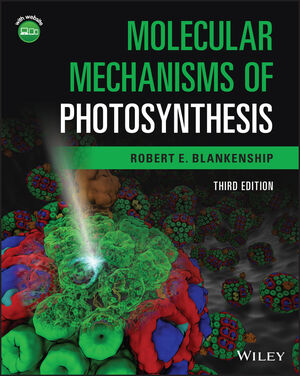
This is a book that I strongly to anyone with a reasonable biochemistry/chemistry background. Reading this book inspired me to create a community dedicated to photosynthesis, because I want to follow the work in this field more closely.

Photosynthesis is a topic introduced early during our education. We are taught that light consists of bundles of energy, and that plants use the energy from carried by sunlight to build carbohydrates from water and CO2.

Around high school and in introductory college level classes many of us also learn that plants are green because of the chlorophyll molecules, which absorb the blue and the red regions of the spectrum and leave enough green behind to be reflected. The absorbed light is used to kick-out an electron from a magnesium ion that is held at the center of the chlorophyll molecules, and this electron begins a sequence of redox reactions that eventually leads to the production of metabolic energy and carbohydrates.

This simplified description provides one with the the overall picture of the process, and it is more than sufficient for most people. But my gripe with this description is that many students may leave photosynthesis class without realizing just how spectacular and complex the system actually is.
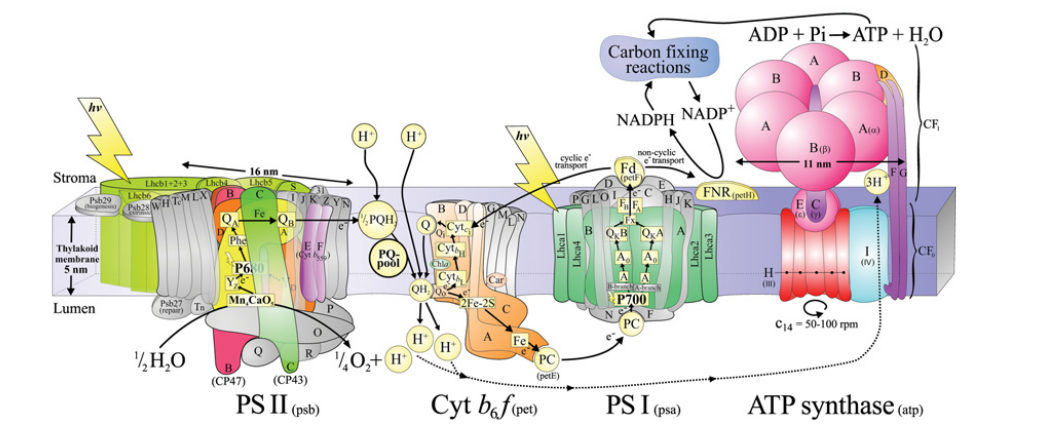
A diagram of the photosynthetic machinery

The photosynthetic machinery is by far the most advanced light-harvesting system that we know of. It uses a combination of many multiple physical principles - efficient energy transfer processes to move energy from light harvesting antennas into reaction centers, the ability to selectively funnel energy into non-radiative and non-photochemical quenching channels as a photoprotective mechanism, it utilizes as-of-today poorly understood 'superexchange' electron transfer mechanisms, and many more things that you can learn about in the recommended book.

There is also the added complexity that photosynthesis is extremely diverse, with different organisms having evolved very different solutions to meet their specific needs. Here is a figure from the text in which the photosynthetic assemblies from different types of organisms are compared:
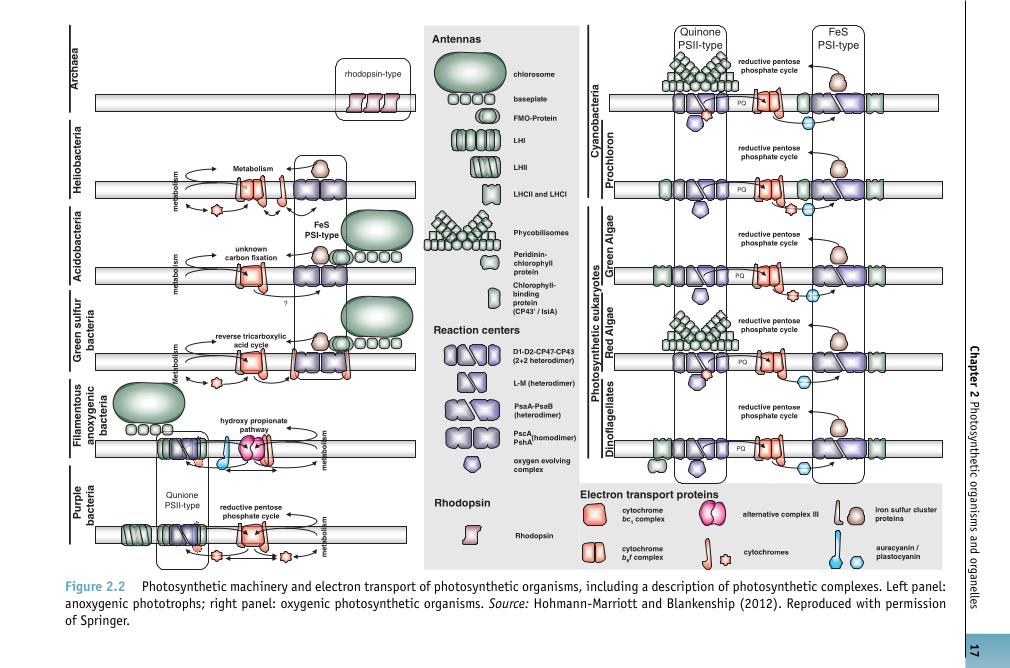
A diagram showing the components of the photosynthetic assemblies of different types of organisms

Maybe this post can inspire someone to take a look at this book. And, if so, hopefully they will also find a lot of value in it!
13