top 50 comments

sorted by: hot top controversial new old
[–] 53 points 3 years ago (1 child)

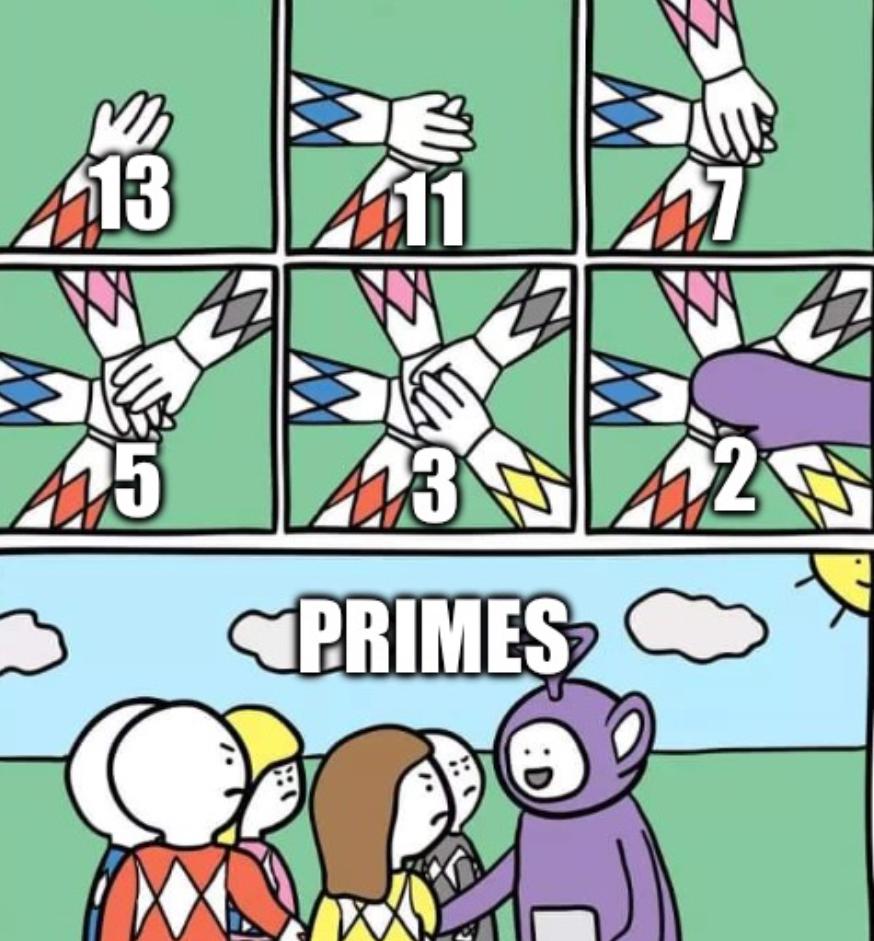
2 may be the only even prime - that is it's the only prime divisible by 2 - but 3 is the only prime divisible by 3 and 5 is the only prime divisible by 5, so I fail to see how this is unique.

  • source
  • hideshow 2 child comments
  • [–] 22 points 3 years ago* (1 child)

    Exactly, "even" litterally means divisible by 2. We could easily come up with a term for divisible by 3 or 5. Maybe there even is one. So yeah 2 is nothing special.

  • source
  • parent
  • hideshow 2 child comments
  • [–] 21 points 3 years ago (2 children)

    "Threven" has a nice ring to it now that I think of it.

  • source
  • parent
  • hideshow 4 child comments
  • [–] 42 points 3 years ago (1 child)

    Even vs odd numbers are not as important as we think they are. We could do the same to any other prime number. 2 is the only even prime (meaning it is divisible by 2) 3 is the only number divisible by 3. 5 is the only prime divisible by 5. When you think about the definition of prime numbers, this is a trivial conclusion.

    Tldr: be mindful of your conventions.

  • source
  • hideshow 2 child comments
  • [–] 13 points 3 years ago* (1 child)

    Yes, but not really.

    With 2, the natural numbers divide into equal halves. One of which we call odd and the other even. And we use this property a lot in math.

    If you do it with 3, then one group is going to be a third and the other two thirds (ignore that both sets are infinite, you may assume a continuous finite subset of the natural numbers for this argument).

    And this imbalance only gets worse with bigger primes.

    So yes, 2 is special. It is the first and smallest prime and it is the number that primarily underlies concepts such as balance, symmetry, duplication and equality.

  • source
  • parent
  • hideshow 2 child comments
  • [–] 8 points 3 years ago (6 children)

    But why would you divide the numbers to two sets? It is reasonable for when considering 2, but if you really want to generalize, for 3 you’d need to divide the numbers to three sets. One that divide by 3, one that has remainder of 1 and one that has remainder of 2. This way you have 3 symmetric sets of numbers and you can give them special names and find their special properties and assign importance to them. This can also be done for 5 with 5 symmetric sets, 7, 11, and any other prime number.

  • source
  • parent
  • hideshow 7 child comments
  • [–] 4 points 3 years ago (1 child)

    Not sure about how relevant this in reality, but when it comes to alternating series, this might be relevant. For example the Fourier series expansion of cosine and other trig function?

  • source
  • parent
  • hideshow 2 child comments
  • load more comments (5 replies)
  • [–] 40 points 3 years ago (3 children)

    2 is a prime though isn't it

  • source
  • hideshow 6 child comments
  • [–] 27 points 3 years ago (1 child)

    The meme works better if it's 1 instead of 2. 1 is mostly not considered a prime number because a bunch of theorems like the fundamental theorem of arithmetic would have to be reworked to say "prime numbers greater than 1." However, just because 1 is not a prime number doesn't mean it's a composite number, so 1 is a number that is neither prime nor composite.

  • source
  • hideshow 2 child comments
  • [–] 7 points 3 years ago (1 child)
    load more comments (1 reply)
    [–] 7 points 3 years ago (3 children)

    I don't get it, why does adding a hand move to the next prime?

  • source
  • hideshow 6 child comments
  • [–] 12 points 3 years ago (7 children)

    🚨 NERD ALERT🚨

    Go define a vector space, nerd.

    Go compute the p value of you being cool

    Go integrate f(x)= 1/x on the domain (-1,1)

    This is meme-ville population: me

    Take a hike.

  • source
  • parent
  • hideshow 9 child comments
  • [–] 3 points 3 years ago* (1 child)
    • let V be you mom’s vagina, a vector space over the field of pubes. We define my d as a vector such that d is in V. Thus my dick is in your mom’s vagina.

    • In this vector space p values are not defined, but I can assure you that my pp is > 9000.

    • The integral of f(x)=1/x from -1 to 1 does not converge, just like how your father is never coming back from buying milk. The principal value of that integral tho is 0, just like the amount of hugs you got as a kid.

    • math is cool, you just too stupid to get it.

  • source
  • parent
  • hideshow 1 child comment
  • load more comments (1 reply)
  • load more comments (5 replies)
  • [–] 7 points 3 years ago (2 children)

    2 is a prime number though…..

    Is it Just because it’s the only even one?

  • source
  • hideshow 4 child comments
  • [–] 7 points 3 years ago (2 children)

    Often things hold true for all primes except 2. You come across things like "for all non two primes"

  • source
  • parent
  • hideshow 4 child comments
  • [–] 4 points 3 years ago* (3 children)

    Any examples? Sounds like you mean the reason why one is excluded from the primes because of the fundamental theorem of arithmetic.

  • source
  • parent
  • hideshow 4 child comments
  • load more comments (2 replies)
  • [–] 7 points 3 years ago

    Two is the oddest prime of them all.

  • source
  • [–] 6 points 3 years ago (2 children)

    Oh yeah? What about 0? And 1?

  • source
  • hideshow 4 child comments
  • [–] 36 points 3 years ago* (2 children)

    They're not prime. By definition primes have two prime factors. 1 and the number itself. 1 is divisible only by 1. 0 has no prime factors.

  • source
  • parent
  • hideshow 4 child comments
  • [–] 16 points 3 years ago (1 child)

    Commonly primes are defined as natural numbers greater than 1 that have only trivial divisors. Your definition kinda works, but 1 can be infinitely many prime factors since every number has 1^n with n ∈ ℕ as a prime factor. And your definition is kinda misleading when generalising primes.

  • source
  • parent
  • hideshow 2 child comments
  • [–] 9 points 3 years ago* (last edited 3 years ago) (1 child)

    Isn't 1^n just 1? As in not a new number. I'd argue that 1*1==1*1*1. They're not some subtly different ones. I agree that the concept of primes only becomes useful for natural numbers >1.
    How is my definition misleading?

  • source
  • parent
  • hideshow 2 child comments
  • [–] 3 points 3 years ago* (last edited 3 years ago) (4 children)

    It is no new number, though you can add infinitely many ones to the prime factorisation if you want to. In general we don't append 1 to the prime factorisation because it is trivial.

    In commutative Algebra, a unitary commutative ring can have multiple units (in the multiplicative group of the reals only 1 is a unit, x*1=x, in this ring you have several "ones"). There are elemrnts in these rings which we call prime, because their prime factorisation only contains trivial prime factors, but of course all units of said ring are prime factors. Hence it is a bit quirky to define ordinary primes they way you did, it is not about the amount of prime factors, it is about their properties.

    Edit: also important to know: (ℝ,×), the multiplicative goup of the reals, is a commutative, unitary ring, which happens to have only one unit, so our ordinary primes are a special case of the general prime elements.

  • source
  • parent
  • hideshow 5 child comments
  • load more comments (3 replies)
  • [–] 3 points 3 years ago (3 children)
  • load more comments
    view more: next ›