▲ 668 ▼ Primes (lemmy.ml) submitted 3 years ago by HiddenLayer5@lemmy.ml to c/memes@lemmy.ml 73 comments fedilink hide all child comments
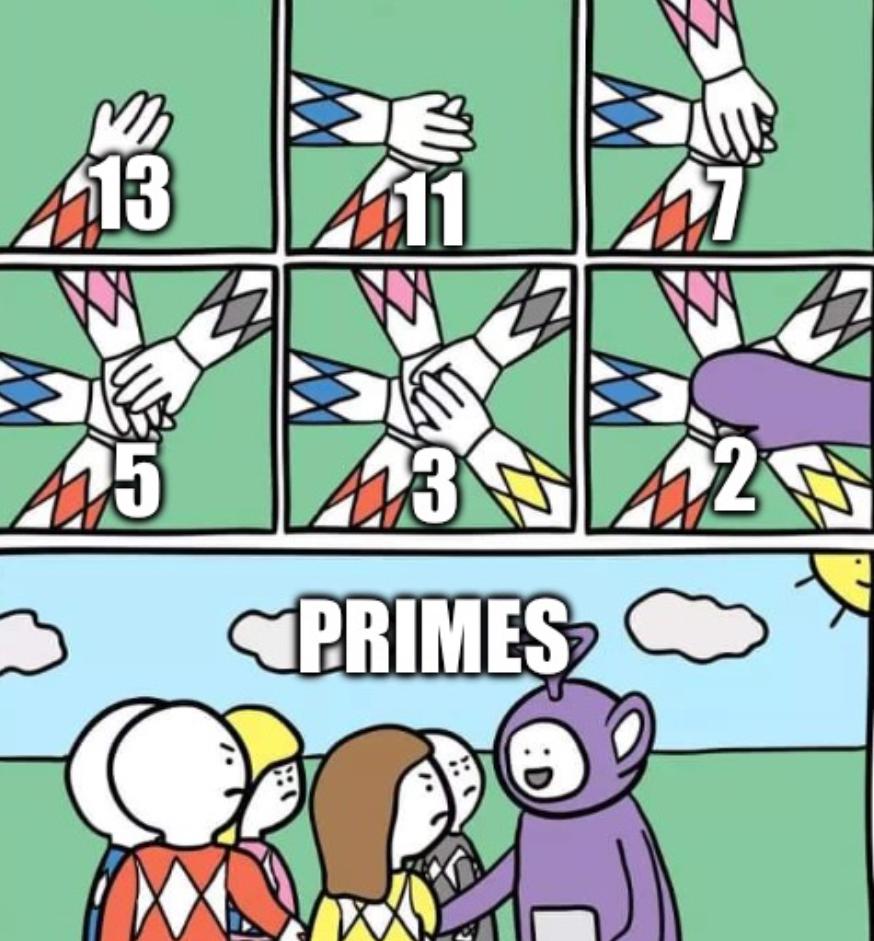
[–] Whirlybird@aussie.zone 7 points 3 years ago (2 children) 2 is a prime number though….. Is it Just because it’s the only even one? permalink fedilink source hideshow 4 child comments replies: [–] JohnDClay@sh.itjust.works 7 points 3 years ago (2 children) Often things hold true for all primes except 2. You come across things like "for all non two primes" permalink fedilink source parent hideshow 4 child comments replies: [–] wischi@programming.dev 4 points 3 years ago* (2 children) Any examples? Sounds like you mean the reason why one is excluded from the primes because of the fundamental theorem of arithmetic. permalink fedilink source parent hideshow 4 child comments replies: [–] kogasa@programming.dev 3 points 3 years ago* (last edited 3 years ago) (1 child) No, he's right. "For any odd prime" is a not-unheard-of expression. It is usually to rule out 2 as a trivial case which may need to be handled separately. https://en.wikipedia.org/wiki/Fermat%27s_theorem_on_sums_of_two_squares https://www.jstor.org/stable/2047029 https://www.jstor.org/stable/2374361 permalink fedilink source parent hideshow 2 child comments replies: [–] wischi@programming.dev 1 point 3 years ago (1 child) It's not unheard of no, but if you have to rule out two for some reason it's because of some other arbitrary choice. In the first instance (haven't yet looked at the second and third one) it has to do with the fact that a sum of "two" was chosen arbitrary. You can come up with other things that requires you to exclude primes up to five. permalink fedilink source parent hideshow 2 child comments replies: [–] kogasa@programming.dev 1 point 3 years ago Okay? Like I said, it's usually to rule out cases where 2 is a trivial edge case. It's common enough that "for any odd prime / let p be an odd prime" is a normal expression. That's all. permalink fedilink source parent [–] JohnDClay@sh.itjust.works 1 point 3 years ago* (1 child) I just remember it from numberphile, I don't remember what videos sorry. permalink fedilink source parent hideshow 2 child comments replies: [–] wischi@programming.dev 3 points 3 years ago* Wow that was fast I just edited my previous comment and you probably mean "1 and prime numbers" by numberphile with james grime. permalink fedilink source parent [–] Whirlybird@aussie.zone 2 points 3 years ago (1 child) Like what? Genuine question, have never heard of this. permalink fedilink source parent hideshow 2 child comments replies: [–] JohnDClay@sh.itjust.works 0 points 3 years ago In the drawer in the living room in the house in my town in my state in my country. permalink fedilink source parent [–] wischi@programming.dev 3 points 3 years ago (1 child) And how is "even" special? Two is the only prime that's divisible by two but three is also the only prime divisible by three. permalink fedilink source parent hideshow 2 child comments replies: [–] Whirlybird@aussie.zone 0 points 3 years ago (1 child) Well 2 is the outlier because it’s the only even prime. It might not be “special” but it is unique out of all of the prime numbers. permalink fedilink source parent hideshow 2 child comments replies: [–] wischi@programming.dev 1 point 3 years ago (1 child) "even" just means divisible by two. So it's not unique at all. Two is the only prime that's even divisible by two and three is the only prime that's divisible by three. You just think two is a special prime because there is a word for "divisible by two" but the prime two isn't any more special or unique in any meaningful way than any other prime. permalink fedilink source parent hideshow 2 child comments replies: [–] Whirlybird@aussie.zone 0 points 3 years ago (1 child) It’s unique because all the others are odd numbers. This is crazy that you’re trying to argue this. permalink fedilink source parent hideshow 2 child comments replies: [–] wischi@programming.dev 1 point 3 years ago (1 child) Of couse all the others are odd because otherwise they wouldn't be prime. All primes after three are also not divisible by three... "magic". The only difference is that there are is no word like "even" or "odd" for "divisible by three" or "not divisible by three". permalink fedilink source parent hideshow 2 child comments replies: [–] Whirlybird@aussie.zone 0 points 3 years ago only difference is that there are is no word like “even” or “odd” for “divisible by three” or “not divisible by three”. Yep, hence why 2 is unique - there is a word to describe numbers that are divisible by 2, and 2 is the only one of those that is a prime number. It seems that you don't know what the word "unique" means. permalink fedilink source parent
[–] JohnDClay@sh.itjust.works 7 points 3 years ago (2 children) Often things hold true for all primes except 2. You come across things like "for all non two primes" permalink fedilink source parent hideshow 4 child comments replies: [–] wischi@programming.dev 4 points 3 years ago* (2 children) Any examples? Sounds like you mean the reason why one is excluded from the primes because of the fundamental theorem of arithmetic. permalink fedilink source parent hideshow 4 child comments replies: [–] kogasa@programming.dev 3 points 3 years ago* (last edited 3 years ago) (1 child) No, he's right. "For any odd prime" is a not-unheard-of expression. It is usually to rule out 2 as a trivial case which may need to be handled separately. https://en.wikipedia.org/wiki/Fermat%27s_theorem_on_sums_of_two_squares https://www.jstor.org/stable/2047029 https://www.jstor.org/stable/2374361 permalink fedilink source parent hideshow 2 child comments replies: [–] wischi@programming.dev 1 point 3 years ago (1 child) It's not unheard of no, but if you have to rule out two for some reason it's because of some other arbitrary choice. In the first instance (haven't yet looked at the second and third one) it has to do with the fact that a sum of "two" was chosen arbitrary. You can come up with other things that requires you to exclude primes up to five. permalink fedilink source parent hideshow 2 child comments replies: [–] kogasa@programming.dev 1 point 3 years ago Okay? Like I said, it's usually to rule out cases where 2 is a trivial edge case. It's common enough that "for any odd prime / let p be an odd prime" is a normal expression. That's all. permalink fedilink source parent [–] JohnDClay@sh.itjust.works 1 point 3 years ago* (1 child) I just remember it from numberphile, I don't remember what videos sorry. permalink fedilink source parent hideshow 2 child comments replies: [–] wischi@programming.dev 3 points 3 years ago* Wow that was fast I just edited my previous comment and you probably mean "1 and prime numbers" by numberphile with james grime. permalink fedilink source parent [–] Whirlybird@aussie.zone 2 points 3 years ago (1 child) Like what? Genuine question, have never heard of this. permalink fedilink source parent hideshow 2 child comments replies: [–] JohnDClay@sh.itjust.works 0 points 3 years ago In the drawer in the living room in the house in my town in my state in my country. permalink fedilink source parent
[–] wischi@programming.dev 4 points 3 years ago* (2 children) Any examples? Sounds like you mean the reason why one is excluded from the primes because of the fundamental theorem of arithmetic. permalink fedilink source parent hideshow 4 child comments replies: [–] kogasa@programming.dev 3 points 3 years ago* (last edited 3 years ago) (1 child) No, he's right. "For any odd prime" is a not-unheard-of expression. It is usually to rule out 2 as a trivial case which may need to be handled separately. https://en.wikipedia.org/wiki/Fermat%27s_theorem_on_sums_of_two_squares https://www.jstor.org/stable/2047029 https://www.jstor.org/stable/2374361 permalink fedilink source parent hideshow 2 child comments replies: [–] wischi@programming.dev 1 point 3 years ago (1 child) It's not unheard of no, but if you have to rule out two for some reason it's because of some other arbitrary choice. In the first instance (haven't yet looked at the second and third one) it has to do with the fact that a sum of "two" was chosen arbitrary. You can come up with other things that requires you to exclude primes up to five. permalink fedilink source parent hideshow 2 child comments replies: [–] kogasa@programming.dev 1 point 3 years ago Okay? Like I said, it's usually to rule out cases where 2 is a trivial edge case. It's common enough that "for any odd prime / let p be an odd prime" is a normal expression. That's all. permalink fedilink source parent [–] JohnDClay@sh.itjust.works 1 point 3 years ago* (1 child) I just remember it from numberphile, I don't remember what videos sorry. permalink fedilink source parent hideshow 2 child comments replies: [–] wischi@programming.dev 3 points 3 years ago* Wow that was fast I just edited my previous comment and you probably mean "1 and prime numbers" by numberphile with james grime. permalink fedilink source parent
[–] kogasa@programming.dev 3 points 3 years ago* (last edited 3 years ago) (1 child) No, he's right. "For any odd prime" is a not-unheard-of expression. It is usually to rule out 2 as a trivial case which may need to be handled separately. https://en.wikipedia.org/wiki/Fermat%27s_theorem_on_sums_of_two_squares https://www.jstor.org/stable/2047029 https://www.jstor.org/stable/2374361 permalink fedilink source parent hideshow 2 child comments replies: [–] wischi@programming.dev 1 point 3 years ago (1 child) It's not unheard of no, but if you have to rule out two for some reason it's because of some other arbitrary choice. In the first instance (haven't yet looked at the second and third one) it has to do with the fact that a sum of "two" was chosen arbitrary. You can come up with other things that requires you to exclude primes up to five. permalink fedilink source parent hideshow 2 child comments replies: [–] kogasa@programming.dev 1 point 3 years ago Okay? Like I said, it's usually to rule out cases where 2 is a trivial edge case. It's common enough that "for any odd prime / let p be an odd prime" is a normal expression. That's all. permalink fedilink source parent
[–] wischi@programming.dev 1 point 3 years ago (1 child) It's not unheard of no, but if you have to rule out two for some reason it's because of some other arbitrary choice. In the first instance (haven't yet looked at the second and third one) it has to do with the fact that a sum of "two" was chosen arbitrary. You can come up with other things that requires you to exclude primes up to five. permalink fedilink source parent hideshow 2 child comments replies: [–] kogasa@programming.dev 1 point 3 years ago Okay? Like I said, it's usually to rule out cases where 2 is a trivial edge case. It's common enough that "for any odd prime / let p be an odd prime" is a normal expression. That's all. permalink fedilink source parent
[–] kogasa@programming.dev 1 point 3 years ago Okay? Like I said, it's usually to rule out cases where 2 is a trivial edge case. It's common enough that "for any odd prime / let p be an odd prime" is a normal expression. That's all. permalink fedilink source parent
[–] JohnDClay@sh.itjust.works 1 point 3 years ago* (1 child) I just remember it from numberphile, I don't remember what videos sorry. permalink fedilink source parent hideshow 2 child comments replies: [–] wischi@programming.dev 3 points 3 years ago* Wow that was fast I just edited my previous comment and you probably mean "1 and prime numbers" by numberphile with james grime. permalink fedilink source parent
[–] wischi@programming.dev 3 points 3 years ago* Wow that was fast I just edited my previous comment and you probably mean "1 and prime numbers" by numberphile with james grime. permalink fedilink source parent
[–] Whirlybird@aussie.zone 2 points 3 years ago (1 child) Like what? Genuine question, have never heard of this. permalink fedilink source parent hideshow 2 child comments replies: [–] JohnDClay@sh.itjust.works 0 points 3 years ago In the drawer in the living room in the house in my town in my state in my country. permalink fedilink source parent
[–] JohnDClay@sh.itjust.works 0 points 3 years ago In the drawer in the living room in the house in my town in my state in my country. permalink fedilink source parent
[–] wischi@programming.dev 3 points 3 years ago (1 child) And how is "even" special? Two is the only prime that's divisible by two but three is also the only prime divisible by three. permalink fedilink source parent hideshow 2 child comments replies: [–] Whirlybird@aussie.zone 0 points 3 years ago (1 child) Well 2 is the outlier because it’s the only even prime. It might not be “special” but it is unique out of all of the prime numbers. permalink fedilink source parent hideshow 2 child comments replies: [–] wischi@programming.dev 1 point 3 years ago (1 child) "even" just means divisible by two. So it's not unique at all. Two is the only prime that's even divisible by two and three is the only prime that's divisible by three. You just think two is a special prime because there is a word for "divisible by two" but the prime two isn't any more special or unique in any meaningful way than any other prime. permalink fedilink source parent hideshow 2 child comments replies: [–] Whirlybird@aussie.zone 0 points 3 years ago (1 child) It’s unique because all the others are odd numbers. This is crazy that you’re trying to argue this. permalink fedilink source parent hideshow 2 child comments replies: [–] wischi@programming.dev 1 point 3 years ago (1 child) Of couse all the others are odd because otherwise they wouldn't be prime. All primes after three are also not divisible by three... "magic". The only difference is that there are is no word like "even" or "odd" for "divisible by three" or "not divisible by three". permalink fedilink source parent hideshow 2 child comments replies: [–] Whirlybird@aussie.zone 0 points 3 years ago only difference is that there are is no word like “even” or “odd” for “divisible by three” or “not divisible by three”. Yep, hence why 2 is unique - there is a word to describe numbers that are divisible by 2, and 2 is the only one of those that is a prime number. It seems that you don't know what the word "unique" means. permalink fedilink source parent
[–] Whirlybird@aussie.zone 0 points 3 years ago (1 child) Well 2 is the outlier because it’s the only even prime. It might not be “special” but it is unique out of all of the prime numbers. permalink fedilink source parent hideshow 2 child comments replies: [–] wischi@programming.dev 1 point 3 years ago (1 child) "even" just means divisible by two. So it's not unique at all. Two is the only prime that's even divisible by two and three is the only prime that's divisible by three. You just think two is a special prime because there is a word for "divisible by two" but the prime two isn't any more special or unique in any meaningful way than any other prime. permalink fedilink source parent hideshow 2 child comments replies: [–] Whirlybird@aussie.zone 0 points 3 years ago (1 child) It’s unique because all the others are odd numbers. This is crazy that you’re trying to argue this. permalink fedilink source parent hideshow 2 child comments replies: [–] wischi@programming.dev 1 point 3 years ago (1 child) Of couse all the others are odd because otherwise they wouldn't be prime. All primes after three are also not divisible by three... "magic". The only difference is that there are is no word like "even" or "odd" for "divisible by three" or "not divisible by three". permalink fedilink source parent hideshow 2 child comments replies: [–] Whirlybird@aussie.zone 0 points 3 years ago only difference is that there are is no word like “even” or “odd” for “divisible by three” or “not divisible by three”. Yep, hence why 2 is unique - there is a word to describe numbers that are divisible by 2, and 2 is the only one of those that is a prime number. It seems that you don't know what the word "unique" means. permalink fedilink source parent
[–] wischi@programming.dev 1 point 3 years ago (1 child) "even" just means divisible by two. So it's not unique at all. Two is the only prime that's even divisible by two and three is the only prime that's divisible by three. You just think two is a special prime because there is a word for "divisible by two" but the prime two isn't any more special or unique in any meaningful way than any other prime. permalink fedilink source parent hideshow 2 child comments replies: [–] Whirlybird@aussie.zone 0 points 3 years ago (1 child) It’s unique because all the others are odd numbers. This is crazy that you’re trying to argue this. permalink fedilink source parent hideshow 2 child comments replies: [–] wischi@programming.dev 1 point 3 years ago (1 child) Of couse all the others are odd because otherwise they wouldn't be prime. All primes after three are also not divisible by three... "magic". The only difference is that there are is no word like "even" or "odd" for "divisible by three" or "not divisible by three". permalink fedilink source parent hideshow 2 child comments replies: [–] Whirlybird@aussie.zone 0 points 3 years ago only difference is that there are is no word like “even” or “odd” for “divisible by three” or “not divisible by three”. Yep, hence why 2 is unique - there is a word to describe numbers that are divisible by 2, and 2 is the only one of those that is a prime number. It seems that you don't know what the word "unique" means. permalink fedilink source parent
[–] Whirlybird@aussie.zone 0 points 3 years ago (1 child) It’s unique because all the others are odd numbers. This is crazy that you’re trying to argue this. permalink fedilink source parent hideshow 2 child comments replies: [–] wischi@programming.dev 1 point 3 years ago (1 child) Of couse all the others are odd because otherwise they wouldn't be prime. All primes after three are also not divisible by three... "magic". The only difference is that there are is no word like "even" or "odd" for "divisible by three" or "not divisible by three". permalink fedilink source parent hideshow 2 child comments replies: [–] Whirlybird@aussie.zone 0 points 3 years ago only difference is that there are is no word like “even” or “odd” for “divisible by three” or “not divisible by three”. Yep, hence why 2 is unique - there is a word to describe numbers that are divisible by 2, and 2 is the only one of those that is a prime number. It seems that you don't know what the word "unique" means. permalink fedilink source parent
[–] wischi@programming.dev 1 point 3 years ago (1 child) Of couse all the others are odd because otherwise they wouldn't be prime. All primes after three are also not divisible by three... "magic". The only difference is that there are is no word like "even" or "odd" for "divisible by three" or "not divisible by three". permalink fedilink source parent hideshow 2 child comments replies: [–] Whirlybird@aussie.zone 0 points 3 years ago only difference is that there are is no word like “even” or “odd” for “divisible by three” or “not divisible by three”. Yep, hence why 2 is unique - there is a word to describe numbers that are divisible by 2, and 2 is the only one of those that is a prime number. It seems that you don't know what the word "unique" means. permalink fedilink source parent
[–] Whirlybird@aussie.zone 0 points 3 years ago only difference is that there are is no word like “even” or “odd” for “divisible by three” or “not divisible by three”. Yep, hence why 2 is unique - there is a word to describe numbers that are divisible by 2, and 2 is the only one of those that is a prime number. It seems that you don't know what the word "unique" means. permalink fedilink source parent