you are viewing a single comment's thread
view the rest of the comments
[–] 13 points 3 years ago* (1 child)

Yes, but not really.

With 2, the natural numbers divide into equal halves. One of which we call odd and the other even. And we use this property a lot in math.

If you do it with 3, then one group is going to be a third and the other two thirds (ignore that both sets are infinite, you may assume a continuous finite subset of the natural numbers for this argument).

And this imbalance only gets worse with bigger primes.

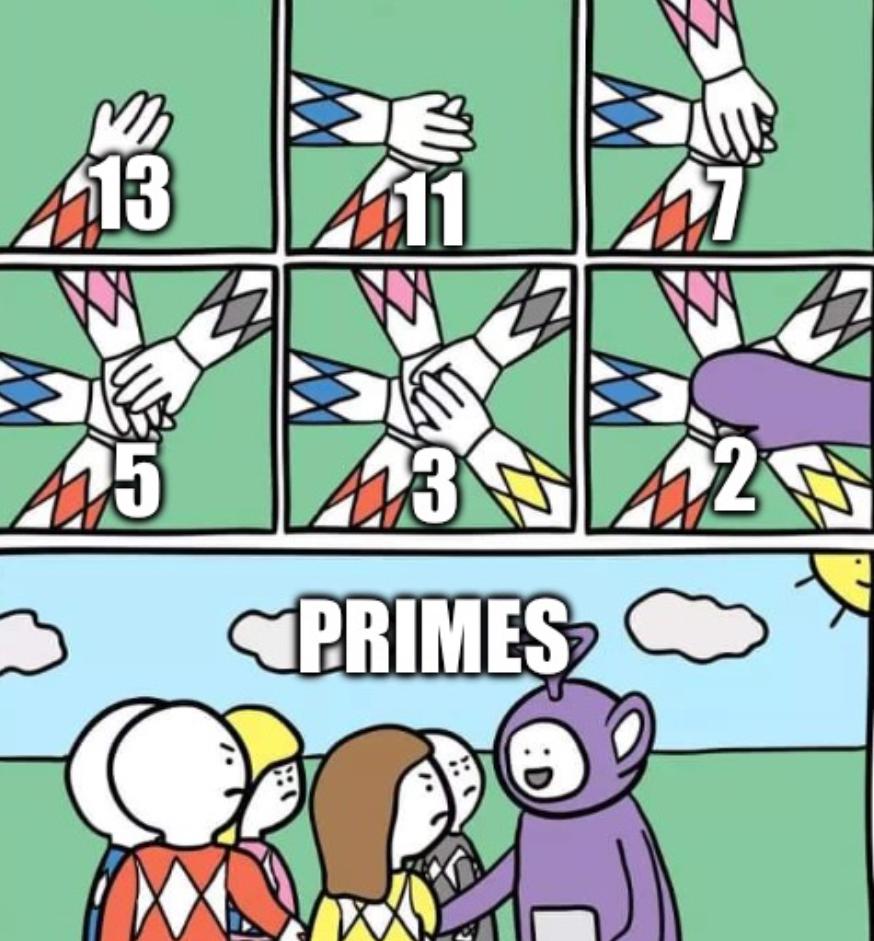
So yes, 2 is special. It is the first and smallest prime and it is the number that primarily underlies concepts such as balance, symmetry, duplication and equality.

  • source
  • parent
  • hideshow 2 child comments
  • [–] 8 points 3 years ago (3 children)

    But why would you divide the numbers to two sets? It is reasonable for when considering 2, but if you really want to generalize, for 3 you’d need to divide the numbers to three sets. One that divide by 3, one that has remainder of 1 and one that has remainder of 2. This way you have 3 symmetric sets of numbers and you can give them special names and find their special properties and assign importance to them. This can also be done for 5 with 5 symmetric sets, 7, 11, and any other prime number.

  • source
  • parent
  • hideshow 6 child comments
  • [–] 4 points 3 years ago (1 child)

    Not sure about how relevant this in reality, but when it comes to alternating series, this might be relevant. For example the Fourier series expansion of cosine and other trig function?

  • source
  • parent
  • hideshow 2 child comments
  • [–] 3 points 3 years ago* (1 child)

    But then it is more natural to use the complex version of the Fourier series, which has a neat symmetric notation

  • source
  • parent
  • hideshow 2 child comments
  • [–] 2 points 3 years ago (1 child)

    Then you have one set that contains multiples of 3 and two sets that do not, so it is not symmetric.

  • source
  • parent
  • hideshow 2 child comments