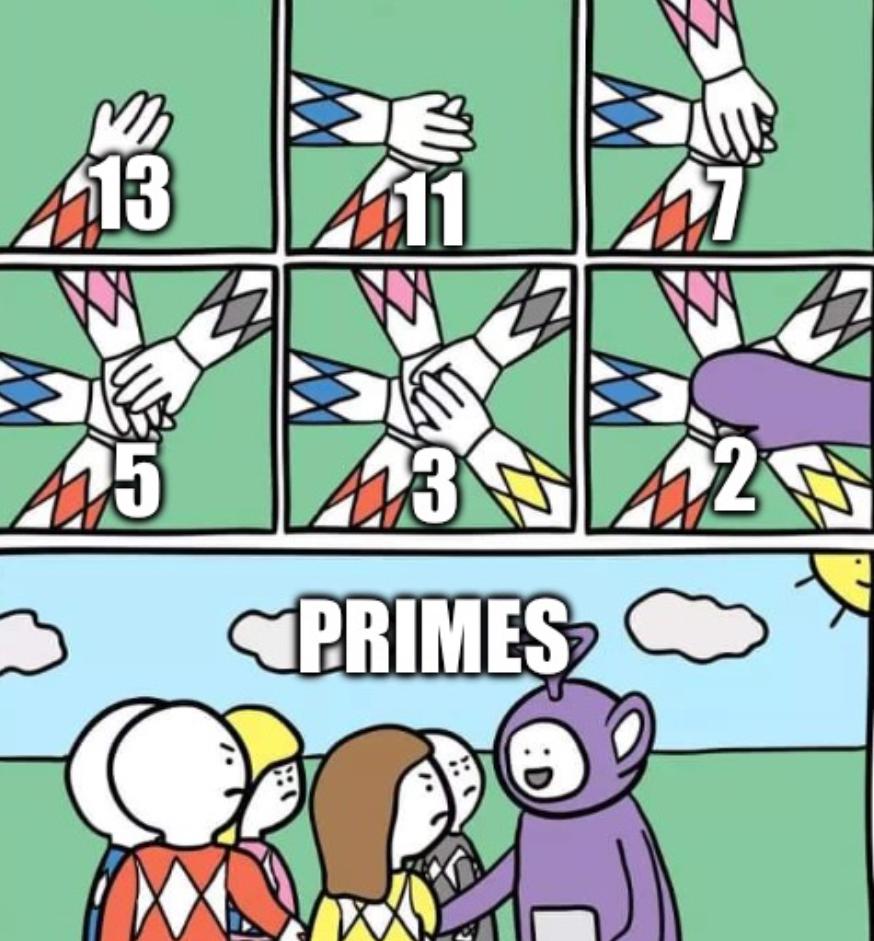
▲ 668 ▼ Primes (lemmy.ml) submitted 3 years ago by HiddenLayer5@lemmy.ml to c/memes@lemmy.ml 73 comments fedilink hide all child comments
[–] NewEnglandRedshirt@lemmy.world 6 points 3 years ago (2 children) Oh yeah? What about 0? And 1? permalink fedilink source hideshow 4 child comments replies: [–] Chais@sh.itjust.works 36 points 3 years ago* (2 children) They're not prime. By definition primes have two prime factors. 1 and the number itself. 1 is divisible only by 1. 0 has no prime factors. permalink fedilink source parent hideshow 4 child comments replies: [–] CAPSLOCKFTW@lemmy.ml 16 points 3 years ago (1 child) Commonly primes are defined as natural numbers greater than 1 that have only trivial divisors. Your definition kinda works, but 1 can be infinitely many prime factors since every number has 1^n with n ∈ ℕ as a prime factor. And your definition is kinda misleading when generalising primes. permalink fedilink source parent hideshow 2 child comments replies: [–] Chais@sh.itjust.works 9 points 3 years ago* (last edited 3 years ago) (1 child) Isn't 1^n just 1? As in not a new number. I'd argue that 1*1==1*1*1. They're not some subtly different ones. I agree that the concept of primes only becomes useful for natural numbers >1. How is my definition misleading? permalink fedilink source parent hideshow 2 child comments replies: [–] CAPSLOCKFTW@lemmy.ml 3 points 3 years ago* (last edited 3 years ago) (2 children) It is no new number, though you can add infinitely many ones to the prime factorisation if you want to. In general we don't append 1 to the prime factorisation because it is trivial. In commutative Algebra, a unitary commutative ring can have multiple units (in the multiplicative group of the reals only 1 is a unit, x*1=x, in this ring you have several "ones"). There are elemrnts in these rings which we call prime, because their prime factorisation only contains trivial prime factors, but of course all units of said ring are prime factors. Hence it is a bit quirky to define ordinary primes they way you did, it is not about the amount of prime factors, it is about their properties. Edit: also important to know: (ℝ,×), the multiplicative goup of the reals, is a commutative, unitary ring, which happens to have only one unit, so our ordinary primes are a special case of the general prime elements. permalink fedilink source parent hideshow 4 child comments replies: [–] Chais@sh.itjust.works 3 points 3 years ago (1 child) Oof, I remember why I didn't study math 😅 But thanks for the explanation permalink fedilink source parent hideshow 2 child comments replies: [–] CAPSLOCKFTW@lemmy.ml 2 points 3 years ago (1 child) Yeah, higher math is a total brainfuck :D You're welcome. permalink fedilink source parent hideshow 2 child comments replies: [–] Llewellyn@lemmy.ml 1 point 3 years ago I was never able to wrap my head around quaternions. permalink fedilink source parent [–] T0Keh@feddit.de 1 point 3 years ago (1 child) There is multiple things wrong here. 1 is not a prime number because it is a unit and hence by definition excluded from being a prime. You probably don't mean units but identity elements: A unit is an element that has a multiplicative inverse An identity element is an element 1 such that 1x =x1 = x for all x in your ring There are more units in R than just 1, take for example -1(unless your ring has characteristic 2 in which case thi argument not always works; however for the case of real numbers this is not relevant). But there is always just one identity element, so there is at most one "1" in any ring. Indeed suppose you have two identities e,f. Then e = ef = f because e,f both are identities. The property "their prime factorisaton only contains trivial prime factors" is a circular definition as this requires knowledge about "being prime". A prime (in Z) is normally defined as an irreducible element, i.e. p is a prime number if p=ab implies that either a or b is a unit (which is exactly the property of only having the factors 1 and p itself (up to a unit)). (R,×) is not a ring (at least not in a way I am aware of) and not even a group (unless you exclude 0). What are those "general prime elements"? Do you mean prime elements in a ring (or irreducible elements?)? Or something completely different? permalink fedilink source parent hideshow 2 child comments replies: [–] CAPSLOCKFTW@lemmy.ml 1 point 3 years ago (1 child) You're mostly right, i misremembered some stuff. My phone keyboard or my client were not capable of adding a small + to the R. With general prime elements I meant prime elements in a ring. But regarding 3.: Not all reducible elements are prime nor vice versa. permalink fedilink source parent hideshow 2 child comments replies: [–] T0Keh@feddit.de 1 point 3 years ago That's why I wrote prime number instead of prime element to not add more confusion. I know that in general prime and irreducible are not equivalent. permalink fedilink source parent [–] bstix@feddit.dk 5 points 3 years ago 0 has all the factors. Itself and any other number. permalink fedilink source parent [–] Blackmist@feddit.uk 4 points 3 years ago Put them in a sieve of Eratosthenes and see what happens. Spoiler, they aren't. permalink fedilink source parent
[–] Chais@sh.itjust.works 36 points 3 years ago* (2 children) They're not prime. By definition primes have two prime factors. 1 and the number itself. 1 is divisible only by 1. 0 has no prime factors. permalink fedilink source parent hideshow 4 child comments replies: [–] CAPSLOCKFTW@lemmy.ml 16 points 3 years ago (1 child) Commonly primes are defined as natural numbers greater than 1 that have only trivial divisors. Your definition kinda works, but 1 can be infinitely many prime factors since every number has 1^n with n ∈ ℕ as a prime factor. And your definition is kinda misleading when generalising primes. permalink fedilink source parent hideshow 2 child comments replies: [–] Chais@sh.itjust.works 9 points 3 years ago* (last edited 3 years ago) (1 child) Isn't 1^n just 1? As in not a new number. I'd argue that 1*1==1*1*1. They're not some subtly different ones. I agree that the concept of primes only becomes useful for natural numbers >1. How is my definition misleading? permalink fedilink source parent hideshow 2 child comments replies: [–] CAPSLOCKFTW@lemmy.ml 3 points 3 years ago* (last edited 3 years ago) (2 children) It is no new number, though you can add infinitely many ones to the prime factorisation if you want to. In general we don't append 1 to the prime factorisation because it is trivial. In commutative Algebra, a unitary commutative ring can have multiple units (in the multiplicative group of the reals only 1 is a unit, x*1=x, in this ring you have several "ones"). There are elemrnts in these rings which we call prime, because their prime factorisation only contains trivial prime factors, but of course all units of said ring are prime factors. Hence it is a bit quirky to define ordinary primes they way you did, it is not about the amount of prime factors, it is about their properties. Edit: also important to know: (ℝ,×), the multiplicative goup of the reals, is a commutative, unitary ring, which happens to have only one unit, so our ordinary primes are a special case of the general prime elements. permalink fedilink source parent hideshow 4 child comments replies: [–] Chais@sh.itjust.works 3 points 3 years ago (1 child) Oof, I remember why I didn't study math 😅 But thanks for the explanation permalink fedilink source parent hideshow 2 child comments replies: [–] CAPSLOCKFTW@lemmy.ml 2 points 3 years ago (1 child) Yeah, higher math is a total brainfuck :D You're welcome. permalink fedilink source parent hideshow 2 child comments replies: [–] Llewellyn@lemmy.ml 1 point 3 years ago I was never able to wrap my head around quaternions. permalink fedilink source parent [–] T0Keh@feddit.de 1 point 3 years ago (1 child) There is multiple things wrong here. 1 is not a prime number because it is a unit and hence by definition excluded from being a prime. You probably don't mean units but identity elements: A unit is an element that has a multiplicative inverse An identity element is an element 1 such that 1x =x1 = x for all x in your ring There are more units in R than just 1, take for example -1(unless your ring has characteristic 2 in which case thi argument not always works; however for the case of real numbers this is not relevant). But there is always just one identity element, so there is at most one "1" in any ring. Indeed suppose you have two identities e,f. Then e = ef = f because e,f both are identities. The property "their prime factorisaton only contains trivial prime factors" is a circular definition as this requires knowledge about "being prime". A prime (in Z) is normally defined as an irreducible element, i.e. p is a prime number if p=ab implies that either a or b is a unit (which is exactly the property of only having the factors 1 and p itself (up to a unit)). (R,×) is not a ring (at least not in a way I am aware of) and not even a group (unless you exclude 0). What are those "general prime elements"? Do you mean prime elements in a ring (or irreducible elements?)? Or something completely different? permalink fedilink source parent hideshow 2 child comments replies: [–] CAPSLOCKFTW@lemmy.ml 1 point 3 years ago (1 child) You're mostly right, i misremembered some stuff. My phone keyboard or my client were not capable of adding a small + to the R. With general prime elements I meant prime elements in a ring. But regarding 3.: Not all reducible elements are prime nor vice versa. permalink fedilink source parent hideshow 2 child comments replies: [–] T0Keh@feddit.de 1 point 3 years ago That's why I wrote prime number instead of prime element to not add more confusion. I know that in general prime and irreducible are not equivalent. permalink fedilink source parent [–] bstix@feddit.dk 5 points 3 years ago 0 has all the factors. Itself and any other number. permalink fedilink source parent
[–] CAPSLOCKFTW@lemmy.ml 16 points 3 years ago (1 child) Commonly primes are defined as natural numbers greater than 1 that have only trivial divisors. Your definition kinda works, but 1 can be infinitely many prime factors since every number has 1^n with n ∈ ℕ as a prime factor. And your definition is kinda misleading when generalising primes. permalink fedilink source parent hideshow 2 child comments replies: [–] Chais@sh.itjust.works 9 points 3 years ago* (last edited 3 years ago) (1 child) Isn't 1^n just 1? As in not a new number. I'd argue that 1*1==1*1*1. They're not some subtly different ones. I agree that the concept of primes only becomes useful for natural numbers >1. How is my definition misleading? permalink fedilink source parent hideshow 2 child comments replies: [–] CAPSLOCKFTW@lemmy.ml 3 points 3 years ago* (last edited 3 years ago) (2 children) It is no new number, though you can add infinitely many ones to the prime factorisation if you want to. In general we don't append 1 to the prime factorisation because it is trivial. In commutative Algebra, a unitary commutative ring can have multiple units (in the multiplicative group of the reals only 1 is a unit, x*1=x, in this ring you have several "ones"). There are elemrnts in these rings which we call prime, because their prime factorisation only contains trivial prime factors, but of course all units of said ring are prime factors. Hence it is a bit quirky to define ordinary primes they way you did, it is not about the amount of prime factors, it is about their properties. Edit: also important to know: (ℝ,×), the multiplicative goup of the reals, is a commutative, unitary ring, which happens to have only one unit, so our ordinary primes are a special case of the general prime elements. permalink fedilink source parent hideshow 4 child comments replies: [–] Chais@sh.itjust.works 3 points 3 years ago (1 child) Oof, I remember why I didn't study math 😅 But thanks for the explanation permalink fedilink source parent hideshow 2 child comments replies: [–] CAPSLOCKFTW@lemmy.ml 2 points 3 years ago (1 child) Yeah, higher math is a total brainfuck :D You're welcome. permalink fedilink source parent hideshow 2 child comments replies: [–] Llewellyn@lemmy.ml 1 point 3 years ago I was never able to wrap my head around quaternions. permalink fedilink source parent [–] T0Keh@feddit.de 1 point 3 years ago (1 child) There is multiple things wrong here. 1 is not a prime number because it is a unit and hence by definition excluded from being a prime. You probably don't mean units but identity elements: A unit is an element that has a multiplicative inverse An identity element is an element 1 such that 1x =x1 = x for all x in your ring There are more units in R than just 1, take for example -1(unless your ring has characteristic 2 in which case thi argument not always works; however for the case of real numbers this is not relevant). But there is always just one identity element, so there is at most one "1" in any ring. Indeed suppose you have two identities e,f. Then e = ef = f because e,f both are identities. The property "their prime factorisaton only contains trivial prime factors" is a circular definition as this requires knowledge about "being prime". A prime (in Z) is normally defined as an irreducible element, i.e. p is a prime number if p=ab implies that either a or b is a unit (which is exactly the property of only having the factors 1 and p itself (up to a unit)). (R,×) is not a ring (at least not in a way I am aware of) and not even a group (unless you exclude 0). What are those "general prime elements"? Do you mean prime elements in a ring (or irreducible elements?)? Or something completely different? permalink fedilink source parent hideshow 2 child comments replies: [–] CAPSLOCKFTW@lemmy.ml 1 point 3 years ago (1 child) You're mostly right, i misremembered some stuff. My phone keyboard or my client were not capable of adding a small + to the R. With general prime elements I meant prime elements in a ring. But regarding 3.: Not all reducible elements are prime nor vice versa. permalink fedilink source parent hideshow 2 child comments replies: [–] T0Keh@feddit.de 1 point 3 years ago That's why I wrote prime number instead of prime element to not add more confusion. I know that in general prime and irreducible are not equivalent. permalink fedilink source parent
[–] Chais@sh.itjust.works 9 points 3 years ago* (last edited 3 years ago) (1 child) Isn't 1^n just 1? As in not a new number. I'd argue that 1*1==1*1*1. They're not some subtly different ones. I agree that the concept of primes only becomes useful for natural numbers >1. How is my definition misleading? permalink fedilink source parent hideshow 2 child comments replies: [–] CAPSLOCKFTW@lemmy.ml 3 points 3 years ago* (last edited 3 years ago) (2 children) It is no new number, though you can add infinitely many ones to the prime factorisation if you want to. In general we don't append 1 to the prime factorisation because it is trivial. In commutative Algebra, a unitary commutative ring can have multiple units (in the multiplicative group of the reals only 1 is a unit, x*1=x, in this ring you have several "ones"). There are elemrnts in these rings which we call prime, because their prime factorisation only contains trivial prime factors, but of course all units of said ring are prime factors. Hence it is a bit quirky to define ordinary primes they way you did, it is not about the amount of prime factors, it is about their properties. Edit: also important to know: (ℝ,×), the multiplicative goup of the reals, is a commutative, unitary ring, which happens to have only one unit, so our ordinary primes are a special case of the general prime elements. permalink fedilink source parent hideshow 4 child comments replies: [–] Chais@sh.itjust.works 3 points 3 years ago (1 child) Oof, I remember why I didn't study math 😅 But thanks for the explanation permalink fedilink source parent hideshow 2 child comments replies: [–] CAPSLOCKFTW@lemmy.ml 2 points 3 years ago (1 child) Yeah, higher math is a total brainfuck :D You're welcome. permalink fedilink source parent hideshow 2 child comments replies: [–] Llewellyn@lemmy.ml 1 point 3 years ago I was never able to wrap my head around quaternions. permalink fedilink source parent [–] T0Keh@feddit.de 1 point 3 years ago (1 child) There is multiple things wrong here. 1 is not a prime number because it is a unit and hence by definition excluded from being a prime. You probably don't mean units but identity elements: A unit is an element that has a multiplicative inverse An identity element is an element 1 such that 1x =x1 = x for all x in your ring There are more units in R than just 1, take for example -1(unless your ring has characteristic 2 in which case thi argument not always works; however for the case of real numbers this is not relevant). But there is always just one identity element, so there is at most one "1" in any ring. Indeed suppose you have two identities e,f. Then e = ef = f because e,f both are identities. The property "their prime factorisaton only contains trivial prime factors" is a circular definition as this requires knowledge about "being prime". A prime (in Z) is normally defined as an irreducible element, i.e. p is a prime number if p=ab implies that either a or b is a unit (which is exactly the property of only having the factors 1 and p itself (up to a unit)). (R,×) is not a ring (at least not in a way I am aware of) and not even a group (unless you exclude 0). What are those "general prime elements"? Do you mean prime elements in a ring (or irreducible elements?)? Or something completely different? permalink fedilink source parent hideshow 2 child comments replies: [–] CAPSLOCKFTW@lemmy.ml 1 point 3 years ago (1 child) You're mostly right, i misremembered some stuff. My phone keyboard or my client were not capable of adding a small + to the R. With general prime elements I meant prime elements in a ring. But regarding 3.: Not all reducible elements are prime nor vice versa. permalink fedilink source parent hideshow 2 child comments replies: [–] T0Keh@feddit.de 1 point 3 years ago That's why I wrote prime number instead of prime element to not add more confusion. I know that in general prime and irreducible are not equivalent. permalink fedilink source parent
[–] CAPSLOCKFTW@lemmy.ml 3 points 3 years ago* (last edited 3 years ago) (2 children) It is no new number, though you can add infinitely many ones to the prime factorisation if you want to. In general we don't append 1 to the prime factorisation because it is trivial. In commutative Algebra, a unitary commutative ring can have multiple units (in the multiplicative group of the reals only 1 is a unit, x*1=x, in this ring you have several "ones"). There are elemrnts in these rings which we call prime, because their prime factorisation only contains trivial prime factors, but of course all units of said ring are prime factors. Hence it is a bit quirky to define ordinary primes they way you did, it is not about the amount of prime factors, it is about their properties. Edit: also important to know: (ℝ,×), the multiplicative goup of the reals, is a commutative, unitary ring, which happens to have only one unit, so our ordinary primes are a special case of the general prime elements. permalink fedilink source parent hideshow 4 child comments replies: [–] Chais@sh.itjust.works 3 points 3 years ago (1 child) Oof, I remember why I didn't study math 😅 But thanks for the explanation permalink fedilink source parent hideshow 2 child comments replies: [–] CAPSLOCKFTW@lemmy.ml 2 points 3 years ago (1 child) Yeah, higher math is a total brainfuck :D You're welcome. permalink fedilink source parent hideshow 2 child comments replies: [–] Llewellyn@lemmy.ml 1 point 3 years ago I was never able to wrap my head around quaternions. permalink fedilink source parent [–] T0Keh@feddit.de 1 point 3 years ago (1 child) There is multiple things wrong here. 1 is not a prime number because it is a unit and hence by definition excluded from being a prime. You probably don't mean units but identity elements: A unit is an element that has a multiplicative inverse An identity element is an element 1 such that 1x =x1 = x for all x in your ring There are more units in R than just 1, take for example -1(unless your ring has characteristic 2 in which case thi argument not always works; however for the case of real numbers this is not relevant). But there is always just one identity element, so there is at most one "1" in any ring. Indeed suppose you have two identities e,f. Then e = ef = f because e,f both are identities. The property "their prime factorisaton only contains trivial prime factors" is a circular definition as this requires knowledge about "being prime". A prime (in Z) is normally defined as an irreducible element, i.e. p is a prime number if p=ab implies that either a or b is a unit (which is exactly the property of only having the factors 1 and p itself (up to a unit)). (R,×) is not a ring (at least not in a way I am aware of) and not even a group (unless you exclude 0). What are those "general prime elements"? Do you mean prime elements in a ring (or irreducible elements?)? Or something completely different? permalink fedilink source parent hideshow 2 child comments replies: [–] CAPSLOCKFTW@lemmy.ml 1 point 3 years ago (1 child) You're mostly right, i misremembered some stuff. My phone keyboard or my client were not capable of adding a small + to the R. With general prime elements I meant prime elements in a ring. But regarding 3.: Not all reducible elements are prime nor vice versa. permalink fedilink source parent hideshow 2 child comments replies: [–] T0Keh@feddit.de 1 point 3 years ago That's why I wrote prime number instead of prime element to not add more confusion. I know that in general prime and irreducible are not equivalent. permalink fedilink source parent
[–] Chais@sh.itjust.works 3 points 3 years ago (1 child) Oof, I remember why I didn't study math 😅 But thanks for the explanation permalink fedilink source parent hideshow 2 child comments replies: [–] CAPSLOCKFTW@lemmy.ml 2 points 3 years ago (1 child) Yeah, higher math is a total brainfuck :D You're welcome. permalink fedilink source parent hideshow 2 child comments replies: [–] Llewellyn@lemmy.ml 1 point 3 years ago I was never able to wrap my head around quaternions. permalink fedilink source parent
[–] CAPSLOCKFTW@lemmy.ml 2 points 3 years ago (1 child) Yeah, higher math is a total brainfuck :D You're welcome. permalink fedilink source parent hideshow 2 child comments replies: [–] Llewellyn@lemmy.ml 1 point 3 years ago I was never able to wrap my head around quaternions. permalink fedilink source parent
[–] Llewellyn@lemmy.ml 1 point 3 years ago I was never able to wrap my head around quaternions. permalink fedilink source parent
[–] T0Keh@feddit.de 1 point 3 years ago (1 child) There is multiple things wrong here. 1 is not a prime number because it is a unit and hence by definition excluded from being a prime. You probably don't mean units but identity elements: A unit is an element that has a multiplicative inverse An identity element is an element 1 such that 1x =x1 = x for all x in your ring There are more units in R than just 1, take for example -1(unless your ring has characteristic 2 in which case thi argument not always works; however for the case of real numbers this is not relevant). But there is always just one identity element, so there is at most one "1" in any ring. Indeed suppose you have two identities e,f. Then e = ef = f because e,f both are identities. The property "their prime factorisaton only contains trivial prime factors" is a circular definition as this requires knowledge about "being prime". A prime (in Z) is normally defined as an irreducible element, i.e. p is a prime number if p=ab implies that either a or b is a unit (which is exactly the property of only having the factors 1 and p itself (up to a unit)). (R,×) is not a ring (at least not in a way I am aware of) and not even a group (unless you exclude 0). What are those "general prime elements"? Do you mean prime elements in a ring (or irreducible elements?)? Or something completely different? permalink fedilink source parent hideshow 2 child comments replies: [–] CAPSLOCKFTW@lemmy.ml 1 point 3 years ago (1 child) You're mostly right, i misremembered some stuff. My phone keyboard or my client were not capable of adding a small + to the R. With general prime elements I meant prime elements in a ring. But regarding 3.: Not all reducible elements are prime nor vice versa. permalink fedilink source parent hideshow 2 child comments replies: [–] T0Keh@feddit.de 1 point 3 years ago That's why I wrote prime number instead of prime element to not add more confusion. I know that in general prime and irreducible are not equivalent. permalink fedilink source parent
[–] CAPSLOCKFTW@lemmy.ml 1 point 3 years ago (1 child) You're mostly right, i misremembered some stuff. My phone keyboard or my client were not capable of adding a small + to the R. With general prime elements I meant prime elements in a ring. But regarding 3.: Not all reducible elements are prime nor vice versa. permalink fedilink source parent hideshow 2 child comments replies: [–] T0Keh@feddit.de 1 point 3 years ago That's why I wrote prime number instead of prime element to not add more confusion. I know that in general prime and irreducible are not equivalent. permalink fedilink source parent
[–] T0Keh@feddit.de 1 point 3 years ago That's why I wrote prime number instead of prime element to not add more confusion. I know that in general prime and irreducible are not equivalent. permalink fedilink source parent
[–] bstix@feddit.dk 5 points 3 years ago 0 has all the factors. Itself and any other number. permalink fedilink source parent
[–] Blackmist@feddit.uk 4 points 3 years ago Put them in a sieve of Eratosthenes and see what happens. Spoiler, they aren't. permalink fedilink source parent