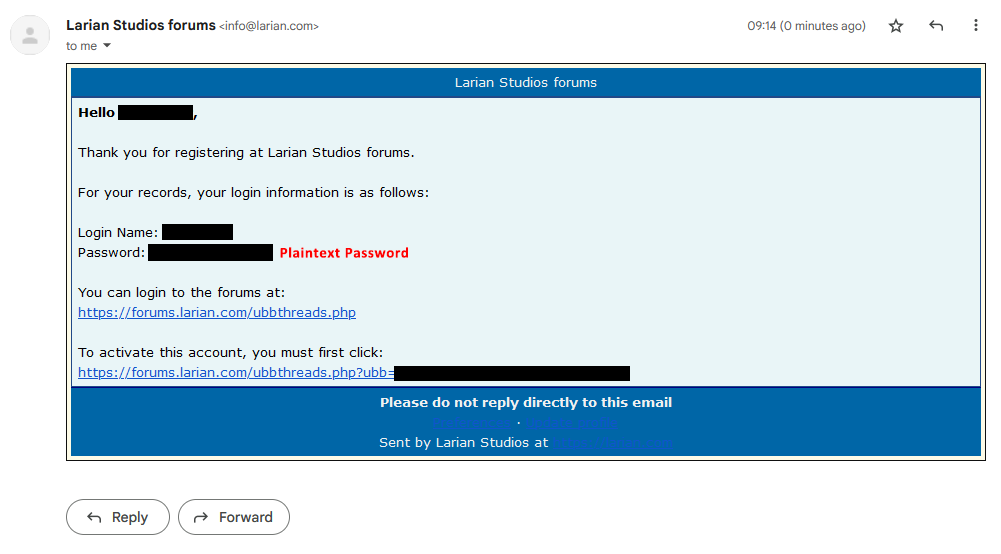
▲ 319 ▼ Larion Studios forum stores your passwords in unhashed plaintext. (lemmy.world) submitted 2 years ago by Cabrio@lemmy.world to c/games@lemmy.world 213 comments fedilink hide all child comments Larion Studios forum stores your passwords in unhashed plaintext. Don't use a password there that you've used anywhere else.
[–] SaltySalamander@kbin.social 23 points 2 years ago (2 children) I just want to drop a reminder (to you specifically) that you don't have to use a cloud-based password manager. Roll your own. permalink fedilink source parent hideshow 4 child comments replies: [–] SomeRandomWords@lemmy.blahaj.zone 12 points 2 years ago (1 child) Can I discourage rolling your own password manager (like using a text doc or spreadsheet) and instead recommend what you hopefully meant, self-hosting your own password manager? permalink fedilink source parent hideshow 2 child comments replies: [–] AnonTwo@kbin.social 14 points 2 years ago (1 child) I don't know what you're trying to say. I think it was safe to assume Salty probably meant the local-based keepass or something like that? I wouldn't have immediately gone to text doc or spreadsheet. those aren't password managers. permalink fedilink source parent hideshow 2 child comments replies: [–] DrQuint@lemm.ee 3 points 2 years ago (1 child) The only annoying part about the modern world is that you want to have that keepass file synchronized between devices, at which point you either go down the path of something like Synchthing (not mainstream user friendly) or you just end up asking yourself "fine, what cloud service do I trust to not go looking at my files?" permalink fedilink source parent hideshow 2 child comments replies: [–] melooone@feddit.de 2 points 2 years ago (1 child) I always synced my database manually either directly over usb, or wifi (KDE Connect). I have to admit that it's not really user friendly, but once I got used to it, it's no problem at all. And uploading it to any cloud service should be fine as long as it's encrypted with a strong password. But that kind of defeats the point of an offline password-manager in my opinion. permalink fedilink source parent hideshow 2 child comments replies: [–] Hexarei@programming.dev 2 points 2 years ago I have mine in a self hosted Nextcloud instance, best of both worlds permalink fedilink source parent [–] h_a_r_u_k_i@programming.dev 1 point 2 years ago Good advice only for tech-savvy and people who are interested in self-hosting. There's so many things that can go wrong like improper backups and accidental networking problems. permalink fedilink source parent
[–] SomeRandomWords@lemmy.blahaj.zone 12 points 2 years ago (1 child) Can I discourage rolling your own password manager (like using a text doc or spreadsheet) and instead recommend what you hopefully meant, self-hosting your own password manager? permalink fedilink source parent hideshow 2 child comments replies: [–] AnonTwo@kbin.social 14 points 2 years ago (1 child) I don't know what you're trying to say. I think it was safe to assume Salty probably meant the local-based keepass or something like that? I wouldn't have immediately gone to text doc or spreadsheet. those aren't password managers. permalink fedilink source parent hideshow 2 child comments replies: [–] DrQuint@lemm.ee 3 points 2 years ago (1 child) The only annoying part about the modern world is that you want to have that keepass file synchronized between devices, at which point you either go down the path of something like Synchthing (not mainstream user friendly) or you just end up asking yourself "fine, what cloud service do I trust to not go looking at my files?" permalink fedilink source parent hideshow 2 child comments replies: [–] melooone@feddit.de 2 points 2 years ago (1 child) I always synced my database manually either directly over usb, or wifi (KDE Connect). I have to admit that it's not really user friendly, but once I got used to it, it's no problem at all. And uploading it to any cloud service should be fine as long as it's encrypted with a strong password. But that kind of defeats the point of an offline password-manager in my opinion. permalink fedilink source parent hideshow 2 child comments replies: [–] Hexarei@programming.dev 2 points 2 years ago I have mine in a self hosted Nextcloud instance, best of both worlds permalink fedilink source parent
[–] AnonTwo@kbin.social 14 points 2 years ago (1 child) I don't know what you're trying to say. I think it was safe to assume Salty probably meant the local-based keepass or something like that? I wouldn't have immediately gone to text doc or spreadsheet. those aren't password managers. permalink fedilink source parent hideshow 2 child comments replies: [–] DrQuint@lemm.ee 3 points 2 years ago (1 child) The only annoying part about the modern world is that you want to have that keepass file synchronized between devices, at which point you either go down the path of something like Synchthing (not mainstream user friendly) or you just end up asking yourself "fine, what cloud service do I trust to not go looking at my files?" permalink fedilink source parent hideshow 2 child comments replies: [–] melooone@feddit.de 2 points 2 years ago (1 child) I always synced my database manually either directly over usb, or wifi (KDE Connect). I have to admit that it's not really user friendly, but once I got used to it, it's no problem at all. And uploading it to any cloud service should be fine as long as it's encrypted with a strong password. But that kind of defeats the point of an offline password-manager in my opinion. permalink fedilink source parent hideshow 2 child comments replies: [–] Hexarei@programming.dev 2 points 2 years ago I have mine in a self hosted Nextcloud instance, best of both worlds permalink fedilink source parent
[–] DrQuint@lemm.ee 3 points 2 years ago (1 child) The only annoying part about the modern world is that you want to have that keepass file synchronized between devices, at which point you either go down the path of something like Synchthing (not mainstream user friendly) or you just end up asking yourself "fine, what cloud service do I trust to not go looking at my files?" permalink fedilink source parent hideshow 2 child comments replies: [–] melooone@feddit.de 2 points 2 years ago (1 child) I always synced my database manually either directly over usb, or wifi (KDE Connect). I have to admit that it's not really user friendly, but once I got used to it, it's no problem at all. And uploading it to any cloud service should be fine as long as it's encrypted with a strong password. But that kind of defeats the point of an offline password-manager in my opinion. permalink fedilink source parent hideshow 2 child comments replies: [–] Hexarei@programming.dev 2 points 2 years ago I have mine in a self hosted Nextcloud instance, best of both worlds permalink fedilink source parent
[–] melooone@feddit.de 2 points 2 years ago (1 child) I always synced my database manually either directly over usb, or wifi (KDE Connect). I have to admit that it's not really user friendly, but once I got used to it, it's no problem at all. And uploading it to any cloud service should be fine as long as it's encrypted with a strong password. But that kind of defeats the point of an offline password-manager in my opinion. permalink fedilink source parent hideshow 2 child comments replies: [–] Hexarei@programming.dev 2 points 2 years ago I have mine in a self hosted Nextcloud instance, best of both worlds permalink fedilink source parent
[–] Hexarei@programming.dev 2 points 2 years ago I have mine in a self hosted Nextcloud instance, best of both worlds permalink fedilink source parent
[–] h_a_r_u_k_i@programming.dev 1 point 2 years ago Good advice only for tech-savvy and people who are interested in self-hosting. There's so many things that can go wrong like improper backups and accidental networking problems. permalink fedilink source parent