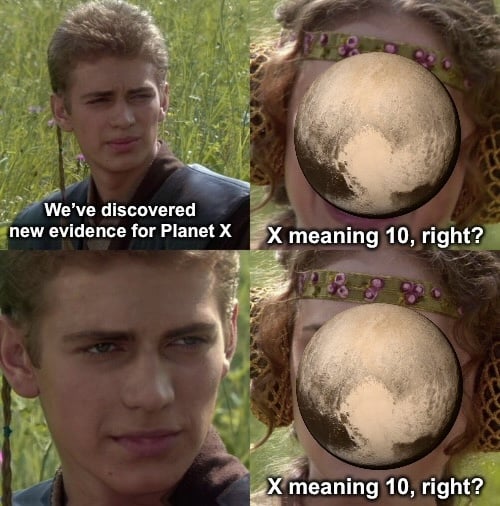
Pluto will always be a planet to me, and you'll pry that definition from my cold, dead hands!
post
You know, this post made me realize something. Some people are viewing it in terms of "rank", instead of an arbitrary scientific classification designed to efficiently communicate ideas in a clear and concise way.
It's like ... mythology or something, and the planet(oid) being anthropomorphized.
Do people also view kingdom, phylum, class, order, family, genus, species as "ranks" of some sort, with some intrinsically greater value being given to some over others?
It’s like … mythology or something, and the planet(oid) being anthropomorphized.
I mean, the planet(oid)s are named after gods.
The personification of its classification is probably related to the exclusivity of the title and “bigger is better” mentality. Since every life form has a taxonomy for domain to species, there’s not really an exclusivity to each echelon. I don’t imagine anybody really thinks like this meme below, for example:

This makes me want to devise a tiered, inclusive classification scheme for space objects.
We could start with orbital objects, any object that normally experiences regular, periodic orbits with minimal deviation. So, everything in the galaxy would be one except potentially Sag A, and the galaxy itself. Perhaps the next branching subsets could be things undergoing continuous fusion somewhere in their body or not?
Do people also view kingdom, phylum, class, order, family, genus, species as "ranks" of some sort, with some intrinsically greater value being given to some over others?
Well, for humans we most certainly do
So, "homo" is better than "sapiens"? And "animal" is better than homo sapiens?
Or do I have it backwards, and "lower" ranks are better? So, "pinus ponderosa" would be better than "plant"?
I think it'll matter a bit more once (if) we get to explore our solar system for real. I feel like right now the concept of "planet" is still rather distant in our minds and a lot of people just base it on vibes
When ever Eris isn't on screen everyone should be asking "Where's Eris?"
"Where is Eris? Is it safe? Is it all right?"
"It appears that, in your anger... You classified it as a dwarf planet."
"NOOOOOOOOOOOOOOOO!"
The planet formerly known as twitter.
aint no planet x coming cause aint no space cuz aint not globe earth
aint no birds flying cause aint no worms cuz aint not soil earth
Imagine how poor Pluto would feel if we decided this new entry counted as a proper planet.
He should pull himself up by his bootstraps and get his Alpha Planet grindset on. No one can be a proper planet with this Sigma Planet mindset
Is planet X really discovered?
They found more evidence for its existence recently, but no. Nobody has ever seen it or even found out in which direction to look. The evidence is that the other planets move in ways that only makes sense if there is some mass somewhere pulling their orbits.
Sort of like having to discover the moon from watching the tides in the sea.
Yes, but that new evidence is way less distinguishable from noise than the one for Neptune.
At this point, the most likely is that there isn't anything there.
Can we just send someone to check it out? Stop being lazy.
Thought there were some significant progress..
Well we figured out where to look for it, and it is definitely the sky. We tried looking the last place we left it, and then we looked all around the basement from top to bottom. Yup, we can say with confidence folks, Planet X is hiding somewhere above us.
Yeah well, not really. Next year maybe, according to the article linked yesterday.
I saw it named planet 9
Named so here https://en.m.wikipedia.org/wiki/Planet_Nine
Ceres and Eris didn’t even get turns being planets
Ceres was considered a planet in the first half of the 1800's, along with a bunch of things in the asteroid belt. There was a point where there were 64 planets.
In the present state of knowledge astronomers give us the following list:
Sixty-four "primary planets" revolving round the Sun as our Earth does.
Twenty satellites, including our Moon.
Of the sixty-four primary planets fifty-six are asteroids, comparatively small bodies, all of which were discovered in this century, and fifty-two since the year 1844.]
top 50 comments