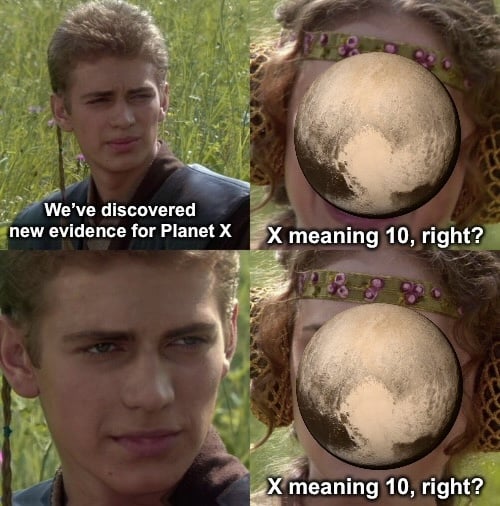
▲ 507 ▼ You are in this solar system, but we do not grant you the rank of planet (lemmy.world) submitted 2 years ago by Squorlple@lemmy.world to c/science_memes@mander.xyz 74 comments fedilink hide all child comments
[–] Kyrgizion@lemmy.world 79 points 2 years ago (7 children) Pluto will always be a planet to me, and you'll pry that definition from my cold, dead hands! permalink fedilink source hideshow 14 child comments replies: [–] kbal@fedia.io 48 points 2 years ago (2 children) Stay strong. A dwarf planet is a perfectly valid kind of planet, don't let anyone tell you otherwise. permalink fedilink source parent hideshow 4 child comments replies: [–] Neato@ttrpg.network 30 points 2 years ago (2 children) It's not the size that counts but the ability to clear your orbit. ;) permalink fedilink source parent hideshow 4 child comments replies: [–] HeyThisIsntTheYMCA@lemmy.world 4 points 2 years ago (1 child) So tell me about Jupiter permalink fedilink source parent hideshow 2 child comments replies: [–] Neato@ttrpg.network 10 points 2 years ago* (1 child) Good question! I had forgotten about Jupiter's Trojans and Greek asteroids! I went and checked the definiton of Clearing the Neighborhood by IAU, emphasis mine: The phrase refers to an orbiting body (a planet or protoplanet) "sweeping out" its orbital region over time, by gravitationally interacting with smaller bodies nearby. Over many orbital cycles, a large body will tend to cause small bodies either to accrete with it, or to be disturbed to another orbit, or to be captured either as a satellite or into a resonant orbit. As a consequence it does not then share its orbital region with other bodies of significant size, except for its own satellites, or other bodies governed by its own gravitational influence. This latter restriction excludes objects whose orbits may cross but that will never collide with each other due to orbital resonance, such as Jupiter and its trojans, Earth and 3753 Cruithne, or Neptune and the plutinos.[3] As to the extent of orbit clearing required, Jean-Luc Margot emphasises "a planet can never completely clear its orbital zone, because gravitational and radiative forces continually perturb the orbits of asteroids and comets into planet-crossing orbits" and states that the IAU did not intend the impossible standard of impeccable orbit clearing.[2] Trojans and Greeks orbit Jupiter's LaGrange points in a stable orbit and so they are governed by Jupiter's gravity. You could say they're really weird moons orbiting semi-stable points Jupiter creates. permalink fedilink source parent hideshow 2 child comments replies: [–] HeyThisIsntTheYMCA@lemmy.world 2 points 2 years ago So since there are like 95 moons (as of last Feb) of jupiter, I'm calling out a dwarf planet permalink fedilink source parent [–] affiliate@lemmy.world -4 points 2 years ago (1 child) this condition makes "planetness" into a local condition. so theoretically, we can throw enough junk into space and stop anything we want from being a planet. pluto just got unlucky in terms of the amount of trash it has in its way. its not fair :( permalink fedilink source parent hideshow 2 child comments replies: [–] Bumblefumble@lemm.ee 23 points 2 years ago (1 child) No, because if it's a proper planet it will clear its orbit. permalink fedilink source parent hideshow 2 child comments replies: [+] DigitalDruid@lemmy.sdf.org 4 points 2 years ago* (last edited 1 year ago) (2 children) [deleted] permalink fedilink source parent hideshow 4 child comments replies: [–] marcos@lemmy.world 2 points 2 years ago (1 child) and whatever species has inherited the earth by then Well, only if we move the Earth safely outwards of the huge Sun. permalink fedilink source parent hideshow 2 child comments replies: [+] DigitalDruid@lemmy.sdf.org 4 points 2 years ago* (last edited 1 year ago) [deleted] permalink fedilink source parent [–] HeyThisIsntTheYMCA@lemmy.world 1 point 2 years ago By the time the Plutians invade they can have Earth permalink fedilink source parent [–] anarchrist@lemmy.dbzer0.com 6 points 2 years ago (2 children) Does it dig mines and sing upbeat work songs? permalink fedilink source parent hideshow 4 child comments replies: [–] dumpsterlid@lemmy.world 4 points 2 years ago ROCK AND STONE…….. and orbits permalink fedilink source parent [–] Gutek8134@lemmy.world 2 points 2 years ago I am a dwarf and I can't clear orbits, can't clear orbits, can't clear orbits permalink fedilink source parent [–] BakerBagel@midwest.social 34 points 2 years ago (1 child) Arenyou gonna start calling Ceres, Haumea, Makemake, and Orcus planets? We went through this 150 years ago ehen the asteroid belt was discovered. Every astronomer wanted credit for discovering a new planet, so at one point there were 15 before all the astronomers got together and said it was untenable. permalink fedilink source parent hideshow 2 child comments replies: [–] Ultraviolet@lemmy.world 12 points 2 years ago Yes. We could have had a planet Orcus and we were like "nah, we'll pass." That would have been metal as shit. permalink fedilink source parent [+] DigitalDruid@lemmy.sdf.org 34 points 2 years ago* (last edited 1 year ago) (3 children) [deleted] permalink fedilink source parent hideshow 6 child comments replies: [–] nxdefiant@startrek.website 14 points 2 years ago (1 child) So Neptune has a rogue rock in its orbit that also orbits the sun and we're just gonna give Neptune a pass on that one because we saw it first. At best, this is size discrimination, and neptunotism, and we both know it! permalink fedilink source parent hideshow 2 child comments replies: [–] meleethecat@lemmy.world 8 points 2 years ago Look, just be careful that you don’t confuse proplutoism with antineptunotism. permalink fedilink source parent [–] Thcdenton@lemmy.world 5 points 2 years ago (1 child) Yeah but it's delivered with a nice hand written note from a single mom in China so I 5 star anyways. permalink fedilink source parent hideshow 2 child comments replies: [–] SplashJackson@lemmy.ca 2 points 2 years ago Upvoted for funny doos ex name permalink fedilink source parent [–] VindictiveJudge@lemmy.world 2 points 2 years ago (1 child) The central point that Pluto and Charon orbit about is also outside of Pluto. All other planets have the center point located within the planet. https://en.wikipedia.org/wiki/File:Pluto-Charon_system-new.gif permalink fedilink source parent hideshow 2 child comments replies: [–] omega_x3@lemmy.world 2 points 2 years ago Then that makes it the solar system's first discovered Binary planets permalink fedilink source parent [–] tacosanonymous@lemm.ee 13 points 2 years ago (1 child) Real scientific, Jerry. permalink fedilink source parent hideshow 2 child comments replies: [–] DAMunzy@lemmy.dbzer0.com 1 point 2 years ago Hungry For Apples? permalink fedilink source parent [–] MonkderDritte@feddit.de 7 points 2 years ago* Whatever, Pluto is a dwarf planet like every other dwarf planet too. permalink fedilink source parent [–] crispyflagstones@sh.itjust.works 3 points 2 years ago (1 child) A dwarf planet is a type of planet, right? permalink fedilink source parent hideshow 2 child comments replies: [–] diverging@lemmy.ml 4 points 2 years ago (1 child) Not according to the IAU. According to the IAU, "planets and dwarf planets are two distinct classes of objects" – in other words, "dwarf planets" are not planets. permalink fedilink source parent hideshow 2 child comments replies: [–] crispyflagstones@sh.itjust.works 2 points 2 years ago :'( permalink fedilink source parent [–] RampantParanoia2365@lemmy.world 1 point 2 years ago New Billy Joel song? I heard he's writing again. permalink fedilink source parent
[–] kbal@fedia.io 48 points 2 years ago (2 children) Stay strong. A dwarf planet is a perfectly valid kind of planet, don't let anyone tell you otherwise. permalink fedilink source parent hideshow 4 child comments replies: [–] Neato@ttrpg.network 30 points 2 years ago (2 children) It's not the size that counts but the ability to clear your orbit. ;) permalink fedilink source parent hideshow 4 child comments replies: [–] HeyThisIsntTheYMCA@lemmy.world 4 points 2 years ago (1 child) So tell me about Jupiter permalink fedilink source parent hideshow 2 child comments replies: [–] Neato@ttrpg.network 10 points 2 years ago* (1 child) Good question! I had forgotten about Jupiter's Trojans and Greek asteroids! I went and checked the definiton of Clearing the Neighborhood by IAU, emphasis mine: The phrase refers to an orbiting body (a planet or protoplanet) "sweeping out" its orbital region over time, by gravitationally interacting with smaller bodies nearby. Over many orbital cycles, a large body will tend to cause small bodies either to accrete with it, or to be disturbed to another orbit, or to be captured either as a satellite or into a resonant orbit. As a consequence it does not then share its orbital region with other bodies of significant size, except for its own satellites, or other bodies governed by its own gravitational influence. This latter restriction excludes objects whose orbits may cross but that will never collide with each other due to orbital resonance, such as Jupiter and its trojans, Earth and 3753 Cruithne, or Neptune and the plutinos.[3] As to the extent of orbit clearing required, Jean-Luc Margot emphasises "a planet can never completely clear its orbital zone, because gravitational and radiative forces continually perturb the orbits of asteroids and comets into planet-crossing orbits" and states that the IAU did not intend the impossible standard of impeccable orbit clearing.[2] Trojans and Greeks orbit Jupiter's LaGrange points in a stable orbit and so they are governed by Jupiter's gravity. You could say they're really weird moons orbiting semi-stable points Jupiter creates. permalink fedilink source parent hideshow 2 child comments replies: [–] HeyThisIsntTheYMCA@lemmy.world 2 points 2 years ago So since there are like 95 moons (as of last Feb) of jupiter, I'm calling out a dwarf planet permalink fedilink source parent [–] affiliate@lemmy.world -4 points 2 years ago (1 child) this condition makes "planetness" into a local condition. so theoretically, we can throw enough junk into space and stop anything we want from being a planet. pluto just got unlucky in terms of the amount of trash it has in its way. its not fair :( permalink fedilink source parent hideshow 2 child comments replies: [–] Bumblefumble@lemm.ee 23 points 2 years ago (1 child) No, because if it's a proper planet it will clear its orbit. permalink fedilink source parent hideshow 2 child comments replies: [+] DigitalDruid@lemmy.sdf.org 4 points 2 years ago* (last edited 1 year ago) (2 children) [deleted] permalink fedilink source parent hideshow 4 child comments replies: [–] marcos@lemmy.world 2 points 2 years ago (1 child) and whatever species has inherited the earth by then Well, only if we move the Earth safely outwards of the huge Sun. permalink fedilink source parent hideshow 2 child comments replies: [+] DigitalDruid@lemmy.sdf.org 4 points 2 years ago* (last edited 1 year ago) [deleted] permalink fedilink source parent [–] HeyThisIsntTheYMCA@lemmy.world 1 point 2 years ago By the time the Plutians invade they can have Earth permalink fedilink source parent [–] anarchrist@lemmy.dbzer0.com 6 points 2 years ago (2 children) Does it dig mines and sing upbeat work songs? permalink fedilink source parent hideshow 4 child comments replies: [–] dumpsterlid@lemmy.world 4 points 2 years ago ROCK AND STONE…….. and orbits permalink fedilink source parent [–] Gutek8134@lemmy.world 2 points 2 years ago I am a dwarf and I can't clear orbits, can't clear orbits, can't clear orbits permalink fedilink source parent
[–] Neato@ttrpg.network 30 points 2 years ago (2 children) It's not the size that counts but the ability to clear your orbit. ;) permalink fedilink source parent hideshow 4 child comments replies: [–] HeyThisIsntTheYMCA@lemmy.world 4 points 2 years ago (1 child) So tell me about Jupiter permalink fedilink source parent hideshow 2 child comments replies: [–] Neato@ttrpg.network 10 points 2 years ago* (1 child) Good question! I had forgotten about Jupiter's Trojans and Greek asteroids! I went and checked the definiton of Clearing the Neighborhood by IAU, emphasis mine: The phrase refers to an orbiting body (a planet or protoplanet) "sweeping out" its orbital region over time, by gravitationally interacting with smaller bodies nearby. Over many orbital cycles, a large body will tend to cause small bodies either to accrete with it, or to be disturbed to another orbit, or to be captured either as a satellite or into a resonant orbit. As a consequence it does not then share its orbital region with other bodies of significant size, except for its own satellites, or other bodies governed by its own gravitational influence. This latter restriction excludes objects whose orbits may cross but that will never collide with each other due to orbital resonance, such as Jupiter and its trojans, Earth and 3753 Cruithne, or Neptune and the plutinos.[3] As to the extent of orbit clearing required, Jean-Luc Margot emphasises "a planet can never completely clear its orbital zone, because gravitational and radiative forces continually perturb the orbits of asteroids and comets into planet-crossing orbits" and states that the IAU did not intend the impossible standard of impeccable orbit clearing.[2] Trojans and Greeks orbit Jupiter's LaGrange points in a stable orbit and so they are governed by Jupiter's gravity. You could say they're really weird moons orbiting semi-stable points Jupiter creates. permalink fedilink source parent hideshow 2 child comments replies: [–] HeyThisIsntTheYMCA@lemmy.world 2 points 2 years ago So since there are like 95 moons (as of last Feb) of jupiter, I'm calling out a dwarf planet permalink fedilink source parent [–] affiliate@lemmy.world -4 points 2 years ago (1 child) this condition makes "planetness" into a local condition. so theoretically, we can throw enough junk into space and stop anything we want from being a planet. pluto just got unlucky in terms of the amount of trash it has in its way. its not fair :( permalink fedilink source parent hideshow 2 child comments replies: [–] Bumblefumble@lemm.ee 23 points 2 years ago (1 child) No, because if it's a proper planet it will clear its orbit. permalink fedilink source parent hideshow 2 child comments replies: [+] DigitalDruid@lemmy.sdf.org 4 points 2 years ago* (last edited 1 year ago) (2 children) [deleted] permalink fedilink source parent hideshow 4 child comments replies: [–] marcos@lemmy.world 2 points 2 years ago (1 child) and whatever species has inherited the earth by then Well, only if we move the Earth safely outwards of the huge Sun. permalink fedilink source parent hideshow 2 child comments replies: [+] DigitalDruid@lemmy.sdf.org 4 points 2 years ago* (last edited 1 year ago) [deleted] permalink fedilink source parent [–] HeyThisIsntTheYMCA@lemmy.world 1 point 2 years ago By the time the Plutians invade they can have Earth permalink fedilink source parent
[–] HeyThisIsntTheYMCA@lemmy.world 4 points 2 years ago (1 child) So tell me about Jupiter permalink fedilink source parent hideshow 2 child comments replies: [–] Neato@ttrpg.network 10 points 2 years ago* (1 child) Good question! I had forgotten about Jupiter's Trojans and Greek asteroids! I went and checked the definiton of Clearing the Neighborhood by IAU, emphasis mine: The phrase refers to an orbiting body (a planet or protoplanet) "sweeping out" its orbital region over time, by gravitationally interacting with smaller bodies nearby. Over many orbital cycles, a large body will tend to cause small bodies either to accrete with it, or to be disturbed to another orbit, or to be captured either as a satellite or into a resonant orbit. As a consequence it does not then share its orbital region with other bodies of significant size, except for its own satellites, or other bodies governed by its own gravitational influence. This latter restriction excludes objects whose orbits may cross but that will never collide with each other due to orbital resonance, such as Jupiter and its trojans, Earth and 3753 Cruithne, or Neptune and the plutinos.[3] As to the extent of orbit clearing required, Jean-Luc Margot emphasises "a planet can never completely clear its orbital zone, because gravitational and radiative forces continually perturb the orbits of asteroids and comets into planet-crossing orbits" and states that the IAU did not intend the impossible standard of impeccable orbit clearing.[2] Trojans and Greeks orbit Jupiter's LaGrange points in a stable orbit and so they are governed by Jupiter's gravity. You could say they're really weird moons orbiting semi-stable points Jupiter creates. permalink fedilink source parent hideshow 2 child comments replies: [–] HeyThisIsntTheYMCA@lemmy.world 2 points 2 years ago So since there are like 95 moons (as of last Feb) of jupiter, I'm calling out a dwarf planet permalink fedilink source parent
[–] Neato@ttrpg.network 10 points 2 years ago* (1 child) Good question! I had forgotten about Jupiter's Trojans and Greek asteroids! I went and checked the definiton of Clearing the Neighborhood by IAU, emphasis mine: The phrase refers to an orbiting body (a planet or protoplanet) "sweeping out" its orbital region over time, by gravitationally interacting with smaller bodies nearby. Over many orbital cycles, a large body will tend to cause small bodies either to accrete with it, or to be disturbed to another orbit, or to be captured either as a satellite or into a resonant orbit. As a consequence it does not then share its orbital region with other bodies of significant size, except for its own satellites, or other bodies governed by its own gravitational influence. This latter restriction excludes objects whose orbits may cross but that will never collide with each other due to orbital resonance, such as Jupiter and its trojans, Earth and 3753 Cruithne, or Neptune and the plutinos.[3] As to the extent of orbit clearing required, Jean-Luc Margot emphasises "a planet can never completely clear its orbital zone, because gravitational and radiative forces continually perturb the orbits of asteroids and comets into planet-crossing orbits" and states that the IAU did not intend the impossible standard of impeccable orbit clearing.[2] Trojans and Greeks orbit Jupiter's LaGrange points in a stable orbit and so they are governed by Jupiter's gravity. You could say they're really weird moons orbiting semi-stable points Jupiter creates. permalink fedilink source parent hideshow 2 child comments replies: [–] HeyThisIsntTheYMCA@lemmy.world 2 points 2 years ago So since there are like 95 moons (as of last Feb) of jupiter, I'm calling out a dwarf planet permalink fedilink source parent
[–] HeyThisIsntTheYMCA@lemmy.world 2 points 2 years ago So since there are like 95 moons (as of last Feb) of jupiter, I'm calling out a dwarf planet permalink fedilink source parent
[–] affiliate@lemmy.world -4 points 2 years ago (1 child) this condition makes "planetness" into a local condition. so theoretically, we can throw enough junk into space and stop anything we want from being a planet. pluto just got unlucky in terms of the amount of trash it has in its way. its not fair :( permalink fedilink source parent hideshow 2 child comments replies: [–] Bumblefumble@lemm.ee 23 points 2 years ago (1 child) No, because if it's a proper planet it will clear its orbit. permalink fedilink source parent hideshow 2 child comments replies: [+] DigitalDruid@lemmy.sdf.org 4 points 2 years ago* (last edited 1 year ago) (2 children) [deleted] permalink fedilink source parent hideshow 4 child comments replies: [–] marcos@lemmy.world 2 points 2 years ago (1 child) and whatever species has inherited the earth by then Well, only if we move the Earth safely outwards of the huge Sun. permalink fedilink source parent hideshow 2 child comments replies: [+] DigitalDruid@lemmy.sdf.org 4 points 2 years ago* (last edited 1 year ago) [deleted] permalink fedilink source parent [–] HeyThisIsntTheYMCA@lemmy.world 1 point 2 years ago By the time the Plutians invade they can have Earth permalink fedilink source parent
[–] Bumblefumble@lemm.ee 23 points 2 years ago (1 child) No, because if it's a proper planet it will clear its orbit. permalink fedilink source parent hideshow 2 child comments replies: [+] DigitalDruid@lemmy.sdf.org 4 points 2 years ago* (last edited 1 year ago) (2 children) [deleted] permalink fedilink source parent hideshow 4 child comments replies: [–] marcos@lemmy.world 2 points 2 years ago (1 child) and whatever species has inherited the earth by then Well, only if we move the Earth safely outwards of the huge Sun. permalink fedilink source parent hideshow 2 child comments replies: [+] DigitalDruid@lemmy.sdf.org 4 points 2 years ago* (last edited 1 year ago) [deleted] permalink fedilink source parent [–] HeyThisIsntTheYMCA@lemmy.world 1 point 2 years ago By the time the Plutians invade they can have Earth permalink fedilink source parent
[+] DigitalDruid@lemmy.sdf.org 4 points 2 years ago* (last edited 1 year ago) (2 children) [deleted] permalink fedilink source parent hideshow 4 child comments replies: [–] marcos@lemmy.world 2 points 2 years ago (1 child) and whatever species has inherited the earth by then Well, only if we move the Earth safely outwards of the huge Sun. permalink fedilink source parent hideshow 2 child comments replies: [+] DigitalDruid@lemmy.sdf.org 4 points 2 years ago* (last edited 1 year ago) [deleted] permalink fedilink source parent [–] HeyThisIsntTheYMCA@lemmy.world 1 point 2 years ago By the time the Plutians invade they can have Earth permalink fedilink source parent
[–] marcos@lemmy.world 2 points 2 years ago (1 child) and whatever species has inherited the earth by then Well, only if we move the Earth safely outwards of the huge Sun. permalink fedilink source parent hideshow 2 child comments replies: [+] DigitalDruid@lemmy.sdf.org 4 points 2 years ago* (last edited 1 year ago) [deleted] permalink fedilink source parent
[+] DigitalDruid@lemmy.sdf.org 4 points 2 years ago* (last edited 1 year ago) [deleted] permalink fedilink source parent
[–] HeyThisIsntTheYMCA@lemmy.world 1 point 2 years ago By the time the Plutians invade they can have Earth permalink fedilink source parent
[–] anarchrist@lemmy.dbzer0.com 6 points 2 years ago (2 children) Does it dig mines and sing upbeat work songs? permalink fedilink source parent hideshow 4 child comments replies: [–] dumpsterlid@lemmy.world 4 points 2 years ago ROCK AND STONE…….. and orbits permalink fedilink source parent [–] Gutek8134@lemmy.world 2 points 2 years ago I am a dwarf and I can't clear orbits, can't clear orbits, can't clear orbits permalink fedilink source parent
[–] dumpsterlid@lemmy.world 4 points 2 years ago ROCK AND STONE…….. and orbits permalink fedilink source parent
[–] Gutek8134@lemmy.world 2 points 2 years ago I am a dwarf and I can't clear orbits, can't clear orbits, can't clear orbits permalink fedilink source parent
[–] BakerBagel@midwest.social 34 points 2 years ago (1 child) Arenyou gonna start calling Ceres, Haumea, Makemake, and Orcus planets? We went through this 150 years ago ehen the asteroid belt was discovered. Every astronomer wanted credit for discovering a new planet, so at one point there were 15 before all the astronomers got together and said it was untenable. permalink fedilink source parent hideshow 2 child comments replies: [–] Ultraviolet@lemmy.world 12 points 2 years ago Yes. We could have had a planet Orcus and we were like "nah, we'll pass." That would have been metal as shit. permalink fedilink source parent
[–] Ultraviolet@lemmy.world 12 points 2 years ago Yes. We could have had a planet Orcus and we were like "nah, we'll pass." That would have been metal as shit. permalink fedilink source parent
[+] DigitalDruid@lemmy.sdf.org 34 points 2 years ago* (last edited 1 year ago) (3 children) [deleted] permalink fedilink source parent hideshow 6 child comments replies: [–] nxdefiant@startrek.website 14 points 2 years ago (1 child) So Neptune has a rogue rock in its orbit that also orbits the sun and we're just gonna give Neptune a pass on that one because we saw it first. At best, this is size discrimination, and neptunotism, and we both know it! permalink fedilink source parent hideshow 2 child comments replies: [–] meleethecat@lemmy.world 8 points 2 years ago Look, just be careful that you don’t confuse proplutoism with antineptunotism. permalink fedilink source parent [–] Thcdenton@lemmy.world 5 points 2 years ago (1 child) Yeah but it's delivered with a nice hand written note from a single mom in China so I 5 star anyways. permalink fedilink source parent hideshow 2 child comments replies: [–] SplashJackson@lemmy.ca 2 points 2 years ago Upvoted for funny doos ex name permalink fedilink source parent [–] VindictiveJudge@lemmy.world 2 points 2 years ago (1 child) The central point that Pluto and Charon orbit about is also outside of Pluto. All other planets have the center point located within the planet. https://en.wikipedia.org/wiki/File:Pluto-Charon_system-new.gif permalink fedilink source parent hideshow 2 child comments replies: [–] omega_x3@lemmy.world 2 points 2 years ago Then that makes it the solar system's first discovered Binary planets permalink fedilink source parent
[–] nxdefiant@startrek.website 14 points 2 years ago (1 child) So Neptune has a rogue rock in its orbit that also orbits the sun and we're just gonna give Neptune a pass on that one because we saw it first. At best, this is size discrimination, and neptunotism, and we both know it! permalink fedilink source parent hideshow 2 child comments replies: [–] meleethecat@lemmy.world 8 points 2 years ago Look, just be careful that you don’t confuse proplutoism with antineptunotism. permalink fedilink source parent
[–] meleethecat@lemmy.world 8 points 2 years ago Look, just be careful that you don’t confuse proplutoism with antineptunotism. permalink fedilink source parent
[–] Thcdenton@lemmy.world 5 points 2 years ago (1 child) Yeah but it's delivered with a nice hand written note from a single mom in China so I 5 star anyways. permalink fedilink source parent hideshow 2 child comments replies: [–] SplashJackson@lemmy.ca 2 points 2 years ago Upvoted for funny doos ex name permalink fedilink source parent
[–] SplashJackson@lemmy.ca 2 points 2 years ago Upvoted for funny doos ex name permalink fedilink source parent
[–] VindictiveJudge@lemmy.world 2 points 2 years ago (1 child) The central point that Pluto and Charon orbit about is also outside of Pluto. All other planets have the center point located within the planet. https://en.wikipedia.org/wiki/File:Pluto-Charon_system-new.gif permalink fedilink source parent hideshow 2 child comments replies: [–] omega_x3@lemmy.world 2 points 2 years ago Then that makes it the solar system's first discovered Binary planets permalink fedilink source parent
[–] omega_x3@lemmy.world 2 points 2 years ago Then that makes it the solar system's first discovered Binary planets permalink fedilink source parent
[–] tacosanonymous@lemm.ee 13 points 2 years ago (1 child) Real scientific, Jerry. permalink fedilink source parent hideshow 2 child comments replies: [–] DAMunzy@lemmy.dbzer0.com 1 point 2 years ago Hungry For Apples? permalink fedilink source parent
[–] MonkderDritte@feddit.de 7 points 2 years ago* Whatever, Pluto is a dwarf planet like every other dwarf planet too. permalink fedilink source parent
[–] crispyflagstones@sh.itjust.works 3 points 2 years ago (1 child) A dwarf planet is a type of planet, right? permalink fedilink source parent hideshow 2 child comments replies: [–] diverging@lemmy.ml 4 points 2 years ago (1 child) Not according to the IAU. According to the IAU, "planets and dwarf planets are two distinct classes of objects" – in other words, "dwarf planets" are not planets. permalink fedilink source parent hideshow 2 child comments replies: [–] crispyflagstones@sh.itjust.works 2 points 2 years ago :'( permalink fedilink source parent
[–] diverging@lemmy.ml 4 points 2 years ago (1 child) Not according to the IAU. According to the IAU, "planets and dwarf planets are two distinct classes of objects" – in other words, "dwarf planets" are not planets. permalink fedilink source parent hideshow 2 child comments replies: [–] crispyflagstones@sh.itjust.works 2 points 2 years ago :'( permalink fedilink source parent
[–] RampantParanoia2365@lemmy.world 1 point 2 years ago New Billy Joel song? I heard he's writing again. permalink fedilink source parent