Saving the climate is not going to be done by guilting consumers into changing individual consumption habits. Enough with the green consumerist bullshit that only serve as neoliberal justifications for inaction.
If the meat industry is hurting the planet, REGULATE IT.
Vegans love to conflate all meat into one big group because their goal is to make veganism look good in comparison.
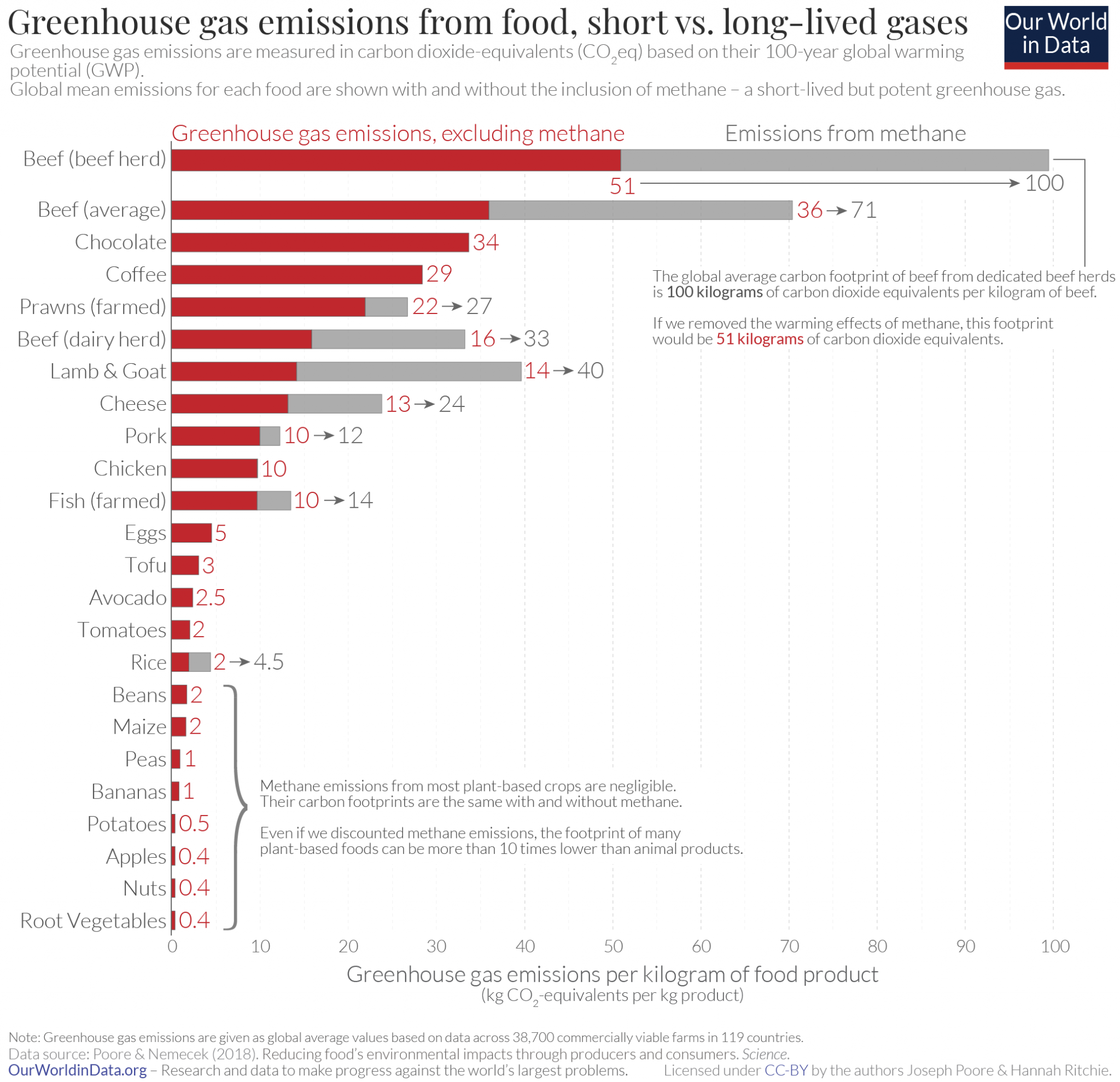
In reality, beef is the main problem.
It would be a lot more environmentally effective to convince people to reduce beef consumption and replace it with chicken/pork instead, but vegans aren't interested in that because for them it's not really about the climate - it's about reducing animal suffering and death.
This duplicity muddies the waters and makes getting real actual change that would benefit the climate harder to achieve and less likely to happen.
I would hazard saying "environmentally effective" here unless we are willing to ignore some of the other large environmental issues with meat production outside of just green house gases emission. Plant-based foods are lower not just on GHG emissions, but water usage, land usage, eutrophication, fertilizer usage^1^, etc.
There's all kinds of other pollutants such as Nitrogen runoff. The rise of the pig farming is has helped fueled a crisis in Nitrogen runoff in the Netherlands for instance
There's the high level of antibiotic usage to maintaining the high levels of production fueling antibiotic resistance.
And so on.
If we do want to look at the suffering, we should also note that chicken farming does not just keep things the same, but actually makes it worse with more chickens required than other creatures due to their smaller size.
EDIT: I should also mention that land use change (deforestation) factor can change as you rapidly increase these industries size. Deforestation makes up a large portion of beef's current emissions. Plant-based foods require overall less cropland due to not needing to grow any feed and removing that energy loss. This is not the case for chicken production. Currently beef does make up the majority of Amazonian deforestation, however, the second largest portion is growing animal feed primary for chickens. Switch from beef to chickens and you might risk just moving around where the deforestation comes from
Yes. Sloppy choice of words on my part but this is a climate change topic, here.
Chicken meat uses 4x less water than beef. I'm not disputing your point, just firming up the perspective for anyone lurking.
Clearly, vegetables are way way better. But in terms of what kind of behavior change people are willing to consider, cutting out beef is a way way easier sell than cutting out all meat.
I tell people to try going without beef temporarily. What often happens is in doing so they learn to cook a bit and cut it out (maybe not fully but mostly) long term. Then they go after pork, chicken, etc. You're right that beef is the worst offender, but we want to be careful not to overemphasise and make it seem like its the only offender. I think a lot of it is setting a tone. I'm veg not vegan but pick vegan options when available. I think the more we can normalise 'eat less meat' the better as that's pretty hard to argue with
one aspect of this is that many vegans care about the environment and the victims of animal agriculture. Things are so bad for the animals (we kill trillions per year. That's insane.) that people are desperate to do or say anything to get people to stop supporting it.
It would be a lot more environmentally effective to convince people to reduce beef consumption and replace it with chicken/pork instead,
Let’s not drive a wedge between the eco-vegans and the animal welfare vegans. Beef is the worst for climate while chickens get the least ethical treatment.
This duplicity muddies the waters and makes getting real actual change that would benefit the climate harder to achieve and less likely to happen.
Dividing an already tiny population of much needed activists is not how you get progressive change. Non-beef meats still shadow plant-based food in terms of their climate harm.
Your pic was too big for me to download but if it’s the same data I’ve seen, then beef is the worst and lamb is 2nd at about ½ the emissions of beef, and all the meats are substantially more harmful than plant based options.
Corn isn't very sweet (read energy rich). It's ridiculous to farm it for fuel. There are crops that are good, but they don't grow well in the continental US.
ITT people do all sorts of gymnastics instead of saying "I know but I just don't care enough"
Just be honest with yourself, if the emissions, pollution, land useage, and staggering cruelty don't bother you more than the 15 minutes of pleasure you get from a Burger pleases you just say it.
If it does, and you feel the need to defend yourself because of it just change. I promise you it's less difficult than you think and there are millions of people waiting to help you learn new delicious and nutritious methods of preparing food. Remember basically all vegans were raised carnist and most of us are complete garbage fires (as the internet so loves to point out (-; ) I promise you that you can do it and you won't even really miss meat after a few months.
Reminder that good is not the enemy of perfect. It is much easier to convince 100 people to eat 10% less meat than to convince 10 people to become vegetarian.
I've started eating vegetarian several days a week and all it's done is introduce me to some amazing tasting food that I haven't tried before because of the dumb stigma that vegetarian means not tasty. I find that I enjoy some of these vegetarian dishes more than it's meat counterpart because it's not ruined by tough overcooked tasteless meat.
Same, meat is just something you don't need in life. The satisfaction I get from a nice delicious meal is no different than it was before I was vegan just now it is better for the environment, my health and animal welfare.
The great thing about meat and dairy consumption is that it is linear; if you eat 50% less you cause 50% less pain. Instead of trying to go full vegan, go half-vegetarian first. The next step can be taken later.
[–]psud@lemmy.world19 points2 years ago* (last edited 2 years ago)
(5 children)
The biggest polluters are
Transport 28%
Electricity 25%
Industry 23%
Commercial & residential 13%
Agriculture 10%
Agriculture (fertiliser, wild rodents, diesel, animals, rotting plants, not including plants wasted by consumers) is only 10%
We're making the best inroads into electricity. It is clearly possible and economical to convert all electrical grids to carbon neutral technology
We're starting to convert residential and commercial to entirely electric (except for the carbon and methane emissions from humans and pets, especially ones that eat beans) so that 13% is solvable
So at the moment 38% of greenhouse gases are easy, just needing political will
Another 23% is harder, industry needs some inventions, especially a green steel making process, and a green concrete making process. Both are years away and probably possible
Transport is hard. 6% is personal transport. That's easy to electrify. Trucking is harder, planes are harder still. I don't know how feasible wind power is for shipping, at least the trade winds blow the right way for Asia to America
The best bet for transport was a green liquid fuel, but the company trying to grow diesel from bacteria folded several years ago.
We are never going to decarbonise agriculture by abandoning any part of it. We can do a bit by practicing permaculture - that keeps more carbon in the ground; we can clean up animal agriculture by not feeding cattle human food, let them eat grass, and there is promising technology for reducing their (and other ruminants') methane emissions by feeding them seaweed
If we waved a wand and removed all farm animals from the world it wouldn't make a dent in carbon emissions or methane, cows would be replaced by deer which also make methane in exactly the same way cows do, but with no one feeding them seaweed
Uneaten grass would rot and be turned into methane (it's the same bacteria that work in cow and deer guts to break down grass). No one's treating rotting grass with seaweed.
Our best bet is to keep the marginal lands occupied by cattle and regulating people running cattle, requiring them to minimise their animals' emissions, or offset them
Unfortunately this is only a small part of the overall picture. For instance, it notably doesn't include carbon sinks (areas that have a net reduction of GHG) like protected wild lands. One of the biggest climate issues is deforestation, since it not only produces emissions, but also damages the earth's ability to sequester CO2. https://thehumaneleague.org/article/meat-industry-deforestation-cop26
In fact, if you look at total land use, an alarming percentage of habitable land is being used to produce meat and dairy, accounting for a relatively small percentage of protein and calorie consumption.
You also have to be careful using GHG emissions as your only metric. Animal agriculture is a major contributor to many of the environmental issues we face:
Biodiversity loss and mass extinction attributed to deforestation and use of land for agriculture.
Antibiotic resistant bacteria resulting from overuse of antibiotics to promote livestock growth.
Eutrophication and dead zones from fertilizers used to produce animal feed and runoff from farms.
Zoonotic diseases which very often originate in livestock before jumping to humans: see swine flu, avian flu, etc.
Additionally, the claim that eliminating livestock would result in a 1:1 replacement in wild mammals is patently false. Livestock is farmed intensively, whereas wild animals live in areas that are, again, carbon sinks. Just looking at the numbers, wild mammals are only a tiny fraction of mammalian biomass, with the vast majority being humans and livestock.
Considering the greater picture, the best bet is for those who are able to eliminate their consumption of animal products to do so.
The problem is only 9% of the beef production and 30% of global sheep and goat production are feed using grazing. The rest so most of them are feed using some form of human edible plants and they would not be replaced by wild animals. Furthermore it is something, which can be easily done today. We would still be able to produce enough food for every human on the planet and it would even be easier, as all the feedstock for animals would no longer be needed. So it really is a nice and easy few percent to get, which pretty much everybody can easily do themself.
For anyone unaware, deforestation is driven by animal agriculture. In fact, most of the crops grown are for animal feed. It’s inefficient, and the more efficient we make it, the crueler it is for the animals.
I get that tons of folks just don't want to stop eating meat. I'm the same. I cut out red meat because it's very much the worst offender. It was much easier than I thought to do, and I can't say I miss it or even really think about it aside from months like this.
Give it a shot. Nothing to lose except a little weight maybe.
Stop telling me what to do and get the corporations to oblige with laws. Oh wait! No one gives a shit because the corpos are running the world now? Oh no, guess i gotta eat shit to make up for their mistakes :(((
As someone who makes delicious plant based foods from inexpensive and available ingredients, I take a lot of issue with the idea that plant based food is "shit".
Climate change isn't my fault! It's those corporations that I refuse to stop buying from fault!
🙄
No one is telling you what to do, but the studies are undeniable. Even if the oil industries weren't such a massive environmental disaster, that wouldn't change the wild levels of inefficiency and waste in animal agriculture. As a whole the meat industry is unsustainable, whataboutism doesnt change the facts.
We recommend four widely applicable high-impact (i.e. low emissions) actions with the potential to contribute to systemic change and substantially reduce annual personal emissions: having one fewer child (an average for developed countries of 58.6 tonnes CO2-equivalent (tCO2e) emission reductions per year), living car-free (2.4 tCO2e saved per year), avoiding airplane travel (1.6 tCO2e saved per roundtrip transatlantic flight) and eating a plant-based diet (0.8 tCO2e saved per year). These actions have much greater potential to reduce emissions than commonly promoted strategies like comprehensive recycling (four times less effective than a plant-based diet) or changing household lightbulbs (eight times less).
top 50 comments