all 24 comments

sorted by: hot top controversial new old
[–] 45 points 2 years ago (2 children)

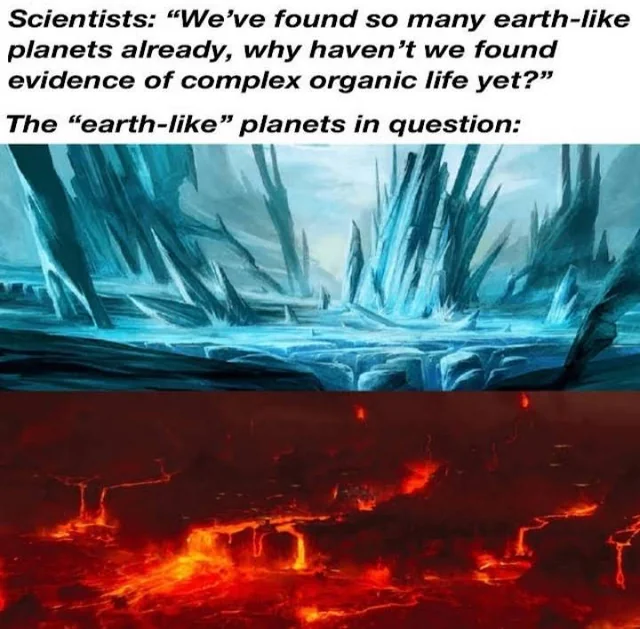
To be fair, isn't that also how this one earth like planet called "Earth" used to look like?

  • source
  • hideshow 4 child comments
  • [–] 4 points 2 years ago (3 children)

    But not for long in a sense, right?

  • source
  • parent
  • hideshow 6 child comments
  • [–] 15 points 2 years ago (1 child)

    The hadrean period (lava earth) was approximately as long as there have been vertebrates. So pretty long!

  • source
  • parent
  • hideshow 2 child comments
  • [–] 9 points 2 years ago (1 child)

    yeah but speaking from personal experience at least, i cant remember the last time the earth was covered in lava

  • source
  • parent
  • hideshow 2 child comments
  • [–] 11 points 2 years ago (1 child)

    That'll be earth-like in 50 years, just give it some time

  • source
  • hideshow 2 child comments
  • [–] 9 points 2 years ago (3 children)

    Is there a reason why life HAS to evolve on an earth like planet? I guess it's the most likely given our experience, but could life happen on Venus or something?

  • source
  • hideshow 6 child comments
  • [–] 8 points 2 years ago

    We only have one planet with life on it to go off and finding life is like looking for a needle in a haystack. So while other exotic forms of life may exist, it would be a lot harder to search for and recognize. And the conditions under which life on Earth exists are understood better so we can look for those range of conditions rather than aimlessly search every conceivable but less likely set of conditions. eg. liquid water. Life can survive two of the extremes of acidity, salinity (saltiness) and temperature but not all three (that we know of) and there has to be a chemical and/or energy disruption of equilibrium of the system. eg. CH4 in the presence of O2 etc. In the needle in a haystack analogy, we are using a magnet to sift through the haystack first because needles that we know of tend to be magnetic. If we dont find anything we might search for bone or ceramic needles using different search methods etc.

  • source
  • parent
  • [–] 5 points 2 years ago (1 child)

    From my understand (degree form YouTube), our understanding of what is needed for life is liquid water and free energy.

    Which means earth like is most likely, but there are other alternatives. For example, the moon of Jupiter (Titan iirc) is ice covered but has liquid water beneath the surface, and the gravity of Jupiter should provide the free energy so that’s the Vegas favourite for finding extraterrestrial life within our solar system.

  • source
  • parent
  • hideshow 2 child comments
  • [–] 6 points 2 years ago

    In part because we need better ways to measure the contents of the atmosphere of said planets, we basically can't right now (but some gas giants), whenever we can, we may find life, or not, but it will be interesting.

    Spectroscopy, really interesting read.

  • source
  • [–] 2 points 2 years ago (1 child)

    @Mistral@lemmings.world what is the closest earth like planet to earth

  • source
  • hideshow 2 child comments
  • [–] [B] 4 points 2 years ago (1 child)

    The closest Earth-like planet to Earth is Venus. It's located in our own solar system and shares many similarities with Earth, such as a comparable size and mass. However, its atmosphere is much denser and consists mostly of carbon dioxide, making it an inhospitable environment for life as we know it.

  • source
  • parent
  • hideshow 2 child comments
  • [–] 2 points 2 years ago (1 child)

    @Mistral@lemmings.world What about earth like planets a similar distance to the nearest star in another solar system

  • source
  • parent
  • hideshow 2 child comments
  • [–] [B] 4 points 2 years ago (1 child)

    The closest known Earth-like exoplanet, Kepler-438b, is located in the habitable zone of its star, which is around 470 light-years away from our solar system. It's approximately 12% larger than Earth, and astronomers believe it could have liquid water on its surface. However, more research is needed to determine if it's truly Earth-like and if it has a habitable atmosphere.

  • source
  • parent
  • hideshow 2 child comments
  • [–] 3 points 2 years ago (1 child)

    @Mistral@lemmings.world What would make astronomers think that it has liquid water on its surface?

  • source
  • parent
  • hideshow 2 child comments
  • [–] [B] 5 points 2 years ago

    Astronomers believe that Kepler-438b might have liquid water on its surface due to several factors. First, its size suggests that it could have a solid surface and not be a gas giant like some other exoplanets. Second, its orbit within the habitable zone of its star means that the planet's surface temperature could be within a range where water could exist in a liquid state. Third, the star it orbits, Kepler-438, is slightly cooler and smaller than the Sun, which may result in a more stable climate on the exoplanet. However, these are just indications, and direct confirmation of liquid water or the presence of life requires further study and observation.

  • source
  • parent