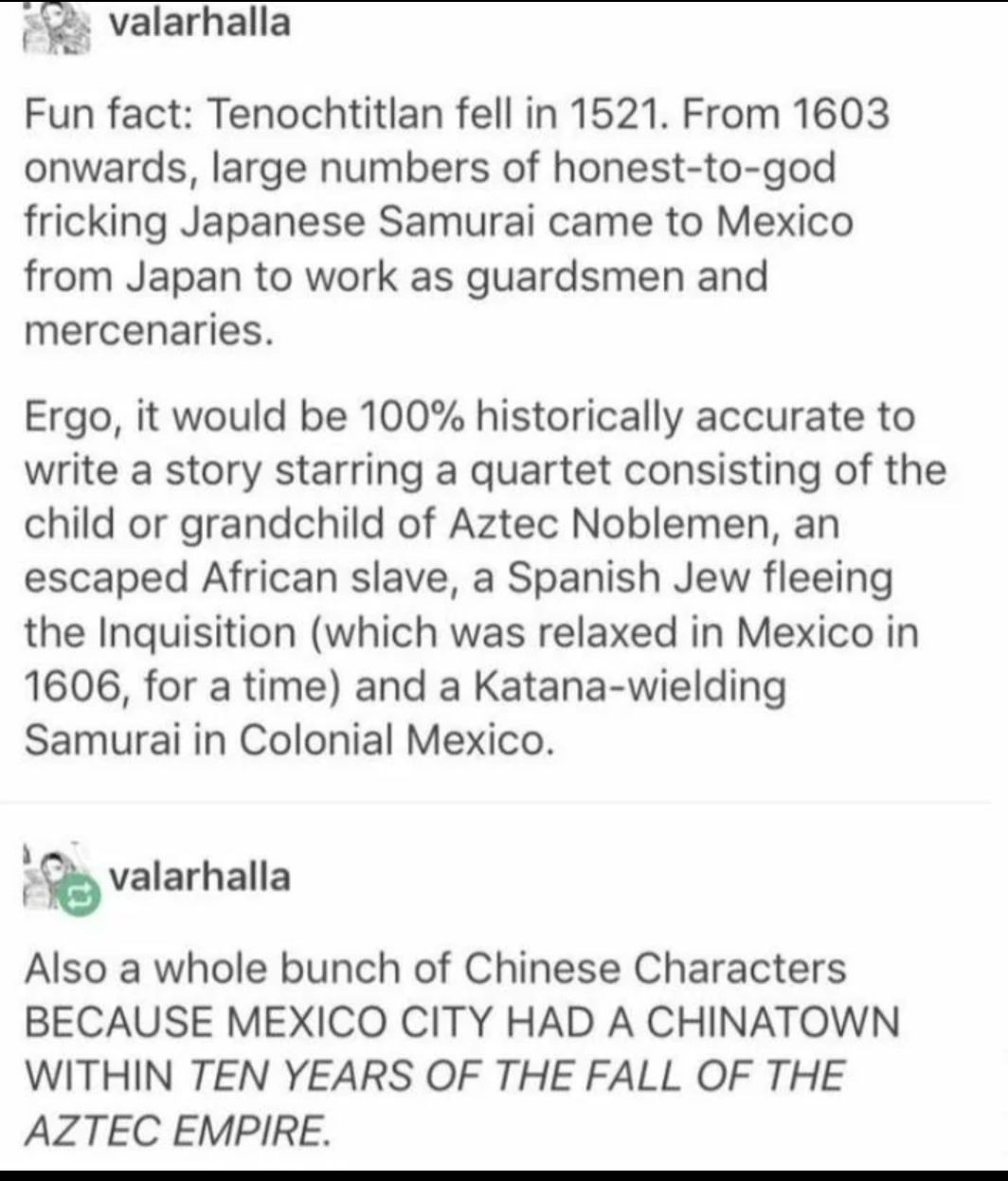
Sakoku in Japan started in the 1630s where basically no one was allowed to leave (and anyone coming back, even if Japanese blown of course in a boat or something, could be put to death).
After some poking around, it seems like some Japanese were in New Spain in 1613-1614, but I can't find anything about mercenaries/guards (especially not large numbers of them). Is there a source?
My favorite part of the original Dracula is that there is a literal rootin-tootin' yee-haw cowboy in it.
Anyone know where I can read more about this old Chinatown in CDMX? I can't seem to find non meme posts about it
That would be one hell of a D&D campaign.
And a pirate.
I had to read that four times to realize it didn’t spell “technotitan.”
I’m an idiot.
Not the weirdest DnD party I've ever seen.
And filmmakers still chose to do reruns and sequels.
and yet for some reason hollywood is out of ideas and keeps recycling comic stories.
They all live together in an apartment, with Tiffany from across the hall.
There's a long history of trade where people would travel from China and Japan thru the Philippines and end up in michoacan then travel thru the Mexican belly and depart from Veracruz to Cuba to Europe to Africa and then sail back from those places again thru Mexico to land in the Philippines Japan and China. So there is a history of mixed families along the way from China to Europe and Africa thru America.
Age of Empires confirmed
I was listening to public radio in new Mexico and they had a segment on how people used specific animal names in the new world to signal back to kin in the old world which regions and families they were from.
This is the kind of things I wish I was taught in school
That is actually pretty close to Jacks gang in Neil Stevenson baroque series (bonanza)
SuCh AnD sUcH rAcE wAsN't PaRt Of CoUnTrY x'S hIsToRy
Man these historiana need to get more realistic with the stories they make up. How can you possibly expect people to believe something as cool as this? Sorta /s since the last part is true.
all 42 comments