cross-posted from: https://slrpnk.net/post/24690127

Solar energy experts in Germany are putting sun-catching cells under the magnifying glass with astounding results, according to multiple reports.

The Fraunhofer Institute for Solar Energy Systems team is perfecting the use of lenses to concentrate sunlight onto solar panels, reducing size and costs while increasing performance, Interesting Engineering and PV Magazine reported.

The "technology has the potential to contribute to the energy transition, facilitating the shift toward more sustainable and renewable energy sources by combining minimal carbon footprint and energy demand with low levelized cost of electricity," the researchers wrote in a study published by the IEEE Journal of Photovoltaics.

The sun-catcher is called a micro-concentrating photovoltaic, or CPV, cell. The lens makes it different from standard solar panels that convert sunlight to energy with average efficiency rates around 20%, per MarketWatch. Fraunhofer's improved CPV cell has an astounding 36% rate in ideal conditions and is made with lower-cost parts. It cuts semiconductor materials "by a factor of 1,300 and reduces module areas by 30% compared to current state-of-the-art CPV systems," per IE.

top 50 comments

sorted by: hot top controversial new old
[–] 61 points 1 year ago (1 child)

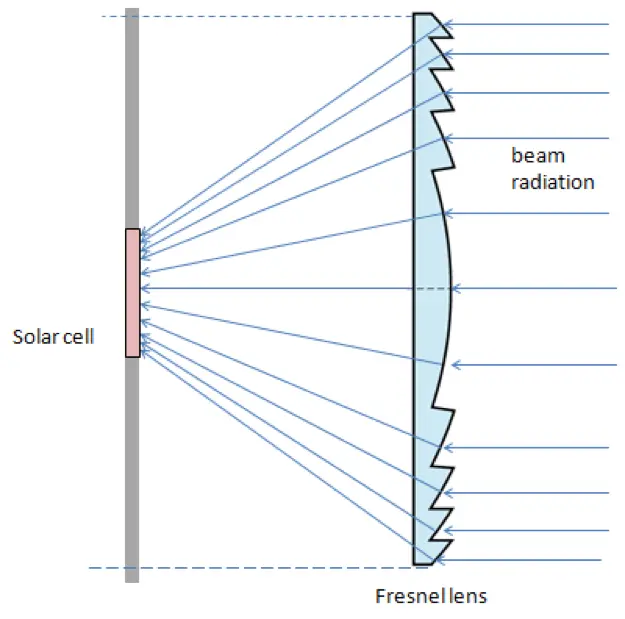
What are concentrating photovoltaics? One of the ways to increase the output from the photovoltaic systems is to supply concentrated light onto the PV cells. This can be done by using optical light collectors, such as lenses or mirrors. The PV systems that use concentrated light are called concentrating photovoltaics (CPV). The CPV collect light from a larger area and concentrate it to a smaller area solar cell. This is illustrated in Figure 5.1.
Also, from the article - 33.6% efficiency in real-world conditions:

A 60 cell-lens prototype was studied for a year. In "real-world" conditions, CPVs achieved up to 33.6% efficiency. The 36% mark was posted at 167 degrees Fahrenheit. The prototype showed no signs of degradation, according to IE.

  • source
  • hideshow 2 child comments
  • [–] 46 points 1 year ago* (8 children)

    A lighthouse uses the same lens, just with the light coming from the inside. Since this is old knowledge, what is the drawback? Why isn't this widespread?

    My completely uninformed guess:

    • The lens and assembly costs too much compared to just more solar panels

    • The lens/panel combo is so bulky/prone to failure it becomes unreasonable to actually install/use.

  • source
  • parent
  • hideshow 12 child comments
  • [–] 34 points 1 year ago (1 child)

    Adding to what Eldest_Malk said: They aren't just putting a new type of lens over standard solar cells, they are also designing/fabricating custom cells to work with the lenses. [I'm not a PV expert, but the fact that the IEEE paper focuses so much on the cells and not just the lenses leads me to believe that the lenses can't just be used with whatever standardized solar cells are on the market]

  • source
  • parent
  • hideshow 1 child comment
  • load more comments (1 reply)
  • [–] 17 points 1 year ago

    They mention standardisations and cost savings in their paper, as well as solving the heat load per cell problem by decreasing cell size. They also mention that there's been a lot of micro-CPV module designs but that they haven't been scaled up. Some quotes below:

    Various researchers and developers have been exploring different micro-CPV module designs [5], [6], [7], [8], [9], [10], [11], [12], [13]. Most approaches have been tested on small prototypes or minimodules, while fewer have been realized with aperture areas (Aap) above 200 and 800 cm2,[...]

    By decreasing the sizes of the primary optics and the solar cells, the heat load per cell is minimized. This reduction allows for sufficient heat spreading via the circuit board, enabling the direct assembly of solar cells onto the circuit board on glass.

    At Fraunhofer ISE, we have developed a micro-CPV module concept [17], [18], [19], [20], [21], which is based on parallelized manufacturing processes and commercially available components.

    The final module features a panel size of 24” × 18”, which is a standard in the microelectronics industry, facilitating machine adaption without necessitating special adjustments.

  • source
  • parent
  • [–] 11 points 1 year ago (1 child)

    The article states that it’s smaller and cheaper. The reason it’s not widespread is that they just invented it.

  • source
  • parent
  • hideshow 2 child comments
  • [–] 9 points 1 year ago (2 children)

    It is interesting that someone just recently thought to use a fresnel lens with photovoltaics when they’ve existed for hundreds of years

  • source
  • parent
  • hideshow 3 child comments
  • [–] 18 points 1 year ago

    It isn't that. They have been talking about Fresnel lenses on PV for decades. It's solving the heat issue and the size issue. A Fresnel lens gathers a large area of light and focuses it down, including focusing the heat. Normal PV cells cannot handle that amount of heat.

  • source
  • parent
  • load more comments (1 reply)
  • load more comments (4 replies)
  • [–] 48 points 1 year ago (2 children)

    Wait for something fucking idiotic like:

    "U.S. government to implement 5,000% tax on new solar technology...."

  • source
  • hideshow 4 child comments
  • [–] 44 points 1 year ago

    The only thing slowing down the transition from fossil fuels to renewables is the same impediment it has always been: oil money protecting itself.

  • source
  • [–] 34 points 1 year ago (5 children)

    I am not a scientist so please correct me if I am off base, but did it really take them this long to attempt to focus light onto PV cells using a fresnel lens?

    My hobby as a 15 year old was buying broken projectors to harvest the fresnel lenses in the lamp on top. They could focus sunlight so powerfully that you could burn shit. I didn't do that, surprisingly. I was like Marge Simpson, I just thought they were neat.

  • source
  • hideshow 9 child comments
  • [–] 20 points 1 year ago (1 child)

    OK, take that Fresnel lens that you were using to melt pennies and then focus it on a PV cell that is also made of metal. What might be the expected response? The science in this case is making PV cells that can handle the intense heat.

  • source
  • parent
  • hideshow 2 child comments
  • [–] 17 points 1 year ago*

    That makes sense. If I understood everyone clearly, it's not the idea to use a fresnel that's new here, it's the fact that we just haven't yet had anything capable of withstanding those temperatures and still allowing for the piezoelectric effect to happen.

  • source
  • parent
  • [–] 6 points 1 year ago

    Not being any kind of solar energy expert, my initial thought was how the cell’s would hold up under the increased heat, and what technology (if any) they’d be using to monitor/mitigate. The article does briefly mention the cells achieving ~33% @ ~167° F, and does mention (what seems to be tangential) technologies that allow for cells to be nailed down as if they were shingles.

    My guess is that it isn’t that they finally using techniques that seem obvious to us, but that they’ve developed supporting tech to mitigate the detrimental effects of using magnification.

  • source
  • parent
  • load more comments (1 reply)
    [–] 29 points 1 year ago (4 children)

    Solar panels are already quite cheap. What we need is much cheaper grid forming inverters so we can stop destabilizing the grid with solar.

  • source
  • hideshow 5 child comments
  • [–] 19 points 1 year ago* (last edited 1 year ago)

    If the cost of panels drops significantly, there would be more capital available to spend on inverters, even if they stay at the current prices, still decreasing the cost of deployment. But yes. 😄

  • source
  • parent
  • load more comments (3 replies)
    [–] 28 points 1 year ago* (6 children)

    I'm not sure what to think about the Fraunhofer institute in general. They have made some nice discoveries/inventions in the past, such as audio compression algorithms and such. That is why i hyped them for a bit.

    But they really disappointed me with their writings on solar panels in the past few years.

    They said that the efficiency of solar panels today is too low to deploy them widely in practice, which is simply not true. They tried pushing Perovskite solar cells for no reason.

    I'm not sure what to think about this article's idea. On one hand, adding lenses to solar parks makes them significantly more complicated and therefore expensive to build. Also, if the parks have complicated physical forms, they're more susceptible to wind, and that could damage them.

    On the other hand, yes, adding lenses means you need fewer actual solar panels for the same amount of energy harvested.

    I'll therefore put it in the category of inconclusive inventions, together with the idea of adding a motor to the solar panels so they can track the sun. That would also make the solar panels more efficient, but also more complicated and more prone to mechanical failure.

  • source
  • hideshow 7 child comments
  • load more comments (5 replies)
    [–] 25 points 1 year ago (13 children)

    https://ieeexplore.ieee.org/document/10938951

    This is 36% MODULE efficiency with expensive cooling. 30% actual year long efficiency without it. Requires dual axis tracking. Seems heavy as its very tall/deep.

    Headline of cost reduction is very unlikely. Especially on a per acre/fairly large area basis. Dual axis tracking requires more spacing than fixed orientation rows, and loses benefits under cloudy conditions. While power at 7am and 5pm is more valuable when competing against high penetration solar, batteries are now more competitive than tracking, and can serve edge of day and night power needs. Tracking solar tends not to be built anymore, due to low cost of panels. The cooling infrastructure is also not as useful as it is on rooftops because the heat capture has useful benefits for homes.

    It is also unclear how this has advantage over parabolic mirror.

    Agri PV is a real use case, where more free land means more land use, even if most of it gets more shade, except around noon.

  • source
  • hideshow 13 child comments
  • load more comments (13 replies)
    [–] 21 points 1 year ago (1 child)

    "The lens makes it different from standard solar panels that convert sunlight to energy with average efficiency rates around 20%, per MarketWatch. Fraunhofer's improved CPV cell has an astounding 36% rate in ideal conditions"

    Why would I want to compare one panel's average efficiency to another panels efficiency in ideal conditions?

  • source
  • hideshow 2 child comments
  • [–] 18 points 1 year ago (2 children)

    They need changes in laws too. Instead of chewing up open space and farmland I'd rather see more urban areas used like parking lots and industrial sites.

  • source
  • hideshow 4 child comments
  • [–] 11 points 1 year ago* (1 child)

    Roughly 50% of germany is used as farmland. On 60% of the farmland crops to feed livestock are grown. On 20% of it crops for energyproduction (biofuel, biogas). If you take for example rapeseeds, used for biodiesel, you would harvest around 50 times as much energy with a pv-plant on the same area. You would need to install pv on 5-6% of the farmland to produce enough electric energy for all of germany for a year. Granted you also can provide the grid for it and enoguh storage.

  • source
  • parent
  • hideshow 2 child comments
  • [–] 18 points 1 year ago (1 child)

    Remember gang, stuff like this means 10-15 years before you see it in market.

  • source
  • hideshow 2 child comments
  • [–] 11 points 1 year ago (2 children)

    What was the stuff like this of 15 years ago ?

  • source
  • parent
  • hideshow 3 child comments
  • load more comments (1 reply)
  • [–] 13 points 1 year ago

    Banned in North America in 3... 2...

  • source
  • [–] 12 points 1 year ago (1 child)

    If I had a penny for every time I heard about new advancements about to revolutionise solar panel technology, I'd have glazed the bloody Sahara with them by now.

  • source
  • hideshow 2 child comments
  • [–] 12 points 1 year ago (4 children)

    Hey it's those guys that invented MP3s.

  • source
  • hideshow 5 child comments
  • load more comments (3 replies)
    [–] 10 points 1 year ago (1 child)

    Oh don't worry, I'm sure the capitalist system will manage to fuck it up somehow.

  • source
  • hideshow 2 child comments
  • [–] 10 points 1 year ago

    I thought this has already been done. Guess there's some nuance to it that is above my understanding of it.

    Anyhow, advancements in solar are cool in my book.

  • source
  • [–] 9 points 1 year ago (1 child)

    is it a real thing or an obligatory overestimated result to get grants because the system is fucked?

  • source
  • hideshow 2 child comments
  • [–] 13 points 1 year ago (6 children)

    I just skimmed the IEEE paper (peer-reviewed, solid journal); The usage of 'slash costs' in the title is entire sensational. The tech gave a SLIGHT increase in efficiency (which is good news - marginal improvements are still very good and can be game-changing if scaled up), but there is no cost/benefit analysis in the paper regarding the additional costs of lenses and whether the increased PV efficiency would offset those costs at scale.

  • source
  • parent
  • hideshow 6 child comments
  • load more comments (6 replies)
  • [–] 7 points 1 year ago (3 children)

    Wouldn't this be negated by the fact, that the same area of roof now has less actual PV cell on it? Since the light gets concentrated on a smaller area?

  • source
  • hideshow 4 child comments
  • [–] 16 points 1 year ago (1 child)

    I think the idea is that it’s the same amount of light is being used but the actual expensive part of the solar cell is cheaper and designed to take the increased heat. So the same size “solar unit” on the roof collecting the same amount of light and generating the same amount of energy but cheaper overall. At least that was my take. Correct me if I’m wrong.

  • source
  • parent
  • hideshow 1 child comment
  • load more comments (1 reply)
  • load more comments (2 replies)
    [–] 7 points 1 year ago

    That is Fraunhofer who are the people most responsible for developing MP3

  • source
  • [–] 6 points 1 year ago

    US Government - not on my watch....

  • source
  • load more comments
    view more: next ›