top 50 comments

sorted by: hot top controversial new old
[–] 62 points 2 years ago (1 child)
  • [–] 38 points 2 years ago (1 child)
  • [–] 73 points 2 years ago (2 children)
  • [–] 41 points 2 years ago (1 child)
  • [–] 25 points 2 years ago (1 child)
  • [–] 10 points 2 years ago (1 child)

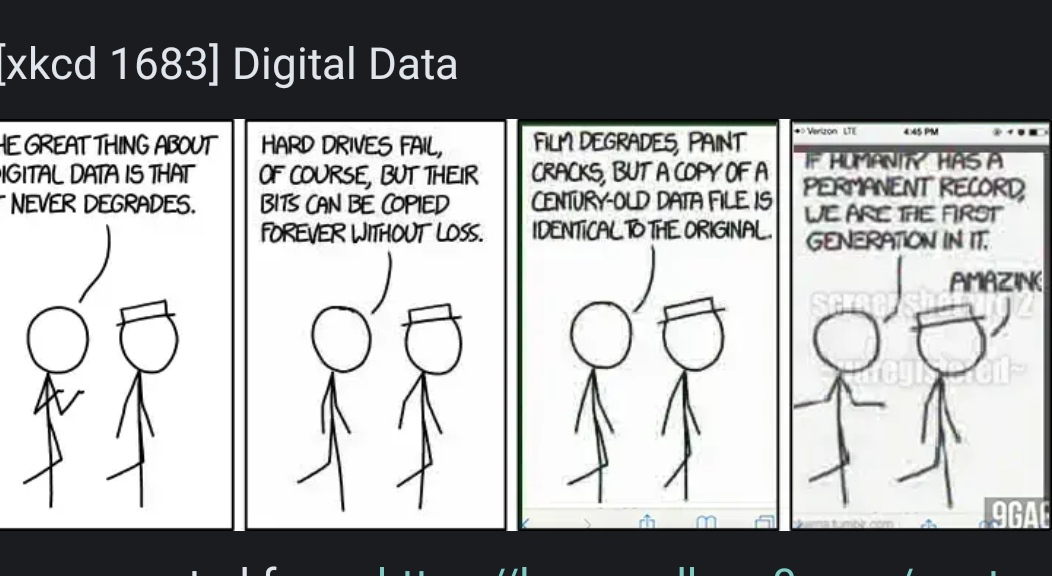
    Hey check this cool meme out!

  • source
  • parent
  • hideshow 2 child comments
  • [–] 50 points 2 years ago (1 child)
  • [–] 22 points 2 years ago* (1 child)

    I've always thought that argument only works as long as data is free or close to free. Once it incurs a cost, I think copies end up getting removed. I think it's fundamentally flawed to say the internet will never forget.

  • source
  • hideshow 2 child comments
  • [–] 19 points 2 years ago (1 child)

    Ironically this is original data we are viewing now.

  • source
  • hideshow 2 child comments
  • [–] 7 points 2 years ago (1 child)

    Well it wasn't even posted on your instance, so you're already just viewing a thirdhand copy of it

  • source
  • parent
  • hideshow 2 child comments
  • [–] 6 points 2 years ago (1 child)

    Despite that its still the same actual bits of data

  • source
  • parent
  • hideshow 2 child comments
  • [–] 16 points 2 years ago (1 child)

    Well, for thot pics, there’s always more jpeg. For everything else, there’s lossless data formats.

  • source
  • hideshow 2 child comments
  • [–] 13 points 2 years ago (4 children)

    Even with jpeg, you only lose data each time it's encoded. If you save the file instead of taking a screenshot, the quality remains the same.

    That said, I don't know if there's a digital storage method widely used that will last longer than a book without some sort of active aspect to the storage (like copying the files to a new medium every now and then).

    I think punch cards are one that can, but they aren't used much anymore due to poor density and speed, plus being susceptible to literal bugs. It's possible to encode digital information into carved rock, but that would also have density issues (higher density means less reliability because the amount of damage required to make it unreadable is lower).

    I think there's a good chance that a lot of the knowledge we have today could be lost entirely if civilization collapses to a certain degree just due to how we store it.

  • source
  • parent
  • hideshow 8 child comments
  • [–] 3 points 2 years ago (2 children)

    You’re right, the format’s integrity is only as good as the medium upon which it’s stored. Hard disks are really only good for a few decades if left untouched. Punchcards maybe a few thousand years if sealed up well.

    The β€œactive aspect” you mentioned is the key. There are file storage systems which employ regenerative error correction to achieve exactly this sort of desired outcome. I use one on my home server called ZFS. It was originally developed by Sun Microsystems and works great. The only catch is that there is a limit to the number of drives in your storage array which can fail before data becomes unrecoverable. So, you have to be constantly vigilant, and if a drive is starting to go, replace it before a potential worst case scenario of cascade failure.

    Unfortunately, I don’t know of a way we could store something indefinitely without this kind of active monitoring and occasional TLC. If a sort of caretaker is required, this might be a good job for AI with real world robotic hooks - have it monitor the array and fabricate replacement drives for installation as needed.

  • source
  • parent
  • hideshow 2 child comments
  • load more comments (2 replies)
  • [–] 15 points 2 years ago

    Good luck finding the raw original video of anything these days. The amount of 3gp an rm files that used to float around compared to the reactionary emoji text bs you see today. Get off my lawn.

  • source
  • [–] 14 points 2 years ago (2 children)

    Trying not to spoil it but this is a plot point in a relatively famous, relatively recent sci-fi book, where the characters need to record a warning that lasts for millennia. They end up carving it into the rock of Pluto since all other data mediums would fail over that timespan.

  • source
  • hideshow 4 child comments
  • [–] 13 points 2 years ago (2 children)

    Only downside is that only data that people care about right now is being saved. But what seems useless now might become valuable in the future. It's hard to grasp how much data has been forgotten on some old computers, or some CDs, or websites that have gone dark.

  • source
  • hideshow 4 child comments
  • [–] 4 points 2 years ago

    I really hope the Internet Archive survive their lawsuits. They're important not just for archival of websites (the Wayback Machine) but also of books, audio recordings, etc. There's a large amount of old content that's only archived at the Internet Archive.

  • source
  • parent
  • [–] 11 points 2 years ago (2 children)

    About that... we could record someone's every word and different people would read entirely different things into it. Consider how strangers have reacted to your own internet comments.

  • source
  • hideshow 4 child comments
  • [–] 8 points 2 years ago (2 children)
  • [–] 4 points 2 years ago (2 children)

    Storing data for decades or even centuries is a difficult thing. But the problem isn't the storage it's the data format!

    Who knows if a person 300 years from now has a program that can open .png or .jpg? Or the dreaded .doc and .xls that even Microsoft has problems with today. This poor future fellow probably won't have the capatibilities and might need a few years or decades to develop a reader app.

  • source
  • hideshow 3 child comments
  • load more comments (1 reply)
    [–] 2 points 2 years ago

    I like how /u/gofsckyourself didn’t show up with a higher quality version.

  • source
  • [–] 2 points 2 years ago (3 children)

    See, that's why I started using JPEG-XL for long-term storage. Apart from being better in every aspect for lossless and near-lossless still images than any competitor, the generation loss even over 1000 lossy save and load cycles is negligible.

  • source
  • hideshow 3 child comments
  • load more comments (3 replies)
    [+] 1 point 2 years ago
    load more comments
    view more: next β€Ί