▲ 587 ▼ 50% survival rate (sh.itjust.works) submitted 2 years ago by sjmarf@sh.itjust.works to c/science_memes@mander.xyz 74 comments fedilink hide all child comments
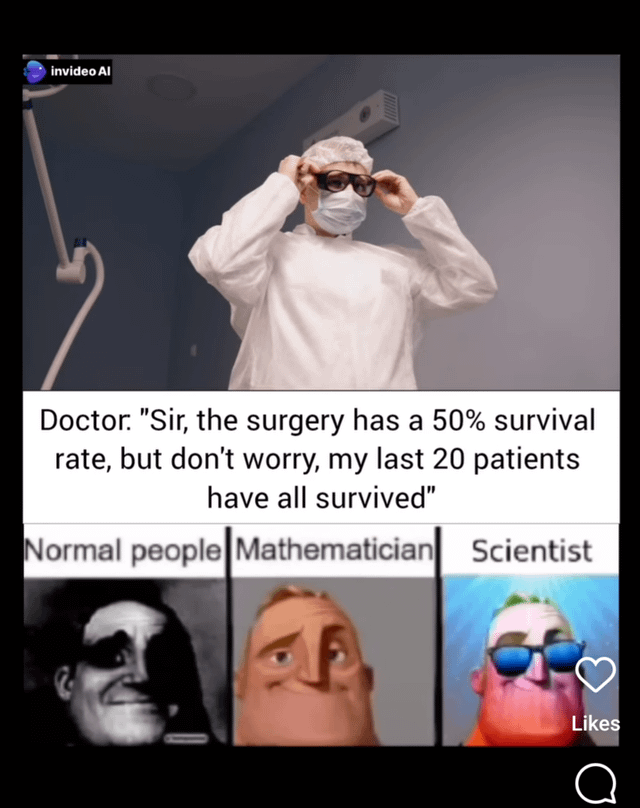
[–] Deconceptualist@lemm.ee 49 points 2 years ago (2 children) Can somebody explain the difference between the mathematician and the scientist parts of this? permalink fedilink source hideshow 4 child comments replies: [–] sjmarf@sh.itjust.works [S] 206 points 2 years ago* (2 children) The normal person thinks that because the last 20 people survived, the next patient is very likely to die. The mathematician considers that the probability of success for each surgery is independent, so in the mathematician’s eyes the next patient has a 50% chance of survival. The scientist thinks that the statistic is probably gathered across a large number of different hospitals. They see that this particular surgeon has an unusually high success rate, so they conclude that their own surgery has a >50% chance of success. permalink fedilink source parent hideshow 4 child comments replies: [–] Deconceptualist@lemm.ee 59 points 2 years ago (2 children) Thanks. I suspect a mathematician would consider the latter point too though. permalink fedilink source parent hideshow 4 child comments replies: [+] x00za@lemmy.dbzer0.com 17 points 2 years ago* (last edited 2 years ago) (2 children) [removed by mod] permalink fedilink source parent hideshow 4 child comments replies: [–] meep_launcher@lemm.ee 19 points 2 years ago* (last edited 2 years ago) (1 child) And me mate paul permalink fedilink source parent hideshow 2 child comments replies: [–] SaharaMaleikuhm@feddit.org 9 points 2 years ago (1 child) My aunt Nancy would surely be in the 50% who die permalink fedilink source parent hideshow 2 child comments replies: [–] RogueBanana@lemmy.zip 2 points 2 years ago Would be or do you want her to be? Sound like aunt Nancy isn't very nice. permalink fedilink source parent [–] RecluseRamble@lemmy.dbzer0.com 16 points 2 years ago (1 child) The popularity of casinos and lotteries say otherwise. permalink fedilink source parent hideshow 2 child comments replies: [–] cazssiew@lemmy.world 6 points 2 years ago* Someone who goes to casinos would come to the same conclusion, thinking that the surgeon is 'running hot'. permalink fedilink source parent [–] arefx@lemmy.ml 6 points 2 years ago* (1 child) Anyone with a good high school education should understand this. permalink fedilink source parent hideshow 2 child comments replies: [–] Deconceptualist@lemm.ee 1 point 2 years ago That's sort of why I asked. I thought I was missing something but no, the meme is apparently assuming academic professionals are dummies. Not to say that we should expect nuance and robust portrayals from a meme. permalink fedilink source parent [+] GoodEye8@lemm.ee -2 points 2 years ago (1 child) [deleted] permalink fedilink source parent hideshow 2 child comments replies: [–] sjmarf@sh.itjust.works [S] 5 points 2 years ago (1 child) Or do think there's something special about the person that makes them flip tails more often? Yes, that’s the conclusion that the scientist has come to. The chance of getting 20 in a row is so extraordinarily unlikely that it’s reasonable to conclude that the chance is not 50/50 for that particular surgeon. permalink fedilink source parent hideshow 2 child comments replies: [+] GoodEye8@lemm.ee 0 points 2 years ago* [deleted] permalink fedilink source parent [–] finitebanjo@lemmy.world 15 points 2 years ago* (last edited 2 years ago) Mathematician sees each individual outcome as independent 50% chance. Scientist realises that the distribution of failures and successes puts him in a favorable position. e.g. for the 20 in a row to be a success in a 50% fail rate that means the previous 20 were all failures or some similar circumstances where the success rate rose over time or similar polarization of outcomes in the sample data which places them above average odds. permalink fedilink source parent
[–] sjmarf@sh.itjust.works [S] 206 points 2 years ago* (2 children) The normal person thinks that because the last 20 people survived, the next patient is very likely to die. The mathematician considers that the probability of success for each surgery is independent, so in the mathematician’s eyes the next patient has a 50% chance of survival. The scientist thinks that the statistic is probably gathered across a large number of different hospitals. They see that this particular surgeon has an unusually high success rate, so they conclude that their own surgery has a >50% chance of success. permalink fedilink source parent hideshow 4 child comments replies: [–] Deconceptualist@lemm.ee 59 points 2 years ago (2 children) Thanks. I suspect a mathematician would consider the latter point too though. permalink fedilink source parent hideshow 4 child comments replies: [+] x00za@lemmy.dbzer0.com 17 points 2 years ago* (last edited 2 years ago) (2 children) [removed by mod] permalink fedilink source parent hideshow 4 child comments replies: [–] meep_launcher@lemm.ee 19 points 2 years ago* (last edited 2 years ago) (1 child) And me mate paul permalink fedilink source parent hideshow 2 child comments replies: [–] SaharaMaleikuhm@feddit.org 9 points 2 years ago (1 child) My aunt Nancy would surely be in the 50% who die permalink fedilink source parent hideshow 2 child comments replies: [–] RogueBanana@lemmy.zip 2 points 2 years ago Would be or do you want her to be? Sound like aunt Nancy isn't very nice. permalink fedilink source parent [–] RecluseRamble@lemmy.dbzer0.com 16 points 2 years ago (1 child) The popularity of casinos and lotteries say otherwise. permalink fedilink source parent hideshow 2 child comments replies: [–] cazssiew@lemmy.world 6 points 2 years ago* Someone who goes to casinos would come to the same conclusion, thinking that the surgeon is 'running hot'. permalink fedilink source parent [–] arefx@lemmy.ml 6 points 2 years ago* (1 child) Anyone with a good high school education should understand this. permalink fedilink source parent hideshow 2 child comments replies: [–] Deconceptualist@lemm.ee 1 point 2 years ago That's sort of why I asked. I thought I was missing something but no, the meme is apparently assuming academic professionals are dummies. Not to say that we should expect nuance and robust portrayals from a meme. permalink fedilink source parent [+] GoodEye8@lemm.ee -2 points 2 years ago (1 child) [deleted] permalink fedilink source parent hideshow 2 child comments replies: [–] sjmarf@sh.itjust.works [S] 5 points 2 years ago (1 child) Or do think there's something special about the person that makes them flip tails more often? Yes, that’s the conclusion that the scientist has come to. The chance of getting 20 in a row is so extraordinarily unlikely that it’s reasonable to conclude that the chance is not 50/50 for that particular surgeon. permalink fedilink source parent hideshow 2 child comments replies: [+] GoodEye8@lemm.ee 0 points 2 years ago* [deleted] permalink fedilink source parent
[–] Deconceptualist@lemm.ee 59 points 2 years ago (2 children) Thanks. I suspect a mathematician would consider the latter point too though. permalink fedilink source parent hideshow 4 child comments replies: [+] x00za@lemmy.dbzer0.com 17 points 2 years ago* (last edited 2 years ago) (2 children) [removed by mod] permalink fedilink source parent hideshow 4 child comments replies: [–] meep_launcher@lemm.ee 19 points 2 years ago* (last edited 2 years ago) (1 child) And me mate paul permalink fedilink source parent hideshow 2 child comments replies: [–] SaharaMaleikuhm@feddit.org 9 points 2 years ago (1 child) My aunt Nancy would surely be in the 50% who die permalink fedilink source parent hideshow 2 child comments replies: [–] RogueBanana@lemmy.zip 2 points 2 years ago Would be or do you want her to be? Sound like aunt Nancy isn't very nice. permalink fedilink source parent [–] RecluseRamble@lemmy.dbzer0.com 16 points 2 years ago (1 child) The popularity of casinos and lotteries say otherwise. permalink fedilink source parent hideshow 2 child comments replies: [–] cazssiew@lemmy.world 6 points 2 years ago* Someone who goes to casinos would come to the same conclusion, thinking that the surgeon is 'running hot'. permalink fedilink source parent [–] arefx@lemmy.ml 6 points 2 years ago* (1 child) Anyone with a good high school education should understand this. permalink fedilink source parent hideshow 2 child comments replies: [–] Deconceptualist@lemm.ee 1 point 2 years ago That's sort of why I asked. I thought I was missing something but no, the meme is apparently assuming academic professionals are dummies. Not to say that we should expect nuance and robust portrayals from a meme. permalink fedilink source parent
[+] x00za@lemmy.dbzer0.com 17 points 2 years ago* (last edited 2 years ago) (2 children) [removed by mod] permalink fedilink source parent hideshow 4 child comments replies: [–] meep_launcher@lemm.ee 19 points 2 years ago* (last edited 2 years ago) (1 child) And me mate paul permalink fedilink source parent hideshow 2 child comments replies: [–] SaharaMaleikuhm@feddit.org 9 points 2 years ago (1 child) My aunt Nancy would surely be in the 50% who die permalink fedilink source parent hideshow 2 child comments replies: [–] RogueBanana@lemmy.zip 2 points 2 years ago Would be or do you want her to be? Sound like aunt Nancy isn't very nice. permalink fedilink source parent [–] RecluseRamble@lemmy.dbzer0.com 16 points 2 years ago (1 child) The popularity of casinos and lotteries say otherwise. permalink fedilink source parent hideshow 2 child comments replies: [–] cazssiew@lemmy.world 6 points 2 years ago* Someone who goes to casinos would come to the same conclusion, thinking that the surgeon is 'running hot'. permalink fedilink source parent
[–] meep_launcher@lemm.ee 19 points 2 years ago* (last edited 2 years ago) (1 child) And me mate paul permalink fedilink source parent hideshow 2 child comments replies: [–] SaharaMaleikuhm@feddit.org 9 points 2 years ago (1 child) My aunt Nancy would surely be in the 50% who die permalink fedilink source parent hideshow 2 child comments replies: [–] RogueBanana@lemmy.zip 2 points 2 years ago Would be or do you want her to be? Sound like aunt Nancy isn't very nice. permalink fedilink source parent
[–] SaharaMaleikuhm@feddit.org 9 points 2 years ago (1 child) My aunt Nancy would surely be in the 50% who die permalink fedilink source parent hideshow 2 child comments replies: [–] RogueBanana@lemmy.zip 2 points 2 years ago Would be or do you want her to be? Sound like aunt Nancy isn't very nice. permalink fedilink source parent
[–] RogueBanana@lemmy.zip 2 points 2 years ago Would be or do you want her to be? Sound like aunt Nancy isn't very nice. permalink fedilink source parent
[–] RecluseRamble@lemmy.dbzer0.com 16 points 2 years ago (1 child) The popularity of casinos and lotteries say otherwise. permalink fedilink source parent hideshow 2 child comments replies: [–] cazssiew@lemmy.world 6 points 2 years ago* Someone who goes to casinos would come to the same conclusion, thinking that the surgeon is 'running hot'. permalink fedilink source parent
[–] cazssiew@lemmy.world 6 points 2 years ago* Someone who goes to casinos would come to the same conclusion, thinking that the surgeon is 'running hot'. permalink fedilink source parent
[–] arefx@lemmy.ml 6 points 2 years ago* (1 child) Anyone with a good high school education should understand this. permalink fedilink source parent hideshow 2 child comments replies: [–] Deconceptualist@lemm.ee 1 point 2 years ago That's sort of why I asked. I thought I was missing something but no, the meme is apparently assuming academic professionals are dummies. Not to say that we should expect nuance and robust portrayals from a meme. permalink fedilink source parent
[–] Deconceptualist@lemm.ee 1 point 2 years ago That's sort of why I asked. I thought I was missing something but no, the meme is apparently assuming academic professionals are dummies. Not to say that we should expect nuance and robust portrayals from a meme. permalink fedilink source parent
[+] GoodEye8@lemm.ee -2 points 2 years ago (1 child) [deleted] permalink fedilink source parent hideshow 2 child comments replies: [–] sjmarf@sh.itjust.works [S] 5 points 2 years ago (1 child) Or do think there's something special about the person that makes them flip tails more often? Yes, that’s the conclusion that the scientist has come to. The chance of getting 20 in a row is so extraordinarily unlikely that it’s reasonable to conclude that the chance is not 50/50 for that particular surgeon. permalink fedilink source parent hideshow 2 child comments replies: [+] GoodEye8@lemm.ee 0 points 2 years ago* [deleted] permalink fedilink source parent
[–] sjmarf@sh.itjust.works [S] 5 points 2 years ago (1 child) Or do think there's something special about the person that makes them flip tails more often? Yes, that’s the conclusion that the scientist has come to. The chance of getting 20 in a row is so extraordinarily unlikely that it’s reasonable to conclude that the chance is not 50/50 for that particular surgeon. permalink fedilink source parent hideshow 2 child comments replies: [+] GoodEye8@lemm.ee 0 points 2 years ago* [deleted] permalink fedilink source parent
[–] finitebanjo@lemmy.world 15 points 2 years ago* (last edited 2 years ago) Mathematician sees each individual outcome as independent 50% chance. Scientist realises that the distribution of failures and successes puts him in a favorable position. e.g. for the 20 in a row to be a success in a 50% fail rate that means the previous 20 were all failures or some similar circumstances where the success rate rose over time or similar polarization of outcomes in the sample data which places them above average odds. permalink fedilink source parent