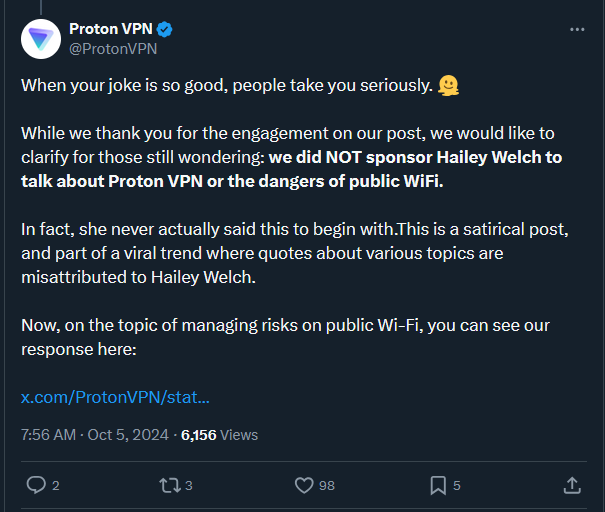
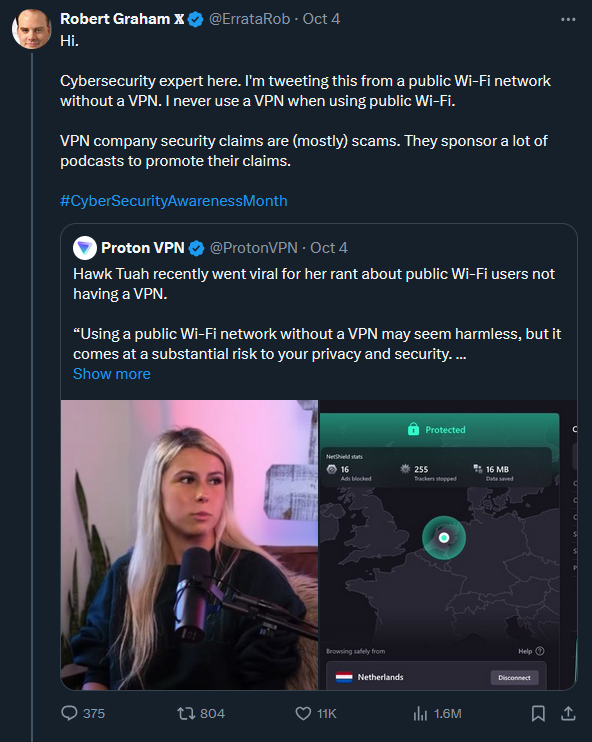
you are viewing a single comment's thread
view the rest of the comments
[–] 133 points 2 years ago (4 children)

I don't know how effective VPNs are over a public WiFi network, but I do know it stopped Spectrum from sending me "you are downloading copyrighted material, stop it" emails once I started using one. Fuck Spectrum, I don't have them anymore, but that seems like a good enough reason to keep using one in certain circumstances.

  • source
  • hideshow 8 child comments
  • [–] 52 points 2 years ago (3 children)

    They need to advertise a legitimate use for their service.

    If they don't have a threat from public wifi or other security concerns to remedy, then the only purpose for their service is to bypass region limits and block infringement notices. They would be considered complicit in such infringement.

    That their service also hinders efforts to stop pirates needs to be an "unintended" and "unavoidable" side effect.

  • source
  • parent
  • hideshow 6 child comments
  • [–] 15 points 2 years ago* (1 child)

    I use Proton when I'm on my university's campus because they switched to using EDUroam for the campus wifi. I used to be a Sys Admin at a different university a while back, and from what I know, EDUroam allows the IT department to monitor basically all of the traffic over the network. I don't know exactly how deep that stuff goes, but if I was doing anything personal or sensitive like banking or whatever, I'd flip on the VPN on my personal computer. I also don't have any personal accounts logged in on the school issued laptop because they have it loaded with institutional spyware. Once I graduate, I'll blank the drive and reinstall the OS to have a decent Lenovo laptop on hand as a spare.

    Edit to add: I use Proton because it was the least shady service that I could get for a reasonable price as a student. It is also helpful for finding textbooks. :)

  • source
  • parent
  • hideshow 2 child comments
  • [–] 9 points 2 years ago (3 children)

    There are plenty of legitimate uses for their services, they just aren't things that the vast majority of people actually need. For example:

    • access things in a LAN from a WAN - i.e. access a personal PC when you're at a friend's house, and your home LAN is behind CGNAT
    • get around local laws - e.g. my state requires ID checks for porn and social media, so getting a VPN one state over gets around that
    • prevent ISP from seeing the sites you visit - very valid privacy concern, especially since SNI exists to de-mask TLS packets

    There are also some sketchier needs, such as:

    • get different content on your streaming platform
    • hide sharing of illegal content (i.e. piracy)
    • perform illegal transactions (e.g. going on Tor to buy drugs or whatever on the black market)

    I think VPNs are trying to appeal to more than just the above needs, they're trying to create needs to grow their marketshare. That isn't something a reputable VPN should do, or at least that's something that would make me hesitate to use a given VPN.

  • source
  • parent
  • hideshow 6 child comments
  • [–] 1 point 2 years ago (1 child)

    The only thing you need to say is "my ISP uses CGNAT" you can't host anything or run games for your friends without a way to punch through the CGNAT layer. I mean you could use IPv6 if it weren't still a joke in the US but here we are.

  • source
  • parent
  • hideshow 2 child comments
  • Yup, CGNAT sucks. But STUN works fine for me, and most games support it, so it's not a huge issue.

    I could pay extra for a public IP, but for the same price I can get a VPS and do other cool stuff, so I just went the WireGuard VPN route. Same end result with a little more latency, but also more flexibility. I host a few static sites directly on the VPS, with everything else going through the VPN, so that's nice.

  • source
  • parent
  • [–] 1 point 2 years ago (1 child)

    get around local laws

    That's not a legitimate use; it's an illegal use just like piracy is.

    especially since SNI exists to de-mask TLS packets

    ECH will finally fix this. https://blog.cloudflare.com/encrypted-client-hello/

    SNI is still better than what we used to have. Before SNI, every site that used TLS or SSL had to have a dedicated IP address.

  • source
  • parent
  • hideshow 2 child comments
  • That’s not a legitimate use; it’s an illegal use just like piracy is.

    My understanding of the law (and yes, I read it) is that it's not illegal. The law in my state is for service providers to authenticate the ID of any state resident, it's not a requirement on the resident themselves. The service provider isn't aware what state I'm a resident of, and state law doesn't apply outside the state, so I don't know what law would be violated here.

    SNI is still better than what we used to have.

    I absolutely agree, and I actually use SNI to route packets for my homelab. Without SNI, I would have to route after handling certificates, which would be annoying because I want TLS to work within my home network, and I mess w/ DNS records to point to my local IPs when inside my network. I could have everything routed through a central hub (so one dedicated machine that handles all TLS), but that's a single point of failure, and I'm not too happy about that. Or I guess I'd have multiple IPs, and route based on which IP is being hit.

    I'll have to check out ECH. Hopefully I can eat my cake and have it too.

  • source
  • parent
  • [–] 4 points 2 years ago* (last edited 2 years ago)

    I'm not defending Proton. I don't even use them.

    Edit: The region limits thing is nice though. It's not why I got the VPN, but it's nice to not have to pay to watch the Olympics and just watch it via the CBC or the BBC.

  • source
  • parent
  • [–] 35 points 2 years ago (1 child)

    On public WiFi I just vpn into my home network. The issue with public WiFi is that it can be sniffed by anyone in range since there is generally no encryption.

    Although pretty much everything we do is over tls these days, and DoH helps protect against even dns sniffing. There's still at least some risk to working in the clear over a public WiFi network. At least in information gathering, what bank you use, etc.

    But, there's no real benefit in using a paid vpn over one you own unless you're downloading illegal content, want to watch another Netflix region, or are in a country with heavy Internet monitoring/filtering.

  • source
  • parent
  • hideshow 2 child comments
  • [–] 9 points 2 years ago (2 children)

    With TLS and DoH, how is your bank and other information leaked?

  • source
  • parent
  • hideshow 4 child comments
  • [–] 11 points 2 years ago (1 child)

    He said "which bank", which could be determined by the sniffing DNS requests, or seeing which IPs his computer is connecting to.

    Not a breach of his personal information (assuming the bank that he's using and the client he's using after putting everything in TLS properly).

  • source
  • parent
  • hideshow 2 child comments
  • [–] 0 points 2 years ago (2 children)

    But with DoH you can’t sniff the DNS, that’s the whole point.

  • source
  • parent
  • hideshow 4 child comments
  • [–] 7 points 2 years ago (1 child)

    But you can see the ip address, which will id the bank. They can derive other information by ip addresses or leaked data and there's still things using unencrypted connections even today. I generally just connect to my home vpn so at least it's inly my isp spying on me.

  • source
  • parent
  • hideshow 2 child comments
  • [–] 10 points 2 years ago (1 child)

    Possibly the domain is visible with a traffic monitoring tool. Everything else is between you and the bank via HTTPS. Having said that, whatever is not over https is visible to whoever sits on the same network as yourself.

  • source
  • parent
  • hideshow 2 child comments
  • [–] 3 points 2 years ago (1 child)

    All ISPs are legally obligated to forward that shit to you. The alerts are not from spectrum, they're just relaying the information.

    Right now, copyright owners do not have legal permission to find out who you are directly without a court order. They would only seek that information if they were planning to file a lawsuit.

    Media companies know, from the Napster incident, that such actions can backfire stupendously. It's rare that they even bother anymore. I can go into detail on why, but I'll leave it out for brevity.

    So they send the notice to your ISP, who is legally obligated to match the information on the notice to the subscriber and forward the notice to you.

    For many, this goes to an ISP provided mailbox, which most people ignore the existence of it. Clearly spectrum operates differently.

    The notices are from copyright holders who have no idea who you are, and can't determine that information unless they intend to sue you. So those can be, for the most part, ignored.

    It's not your ISPs fault that you got those. They couldn't give a shit less about what you do on their service, or what you download. They just want you to pay your bill every month and keep the gravy train rolling.

  • source
  • parent
  • hideshow 2 child comments
  • [–] 3 points 2 years ago (1 child)

    I'm saying fuck Spectrum for other reasons. Either way, there's less of a trail.

  • source
  • parent
  • hideshow 2 child comments
  • [–] 2 points 2 years ago (1 child)

    Fair enough. I haven't used spectrum, so I have no opinion. I'm not in the right country to subscribe to their service, so there's that.

    Have a good day.

  • source
  • parent
  • hideshow 2 child comments
  • [–] 2 points 2 years ago

    Spectrum is a total shit ISP that does shady shit constantly, while being owned by a massive corporation run by a Trump supporter and unfortunately is the only option people have in a lot of places in the U.S.

    Anyway, good talk. You have a good day too!

  • source
  • parent