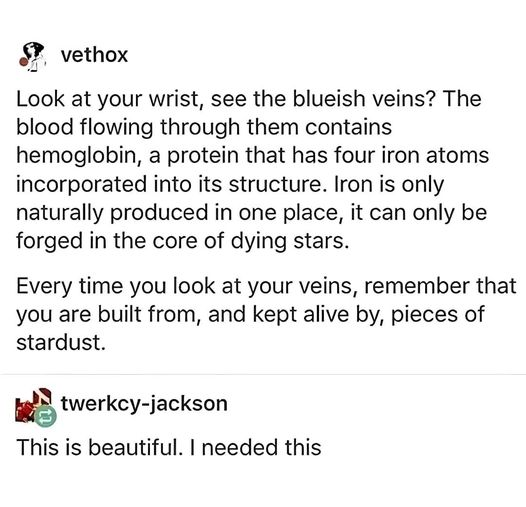
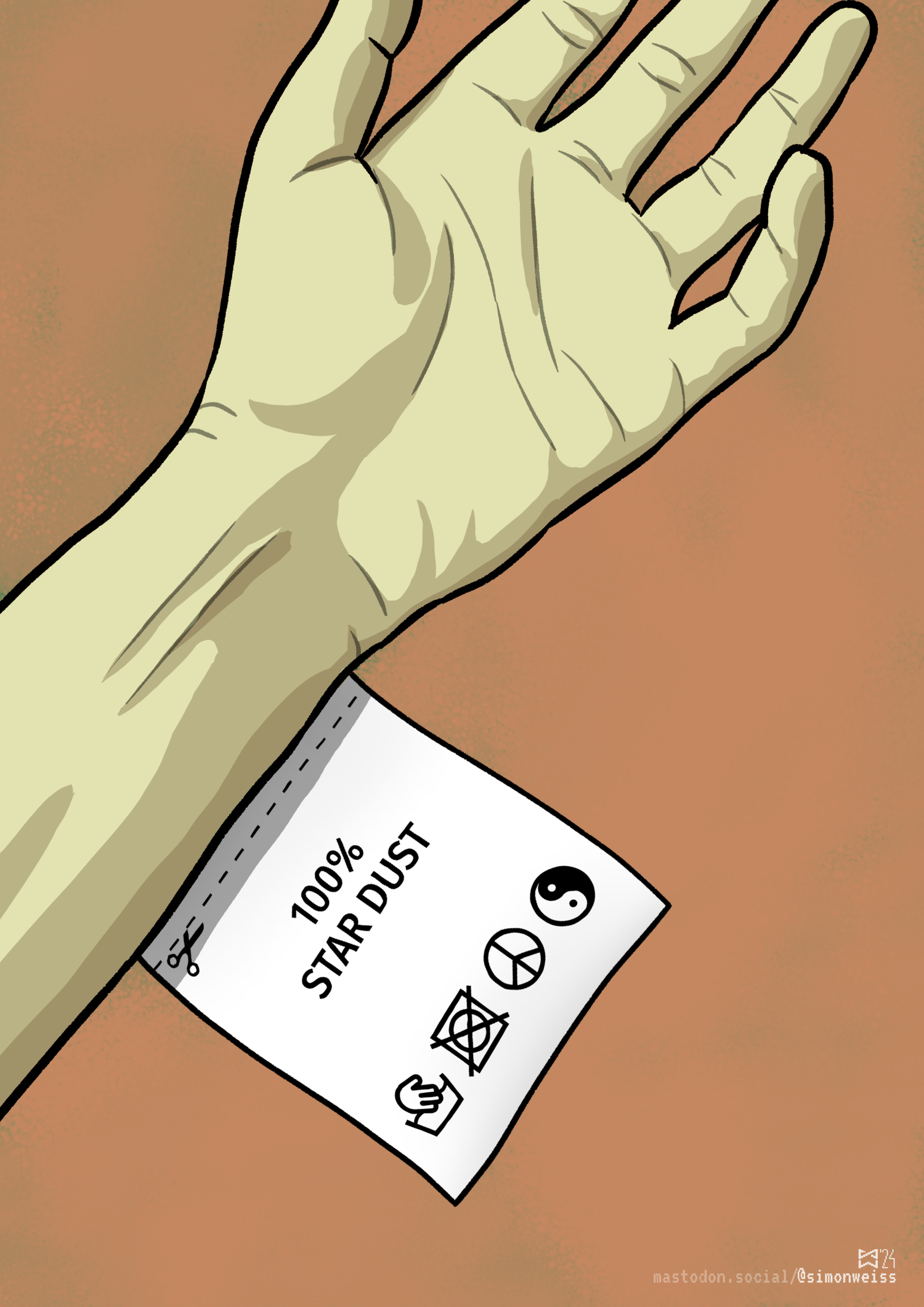
▲ 494 ▼ We are stardust. (mander.xyz) submitted 2 years ago by fossilesque@mander.xyz to c/science_memes@mander.xyz 23 comments fedilink hide all child comments
[–] simonweiss@lemmy.ml 34 points 2 years ago (1 child) permalink fedilink source hideshow 2 child comments replies: [–] Eheran@lemmy.world 19 points 2 years ago* (2 children) Incorrect, the hydrogen is mostly from the big bang. Not to mention that neutron star mergers produced a while lot of the heavier stuff. permalink fedilink source parent hideshow 4 child comments replies: [–] tate@lemmy.sdf.org 14 points 2 years ago (2 children) If that hydrogen was previously incorporated in a star, I think it's fair to call it stardust. That's very likely, since our solar system would have formed from a relatively dense cloud of the remnants of earlier stars, with just a smidge of primordial hydrogen mixed in. permalink fedilink source parent hideshow 4 child comments replies: [–] Eheran@lemmy.world 11 points 2 years ago grumpy I guess permalink fedilink source parent [–] brbposting@sh.itjust.works 1 point 2 years ago (2 children) Tell me more about primordial hydrogen?! permalink fedilink source parent hideshow 4 child comments replies: [–] tate@lemmy.sdf.org 5 points 2 years ago All of the hydrogen was created at the initial cooling of the big bang. In this case what I mean by primordial, is that it was never part of a larger composite object like a star. permalink fedilink source parent [–] DragonTypeWyvern@midwest.social 2 points 2 years ago It just means the remnants of the Big Bang that mostly created hydrogen, helium, and lithium. There's nothing particularly special about it other than the possibility that it is as old as creation because there are stable isotopes. permalink fedilink source parent [–] ininewcrow@lemmy.ca 3 points 2 years ago* I also like the science behind particles like neutrinos blasting their way through everything in space and matter, even through our own bodies and cells. Every once in a while, one of those tiny particles hits a piece of DNA at just the right spot to cause a chain reaction that leads to a new minor or major mutation in the next generation. It's generally thought that this kind of physics is one of forces that drive evolution of all lifeforms on our planet. We are made of star stuff ..... and we are and will always be affected by star energy. permalink fedilink source parent
[–] Eheran@lemmy.world 19 points 2 years ago* (2 children) Incorrect, the hydrogen is mostly from the big bang. Not to mention that neutron star mergers produced a while lot of the heavier stuff. permalink fedilink source parent hideshow 4 child comments replies: [–] tate@lemmy.sdf.org 14 points 2 years ago (2 children) If that hydrogen was previously incorporated in a star, I think it's fair to call it stardust. That's very likely, since our solar system would have formed from a relatively dense cloud of the remnants of earlier stars, with just a smidge of primordial hydrogen mixed in. permalink fedilink source parent hideshow 4 child comments replies: [–] Eheran@lemmy.world 11 points 2 years ago grumpy I guess permalink fedilink source parent [–] brbposting@sh.itjust.works 1 point 2 years ago (2 children) Tell me more about primordial hydrogen?! permalink fedilink source parent hideshow 4 child comments replies: [–] tate@lemmy.sdf.org 5 points 2 years ago All of the hydrogen was created at the initial cooling of the big bang. In this case what I mean by primordial, is that it was never part of a larger composite object like a star. permalink fedilink source parent [–] DragonTypeWyvern@midwest.social 2 points 2 years ago It just means the remnants of the Big Bang that mostly created hydrogen, helium, and lithium. There's nothing particularly special about it other than the possibility that it is as old as creation because there are stable isotopes. permalink fedilink source parent [–] ininewcrow@lemmy.ca 3 points 2 years ago* I also like the science behind particles like neutrinos blasting their way through everything in space and matter, even through our own bodies and cells. Every once in a while, one of those tiny particles hits a piece of DNA at just the right spot to cause a chain reaction that leads to a new minor or major mutation in the next generation. It's generally thought that this kind of physics is one of forces that drive evolution of all lifeforms on our planet. We are made of star stuff ..... and we are and will always be affected by star energy. permalink fedilink source parent
[–] tate@lemmy.sdf.org 14 points 2 years ago (2 children) If that hydrogen was previously incorporated in a star, I think it's fair to call it stardust. That's very likely, since our solar system would have formed from a relatively dense cloud of the remnants of earlier stars, with just a smidge of primordial hydrogen mixed in. permalink fedilink source parent hideshow 4 child comments replies: [–] Eheran@lemmy.world 11 points 2 years ago grumpy I guess permalink fedilink source parent [–] brbposting@sh.itjust.works 1 point 2 years ago (2 children) Tell me more about primordial hydrogen?! permalink fedilink source parent hideshow 4 child comments replies: [–] tate@lemmy.sdf.org 5 points 2 years ago All of the hydrogen was created at the initial cooling of the big bang. In this case what I mean by primordial, is that it was never part of a larger composite object like a star. permalink fedilink source parent [–] DragonTypeWyvern@midwest.social 2 points 2 years ago It just means the remnants of the Big Bang that mostly created hydrogen, helium, and lithium. There's nothing particularly special about it other than the possibility that it is as old as creation because there are stable isotopes. permalink fedilink source parent
[–] brbposting@sh.itjust.works 1 point 2 years ago (2 children) Tell me more about primordial hydrogen?! permalink fedilink source parent hideshow 4 child comments replies: [–] tate@lemmy.sdf.org 5 points 2 years ago All of the hydrogen was created at the initial cooling of the big bang. In this case what I mean by primordial, is that it was never part of a larger composite object like a star. permalink fedilink source parent [–] DragonTypeWyvern@midwest.social 2 points 2 years ago It just means the remnants of the Big Bang that mostly created hydrogen, helium, and lithium. There's nothing particularly special about it other than the possibility that it is as old as creation because there are stable isotopes. permalink fedilink source parent
[–] tate@lemmy.sdf.org 5 points 2 years ago All of the hydrogen was created at the initial cooling of the big bang. In this case what I mean by primordial, is that it was never part of a larger composite object like a star. permalink fedilink source parent
[–] DragonTypeWyvern@midwest.social 2 points 2 years ago It just means the remnants of the Big Bang that mostly created hydrogen, helium, and lithium. There's nothing particularly special about it other than the possibility that it is as old as creation because there are stable isotopes. permalink fedilink source parent
[–] ininewcrow@lemmy.ca 3 points 2 years ago* I also like the science behind particles like neutrinos blasting their way through everything in space and matter, even through our own bodies and cells. Every once in a while, one of those tiny particles hits a piece of DNA at just the right spot to cause a chain reaction that leads to a new minor or major mutation in the next generation. It's generally thought that this kind of physics is one of forces that drive evolution of all lifeforms on our planet. We are made of star stuff ..... and we are and will always be affected by star energy. permalink fedilink source parent