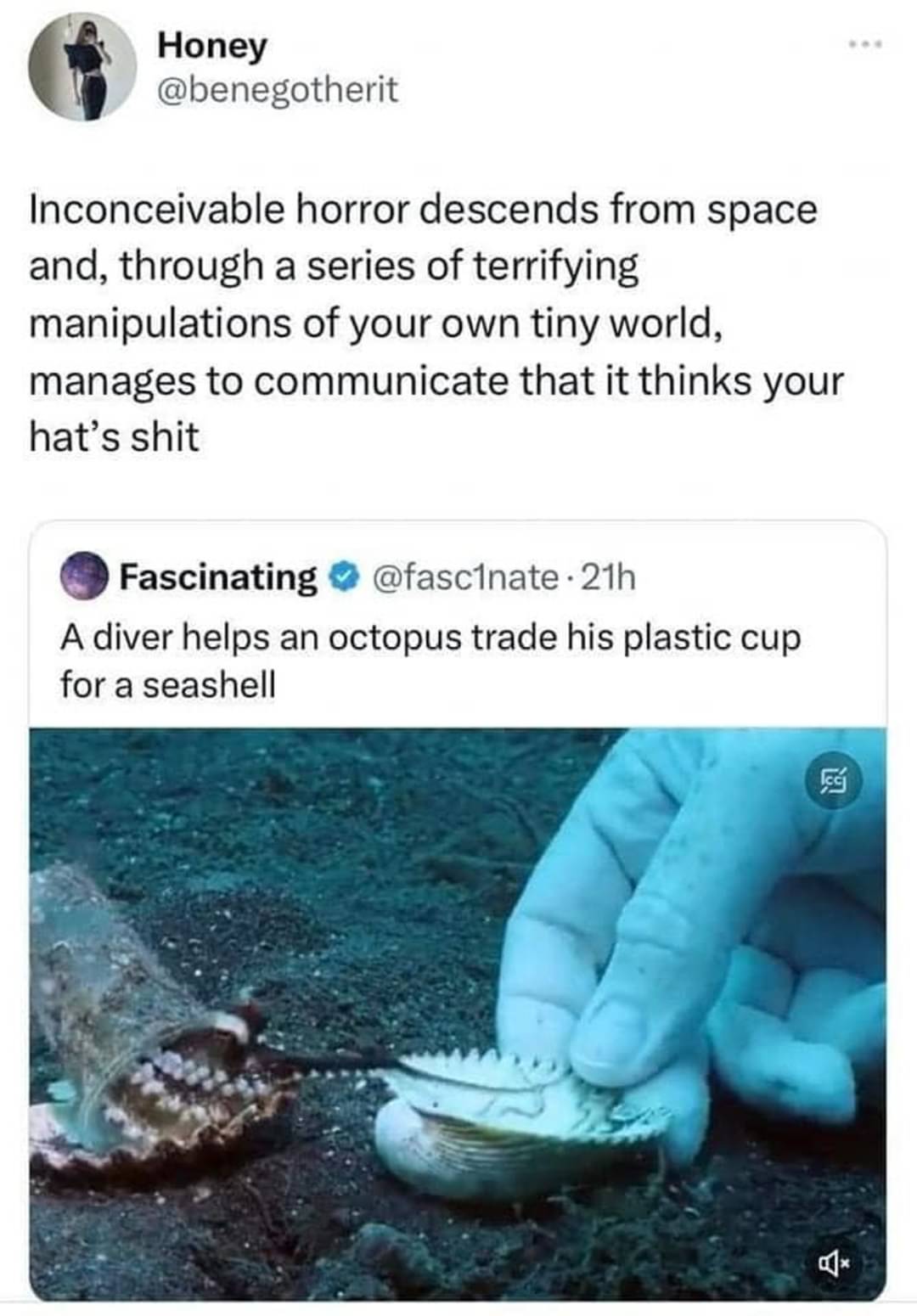
▲ 1040 ▼ Inconceivable Horror (mander.xyz) submitted 2 years ago by fossilesque@mander.xyz to c/science_memes@mander.xyz 46 comments fedilink hide all child comments
[–] abfarid@startrek.website 68 points 2 years ago (2 children) Their hat/house is literally trash though. permalink fedilink source hideshow 4 child comments replies: [–] Imgonnatrythis@sh.itjust.works 45 points 2 years ago (1 child) It is now! It was reuse, one of the best Rs in reduce, Reuse, Recycle! permalink fedilink source parent hideshow 2 child comments replies: [–] thedirtyknapkin@lemmy.world 4 points 2 years ago* (2 children) damn... does this count? like generally we want to avoid plastic cups in the ocean, but would it be bad to take something like this from say, a hermit crab? if we take the cup where will it go? chances are it will just end up somewhere else it shouldn't, but this time without being made use of by crabs. my knee jerk reaction was to say animals using plastics don't count, but that's clearly not true when we reuse garbage intentionally to create animal habitat like artificial reefs. can we really say that only humans have the capacity to reuse their own garbage effectively? permalink fedilink source parent hideshow 4 child comments replies: [–] DrDominate@lemmy.world 20 points 2 years ago Plastic cups are not good protection for animals that use shells. These divers dont forcefully take the cup shell either. They'll happily give up their plastic cups for the new shells being offered as long as they like it. Then the plastic cup is thrown away. There's a difference from scientists trying to make artificial reefs (which even then like the tire reef fiasco turned out to be a terrible idea) and random trash being picked up and used by the local wildlife. permalink fedilink source parent [–] brbposting@sh.itjust.works 8 points 2 years ago Our trash is going to be an inferior product, I would imagine. Petroleum-based, breaks down into microplastic particles. Might not offer the same protection of the harder shell, either in hardness or camouflage from predators. Obviously, this raises a new question. Is it a big deal to litter titanium shells? Properly anodized for camouflage, of course. :) permalink fedilink source parent [–] Crikeste@lemm.ee 15 points 2 years ago It’s thrifted be nice permalink fedilink source parent
[–] Imgonnatrythis@sh.itjust.works 45 points 2 years ago (1 child) It is now! It was reuse, one of the best Rs in reduce, Reuse, Recycle! permalink fedilink source parent hideshow 2 child comments replies: [–] thedirtyknapkin@lemmy.world 4 points 2 years ago* (2 children) damn... does this count? like generally we want to avoid plastic cups in the ocean, but would it be bad to take something like this from say, a hermit crab? if we take the cup where will it go? chances are it will just end up somewhere else it shouldn't, but this time without being made use of by crabs. my knee jerk reaction was to say animals using plastics don't count, but that's clearly not true when we reuse garbage intentionally to create animal habitat like artificial reefs. can we really say that only humans have the capacity to reuse their own garbage effectively? permalink fedilink source parent hideshow 4 child comments replies: [–] DrDominate@lemmy.world 20 points 2 years ago Plastic cups are not good protection for animals that use shells. These divers dont forcefully take the cup shell either. They'll happily give up their plastic cups for the new shells being offered as long as they like it. Then the plastic cup is thrown away. There's a difference from scientists trying to make artificial reefs (which even then like the tire reef fiasco turned out to be a terrible idea) and random trash being picked up and used by the local wildlife. permalink fedilink source parent [–] brbposting@sh.itjust.works 8 points 2 years ago Our trash is going to be an inferior product, I would imagine. Petroleum-based, breaks down into microplastic particles. Might not offer the same protection of the harder shell, either in hardness or camouflage from predators. Obviously, this raises a new question. Is it a big deal to litter titanium shells? Properly anodized for camouflage, of course. :) permalink fedilink source parent
[–] thedirtyknapkin@lemmy.world 4 points 2 years ago* (2 children) damn... does this count? like generally we want to avoid plastic cups in the ocean, but would it be bad to take something like this from say, a hermit crab? if we take the cup where will it go? chances are it will just end up somewhere else it shouldn't, but this time without being made use of by crabs. my knee jerk reaction was to say animals using plastics don't count, but that's clearly not true when we reuse garbage intentionally to create animal habitat like artificial reefs. can we really say that only humans have the capacity to reuse their own garbage effectively? permalink fedilink source parent hideshow 4 child comments replies: [–] DrDominate@lemmy.world 20 points 2 years ago Plastic cups are not good protection for animals that use shells. These divers dont forcefully take the cup shell either. They'll happily give up their plastic cups for the new shells being offered as long as they like it. Then the plastic cup is thrown away. There's a difference from scientists trying to make artificial reefs (which even then like the tire reef fiasco turned out to be a terrible idea) and random trash being picked up and used by the local wildlife. permalink fedilink source parent [–] brbposting@sh.itjust.works 8 points 2 years ago Our trash is going to be an inferior product, I would imagine. Petroleum-based, breaks down into microplastic particles. Might not offer the same protection of the harder shell, either in hardness or camouflage from predators. Obviously, this raises a new question. Is it a big deal to litter titanium shells? Properly anodized for camouflage, of course. :) permalink fedilink source parent
[–] DrDominate@lemmy.world 20 points 2 years ago Plastic cups are not good protection for animals that use shells. These divers dont forcefully take the cup shell either. They'll happily give up their plastic cups for the new shells being offered as long as they like it. Then the plastic cup is thrown away. There's a difference from scientists trying to make artificial reefs (which even then like the tire reef fiasco turned out to be a terrible idea) and random trash being picked up and used by the local wildlife. permalink fedilink source parent
[–] brbposting@sh.itjust.works 8 points 2 years ago Our trash is going to be an inferior product, I would imagine. Petroleum-based, breaks down into microplastic particles. Might not offer the same protection of the harder shell, either in hardness or camouflage from predators. Obviously, this raises a new question. Is it a big deal to litter titanium shells? Properly anodized for camouflage, of course. :) permalink fedilink source parent