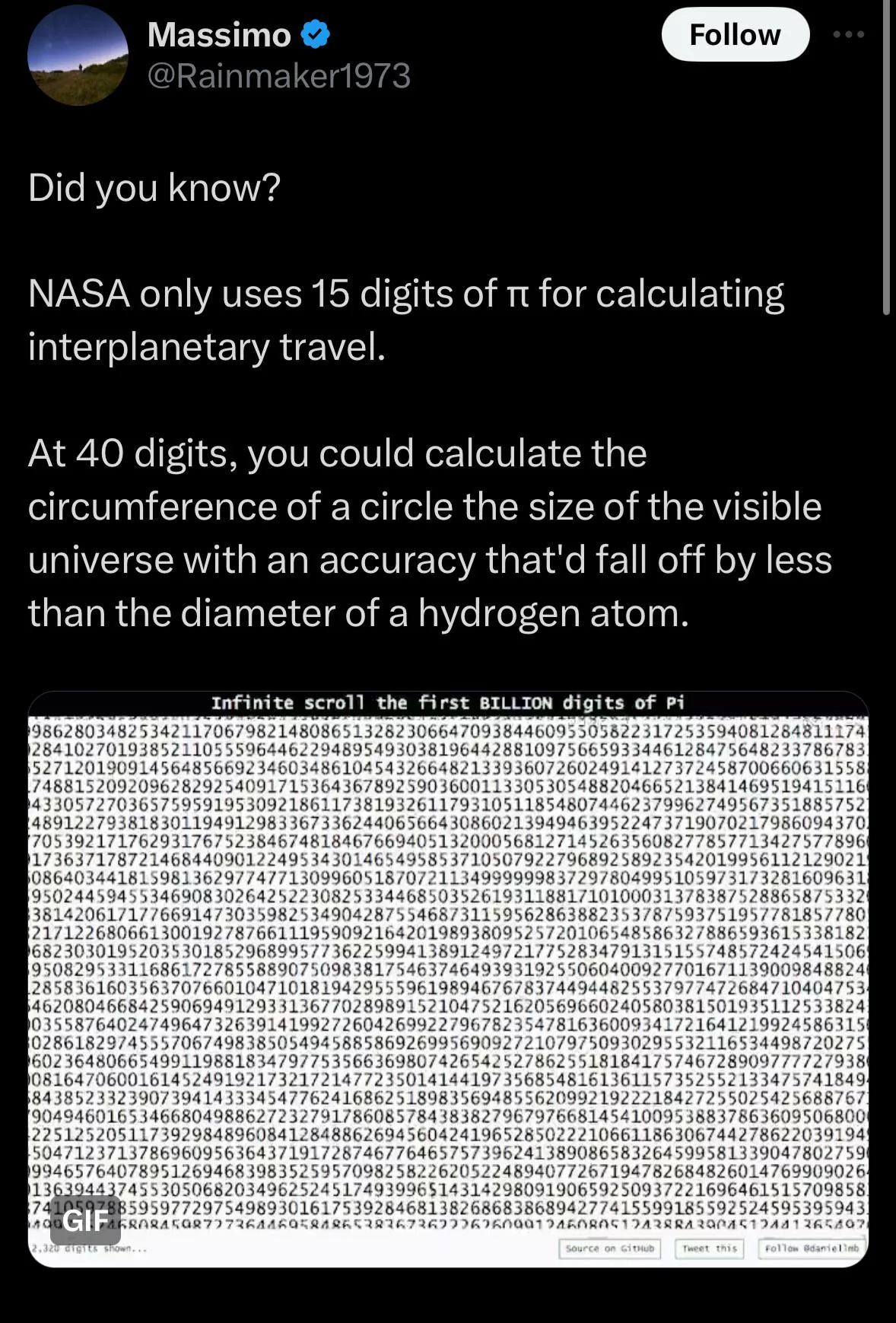
▲ 698 ▼ Magic π (mander.xyz) submitted 2 years ago by fossilesque@mander.xyz to c/science_memes@mander.xyz 63 comments fedilink hide all child comments
[–] Carrick1973@lemmy.world 14 points 2 years ago (3 children) There's a 9 repeating 6 times in there which I'd think is a pretty rare occurrence in pi. I wonder what the longest occurrence of a repeating digit is. permalink fedilink source hideshow 6 child comments replies: [–] ILikeBoobies@lemmy.ca 23 points 2 years ago* (1 child) Pi is infinite so every combination/string of numbers is in there, if we calculated enough you could find a billion 2s next to each other You can look through the first trillion here https://archive.org/details/pi_dec_1t Though it’s a bunch of downloading permalink fedilink source parent hideshow 2 child comments replies: [–] Guest_User@lemmy.world 15 points 2 years ago (2 children) Not necessarily. It could just become a series of 1's repeating forever. Nothing would require it to contain all strings of numbers. permalink fedilink source parent hideshow 4 child comments replies: [–] diverging@lemmy.ml 6 points 2 years ago It could just become a series of 1’s repeating forever If that happens in a number, then it is rational. Pi is not rational, so that will never happen in pi. permalink fedilink source parent [–] ILikeBoobies@lemmy.ca 2 points 2 years ago (2 children) The point of pi is that it’s non-repeating permalink fedilink source parent hideshow 4 child comments replies: [–] Jenztsch@feddit.de 26 points 2 years ago (1 child) Take a look at 0.101001000100001... This number is also non-repeating, but obviously doesn't contain all numbers with finite digits. The property you're looking for is called to be a normal number. Pi is assumed to be one, but it hasn't yet been proven. However, in a sense this is an unremarkable property as almost all real numbers are normal. :) permalink fedilink source parent hideshow 2 child comments replies: [–] ILikeBoobies@lemmy.ca -2 points 2 years ago but obviously doesn’t contain all numbers with finite digits. I was just claiming possibility because we haven’t calculated the infinite string permalink fedilink source parent [–] Guest_User@lemmy.world 4 points 2 years ago* (1 child) At work at the moment so can't go deep into it. But I think you misunderstand what non repeating numbers mean. Of course there are repeating numbers within pi which is fine, the issue would be if ALL the digits were to simply cycle over and repeat themselves. If however there are a few trillion digits then a series of 1's and 0's for ever, pi is still non repeating permalink fedilink source parent hideshow 2 child comments replies: [–] ILikeBoobies@lemmy.ca -1 points 2 years ago (1 child) Did you read what I responded to? It could just become a series of 1’s repeating forever. permalink fedilink source parent hideshow 2 child comments replies: [–] Guest_User@lemmy.world 4 points 2 years ago (1 child) I did read it, I also wrote it. Wasn't trying to put you down or anything just sharing a bit of knowledge I found interesting. I know many people (my self included at one point) assumed pi would have to include everything when that just isn't true. Apologies if I did a bad job explaining it though permalink fedilink source parent hideshow 2 child comments replies: [–] ILikeBoobies@lemmy.ca -1 points 2 years ago I wasn’t clear then, it’s not that it has to It’s that it can until calculated permalink fedilink source parent [–] chetradley@lemmy.world 10 points 2 years ago (1 child) Looked it up, and it's apparently called the Feynman point after Physicist Richard Feynman (though the story behind that attribution is disputed). https://en.wikipedia.org/wiki/Six_nines_in_pi?wprov=sfla1 permalink fedilink source parent hideshow 2 child comments replies: [–] Carrick1973@lemmy.world 1 point 2 years ago That's fascinating. Obviously, there's a series of repeating numbers in there, and one of the numbers would have a highest number of repeats... until further places of pi are determined and another number knocks it off... I assume there's a repeating 1, or 2 that repeats 7 or 8 times,etc... at some point... permalink fedilink source parent [–] Aermis@lemmy.world 4 points 2 years ago (1 child) On a long enough string I'm guessing... Infinite? Pi isn't a pattern so does it follow the same "if monkeys hade an infinite amount of time to type at a typewriter they'd type Shakespeare" permalink fedilink source parent hideshow 2 child comments replies: [–] Carrick1973@lemmy.world 1 point 2 years ago Well I thought that at first, but it has to be less than infinite since other numbers have to repeat in there as well with at least some occurrence so it's infinite minus something, but since pi goes on infinitely, it's obviously some high number... permalink fedilink source parent
[–] ILikeBoobies@lemmy.ca 23 points 2 years ago* (1 child) Pi is infinite so every combination/string of numbers is in there, if we calculated enough you could find a billion 2s next to each other You can look through the first trillion here https://archive.org/details/pi_dec_1t Though it’s a bunch of downloading permalink fedilink source parent hideshow 2 child comments replies: [–] Guest_User@lemmy.world 15 points 2 years ago (2 children) Not necessarily. It could just become a series of 1's repeating forever. Nothing would require it to contain all strings of numbers. permalink fedilink source parent hideshow 4 child comments replies: [–] diverging@lemmy.ml 6 points 2 years ago It could just become a series of 1’s repeating forever If that happens in a number, then it is rational. Pi is not rational, so that will never happen in pi. permalink fedilink source parent [–] ILikeBoobies@lemmy.ca 2 points 2 years ago (2 children) The point of pi is that it’s non-repeating permalink fedilink source parent hideshow 4 child comments replies: [–] Jenztsch@feddit.de 26 points 2 years ago (1 child) Take a look at 0.101001000100001... This number is also non-repeating, but obviously doesn't contain all numbers with finite digits. The property you're looking for is called to be a normal number. Pi is assumed to be one, but it hasn't yet been proven. However, in a sense this is an unremarkable property as almost all real numbers are normal. :) permalink fedilink source parent hideshow 2 child comments replies: [–] ILikeBoobies@lemmy.ca -2 points 2 years ago but obviously doesn’t contain all numbers with finite digits. I was just claiming possibility because we haven’t calculated the infinite string permalink fedilink source parent [–] Guest_User@lemmy.world 4 points 2 years ago* (1 child) At work at the moment so can't go deep into it. But I think you misunderstand what non repeating numbers mean. Of course there are repeating numbers within pi which is fine, the issue would be if ALL the digits were to simply cycle over and repeat themselves. If however there are a few trillion digits then a series of 1's and 0's for ever, pi is still non repeating permalink fedilink source parent hideshow 2 child comments replies: [–] ILikeBoobies@lemmy.ca -1 points 2 years ago (1 child) Did you read what I responded to? It could just become a series of 1’s repeating forever. permalink fedilink source parent hideshow 2 child comments replies: [–] Guest_User@lemmy.world 4 points 2 years ago (1 child) I did read it, I also wrote it. Wasn't trying to put you down or anything just sharing a bit of knowledge I found interesting. I know many people (my self included at one point) assumed pi would have to include everything when that just isn't true. Apologies if I did a bad job explaining it though permalink fedilink source parent hideshow 2 child comments replies: [–] ILikeBoobies@lemmy.ca -1 points 2 years ago I wasn’t clear then, it’s not that it has to It’s that it can until calculated permalink fedilink source parent
[–] Guest_User@lemmy.world 15 points 2 years ago (2 children) Not necessarily. It could just become a series of 1's repeating forever. Nothing would require it to contain all strings of numbers. permalink fedilink source parent hideshow 4 child comments replies: [–] diverging@lemmy.ml 6 points 2 years ago It could just become a series of 1’s repeating forever If that happens in a number, then it is rational. Pi is not rational, so that will never happen in pi. permalink fedilink source parent [–] ILikeBoobies@lemmy.ca 2 points 2 years ago (2 children) The point of pi is that it’s non-repeating permalink fedilink source parent hideshow 4 child comments replies: [–] Jenztsch@feddit.de 26 points 2 years ago (1 child) Take a look at 0.101001000100001... This number is also non-repeating, but obviously doesn't contain all numbers with finite digits. The property you're looking for is called to be a normal number. Pi is assumed to be one, but it hasn't yet been proven. However, in a sense this is an unremarkable property as almost all real numbers are normal. :) permalink fedilink source parent hideshow 2 child comments replies: [–] ILikeBoobies@lemmy.ca -2 points 2 years ago but obviously doesn’t contain all numbers with finite digits. I was just claiming possibility because we haven’t calculated the infinite string permalink fedilink source parent [–] Guest_User@lemmy.world 4 points 2 years ago* (1 child) At work at the moment so can't go deep into it. But I think you misunderstand what non repeating numbers mean. Of course there are repeating numbers within pi which is fine, the issue would be if ALL the digits were to simply cycle over and repeat themselves. If however there are a few trillion digits then a series of 1's and 0's for ever, pi is still non repeating permalink fedilink source parent hideshow 2 child comments replies: [–] ILikeBoobies@lemmy.ca -1 points 2 years ago (1 child) Did you read what I responded to? It could just become a series of 1’s repeating forever. permalink fedilink source parent hideshow 2 child comments replies: [–] Guest_User@lemmy.world 4 points 2 years ago (1 child) I did read it, I also wrote it. Wasn't trying to put you down or anything just sharing a bit of knowledge I found interesting. I know many people (my self included at one point) assumed pi would have to include everything when that just isn't true. Apologies if I did a bad job explaining it though permalink fedilink source parent hideshow 2 child comments replies: [–] ILikeBoobies@lemmy.ca -1 points 2 years ago I wasn’t clear then, it’s not that it has to It’s that it can until calculated permalink fedilink source parent
[–] diverging@lemmy.ml 6 points 2 years ago It could just become a series of 1’s repeating forever If that happens in a number, then it is rational. Pi is not rational, so that will never happen in pi. permalink fedilink source parent
[–] ILikeBoobies@lemmy.ca 2 points 2 years ago (2 children) The point of pi is that it’s non-repeating permalink fedilink source parent hideshow 4 child comments replies: [–] Jenztsch@feddit.de 26 points 2 years ago (1 child) Take a look at 0.101001000100001... This number is also non-repeating, but obviously doesn't contain all numbers with finite digits. The property you're looking for is called to be a normal number. Pi is assumed to be one, but it hasn't yet been proven. However, in a sense this is an unremarkable property as almost all real numbers are normal. :) permalink fedilink source parent hideshow 2 child comments replies: [–] ILikeBoobies@lemmy.ca -2 points 2 years ago but obviously doesn’t contain all numbers with finite digits. I was just claiming possibility because we haven’t calculated the infinite string permalink fedilink source parent [–] Guest_User@lemmy.world 4 points 2 years ago* (1 child) At work at the moment so can't go deep into it. But I think you misunderstand what non repeating numbers mean. Of course there are repeating numbers within pi which is fine, the issue would be if ALL the digits were to simply cycle over and repeat themselves. If however there are a few trillion digits then a series of 1's and 0's for ever, pi is still non repeating permalink fedilink source parent hideshow 2 child comments replies: [–] ILikeBoobies@lemmy.ca -1 points 2 years ago (1 child) Did you read what I responded to? It could just become a series of 1’s repeating forever. permalink fedilink source parent hideshow 2 child comments replies: [–] Guest_User@lemmy.world 4 points 2 years ago (1 child) I did read it, I also wrote it. Wasn't trying to put you down or anything just sharing a bit of knowledge I found interesting. I know many people (my self included at one point) assumed pi would have to include everything when that just isn't true. Apologies if I did a bad job explaining it though permalink fedilink source parent hideshow 2 child comments replies: [–] ILikeBoobies@lemmy.ca -1 points 2 years ago I wasn’t clear then, it’s not that it has to It’s that it can until calculated permalink fedilink source parent
[–] Jenztsch@feddit.de 26 points 2 years ago (1 child) Take a look at 0.101001000100001... This number is also non-repeating, but obviously doesn't contain all numbers with finite digits. The property you're looking for is called to be a normal number. Pi is assumed to be one, but it hasn't yet been proven. However, in a sense this is an unremarkable property as almost all real numbers are normal. :) permalink fedilink source parent hideshow 2 child comments replies: [–] ILikeBoobies@lemmy.ca -2 points 2 years ago but obviously doesn’t contain all numbers with finite digits. I was just claiming possibility because we haven’t calculated the infinite string permalink fedilink source parent
[–] ILikeBoobies@lemmy.ca -2 points 2 years ago but obviously doesn’t contain all numbers with finite digits. I was just claiming possibility because we haven’t calculated the infinite string permalink fedilink source parent
[–] Guest_User@lemmy.world 4 points 2 years ago* (1 child) At work at the moment so can't go deep into it. But I think you misunderstand what non repeating numbers mean. Of course there are repeating numbers within pi which is fine, the issue would be if ALL the digits were to simply cycle over and repeat themselves. If however there are a few trillion digits then a series of 1's and 0's for ever, pi is still non repeating permalink fedilink source parent hideshow 2 child comments replies: [–] ILikeBoobies@lemmy.ca -1 points 2 years ago (1 child) Did you read what I responded to? It could just become a series of 1’s repeating forever. permalink fedilink source parent hideshow 2 child comments replies: [–] Guest_User@lemmy.world 4 points 2 years ago (1 child) I did read it, I also wrote it. Wasn't trying to put you down or anything just sharing a bit of knowledge I found interesting. I know many people (my self included at one point) assumed pi would have to include everything when that just isn't true. Apologies if I did a bad job explaining it though permalink fedilink source parent hideshow 2 child comments replies: [–] ILikeBoobies@lemmy.ca -1 points 2 years ago I wasn’t clear then, it’s not that it has to It’s that it can until calculated permalink fedilink source parent
[–] ILikeBoobies@lemmy.ca -1 points 2 years ago (1 child) Did you read what I responded to? It could just become a series of 1’s repeating forever. permalink fedilink source parent hideshow 2 child comments replies: [–] Guest_User@lemmy.world 4 points 2 years ago (1 child) I did read it, I also wrote it. Wasn't trying to put you down or anything just sharing a bit of knowledge I found interesting. I know many people (my self included at one point) assumed pi would have to include everything when that just isn't true. Apologies if I did a bad job explaining it though permalink fedilink source parent hideshow 2 child comments replies: [–] ILikeBoobies@lemmy.ca -1 points 2 years ago I wasn’t clear then, it’s not that it has to It’s that it can until calculated permalink fedilink source parent
[–] Guest_User@lemmy.world 4 points 2 years ago (1 child) I did read it, I also wrote it. Wasn't trying to put you down or anything just sharing a bit of knowledge I found interesting. I know many people (my self included at one point) assumed pi would have to include everything when that just isn't true. Apologies if I did a bad job explaining it though permalink fedilink source parent hideshow 2 child comments replies: [–] ILikeBoobies@lemmy.ca -1 points 2 years ago I wasn’t clear then, it’s not that it has to It’s that it can until calculated permalink fedilink source parent
[–] ILikeBoobies@lemmy.ca -1 points 2 years ago I wasn’t clear then, it’s not that it has to It’s that it can until calculated permalink fedilink source parent
[–] chetradley@lemmy.world 10 points 2 years ago (1 child) Looked it up, and it's apparently called the Feynman point after Physicist Richard Feynman (though the story behind that attribution is disputed). https://en.wikipedia.org/wiki/Six_nines_in_pi?wprov=sfla1 permalink fedilink source parent hideshow 2 child comments replies: [–] Carrick1973@lemmy.world 1 point 2 years ago That's fascinating. Obviously, there's a series of repeating numbers in there, and one of the numbers would have a highest number of repeats... until further places of pi are determined and another number knocks it off... I assume there's a repeating 1, or 2 that repeats 7 or 8 times,etc... at some point... permalink fedilink source parent
[–] Carrick1973@lemmy.world 1 point 2 years ago That's fascinating. Obviously, there's a series of repeating numbers in there, and one of the numbers would have a highest number of repeats... until further places of pi are determined and another number knocks it off... I assume there's a repeating 1, or 2 that repeats 7 or 8 times,etc... at some point... permalink fedilink source parent
[–] Aermis@lemmy.world 4 points 2 years ago (1 child) On a long enough string I'm guessing... Infinite? Pi isn't a pattern so does it follow the same "if monkeys hade an infinite amount of time to type at a typewriter they'd type Shakespeare" permalink fedilink source parent hideshow 2 child comments replies: [–] Carrick1973@lemmy.world 1 point 2 years ago Well I thought that at first, but it has to be less than infinite since other numbers have to repeat in there as well with at least some occurrence so it's infinite minus something, but since pi goes on infinitely, it's obviously some high number... permalink fedilink source parent
[–] Carrick1973@lemmy.world 1 point 2 years ago Well I thought that at first, but it has to be less than infinite since other numbers have to repeat in there as well with at least some occurrence so it's infinite minus something, but since pi goes on infinitely, it's obviously some high number... permalink fedilink source parent