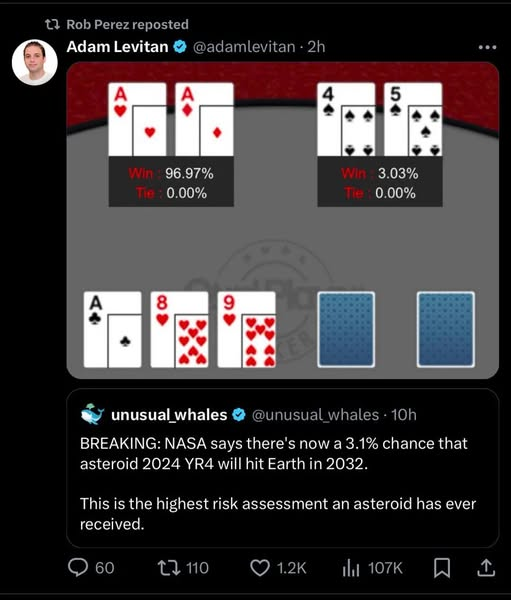
▲ 448 ▼ place yer bets (mander.xyz) submitted 1 year ago by fossilesque@mander.xyz to c/science_memes@mander.xyz 81 comments fedilink hide all child comments
[–] LibertyLizard@slrpnk.net 16 points 1 year ago (3 children) So what level of calamity are we talking about here? 3% doesn’t sound that low to me. permalink fedilink source hideshow 6 child comments replies: [–] Enkers@sh.itjust.works 33 points 1 year ago (2 children) I recall hearing it was medium-ish nuclear weapon sized, but not wipe out civilisation size. Wherever it's heading would need to be evacuated. That was a week ago, though, and I'm sure the size projections will be updated as we get more data. permalink fedilink source parent hideshow 4 child comments replies: [–] LadyAutumn@lemmy.blahaj.zone 15 points 1 year ago* (last edited 1 year ago) This is correct. Current estimates place a possible impact event at an energy release of ~7.8 Megatons of TNT. Approximately 500 times the bomb dropped on Hiroshima. Comparable to the Tunguska Event. This is accounting for current size estimates under 100m in diameter. It is a very serious asteroid. The Tunguska Event could have killed millions of people. The primary reason it didn't was because it happened in the middle of Siberia. The primary witnesses to the devastation were local native groups who still lived that for out, of which there were few. It wasn't properly investigated for over a decade because of the remoteness of where it happened and the low priority as it didn't affect very many people. If that happened over a major city the consequences would be utterly devastating. It's not K-T Extinction event level, but it is nonetheless quite serious. permalink fedilink source parent [–] knightly@pawb.social 13 points 1 year ago (2 children) We'll get a better idea of whether it'll hit or not in 2028 the next time it passes close to earth, which will give us plenty of time to respond before it might hit in 2032. permalink fedilink source parent hideshow 4 child comments replies: [–] apprehensively_human@lemmy.ca 5 points 1 year ago (1 child) Except that 2028 would also be our window to do something about it before it disappears back into space. There needs to be a plan now, even if that plan is to wait and see where it's going to hit. permalink fedilink source parent hideshow 2 child comments replies: [–] knightly@pawb.social 3 points 1 year ago* In short, we already have a plan. DART proved that we can do it, and off-the-shelf rockets like the Falcon 9 have plenty of performance. All that remains is to wait until early 2028 when we get a proper fix on the asteroid, then we've got 7 or 8 months to prep and launch a mission before the window of opportunity closes. https://www.youtube.com/watch?v=kK5IXX4p2d0 permalink fedilink source parent [–] DontRedditMyLemmy@lemmy.world 4 points 1 year ago (1 child) 4 years to develop an effective anti-asteroid response? permalink fedilink source parent hideshow 2 child comments replies: [–] knightly@pawb.social 6 points 1 year ago* (1 child) Well, yeah. Deflecting an impact that's scheduled 4 years in the future wouldn't take much force and the DART mission proved that it's achievable. We can just do that again in the months between when the asteroid comes back around and when it flies past us. permalink fedilink source parent hideshow 2 child comments replies: [–] DontRedditMyLemmy@lemmy.world 5 points 1 year ago (1 child) I think the DART mission picked a target of some convenience. This is no arbitrary target - it picked us. The stakes are a lot higher if failure is not an option. And of course, the world is currently tearing itself apart, so that won't help when the moment for unity and collaboration approaches. permalink fedilink source parent hideshow 2 child comments replies: [–] knightly@pawb.social 2 points 1 year ago You're not wrong, but something like this is well within the capabilities of private companies like ArianeSpace or SpaceX. Also, the stakes are just a city-killer asteroid, failure is entirely an option when there's plenty of time to evacuate the impact zone. permalink fedilink source parent [+] yozul@beehaw.org 16 points 1 year ago* (last edited 9 months ago) [deleted] permalink fedilink source parent [–] Morgoon@startrek.website 3 points 1 year ago (1 child) Well we wouldn't have to worry about global warming anymore permalink fedilink source parent hideshow 2 child comments replies: [–] deegeese@sopuli.xyz 17 points 1 year ago This size meteor would destroy a city but not have lasting planet-scale effects. Think Tonguska event. permalink fedilink source parent
[–] Enkers@sh.itjust.works 33 points 1 year ago (2 children) I recall hearing it was medium-ish nuclear weapon sized, but not wipe out civilisation size. Wherever it's heading would need to be evacuated. That was a week ago, though, and I'm sure the size projections will be updated as we get more data. permalink fedilink source parent hideshow 4 child comments replies: [–] LadyAutumn@lemmy.blahaj.zone 15 points 1 year ago* (last edited 1 year ago) This is correct. Current estimates place a possible impact event at an energy release of ~7.8 Megatons of TNT. Approximately 500 times the bomb dropped on Hiroshima. Comparable to the Tunguska Event. This is accounting for current size estimates under 100m in diameter. It is a very serious asteroid. The Tunguska Event could have killed millions of people. The primary reason it didn't was because it happened in the middle of Siberia. The primary witnesses to the devastation were local native groups who still lived that for out, of which there were few. It wasn't properly investigated for over a decade because of the remoteness of where it happened and the low priority as it didn't affect very many people. If that happened over a major city the consequences would be utterly devastating. It's not K-T Extinction event level, but it is nonetheless quite serious. permalink fedilink source parent [–] knightly@pawb.social 13 points 1 year ago (2 children) We'll get a better idea of whether it'll hit or not in 2028 the next time it passes close to earth, which will give us plenty of time to respond before it might hit in 2032. permalink fedilink source parent hideshow 4 child comments replies: [–] apprehensively_human@lemmy.ca 5 points 1 year ago (1 child) Except that 2028 would also be our window to do something about it before it disappears back into space. There needs to be a plan now, even if that plan is to wait and see where it's going to hit. permalink fedilink source parent hideshow 2 child comments replies: [–] knightly@pawb.social 3 points 1 year ago* In short, we already have a plan. DART proved that we can do it, and off-the-shelf rockets like the Falcon 9 have plenty of performance. All that remains is to wait until early 2028 when we get a proper fix on the asteroid, then we've got 7 or 8 months to prep and launch a mission before the window of opportunity closes. https://www.youtube.com/watch?v=kK5IXX4p2d0 permalink fedilink source parent [–] DontRedditMyLemmy@lemmy.world 4 points 1 year ago (1 child) 4 years to develop an effective anti-asteroid response? permalink fedilink source parent hideshow 2 child comments replies: [–] knightly@pawb.social 6 points 1 year ago* (1 child) Well, yeah. Deflecting an impact that's scheduled 4 years in the future wouldn't take much force and the DART mission proved that it's achievable. We can just do that again in the months between when the asteroid comes back around and when it flies past us. permalink fedilink source parent hideshow 2 child comments replies: [–] DontRedditMyLemmy@lemmy.world 5 points 1 year ago (1 child) I think the DART mission picked a target of some convenience. This is no arbitrary target - it picked us. The stakes are a lot higher if failure is not an option. And of course, the world is currently tearing itself apart, so that won't help when the moment for unity and collaboration approaches. permalink fedilink source parent hideshow 2 child comments replies: [–] knightly@pawb.social 2 points 1 year ago You're not wrong, but something like this is well within the capabilities of private companies like ArianeSpace or SpaceX. Also, the stakes are just a city-killer asteroid, failure is entirely an option when there's plenty of time to evacuate the impact zone. permalink fedilink source parent
[–] LadyAutumn@lemmy.blahaj.zone 15 points 1 year ago* (last edited 1 year ago) This is correct. Current estimates place a possible impact event at an energy release of ~7.8 Megatons of TNT. Approximately 500 times the bomb dropped on Hiroshima. Comparable to the Tunguska Event. This is accounting for current size estimates under 100m in diameter. It is a very serious asteroid. The Tunguska Event could have killed millions of people. The primary reason it didn't was because it happened in the middle of Siberia. The primary witnesses to the devastation were local native groups who still lived that for out, of which there were few. It wasn't properly investigated for over a decade because of the remoteness of where it happened and the low priority as it didn't affect very many people. If that happened over a major city the consequences would be utterly devastating. It's not K-T Extinction event level, but it is nonetheless quite serious. permalink fedilink source parent
[–] knightly@pawb.social 13 points 1 year ago (2 children) We'll get a better idea of whether it'll hit or not in 2028 the next time it passes close to earth, which will give us plenty of time to respond before it might hit in 2032. permalink fedilink source parent hideshow 4 child comments replies: [–] apprehensively_human@lemmy.ca 5 points 1 year ago (1 child) Except that 2028 would also be our window to do something about it before it disappears back into space. There needs to be a plan now, even if that plan is to wait and see where it's going to hit. permalink fedilink source parent hideshow 2 child comments replies: [–] knightly@pawb.social 3 points 1 year ago* In short, we already have a plan. DART proved that we can do it, and off-the-shelf rockets like the Falcon 9 have plenty of performance. All that remains is to wait until early 2028 when we get a proper fix on the asteroid, then we've got 7 or 8 months to prep and launch a mission before the window of opportunity closes. https://www.youtube.com/watch?v=kK5IXX4p2d0 permalink fedilink source parent [–] DontRedditMyLemmy@lemmy.world 4 points 1 year ago (1 child) 4 years to develop an effective anti-asteroid response? permalink fedilink source parent hideshow 2 child comments replies: [–] knightly@pawb.social 6 points 1 year ago* (1 child) Well, yeah. Deflecting an impact that's scheduled 4 years in the future wouldn't take much force and the DART mission proved that it's achievable. We can just do that again in the months between when the asteroid comes back around and when it flies past us. permalink fedilink source parent hideshow 2 child comments replies: [–] DontRedditMyLemmy@lemmy.world 5 points 1 year ago (1 child) I think the DART mission picked a target of some convenience. This is no arbitrary target - it picked us. The stakes are a lot higher if failure is not an option. And of course, the world is currently tearing itself apart, so that won't help when the moment for unity and collaboration approaches. permalink fedilink source parent hideshow 2 child comments replies: [–] knightly@pawb.social 2 points 1 year ago You're not wrong, but something like this is well within the capabilities of private companies like ArianeSpace or SpaceX. Also, the stakes are just a city-killer asteroid, failure is entirely an option when there's plenty of time to evacuate the impact zone. permalink fedilink source parent
[–] apprehensively_human@lemmy.ca 5 points 1 year ago (1 child) Except that 2028 would also be our window to do something about it before it disappears back into space. There needs to be a plan now, even if that plan is to wait and see where it's going to hit. permalink fedilink source parent hideshow 2 child comments replies: [–] knightly@pawb.social 3 points 1 year ago* In short, we already have a plan. DART proved that we can do it, and off-the-shelf rockets like the Falcon 9 have plenty of performance. All that remains is to wait until early 2028 when we get a proper fix on the asteroid, then we've got 7 or 8 months to prep and launch a mission before the window of opportunity closes. https://www.youtube.com/watch?v=kK5IXX4p2d0 permalink fedilink source parent
[–] knightly@pawb.social 3 points 1 year ago* In short, we already have a plan. DART proved that we can do it, and off-the-shelf rockets like the Falcon 9 have plenty of performance. All that remains is to wait until early 2028 when we get a proper fix on the asteroid, then we've got 7 or 8 months to prep and launch a mission before the window of opportunity closes. https://www.youtube.com/watch?v=kK5IXX4p2d0 permalink fedilink source parent
[–] DontRedditMyLemmy@lemmy.world 4 points 1 year ago (1 child) 4 years to develop an effective anti-asteroid response? permalink fedilink source parent hideshow 2 child comments replies: [–] knightly@pawb.social 6 points 1 year ago* (1 child) Well, yeah. Deflecting an impact that's scheduled 4 years in the future wouldn't take much force and the DART mission proved that it's achievable. We can just do that again in the months between when the asteroid comes back around and when it flies past us. permalink fedilink source parent hideshow 2 child comments replies: [–] DontRedditMyLemmy@lemmy.world 5 points 1 year ago (1 child) I think the DART mission picked a target of some convenience. This is no arbitrary target - it picked us. The stakes are a lot higher if failure is not an option. And of course, the world is currently tearing itself apart, so that won't help when the moment for unity and collaboration approaches. permalink fedilink source parent hideshow 2 child comments replies: [–] knightly@pawb.social 2 points 1 year ago You're not wrong, but something like this is well within the capabilities of private companies like ArianeSpace or SpaceX. Also, the stakes are just a city-killer asteroid, failure is entirely an option when there's plenty of time to evacuate the impact zone. permalink fedilink source parent
[–] knightly@pawb.social 6 points 1 year ago* (1 child) Well, yeah. Deflecting an impact that's scheduled 4 years in the future wouldn't take much force and the DART mission proved that it's achievable. We can just do that again in the months between when the asteroid comes back around and when it flies past us. permalink fedilink source parent hideshow 2 child comments replies: [–] DontRedditMyLemmy@lemmy.world 5 points 1 year ago (1 child) I think the DART mission picked a target of some convenience. This is no arbitrary target - it picked us. The stakes are a lot higher if failure is not an option. And of course, the world is currently tearing itself apart, so that won't help when the moment for unity and collaboration approaches. permalink fedilink source parent hideshow 2 child comments replies: [–] knightly@pawb.social 2 points 1 year ago You're not wrong, but something like this is well within the capabilities of private companies like ArianeSpace or SpaceX. Also, the stakes are just a city-killer asteroid, failure is entirely an option when there's plenty of time to evacuate the impact zone. permalink fedilink source parent
[–] DontRedditMyLemmy@lemmy.world 5 points 1 year ago (1 child) I think the DART mission picked a target of some convenience. This is no arbitrary target - it picked us. The stakes are a lot higher if failure is not an option. And of course, the world is currently tearing itself apart, so that won't help when the moment for unity and collaboration approaches. permalink fedilink source parent hideshow 2 child comments replies: [–] knightly@pawb.social 2 points 1 year ago You're not wrong, but something like this is well within the capabilities of private companies like ArianeSpace or SpaceX. Also, the stakes are just a city-killer asteroid, failure is entirely an option when there's plenty of time to evacuate the impact zone. permalink fedilink source parent
[–] knightly@pawb.social 2 points 1 year ago You're not wrong, but something like this is well within the capabilities of private companies like ArianeSpace or SpaceX. Also, the stakes are just a city-killer asteroid, failure is entirely an option when there's plenty of time to evacuate the impact zone. permalink fedilink source parent
[+] yozul@beehaw.org 16 points 1 year ago* (last edited 9 months ago) [deleted] permalink fedilink source parent
[–] Morgoon@startrek.website 3 points 1 year ago (1 child) Well we wouldn't have to worry about global warming anymore permalink fedilink source parent hideshow 2 child comments replies: [–] deegeese@sopuli.xyz 17 points 1 year ago This size meteor would destroy a city but not have lasting planet-scale effects. Think Tonguska event. permalink fedilink source parent
[–] deegeese@sopuli.xyz 17 points 1 year ago This size meteor would destroy a city but not have lasting planet-scale effects. Think Tonguska event. permalink fedilink source parent