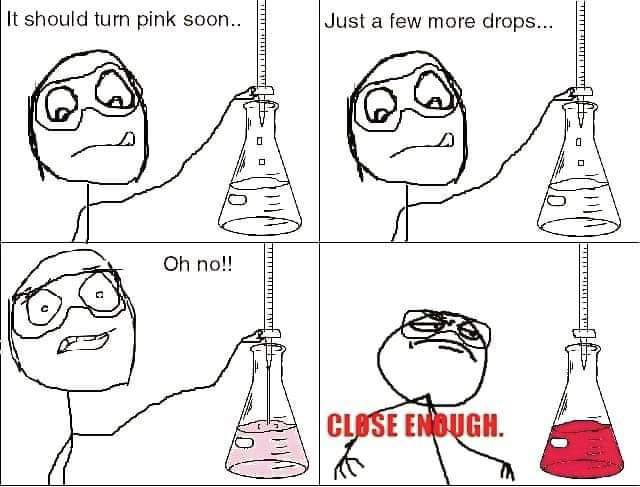
▲ 363 ▼ fck yea (mander.xyz) submitted 2 years ago by fossilesque@mander.xyz to c/science_memes@mander.xyz 30 comments fedilink hide all child comments
[+] Fleur_@lemm.ee 8 points 2 years ago* (last edited 2 years ago) (1 child) [removed by mod] permalink fedilink source hideshow 2 child comments replies: [–] GrammarPolice@lemmy.world 4 points 2 years ago (1 child) I still don't know what titration was about. Only that the solution was supposed to either turn pink or orange in some cases💀🙏 permalink fedilink source parent hideshow 2 child comments replies: [–] wolframhydroxide@sh.itjust.works 3 points 2 years ago* (1 child) Suppose you are trying to determine the concentration of a solution. You could try to boil off the water and figure out how much solid stuff is left over, but what if it's a mixture, and you just want to know how much, for instance, "Hydrochloric Acid" is in the water. Or, alternatively, some chemicals (such as Hydrochloric acid) evaporate with the water. We need a way to figure out the concentration of this chemical ( we'll call it "Chemical X") without trying to pull it out of the solution. So, you need to know how much Chemical X is in your solution, but you can't really easily separate it from the solution. What do you do? You Titrate! You find some other chemical that reacts with Chemical X, so that this new chemical (which we will call Chemical Y) will get instantly destroyed as long as there is still more Chemical X in solution. So, as long as there is more Chemical X in solution, the Chemical Y will get eaten up instantaneously, reacting with Chemical Y. Finally, you just need to have some way of detecting whether any Chemical Y exists in the solution, since the moment you see it in solution, you know there's no more Chemical X to eat it up. Now, you titrate: take a specific volume of your sample solution, and add a known concentration of Chemical Y, drop by drop. Once there is any chemical Y left over, you know you have found how much Chemical X was in the solution to start. Congratulations, you now know the concentration of Chemical X in the sample solution. permalink fedilink source parent hideshow 2 child comments replies: [–] GrammarPolice@lemmy.world 1 point 2 years ago (1 child) Thanks, but I'm now past the point where this info is useful to me. If this came 3 years ago though... permalink fedilink source parent hideshow 2 child comments replies: [–] captainlezbian@lemmy.world 1 point 2 years ago Knowledge always has the capacity to become useful again at some point permalink fedilink source parent
[–] GrammarPolice@lemmy.world 4 points 2 years ago (1 child) I still don't know what titration was about. Only that the solution was supposed to either turn pink or orange in some cases💀🙏 permalink fedilink source parent hideshow 2 child comments replies: [–] wolframhydroxide@sh.itjust.works 3 points 2 years ago* (1 child) Suppose you are trying to determine the concentration of a solution. You could try to boil off the water and figure out how much solid stuff is left over, but what if it's a mixture, and you just want to know how much, for instance, "Hydrochloric Acid" is in the water. Or, alternatively, some chemicals (such as Hydrochloric acid) evaporate with the water. We need a way to figure out the concentration of this chemical ( we'll call it "Chemical X") without trying to pull it out of the solution. So, you need to know how much Chemical X is in your solution, but you can't really easily separate it from the solution. What do you do? You Titrate! You find some other chemical that reacts with Chemical X, so that this new chemical (which we will call Chemical Y) will get instantly destroyed as long as there is still more Chemical X in solution. So, as long as there is more Chemical X in solution, the Chemical Y will get eaten up instantaneously, reacting with Chemical Y. Finally, you just need to have some way of detecting whether any Chemical Y exists in the solution, since the moment you see it in solution, you know there's no more Chemical X to eat it up. Now, you titrate: take a specific volume of your sample solution, and add a known concentration of Chemical Y, drop by drop. Once there is any chemical Y left over, you know you have found how much Chemical X was in the solution to start. Congratulations, you now know the concentration of Chemical X in the sample solution. permalink fedilink source parent hideshow 2 child comments replies: [–] GrammarPolice@lemmy.world 1 point 2 years ago (1 child) Thanks, but I'm now past the point where this info is useful to me. If this came 3 years ago though... permalink fedilink source parent hideshow 2 child comments replies: [–] captainlezbian@lemmy.world 1 point 2 years ago Knowledge always has the capacity to become useful again at some point permalink fedilink source parent
[–] wolframhydroxide@sh.itjust.works 3 points 2 years ago* (1 child) Suppose you are trying to determine the concentration of a solution. You could try to boil off the water and figure out how much solid stuff is left over, but what if it's a mixture, and you just want to know how much, for instance, "Hydrochloric Acid" is in the water. Or, alternatively, some chemicals (such as Hydrochloric acid) evaporate with the water. We need a way to figure out the concentration of this chemical ( we'll call it "Chemical X") without trying to pull it out of the solution. So, you need to know how much Chemical X is in your solution, but you can't really easily separate it from the solution. What do you do? You Titrate! You find some other chemical that reacts with Chemical X, so that this new chemical (which we will call Chemical Y) will get instantly destroyed as long as there is still more Chemical X in solution. So, as long as there is more Chemical X in solution, the Chemical Y will get eaten up instantaneously, reacting with Chemical Y. Finally, you just need to have some way of detecting whether any Chemical Y exists in the solution, since the moment you see it in solution, you know there's no more Chemical X to eat it up. Now, you titrate: take a specific volume of your sample solution, and add a known concentration of Chemical Y, drop by drop. Once there is any chemical Y left over, you know you have found how much Chemical X was in the solution to start. Congratulations, you now know the concentration of Chemical X in the sample solution. permalink fedilink source parent hideshow 2 child comments replies: [–] GrammarPolice@lemmy.world 1 point 2 years ago (1 child) Thanks, but I'm now past the point where this info is useful to me. If this came 3 years ago though... permalink fedilink source parent hideshow 2 child comments replies: [–] captainlezbian@lemmy.world 1 point 2 years ago Knowledge always has the capacity to become useful again at some point permalink fedilink source parent
[–] GrammarPolice@lemmy.world 1 point 2 years ago (1 child) Thanks, but I'm now past the point where this info is useful to me. If this came 3 years ago though... permalink fedilink source parent hideshow 2 child comments replies: [–] captainlezbian@lemmy.world 1 point 2 years ago Knowledge always has the capacity to become useful again at some point permalink fedilink source parent
[–] captainlezbian@lemmy.world 1 point 2 years ago Knowledge always has the capacity to become useful again at some point permalink fedilink source parent