1
submitted 3 years ago by [M] to c/selfhosting@slrpnk.net


Beneath the dark and uncertain clouds of bigtech, hidden among the declassed byte workers and the false technological prophets who with siren songs offer their digital services to "facilitate" digital life, rises an anarchic and countercultural community that seeks to reclaim the Internet and fight against those who squeeze our identity in the form of data to generate wealth and advertising for mass social manipulation and cohesion. Navigating the network of networks, with a small fleet of self-managed servers, geographically distributed yet cohesively united by cyberspace, the self-hosting community emerges as a way of life, a logic of inhabiting the digital, a way of fighting for an open, human network, free from the oligarchy of data.

To the naturalization of the already crystallized phrase "the cloud is someone else's computer" we add that this "someone else" is nothing more than a conglomerate of corporations that, like a hungry kraken, devours and controls the oceans of cyberspace. Against this we arm ourselves in community action, direct and self-managed by and for those of us who inhabit and fight for a more sovereign and just Internet. Our objectives are clear, and our principles are precise. We seek to break the mirage and charm that these beasts imposed at the point of ISPs and blacklist and we promote the ideal of an organized community based on their computing needs without the intermediation of outlaws and byte smugglers.

The big tech companies disembarked on the net with a myriad of free services that came to replace standards established during years of work among users, developers, communities, technocrats and other enthusiasts of the sidereal tide of cyberspace. By commoditizing basic Internet services and transforming them into objects of consumption, they led us to their islands of stylized products, built entirely with the aim of commercializing every aspect of our lives in an attempt to digitize and direct our consumption. Sending an email, chatting with family and friends, saving files on the network or simply sharing a link, everything becomes duly indexed, tagged and processed by someone else's computer. An other that is not a friend, nor a family member, nor anyone we know, but a megacorporation that, based on coldly calculated decisions, tries to manipulate and modify our habits and consumption. Anyone who has inhabited these digital spaces has seen how these services have changed our social behaviors and perceptions of reality, or will we continue to turn a blind eye to the tremendous disruption that social networks generate in all young people or the absurd waste of resources involved in sustaining the applications of technological mega-companies? Perhaps those who praise the Silicon Valley technogurus so much do not see the disaster of having to change your cell phone or computer because you can no longer surf the web or send an email.

If this is the technosolutionism that crypto-enthusiasts, evangelists of the web of the future or false shamans of programming offer us, we reject it out of hand. We are hacktivists and grassroots free software activists: we appropriate technology in pursuit of a collective construction according to our communities and not to the spurious designs of a hypercommercialized IT market. If today the byte worker plays the same role as the charcoal burner or workshop worker at the end of the 19th century, it is imperative that he politicizes and appropriates the means of production to build an alternative to this data violence. Only when this huge mass of computer workers awaken from their lethargy will we be able to take the next step towards the re-foundation of a cyberspace.

But we do not have to build on the empty ocean, as if we were lost overseas far from any coast; there is already a small but solid fleet of nomadic islands, which dodge and cut off the tentacles of the big tech kraken. Those islands are the computers of others, but real others, self-managed and organized in pursuit of personal, community and social needs. Self-hosting consists of materializing what is known as "the cloud", but stripped of the tyranny of data and the waste of energy to which the big tech companies have accustomed us. They are not organized to commoditize our identities, but to provide email, chat, file hosting, voice chat or any other existing digital need. Our small server-islands demonstrate that it is possible to stay active on the network without the violent tracking and theft, nor the imposed need to constantly replace our computer equipment: the self-hosted services, being thought by and for the community, are thought from the highest possible efficiency and not the immoral waste that directly collaborates with the climate crisis.

For this reason, we say to you, declassed byte workers, train yourself, question yourself, and appropriate the tools you use in order to form a commonwealth of hacktivists! Only between the union of computer workers and the communities of self-hosting and hacktivism we will be able to build alternatives for the refoundation of a cyberspace at the service of the people and not of the byte oligarchy.

But we need not only the working masses but also ordinary digital citizens, let's wake up from the generalized apathy to which we have been accustomed! No one can say anymore that technology is not their thing or that computing does not matter to them when all our lives are mediated through digital systems. That android phone that is still alive but no longer allows you to check your emails or chat with your family is simply the technological reality hitting you in the face; as much as the anxiety or dispersion that has existed in you for the last 15 years. Imagine the brain of a 14 year old teenager, totally moth-eaten by the violent algorithms of big tech!

Community digital needs are settled on the shores of our server-islands, not on the flagships of data refineries. Let's unite by building small servers in our homes, workplaces or cultural spaces; let's unite by building data networks that provide federated public instant messaging services that truly respect our freedoms and privacy. Let's publish robust, low-latency voice services; let's encourage the use of low computational consumption services to democratize voices whether you use a boat or a state-of-the-art racing boat. Let's create specialized forums and interconnect communities to unite us all, let's set our sails with the protocols and standards that exist, which allow us to dive the network using the device we want and not the one imposed on us. Let's lose the fear that prevents us from taking the first step and start this great learning path, which as an extra benefit will make us regain not only our technological sovereignty but also the control of our digital essence. It is not a matter of cutting off the private data networks of big tech but rather of building self-managed, self-hosted and self-administered spaces from the hacktivist bases, together with the workers of the byte and the digital citizenship: an Internet of the community for the community.
2
submitted 5 days ago* (last edited 5 days ago) by to c/selfhosting@slrpnk.net


Cross posted from: https://lemmy.nocturnal.garden/post/814241

Paperless-ngx is an extensive document management system. 3.0.0 has just been released.

It seems from a user/admin perspective that a lot of obsolete stuff under the hood got removed and they did some performance stuff, but it's also full of AI features. There's too many changes to read them all though, I wonder if there's a blogpost or something somewhere summarizing the main changes.

Personally I'll stay with 2.X for some days at least to see what people say about the new version. I'm not interested to have AI parse my documents, the alrogirthmic auto tagging etc works quite well.

3


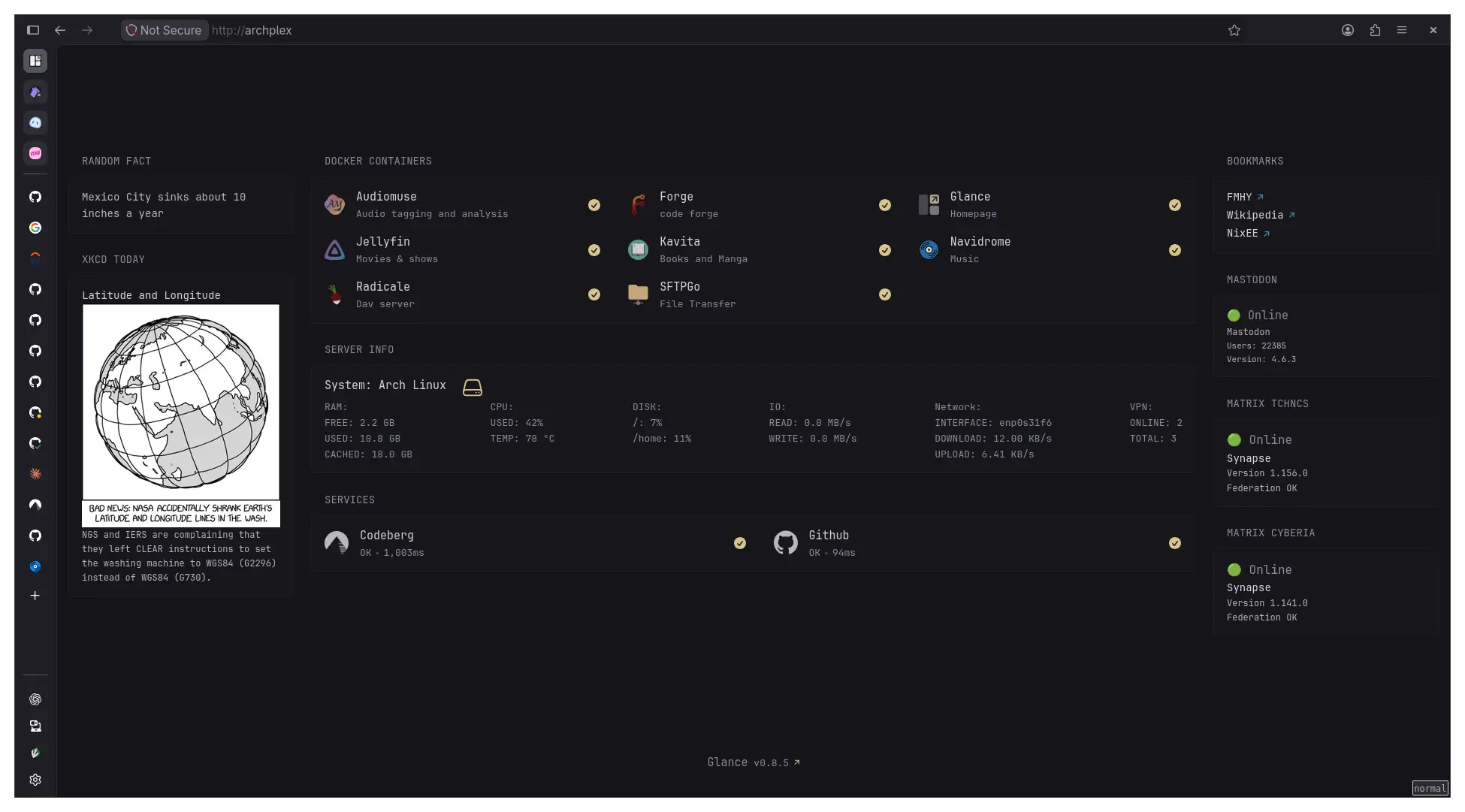
Cross-posted from "My selfhosting setup so far" by @innocentz3r0@programming.dev in !selfhosted@lemmy.world


Hey everyone! I'm sort of still green for selfhosting, but I wanted to share my setup so far:

The following services are selfhosted in docker

  • Audiomuse (smart music tagging, mood based and all that)
  • Navidrome for music hosting
  • Jellyfin for TV shows (not a lot) and Films (not a lot again, but steadily increasing)
  • Radicale for serving contacts/TODOs/calendar
  • SFTPGo to act as my drive
  • Kavita for ebooks and manga (I have tons of both)
  • Glance for homepage
  • forgejo for git forge hosting

The system specs are kind of visible in the homepage, so I won't spell them out here again. Mostly an old optiplex running arch, though I want to change it to nixos later on.

System tools:

  • nushell for shell
  • calibre for ebook management and tagging + fanficfare plugin to download fanfictions
  • Caddy for reverse proxy (so I don't have to remember ports)
  • netbird for VPN (also because it allows me to set wildcard DNS resolution for nodes, so I don't have to set up a dedicated pi-hole or adguard)
  • Handbrake and ffmpeg for processing videos and such
  • beets for tagging music
  • a sysinfo script to generate system information for glance to consume
  • Probably other things too, I'm forgetting

Everything is accessible only via netbird, and external inbound connections are firewalled off

Apart from that, I eventually plan on adding the following as well:

  • Immich for photo hosting
  • Vaultwarden for passwords
  • Gollum (still debating on alternatives) for a webUI for my notes
  • Paperless-NGX

I'm still thinking on more that I can add. Note that whatever I add should not need an inbound connection/stable IP address, since I don't intend to expose the server to the public. Any suggestions/tips? Thanks!

UPDATE: Forgot to add, I'd probably add homebox too, for inventory management 😅

UPDATE 2: I'm silly, I forgot that I'm also looking into self-hosted RSS feed readers 😆

4
5
6
7
8
submitted 2 weeks ago by [M] to c/selfhosting@slrpnk.net


Flohmarkt is a federated classified ads software.

9


forgive the tyos, english is absolutely my first language but we strugglin over here, ya feel? or, take it as confirmation this ain't some damn clanker bullshit

It's just like holy shit! this is what I've wanted my music to do my whole life! This is almost just another member of the family.

Feishin and the smart playlists really really shine when adding user ratings into the mix. plus, adding a "mood" tag and then being able to use our own terms, it is incredible.

Build a custom station with the tags you want, then add "not played in the last days" (depending on how much traffic/supply of that particular kind of music gets) and it keeps it fresh. Add in "rating is not 1" and you'll see the stuff that hasn't been rated yet, but it won't even let 1 start tracks into the queue!

I have rediscovered old favorites, found new songs by classic artists, have perfectly curated playlists down to the nth degree, custom stations that show me exactly what i want before i even knew i wanted to listen to that right then, all without commercials, on every device i own.

i am pumped for the future of the open subsonic API's! I think a skipped count could be awesome. I'd like to automate some stuff based off skip counts.

the navidrome plugins are getting some inertia, i am excited to see where that goes.

Other Navidrome/opensubsonic users, how do you guys use the 5 stars? for me it is

  • 5 amazing song, not only will i 99% of the time never skip it, i will try to get everyone's attention and have them listen
  • 4 i really like this song and have stopped what i am doing to pay attention to it, it is not likely but may get skipped depending on the mood/genre desired at that time
  • 3 - this song is good and i notice it and smile while continuing doing my thing, unless it is the wrong mood/genre (can i blast it while working?), which means it gets skipped.
  • 2 - this song is unobtrusive and doesn't appear to bother or inspire me.
  • 1 this song catches my attention due to disliking it. I will go out of my way to stop it from playing. i set up my stations to never call for those again.

I am looking for other ways to interface with this to be able to rate songs a little easier/safer (while driving?)

I am hopeful i will have the wiggle room to donate to navidrome, feishin, snapcast, mopidy, spindle, soon!!!!

10
submitted 2 weeks ago* (last edited 2 weeks ago) by [M] to c/selfhosting@slrpnk.net


wanderer is a self-hosted trail database. Save your adventures!

11


So, I tried to install lidarr on my windows machine via the exe on the website, but my antivirus flagged it immediately. I am sure i could just work around this by disabling the antivirus for a bit or by composing it manually, but for all I know maybe someone inserted some malicious code. Is this an issue y'all have noticed? How can I tell if this is actually malicious?

12
13
submitted 1 month ago by to c/selfhosting@slrpnk.net


I'm considering running Stirling PDF. In a way, it's pretty niche: a tool for editing PDF files. On the other hand, when the need arises every now and then, for myself or those around me, it's always a bit of a pain to figure out how to do it right on Linux.

Stirling seems to be a decent solution for this.

However, seeing things like this in the docs is giving me pause :

Before configuring OAuth 2.0 SSO, ensure you have:

  • Stirling PDF with login enabled (security.enableLogin: true)
  • Valid license for Professional tier or higher

Requirements:

  • Java 21+
  • Linux/Unix system
  • 2GB RAM minimum
  • LibreOffice, Tesseract (for features)

Have some of you deployed it and used it? What's your take?

Thanks!

14


cross-posted from: https://programming.dev/post/51407459

Check what can you use and at what rate of token per seconds would it be... It has examples of many models and quantization levels. Huge resource!

15
16


Hello,

I'm relatively new to self-hosting, please be gentle. If any of what I'm about to say reveals some egregious lack in understanding, I'm listening :)

I have a cute little Synology NAS on our local LAN through a Fritz Box and I'm quite happy with how I've been able to figure out stuff on my own so far (bit proud of meself here). Using Portainer to manage Immich, Syncthing, Jellyfin, some arrs, Dashy, jDownloader, tinyMediaManager, in the process of setting up Navidrome, looking into ways to block ads that agree with the Fritz Box, it's all very nice and cosy.

The thing is that it's getting a bit difficult to remember what's on which port. Dashy is at 192.168.178.36:4500, Immich is at 192.168.178.36:2283 etc. Which isn't a problem per se but it's not exactly pretty (and I have a husband who isn't interested in all that stuff at all but might want to use some things if he can remember where they are) (also numbers are scawwy).

So, question: is there a way to make these services reachable from inside the LAN at, say, 192.168.178.36/[service name]? Or, even better, something like //[service name]?

Like, a kind of DNS thing to route [service name] to [(NAS IP:)port]? Maybe? I think? I'm behind a CGNAT so I can't go through any external service (I think? right?). I know there are ways around that but I don't need to access my network from the outside for now (and the foreseeable future) so this is lowest priority.

Been trying to figure this out for several days but tbh I don't even know what I'm looking for, so if anyone can even give me some terms to ask the internet about, that would already be progress and I'd be very grateful. Also, please speak slowly i'm new uwu

17


Hello everyone, since this is my first post, i hope i am at the right place :D

I am hosting a webring for solarpunk websites and wanted to move this from the corporate hoster to the raspberry pi that was collecting dust in my cupboard to hopefully host it on solar in the future.

I installed nginx and put the website there, configured the portforwarding on my router (ports 80 and 443 to 80 and 443 on the pi) and gave it a fixed local IP. I then used ddclient to update the IP of the pi to the dyndns-API of my hoster (which i will keep for the domain for now). It is reachable through HTTP (http://solarpunk-ring.net/) but refuses connection for HTTPS.

The Internet is full of AI-generated tutorials on how to self host and use a DynDNS-service, but i couldn't find any info on this excact issue.

I assume it is not the DynDNS since that would otherwise also not refer to the correct IP with HTTP without S. Now i don't know if it is the router or nginx or the pi itself refusing connection. The error log of nginx is empty. Ports are allowed in firewall, i also tried disabling the firewall, same error.

I have no idea what to check next and as i said, the ai-shit i get from my search engine isn't helping either.

Sorry if this is the wrong place.

18


any suggestions on enclosure or room temp/humidity sensors? PoE network connected would be ideal, but USB works as well (cheap, simple). polling/transformation of data will ultimately be done by a raspi 3b.

open software/hardware is highly desirable and, as long as data is structured, I can transform as needed for insertion into a zabbix backend.

thanks for any recommendations :-)

19
 
 
20


I just bought a 2nd-hand CubieTruck which apparently has a cubieboard 3. The cubieboard.org website is a shit-show of dead links. There are some docs but all the drivers and software are dead links. No Android or Debian images. It’s also a shit-show over at archive.org:

http://web.archive.org/web/20171105012836/http://dl.cubieboard.org/software/a20-cubieboard/android/v2.0_A20_android_source.tar.gz

There is a tree of directories here:

http://web.archive.org/web/20180225200418/http://dl.cubieboard.org/

but 404 errors on all files. In principle, softwareheritage.org should have the software. But it doesn’t because (I suspect) s/w heritage fixates on github and probably needed someone to manually request that they keep software outside of Microsoft’s walled garden.

I don’t suppose anyone has cubieboard 3 files.. but in the very least I hope this post will serve to warn ppl to avoid cubieboard.

21


I run some services on machine A. I want to backup the data to machine B. It's around 40 gigabytes in thousands of small files. I would prefer to compress the data, but there's not enough space on machine A to keep the data twice (original + tar archive). I would like to avoid copying that many files via scp/rsync since it's taking forever and a bit fragile.

Any solutions on how to solve this? Is it possible to compress live on machine A and stream into the archive on machine B without the need to keep the big archive file on A?

Eventually, it's supposed to be automated and B has like the last 3 dailys, 1 weekly, 1 montly.

B can ssh into A.

22


I want something simple that works for my family and myself. We used Discord, but for when they pull their next stunt, I want to be ready and having something working already.

What do you all use?

23


Hi all! i finally come around publishing a small side project i am running at my home for the last few years. This past month i have revamped it by rewriting the C++ backend and improving the web UI (single page HTML+CSS+AlpineJS) for a broader public.

LazyNVR is a different take on hosting webcams and centralizing access to them. Instead of working on the cameras feed, which is CPU/GPU heavy and doesn't scale much, it relies on cameras on-board capabilities to detect motion and upload recorded videos to your own server.

If you own IP cameras from brands like Dahua, Reolink and many others, you can leverage their on board motion detection capabilities and off-load your server computational power using LazyNVR.

I have some 15 cameras and tools like Frigate or MotionEye just kill my server CPU, but all my cameras can detect motions and automatically record a video and upload it to my server using different protocols (like FTP, sftp, and such). So LazyNVR was born.

The server is written in C++ and basically detect incoming videos, recode (without re-encoding) them to an MP4 web streammable format, and store them well sorted. It will also keep your incoming folders clean and purge stored videos when they are too old. The server will also fetch and refresh still live images from the cameras.

The client is a WEB GUI, actually a single HTML file with CSS and some AlpineJS, which will show the still live images and the list of all the recorded videos letting you download or view them directly.

I am running over 15 cameras from my RaspPi with basically 0% CPU overhead.

I have published LazyNVR on Codeberg (here https://codeberg.org/LazyNVR/lazynvr-sources) because well, i think it's better than GitHub. And there is also a pretty lazy web site on https://www.lazynvr.it/ (which mostly redirect to Codeberg).

Currently there are docker images for AMD64 and ARM64, but it's pretty easy to compile directly, with the provided instructions in the Codeberg Wiki.

Please, feel free to try it!

Mandatory AI disclaimer: i don't use AI for coding. Zero code (C++ or Javscript) has been written by or with AI support in this project. I have used AI extensively for the CSS stuff that i hate, but reviewed and mostly edited it anyway. I have also used AI for research and to write the dockerfile faster, since i am no docker expert. I have personally written the dockerfile anyway, and personally tested as well. The logo has been created with AI, probably it shows.

Developer @Shimitar@downonthestreet.eu

24


cross-posted from: https://feddit.nl/post/56825643

So you don't want to port-forward on your home router or have Cloudflare decrypt all your traffic? Check out Towonel.

Most open source Cloudflare Tunnel alternatives involve setting up a VPS, terminating TLS there on a reverse proxy, then setting up a Wireguard tunnel to your server at home.

Towonel is different: it does not decrypt your traffic on the VPS and you can easily share one, so not every self-hoster has to buy and maintain a VPS.

Check it out!

Mastodon link: https://gts.erwanleboucher.dev/@eleboucher/statuses/01KS4YNA2SYMSP0FSKJVNJA155

25
submitted 2 months ago* (last edited 2 months ago) by to c/selfhosting@slrpnk.net


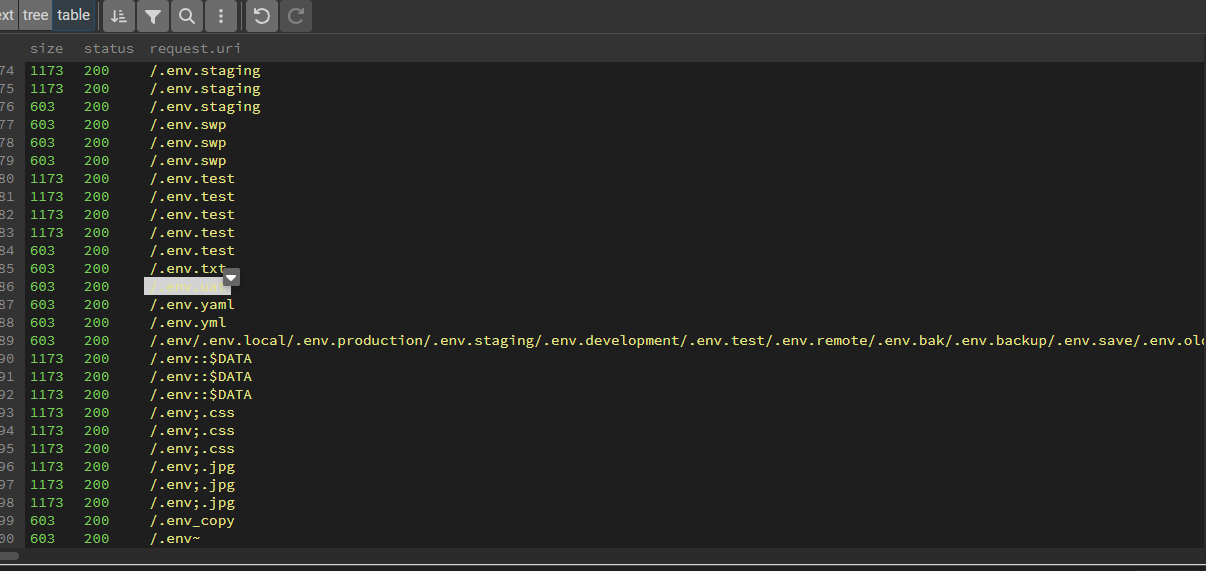
Someone messed their loop

FULL TRANSCRIPT URI

"request.uri" = /.env/.env.local/.env.production/.env.staging/.env.development/.env.test/.env.remote/.env.bak/.env.backup/.env.save/.env.old/.env.sample/.env.example/.env.dev/.env.prod/.env.stage/.env.ci/.env.docker/.env.live/.env.preprod/.env.uat/.env.dist/.env.swp/.env~/.env1/.env2/.env_copy/.env.txt/.env.json/.env.yaml/.env.yml/app/.env/apps/.env/api/.env/web/.env/site/.env/public/.env/admin/.env/backend/.env/server/.env/frontend/.env/src/.env/core/.env/core/app/.env/config/.env/private/.env/application/.env/bootstrap/.env/database/.env/storage/.env/var/www/.env/var/www/html/.env/current/.env/release/.env/releases/.env/shared/.env/deploy/.env/build/.env/dist/.env/public_html/.env/htdocs/.env/www/.env/html/.env/live/.env/prod/.env/dev/.env/staging/.env/opt/.env/laravel/.env/symfony/.env/wordpress/.env/wp/.env/cms/.env/drupal/.env/joomla/.env/magento/.env/shopify/.env/prestashop/.env/codeigniter/.env/cakephp/.env/zend/.env/yii/.env/laravel5/.env/v1/.env/v2/.env/v3/.env/api/v1/.env/api/v2/.env/rest/.env/graphql/.env/gateway/.env/microservice/.env/service/.env/api/v3/.env/api/dev/.env/api/staging/.env/vendor/.env/lib/.env/resources/.env/assets/.env/uploads/.env/internal/.env/tools/.env/scripts/.env/bin/.env/sbin/.env/local/.env/portal/.env/dashboard/.env/panel/.env/crm/.env/erp/.env/shop/.env/store/.env/saas/.env/client/.env/project/.env/admin-panel/.env/control-panel/.env/user-panel/.env/node/.env/express/.env/next/.env/nuxt/.env/nest/.env/react/.env/vue/.env/angular/.env/svelte/.env/vite/.env/backup/.env/backups/.env/old/.env/tmp/.env/temp/.env/lab/.env/cronlab/.env/cron/.env/en/.env/administrator/.env/psnlink/.env/exapi/.env/sitemaps/.env/.env.backup1/.env.backup2/logs/.env/cache/.env/mailer/.env/mail/.env/email/.env/smtp/.env/mailing/.env/notifications/.env/notify/.env/sender/.env/campaign/.env/newsletter/.env/ses/.env/sendgrid/.env/sparkpost/.env/postmark/.env/mailgun/.env/mandrill/.env/mailjet/.env/brevo/.env/transactional/.env/bulk/.env/aws/.env/azure/.env/gcp/.env/cloud/.env/infrastructure/.env/docker/.env/k8s/.env/kubernetes/.env/terraform/.env/ansible/.env/.git/.env/ci/.env/cd/.env/jenkins/.env/gitlab/.env/github/.env/actions/.env/circleci/.env/travis/.env/buildkite/.env/mysql/.env/postgres/.env/mongodb/.env/redis/.env/elasticsearch/.env/rabbitmq/.env/kafka/.env/queue/.env/worker/.env/job/.env/test/.env/qa/.env/preview/.env/beta/.env/uat/.env/stage/.env/development/.env/production/.env/config/app/.env

view more: next ›