[–] [S] 2 points 6 days ago

Ok, so reading the replies I see that it was meant for me.

All the relevant volumes are mapped to the actual filesystem on disk (like you do in docker compose, ig it's called a volume bind-mount?), so when I have to take backups I stop the docker container and manually cp/rsync/whatever from the directory.

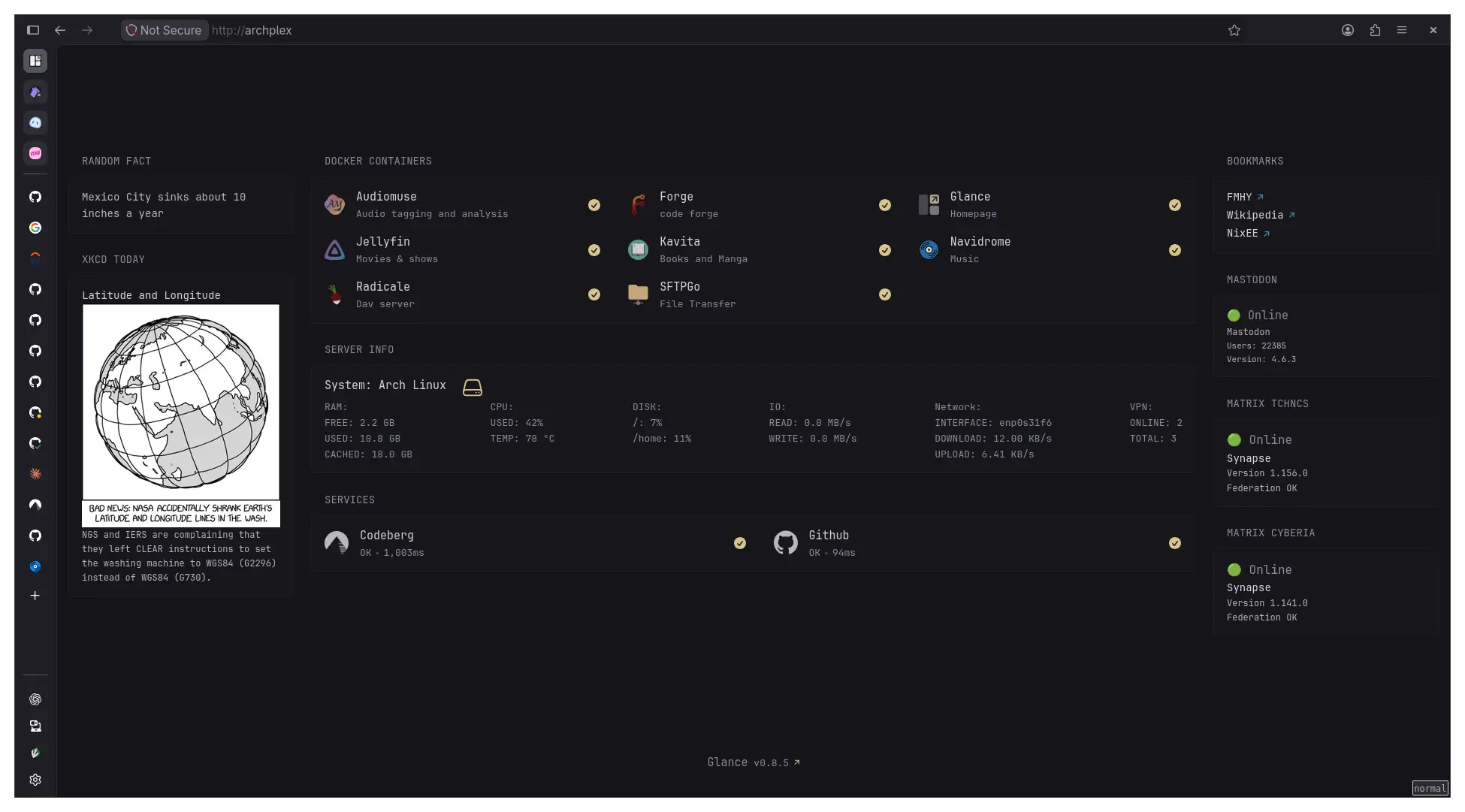
The github and codeberg services are nothing but HTTPS checks for both of them

  • source
  • parent
  • context
  • [–] [S] 4 points 1 week ago

    Ah, I asked around and people recommended miniflux over freshrss since the former is written in Go and is lighter and faster.

    Radicale is pretty nice, fits my bill well, and just works. Some people say Baikal is better, but Radicale fits my bill very well so I didn't bother changing.

  • source
  • parent
  • context
  • [–] [S] 2 points 1 week ago (1 child)

    Well, as I mentioned, I don't think I can host an XMPP server without having a fixed IP address and exposing it to the public internet and allowing inbound connections.

    So it's probably a no-no (for now) 😅

    Also, idk if xmpp is lightweight, but as a user, I quite like matrix

  • source
  • parent
  • context
  • [–] [S] 2 points 1 week ago

    Ah yes, I got it working, the issue was unshare-pgid which had already been sort of raised in nixpak.

    In my case, I used bubblewrap.newSession (which is equivalent of --new-session). Idk why that worked out finally with --unshare-pgid, but I'd rather not spend more time on this.

    I like the idea of let binding the package declaration to use it in the config as well. I'll probably use that. Thanks!

  • source
  •  

    Cross-posted from "My selfhosting setup so far" by @innocentz3r0@programming.dev in !selfhosted@lemmy.world


    Hey everyone! I'm sort of still green for selfhosting, but I wanted to share my setup so far:

    The following services are selfhosted in docker

    • Audiomuse (smart music tagging, mood based and all that)
    • Navidrome for music hosting
    • Jellyfin for TV shows (not a lot) and Films (not a lot again, but steadily increasing)
    • Radicale for serving contacts/TODOs/calendar
    • SFTPGo to act as my drive
    • Kavita for ebooks and manga (I have tons of both)
    • Glance for homepage
    • forgejo for git forge hosting

    The system specs are kind of visible in the homepage, so I won't spell them out here again. Mostly an old optiplex running arch, though I want to change it to nixos later on.

    System tools:

    • nushell for shell
    • calibre for ebook management and tagging + fanficfare plugin to download fanfictions
    • Caddy for reverse proxy (so I don't have to remember ports)
    • netbird for VPN (also because it allows me to set wildcard DNS resolution for nodes, so I don't have to set up a dedicated pi-hole or adguard)
    • Handbrake and ffmpeg for processing videos and such
    • beets for tagging music
    • a sysinfo script to generate system information for glance to consume
    • Probably other things too, I'm forgetting

    Everything is accessible only via netbird, and external inbound connections are firewalled off

    Apart from that, I eventually plan on adding the following as well:

    • Immich for photo hosting
    • Vaultwarden for passwords
    • Gollum (still debating on alternatives) for a webUI for my notes
    • Paperless-NGX

    I'm still thinking on more that I can add. Note that whatever I add should not need an inbound connection/stable IP address, since I don't intend to expose the server to the public. Any suggestions/tips? Thanks!

    UPDATE: Forgot to add, I'd probably add homebox too, for inventory management 😅

    UPDATE 2: I'm silly, I forgot that I'm also looking into self-hosted RSS feed readers 😆
    [–] [S] 4 points 1 week ago (2 children)

    I access it using the hostname of the device (since netbird and tailscale both let you do that)

    I also open docker ports only for localhost, and use caddy to reverse proxy subdomains to the respective localhost ports. Less port clutter from outside this way. Ofcourse things like SFTPGo's SFTP port is an exception

    Also, vaultwarden requires HTTPS?? Ah drat, that's not good :/ I don't have experience with that.

  • source
  • parent
  • context
  • [–] [S] 3 points 1 week ago (1 child)

    I've heard good things about SearXNG. I'll be sure to check that out.

    I don't see the need for cryptpad, since SFTPGo serves my purposes.

    I'd look into mealie, since I'm going to live alone and need to figure my own meals out. Perhaps Sure/Actual too!

    I am still looking at container management, right now I just manually update/backup everything.

  • source
  • parent
  • context
  • submitted 1 week ago* (last edited 1 week ago) by to c/selfhosted@lemmy.world
     

    Hey everyone! I'm sort of still green for selfhosting, but I wanted to share my setup so far:

    The following services are selfhosted in docker

    • Audiomuse (smart music tagging, mood based and all that)
    • Navidrome for music hosting
    • Jellyfin for TV shows (not a lot) and Films (not a lot again, but steadily increasing)
    • Radicale for serving contacts/TODOs/calendar
    • SFTPGo to act as my drive
    • Kavita for ebooks and manga (I have tons of both)
    • Glance for homepage
    • forgejo for git forge hosting

    The system specs are kind of visible in the homepage, so I won't spell them out here again. Mostly an old optiplex running arch, though I want to change it to nixos later on.

    System tools:

    • nushell for shell
    • calibre for ebook management and tagging + fanficfare plugin to download fanfictions
    • Caddy for reverse proxy (so I don't have to remember ports)
    • netbird for VPN (also because it allows me to set wildcard DNS resolution for nodes, so I don't have to set up a dedicated pi-hole or adguard)
    • Handbrake and ffmpeg for processing videos and such
    • beets for tagging music
    • a sysinfo script to generate system information for glance to consume
    • Probably other things too, I'm forgetting

    Everything is accessible only via netbird, and external inbound connections are firewalled off

    Apart from that, I eventually plan on adding the following as well:

    • Immich for photo hosting
    • Vaultwarden for passwords
    • Gollum (still debating on alternatives) for a webUI for my notes
    • Paperless-NGX

    I'm still thinking on more that I can add. Note that whatever I add should not need an inbound connection/stable IP address, since I don't intend to expose the server to the public. Any suggestions/tips? Thanks!

    UPDATE: Forgot to add, I'd probably add homebox too, for inventory management 😅

    UPDATE 2: I'm silly, I forgot that I'm also looking into self-hosted RSS feed readers 😆


    Pretty much the title. Please bear with me, since I'm sort of a beginner 😅

    I am trying to use nixpak to sandbox iamb, but for whatever reason, it doesn't start up and run properly. Here's the relevant section of the config

    environment.systemPackages = [
          (mkNixPak {
            config = { pkgs, sloth, ... }: {
              app.package = pkgs.iamb;
    
              bubblewrap = {
                network = true;
                shareIpc = false;
                dieWithParent = true;
    
                bind.rw = [
                  [
                    (sloth.mkdir (sloth.concat' sloth.homeDir "/Downloads/iamb"))
                    (sloth.concat' sloth.homeDir "/Downloads")
                  ]
    
                  (sloth.mkdir (sloth.concat' sloth.xdgConfigHome "/iamb"))
                  (sloth.mkdir (sloth.concat' sloth.xdgDataHome "/iamb"))
                  (sloth.mkdir (sloth.concat' sloth.xdgStateHome "/iamb"))
                  (sloth.mkdir (sloth.concat' sloth.xdgCacheHome "/iamb"))
    
                ];
    
                bind.ro = [
                "/etc"
                "/usr"
                # To mount the systemd resolution stuff and so on
                "/run/systemd"
                ];
    
                apivfs = {
                  proc = true;
                  dev = true;
                };
    
                bind.dev = [
                  "/dev"
                ];
    
                tmpfs = [
                  (sloth.mkdir "/tmp/iamb")
                ];
    
                env = {
                    TERMINFO = "${pkgs.kitty}/lib/kitty/terminfo";
                };
              };
    
            };
          }).config.env
    ];
    

    The full config can be found here

    The following bubblewrap command works as-is on nixos, and doesn't lead to any errors whatsoever:

    bwrap --ro-bind /usr /usr \
    --ro-bind /etc /etc \
    --proc /proc \
    --ro-bind /home/innocentzero/.local/state/nix/profile /home/innocentzero/.local/state/nix/profile \
    --ro-bind /nix/store /nix/store \
    --ro-bind /run/systemd /run/systemd \
    --dev /dev \
    --tmpfs /tmp \
    --unshare-all \
    --share-net \
    --die-with-parent \
    --bind /home/innocentzero/.config/iamb /home/innocentzero/.config/iamb \
    --bind /home/innocentzero/.cache/iamb /home/innocentzero/.cache/iamb \
    --bind /home/innocentzero/.local/share/iamb /home/innocentzero/.local/share/iamb \
    iamb
    

    However, executing the nixpak wrapped iamb produces the following (including the control characters):

    ^[[?62;4;22;28;52c^[[6;25;11t^[[0n* Logging in for @innocentzer0:cyberia.club...

    Any ideas/suggestions? I'm not sure how exactly to get this to work. From what I see in the nixpak module, the generated command should be about the same. Any help is appreciated. Thanks!


    cross-posted from: https://programming.dev/post/45148310

    Supac - a declarative package manager written in Rust, scriptable in nushell

    Supac is a declarative package manager written in Rust fully scriptable in nushell. It's meant to make it easy to use the native package managers in existing distros without going through the associated headaches of using Nix, while maintaining the ergonomics of structured data in nushell.

    Currently supported backends are:

    • Archlinux and derivatives
    • flatpak
    • cargo/cargo-binstall
    • uvx (packages only for now)
    • rustup toolchains

    I daily drive it, and it works well. Feel free to give it a try!


    cross-posted from: https://programming.dev/post/45148310

    Supac - a declarative package manager written in Rust, scriptable in nushell

    Supac is a declarative package manager written in Rust fully scriptable in nushell. It's meant to make it easy to use the native package managers in existing distros without going through the associated headaches of using Nix, while maintaining the ergonomics of structured data in nushell.

    Currently supported backends are:

    • Archlinux and derivatives
    • flatpak
    • cargo/cargo-binstall
    • uvx (packages only for now)
    • rustup toolchains

    I daily drive it, and it works well. Feel free to give it a try!


    cross-posted from: https://programming.dev/post/45148310

    Supac - a declarative package manager written in Rust, scriptable in nushell

    Supac is a declarative package manager written in Rust fully scriptable in nushell. It's meant to make it easy to use the native package managers in existing distros without going through the associated headaches of using Nix, while maintaining the ergonomics of structured data in nushell.

    Currently supported backends are:

    • Archlinux and derivatives
    • flatpak
    • cargo/cargo-binstall
    • uvx (packages only for now)
    • rustup toolchains

    I daily drive it, and it works well. Feel free to give it a try!


    cross-posted from: https://programming.dev/post/45148310

    Supac is a declarative package manager written in Rust fully scriptable in nushell. It's meant to make it easy to use the native package managers in existing distros without going through the associated headaches of using Nix, while maintaining the ergonomics of structured data in nushell.

    Currently supported backends are:

    • Archlinux and derivatives
    • flatpak
    • cargo/cargo-binstall
    • uvx (packages only for now)
    • rustup toolchains

    I daily drive it, and it works well. Feel free to give it a try!


    cross-posted from: https://programming.dev/post/45148310

    Supac is a declarative package manager written in Rust fully scriptable in nushell. It's meant to make it easy to use the native package managers in existing distros without going through the associated headaches of using Nix, while maintaining the ergonomics of structured data in nushell.

    Currently supported backends are:

    • Archlinux and derivatives
    • flatpak
    • cargo/cargo-binstall
    • uvx (packages only for now)
    • rustup toolchains

    I daily drive it, and it works well. Feel free to give it a try!


    cross-posted from: https://programming.dev/post/45148310

    Supac is a declarative package manager written in Rust fully scriptable in nushell. It's meant to make it easy to use the native package managers in existing distros without going through the associated headaches of using Nix, while maintaining the ergonomics of structured data in nushell.

    Currently supported backends are:

    • Archlinux and derivatives
    • flatpak
    • cargo/cargo-binstall
    • uvx (packages only for now)
    • rustup toolchains

    I daily drive it, and it works well. Feel free to give it a try!


    Supac is a declarative package manager written in Rust fully scriptable in nushell. It's meant to make it easy to use the native package managers in existing distros without going through the associated headaches of using Nix, while maintaining the ergonomics of structured data in nushell.

    Currently supported backends are:

    • Archlinux and derivatives
    • flatpak
    • cargo/cargo-binstall
    • uvx (packages only for now)
    • rustup toolchains

    I daily drive it, and it works well. Feel free to give it a try!

    view more: next ›