Spamming the trade buttons seems to be a good strategy
It's not his tests. It's the ai writing tests.
Who wrote the tests?
Who will lose money?
You're right, I think most of the Western world politics is too dependent on the capital and that is dependent on the US markets. When the entire thing crashes, it's going to be bad. I'm pretty sure I'll be among those people affected, I'm in software, working (remotely) for an US firm. That was after recently losing my job due to failed investment. My wife's job just got "restructured" as well, and it's the second time in three years as well.
Not sure how we'll deal. I should be making plans on what to do when I lose the house and everything else. I kinda know it but I'm not sure what can I do.
Why collaborate with Britain? That's basically just going back to giving everything to us again, without getting much in return? Talking about that missile program in the article.
Could be both, but that's a good question. They say memory but mention the space for updates.
I don't know how that works, is 60k karma good? That's post karma, not comment karma, right?
I know and the commenter above seems to understand that it's possible, but they agreed about contributing.
Donating hardware that you already own is probably possible, but can be tricky and has security connotations, depending on the arrangement. Unless you're simply paying for hosting costs for that node and have no operational control at all.
There are simpler and better days.
If you want to donate, chip in to whatever server you're on (e.g. lemmy.zip) - send them a few dollars a month, or a one time donation. Or find an instance or a software project (e.g. Lemmy or Gotosocial or Mastodon) and give them those few bucks.
Just making the effort is both not that hard, but it's also great. Even people who don't have money to spare can try it. I don't know, find something like a book or a cupboard you're not using, sell it for a small amount of money, and send it.
Of course, lots of people can't afford to, and that's why other people are running open servers. That part is super hard not just because of money, but moderation. Running an instance means you commit your time, every day, all the time, to moderate the users, to monitor the software, to fight off DDoS attacks and a million other things. So you can also offer to donate some of your time. Be it moderation or e.g. issue triage or something, it's usually welcome. So you can look into it. But make sure you can commit - short term "I'll try it" help is often taking more time to train the volunteer then they're going to contribute back before giving up.
Finally, as someone says, it's also easy to run your own server. Either buy hosting and operation - I know e.g. masto.host but I'm sure there are others - you pay and they monitor and maintain the software. You just moderate it l like an admin. Invite your buddy there.
Some people have the time and skills and operate their own servers, without spending the time for moderation. I'm running a single user instance of Gotosocial. I have control, but I don't have to deal with moderation. That's also feasible.
Anyway, for your buddy, educate them that it's not the same as Twitter Reddit or Instagram, but the core ideas are similar. Send them a meme post or an interesting thread from time to time. They'll want to engage eventually. Upvote or reply. They have to make the account. They'll then get bored, give up, but that's fine. Moderate yourself, don't spam them. If they like it they'll come back. Or they'll get frustrated by another ad Block busting scheme by Reddit and come back again. Or not. Which is also fine.
And if they do misdiagnose one in five patients, well, they shouldn't have gotten infected, it's their fault.
I would hardly call this dropping a hammer, though. I mean, the article itself says that OpenAI was lobbying for stuff like this.
For one, I don't think it's addressing any of the most troublesome problems. No mention of environmental impact. No mention of societal impact, or economic one. Nobody is addressing the horrible misuse of LLMs in, say education or biases that are built into the LLMs.
For two, what are the consequences? Sam Altman can go around saying whatever the hell he wants, mislead the government, the public, even their own users. No consequences. They can use bait and switch, no problems. The worst thing they can get is a few million dollars of fines. That's for the long time been just the cost of doing business.
It's a fig leaf law that doesn't look at any of the worst problems we have but the worst offenders can use it to say "no wait we're regulated".
I am getting started with film - shooting, developing, processing - so it's not perfect, yet. But I like the result.

This one was for my 52frames Egg entry. There's more at my photo site.
Hashtag egg, also I should tag my Fuji with which I've taken them and all that ;)

I liked @blendan@blendan@lemmy.world's duck, and I wanted to show this pair.

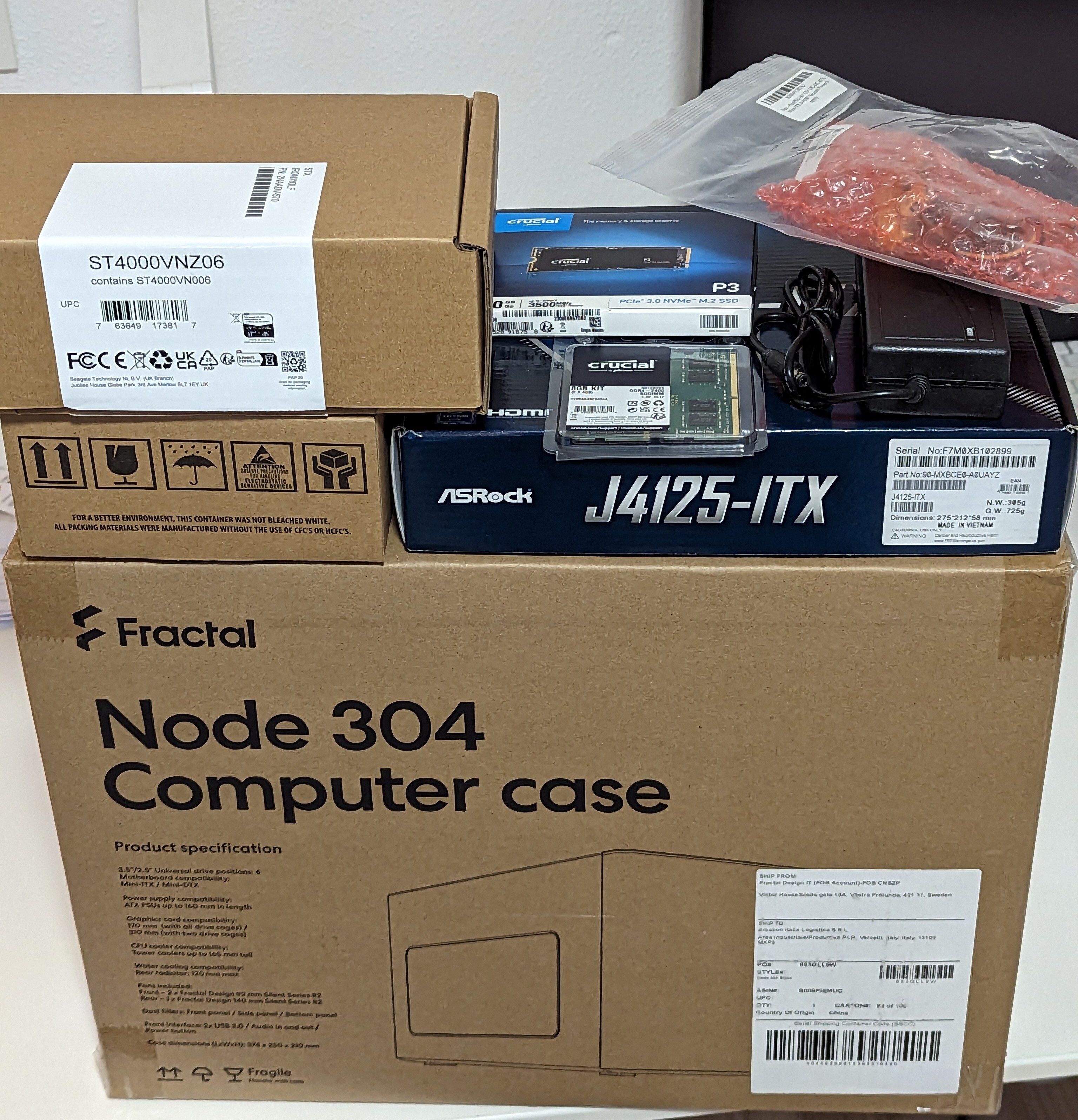
I'm building a NAS for the first time on my own, so I wanted to share the story so far here.
I'm not a stranger to custom builds, in fact I don't think I ever bought an assembled PC (not counting second hand 386 box a million years ago). But this is my first small, low power build, so it's not perfect, I already ran into a wall (more later).
I base the build on an AsRock mini-ITX board, the CPU is included, it's passively cooled, low power consumption but still powerful for a NAS. I'm sticking it into a Node 304 Fractal Design case. Here's the full list of parts I got:
- AsRock J4125-ITX board with a Celeron 4125 (4-core CPU)
- 8GB DDR4 RAM (a Crucial kit)
- a 500GB NVMe SSD (which I can't use)
- a couple of Seagate IronWolf 4TB drives
- 90W PicoPSU and some no-name power brick
- Fractal Design Node 304 mini-ITX case.
I planned to have an SSD for OS, these two disks for my photography and media, and then later on expand with more storage (preferably SSD, when I can afford it).
As mentioned, I messed up: the M2 slot on the motherboard is a "Key E" slot. I never bothered with these keys before, so I didn't know that a Key E slot does not have a SATA protocol, it won't take my SSD.
Another thing, the PicoPSU is a 20-pin power supply, and the board has a 24-pin slot. It should still be fine, the specs say that this is still okay, but I'll have to see. According to my back-of-the-napkin calculations, 90 Watts should be enough power for the mobo and CPU, the SSD and the two spinning disks.
Anyway I'll get a regular SATA SSD tomorrow and see how it's shaping up. Let me know if you want me to post more on my progress/end result or if you have any questions.
Taken for the 52frames.com challenge last week. I have a few more shots on my (relatively new) photo site.

view more:
next ›