[–] 1 point 11 minutes ago*

If ai tech is so important and life saving tell me what it can actually do right now.

I'm not sure if your statement is rhetorical or if you're actually looking for provable life saving AI. If you're looking for actual use cases today then here's a couple:

  • Waymo driver (the computer) has fewer car crashes and of those crashes they are far less severe than human drivers. This includes 94% fewer serious injury or worse crashes than a human driver and 82% fewer injury crashes than a human driver. source
  • Breast cancer detection - The study revealed that the AI group had 20% more cancers detected than the radiologist-only group. source
  • source
  • parent
  • context
  • [–] 11 points 10 hours ago

    With this digitally connected world, when a friend leaves the city that doesn't have to be the end of the friendship. One of my best friends moved to another city 3 hours away. We still talk or text a few times every month. We meet in person a few times a year when they're in my city or I'm in theirs. Sometimes we drive to meet at a third city between our two cities. We've met up and gone on multiple vacations with each other with our spouses. He moved away over 25 years ago to be closer to family when he was raising his first child. We certainly had busy lives of our own in adulthood, but that doesn't mean we lost that friendship. We are still close today.

    Is it possible some of your friends feel the same about you where they believe the distance won't diminish your friendship? As in, they do have lives and commitments they have to do so they don't have the opportunity to meet you before you finally move, but that they fully expect to be in your life even after you leave your city so they don't see missing a final dinner in your city as final?

  • source
  • [–] 3 points 13 hours ago* (1 child)

    Most of this isn't going to help you right now, but this may be an important moment for something in the near future.

    Earlier in my career (also IT) I had a couple very similar employment scares. My employer at the time was famous for firing people at the drop of a hat. Worse, while some firings were justified, many were bullshit reasons that no one should be fired for. I remember specifically driving to work one day in during a declared snow emergency (state wide system telling you you should not drive unless someone needs to go to a hospital or other high emergency) which my employer would not honor. It was dangerous driving, and my employer was an extreme stickler for punctuality. If you were 2 minutes late after 7am, you'd get a sit down from your manager by lunch. Here I was scared that I was going to lose my job for being less than 5 minutes late while driving in unsafe conditions to work I shouldn't even be driving to because if I didn't I might lose my job for a stupid reason or no reason at all.

    It hit me like a lightning bolt in that moment: I could be fired for bad actions on my part or even good actions on my part. I had zero control or influence over being fired. Instead of having any influence over keeping my job, it was a pure arbitrary whim of my employer. Nothing I could do would change the events that were going to occur in the next hour when I pulled into the office and went inside to my desk. If they were going to fire me, they'd already decided and I'd be gone. If they weren't, it was just going to be a normal day. I was panicking like there was something I could do, when indeed there was nothing to be done.

    I slowed the car down to safer driving speeds in that bad weather. I drove in, parked, and walked to my desk like any other day. It turns out that lots of people were out or late that day because of the weather. Some of my coworkers even lived significantly closer than I did, but chose the safe path of not coming in. I put myself at risk for a shitty employer because I was terrified what would happen in the immediate days following without an income. I needed to fix that.

    The fix is money. If at some point I would be fired and if I had a savings, I would have the breathing room to know I could take care of next months bills and buy time to find a job. At that time outside of retirement savings and paying bills, each pay period would have me be spending nearly every left over cent I had. The next pay period I would do the same. I needed to change that.

    I went to war on my expenses. For a three month I lived like a monk. I canceled every subscription except internet and mobile phone. I only ate out once the entire month and that was because it was the birthday celebration for a family member. I bought the cheapest staple groceries (oats, dried beans, bulk rice, potatoes, canned vegetables, and the cheapest cuts of pork and chicken) and cooked everything myself. I didn't drive anywhere I didn't absolutely have to. I read books and got movies from the public library. I watched OTA TV instead of streaming or cable/satellite. I bought virtually nothing. I sold personal belongings I didn't truly need. I did all of this to build a savings. It sucked to live like this for those months, but I had burned into my memory that most recent day of terror I felt driving into work on that snow day in a long line of prior days just like that. I never wanted to feel that. I saved about 1 months worth of slimmed down expenses that would keep the roof over my head and my belly full.

    This meager savings was armor against anxiety! When the next event happened where I thought my employer may fire me, I wasn't worried. I wasn't anxious. I was calm knowing that I could handle it and would have an entire month where I could focus on finding something else if I needed to. In the months ahead I would get some raises or bonus and would put that into the savings too. Over the next 2 years I had built up a 6 savings month buffer.

    I didn't know it at the time, but this was the turning point for my career. I discovered by accident a path to success. That buffer savings meant I wasn't worried about my job anymore. I wasn't worried about today, which let me start looking at tomorrow. I had the ability to take professional risks. Not all the risks I took paid off, but way more than I expected did and it launched my career to places (and pay) I never would have ever dreamed of. I can talk more about these risks I took if you're interested.

    So most of this doesn't help you with where you are in this exact moment except this part:

    Nothing I could do would change the events that were going to occur in the next hour when I pulled into the office and went inside to my desk.

    There is nothing you can do to change what is ahead for you tomorrow. No amount of worry will influence the events. The die is already cast. If you're going to be fired, you're already fired you just don't know it yet. If you're not, its just going to be another day at the office. Be at peace in this moment, but also commit this anxiety to memory. Perhaps write it down like its a journal entry. Try to capture all of what you're feeling right now in words and put them on a page. This is going to be an artifact you can use later if you ever need to remember what now feels like. This also flattens the anxiety from an enormous amorphous idea of feelings down to something contained on a piece of paper with borders and boundaries. Limits by edges that cannot be crossed. Do all of that, and then decide if you ever want to feel this way again and what you would need to personally sacrifice (in the short term) to not have to (in the long term). Would it be worth it to you to live like a monk for a few months to have the armor of comfort surrounding yourself?

  • source
  • [–] 2 points 22 hours ago

    I guess I'll go against the common answer. I choose "customs".

    Learning customs requires vastly more time than language. Each situation would have its own nuance given the parties involved, the prior events, and the intent you want to communicate. Social class, religion, and history all influence customs. Dress, speech, body language, all are part of customs that are subtle and not necessarily written down to study.

    To be able to instantly know all the customs for every situation would be amazing! Language can be learned in isolation and with the instant knowledge of custom language learning itself would be significantly easier.

  • source
  • [–] 4 points 23 hours ago

    Although less integrated with the vehicle’s systems, aftermarket telematics and diagnostic-port (OBD) solutions offer limited cloud connectivity to fill the gap left by OE services when they’re phased out. Unfortunately, most are engineered for fleet services

    No mention of Open Vehicle Monitoring System (OVMS) here? Its mostly focused on older EVs where the manufacturer has abandoned the cloud portal for remote management of the car. However, that's nearly the exact problem the article is calling out for other non-EV cars.

  • source
  • [–] 1 point 1 day ago* (1 child)

    oil

    It’s right there, in the first paragraph. How did the writers miss it?

    One important fact that the article author left out of their article that might have cleared up the confusion:

    "Oil generates a very small amount of electricity in the United States, totaling about 16 billion kilowatt-hours (kWh) or roughly 0.4% of the nation's total utility-scale electricity generation." source

    So (in the USA anyway) increases in oil costs don't have a substantive increase in the price of electricity. So to confirm the headline accuracy, Iran war (and the subsequent increase in oil prices) isn't increasing electricity prices in the USA.

  • source
  • parent
  • context
  • [–] 8 points 2 days ago

    A tesseract is a 3 dimensional representation of a 4 dimensional body. The fact that a tesseract has to be animated to show all of its 4 dimensional vertices in 3 dimension is an act of shaming 3 dimensional space for being "less than". Frankly, I don't stand for this type of body shaming.

  • source
  • parent
  • context
  •  

    I am not the author of this video, but found it interesting and wanted to share it.

    I've always heard about the concept of doing cryptocurrency mining with excess home capacity. However, what was always missing was the info on costs and scale if it would be worth it. This is the first real-world costs breakdown of all input hardware as well as the amount of bitcoin produced. The video's author even does a number of very good min-maxing strategies to yield the most out of his hardware including solar tracking, water cooling, and even buying some used panels. This was close to as perfect as possible to give the effort the most performance. It was very eye-opening.

    tldw; $184,482 spent on hardware. So far this year it has produced 0.1447 BTC. At today's Bitcoin price that is a total of $9,438.43 in bitcoin. The video author estimates about this much production again for the rest of the year, so possibly just short of $19,000 of bitcoin at today's bitcoin price.


    With The Bay now out of business, that was the last chain I knew I could find Stanfields undershirts in at retail. Online orders aren't really an option for me. While the Stanfields website has a store finder, it will list the store if they carry any Stanfield product. So a store that carries only Stanfield base layers won't help me.

    Anyone know where I can buy Stanfield undershirts in southern Ontario?


    You can answer in one of two ways:

    • Serious - actual serious suggestions for tracks
    • Fantasy - not serious, but where you'd love to see F1 run

    Here's my answers...

    Serious:

    China x2, and Japan x2. As in, run two completely extra races at each track. The teams, cars, and gear will already be in both places. Simply add a few days between the races and run on the same courses having the second race at the same track count for an extra set of points as though it was at a different geographic location.

    Fantasy:

    Max already has time time booked at the the Nürburgring. How about they use that for an F1 event on the 2026 calendar. With the lack of power of the current 2026 spec cars it won't be as dangerous as before. They could say they're doing it to honor Niki Lauda. There have been F1 cars on the Nürburgring as recently as 2020 but not as an official race.


    This text description is mine, not from the article. The article linked goes into much more detail.

    This is an anti-scam/anti-fraud protection measure. This is apparently a method folks are getting their accounts cleaned out by thieves. They get your SSN, name, and account number from one of the many data breaches that happen today, they open an another account at another brokerage in your name, then transfer your funds out to the new brokerage they control. The system used to do this is called ACATS which is designed to easily let customers transfer funds from other accounts, but it is apparently easy to abuse.

    Fidelity makes turning on the block crazy easy just by logging into your account and setting the "Money Transfer Lock" to "on". If you ever do want to use the ACATS to legitimately move your money to another broker, you just need to go back in here and set it to "off", complete your transfer, and turn it back "on" if you still have funds remaining.

    Vanguard has this feature too, but its super sketchy to get it turned on. You have to call the vanguard agent, pass an OTP code, try to get them to understand what you're asking for as the agent I talked to did, get transferred around again a few times, do another OTP to a different department and finally they enable it. However they say it takes 5-7 days to take effect. Better than nothing I suppose.

    Currently Schwab doesn't have a feature to block ACATS transfers at all in any capacity.


    TLDR; more things working. More confidence of this being a permanent go-forward solution.

    USB-C 2nd port now working

    Both USB-C ports are working now, and also with hubs (both USB3 and USB2 hubs) with devices off of them. I wish I could say it was up to my diligent work, but what seemed to do the trick was just a reboot. I’ve rebooted multiple times since that one time for other reasons and both USB-C ports continue to work. My USB-C (USB3) gigabit NIC is also consistently working, which is great.

    Display

    Still with my old DL-165 based Displaylink adapter, I’ve revered back to the default resolution of 1680x1050 at 60Hz. At the display adapters limit of 1920x1080 the desktop stitching seems to be unreliable where there will be overlap between the left and right displays by about 30 pixels. Additionally video performance is noticeably impacted for full motion video at the max res. The overlap is likely fixable, but I’m just going to source a modern Displaylink adapter instead of trying to get this one from 2009 working solid on a machine from 2022. The current config is still sufficient with the old adapter for my needs right now.

    I’ve also dug quite a bit more into Displaylink technology in general to understand what is going on under the hood. It can be very CPU and RAM hungry. At one point I had a kworker thread taking 48% of the total system CPU and as soon as I unplugged the Displaylink adapter that thread disappeared. I’m also seeing much of the 24GB of RAM in this laptop being used by something and I suspect a its also Displaylink. I don’t know if its because of this old model, or if all Displaylink adapters would have equal resource consumption on the host system.

    I want to figure out how to see how much of the shared memory is being consumed for the integrated graphics, and for the Displaylink frame buffer but having found a measurement point for either yet.

    Power Management

    I’ve done some work with ACPI and power configuration on x86 systems and assumed much would be the same. That was NOT a good assumption. At least Mac silicon doesn’t use anything like BIOS, EUFI, or ACPI. Instead it uses a Device Tree initialization which is something I’ll have to do a lot of reading on. Further, I’ve read some of the documentation from the m1n1 developers regarding the SMC where I’m guessing all of the power management sensors, data, and many of the controls reside to improve the power management of the hardware under Linux. The 1400 different values, with many being read/payload returns show me that the folks working on this have already done a HUGE amount of work, and there is still so much left to uncover with no documentation from Apple.

    General

    I’m doing more tweaks to the desktop environment. Learning the keyboard shortcuts, and uncovering small nice features (like “limit battery charging to X%”). I now have the unit only charge to 80% before stopping to save wear and tear on the battery from deep cycling.

    The unit is plenty fast for my need and I have room to grow in it. My thanks again to the Asahi developers both past and present as well as the Fedora Remix maintainers!

     

    TLDR; So far so good! I'm not seeing any dealbreakers yet, and the prospects look good for a permanent solution for me.

    I have never been a Mac owner prior to this (but have used them for work numerous times). My (new to me) used Macbook Air M2 arrive in the mail yesterday. After making sure all the hardware was functional in OSX, I used the curl based Asahi Linux installer, choosing Asahi Fedora Remix with KDE.

    The install:

    Very VERY easy! The installer was probably the best Linux installation experience I've ever had. Of the 2TB storage I reserved 500GB for OSX, allocated 1TB for Asahi, and leaving 500GB unallocated (plans for later).

    The good:

    • The desktop experience is fast and responsive. - I was worried now that I was in ARM (aarch64) architecture, applications I wanted to use would have issues with compatibility. I have zero issues installing and running from simple "dnf install" commands. So far all have aarch64 native builds.
    • I have a functional external display
    • The macbook hardware is high performing, low weight, and great build quality.
    • Battery life looks decent enough for my needs

    The bad:

    • External Display: While I mentioned I have a working display, its via an old DL-165 based USB 2.0 Displaylink adapter. It appears to be very finicky with which DVI to HDMI adapter it will work with. Additionally, on first use it doesn't appear to set up the display properly for the 1920x1080 resolution (the limit of this adapter) but instead defaults to 1650x1080. I've been able to fix this with a kscreen-doctor command on the CLI though. I may have to do more to automate this in the future, though.
    • Power management/hibernation: I learned that Asahi not only doesn't support S4 hibernation (my ACHI sleep profile of choice), but its not even on the development roadmap. I've seen a couple of the developer notes as to the difficulties, and it makes sense with the limited resources, so I agree with their path. However, that leaves me with concerns for the life of the hardware. In the days ahead, I'll explore what I can do from userland to reduce impact on the hardware and cycles on the battery.
    • USB port behavior: The Macboook air only has 2 USB-C/Thunderbolt ports. I understand Thunderbolt isn't supported yet, and I'm just fine with that. USB3 is plenty for all of my needs at this point. However, the two ports on the unit don't seem to behave the same. The USB-C port closer to the charging port works with my USB-C hub, USB2 DisplayLink adaptor, and USB2 100Mb/s NIC, and even my USB2 headset/mic. None of these work on the second USB-C port on the Macbook. I would have written this off as bad hardware, but USB-C charging works fine on this port. I need to do more checks from OSX to validate hardware functionality, and more investigation on /var/log/messages to see if I can find a reason for this difference. I did see a developer note that one USB-C port on the Mac is more functional for development, but I don't know what that means yet.
    • Community: I haven't found THE PLACE where Asahi users congregate to talk about issues or solutions. I see there's a Reddit subreddit which has the most (but I have chosen to not post to Reddit anymore, and avoid it as much as possible). There is a Fedora community with some Asahi posts. Lastly, today I found this Lemmy community with a handful of users. I hope to find THE PLACE to best be able to learn from others and share what I've learned.
     

    No spoilers in my post here, but I can make no claim about what others may respond with:

    The thought of living consciously for infinity can be just as existentially terrifying as winking out of existence at the moment of mortal death. There's a really pleasant balance that Pullman created in this series that is incredibly appealing.


    cross-posted from: https://ibbit.at/post/66094

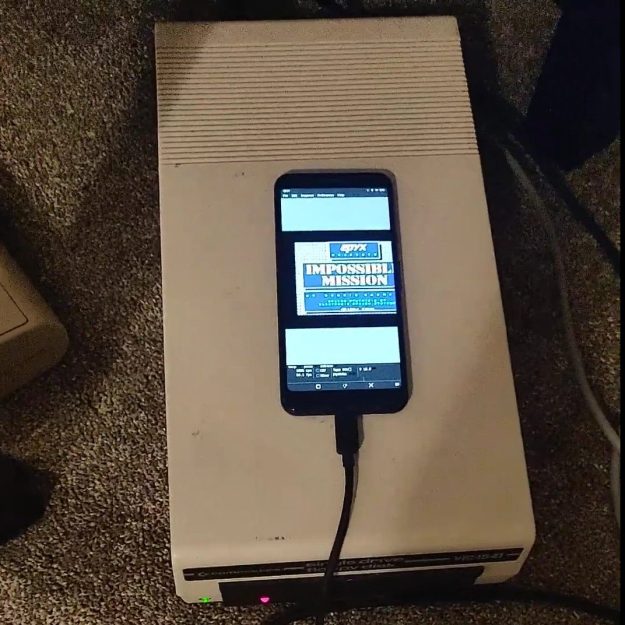
    It all started with a sarcastic comment right here on Hackaday.com: ” How many phones do you know that sport a 5 and 1/4 inch diskette drive?” — and [Paul Sanjay] took that personally, or at least thought “Challenge accepted” because he immediately hooked an old Commodore floppy drive to his somewhat-less-old smartphone.

    The argument started over UNIX file directories, in a post about Redox OS on smartphones— which was a [Paul Sanja] hack as well. [Paul] had everything he needed to pick up the gauntlet, and evidently did so promptly. The drive is a classic Commodore 1541, which means you’ll want to watch the demo video at 2x speed or better. (If you thought loading times felt slow in the old days, they’re positively glacial by modern standards.) The old floppy drive is plugged into a Google Pixel 3 running Postmarket OS. Sure, you could do this on Android, but a fully open Linux system is obviously the hacker’s choice. As a bonus, it makes the whole endeavor almost trivial.

    Between the seven-year-old phone and the forty-year-old disk drive is an Arduino Pro Micro, configured with the XUM1541 firmware by [OpenBCM] to act as a translator. On the phone, the VICE emulator pretends to be a C64, and successfully loads Impossible Mission from an original disk. Arguably, the phone doesn’t “sport” the disk drive–if anything, it’s the other way around, given the size difference–but we think [Paul Sanja] has proven the point regardless. Bravo, [Paul].

    Thanks to [Joseph Eoff], who accidentally issued the challenge and submitted the tip. If you’ve vexed someone into hacking (or been so vexed yourself), don’t hesitate to drop us a line!

    We wish more people would try hacking their way through disagreements. It really, really beats a flame war.


    From Blog – Hackaday via this RSS feed

    view more: next ›