[–] 2 points 5 months ago (1 child)

This bulb lists mains voltage as the input. In another comment you include a picture of a ballast which isn't a typical transformer. I'd try plugging that bulb straight into the wall and see what happens. It's possible you can get rid of anything fancy like a ballast or transformer. Or maybe it'll only work with a ballast since there were originally florescent tubes there.

  • source
  • parent
  • context
  • [–] 27 points 5 months ago (2 children)

    If you're using LUKS don't forget you can dump/backup the header. It isn't the encryption key but is critical if you accidentally do a stupid. As to the keys themselves, how about convert them to qr codes, print them, and store them in a safe.

  • source
  • [–] 7 points 5 months ago (1 child)

    I got tricked. Thought this was going to be awesome content with a cool story and OP getting a fun windfall only to realize this is /c/funhole and it was even awesomest content.

  • source
  • SDRPlay API on RPI5 (lemmy.gregw.us)
    submitted 1 year ago* (last edited 1 year ago) by to c/amateur_radio@lemmy.radio
     

    I'm looking to get OpenWebRX running on my RSPDuo connected to a RPI5 running the latest Debian. Currently getting SoapySDR to talk to the hardware via the sdrplay_apiService "driver" but the apiService doesn't actually reach the point of listening for TCP connections.

    root@raspberrypi:~# systemctl status sdrplay
    ● sdrplay.service - SDRplay API Service
         Loaded: loaded (/etc/systemd/system/sdrplay.service; enabled; preset: enabled)
         Active: active (running) since Thu 2025-03-13 15:10:01 CDT; 6s ago
       Main PID: 1447884 (sdrplay_apiServ)
          Tasks: 3 (limit: 9431)
            CPU: 8ms
         CGroup: /system.slice/sdrplay.service
                 └─1447884 /opt/sdrplay_api/sdrplay_apiService
    
    Mar 13 15:10:01 raspberrypi systemd[1]: Started sdrplay.service - SDRplay API Service.
    Mar 13 15:10:01 raspberrypi sdrplay_apiService[1447884]: [1447884]: sdrplay_apiService: sdrplay_apiServiceWorkerThread: Entry
    Mar 13 15:10:01 raspberrypi sdrplay_apiService[1447884]: [1447885]: sdrplay_apiService_device: heartBeatThread: Entry
    Mar 13 15:10:01 raspberrypi sdrplay_apiService[1447884]: [1447886]: sdrplay_apiService_device: registerDevThread: Entry
    
    root@raspberrypi:~# netstat -tupan | grep sdr
    root@raspberrypi:~#
    

    I've straced the process and just get a lot of

    futex(0x7fae6d2058, FUTEX_WAIT_BITSET|FUTEX_CLOCK_REALTIME, 0, {tv_sec=1741893489, tv_nsec=743687000}, FUTEX_BITSET_MATCH_ANY) = -1 ETIMEDOUT (Connection timed out)
    futex(0x7fae6d2000, FUTEX_WAKE, 1)      = 0
    futex(0x7fae6d2058, FUTEX_WAIT_BITSET|FUTEX_CLOCK_REALTIME, 0, {tv_sec=1741893489, tv_nsec=753687000}, FUTEX_BITSET_MATCH_ANY) = -1 ETIMEDOUT (Connection timed out)
    futex(0x7fae6d2000, FUTEX_WAKE, 1)      = 0
    futex(0x7fae6d2058, FUTEX_WAIT_BITSET|FUTEX_CLOCK_REALTIME, 0, {tv_sec=1741893489, tv_nsec=763687000}, FUTEX_BITSET_MATCH_ANY) = -1 ETIMEDOUT (Connection timed out)
    futex(0x7fae6d2000, FUTEX_WAKE, 1)      = 0
    

    Anyone using the SDRPlay API successfully on recent debians? Anyone know how to debug sdrplay_apiService?

     

    I bought a RSPduo recently and it has two receive tuners; each with a dedicated antenna connection. It'll receive from 1kHz to 2GHz. I plan on hooking a DMN-D3000N that'll receive 25-3,000MHz and I'd really like to avoid running two separate antennas for it. At least until I can figure out how to run a proper long-wire to port one parallel and close to my dipole without frying things...

    Anyway, 50-ohm antenna splitters seem to be pretty narrow bandwidth wise. Would splicing together two connectors and the antenna feed line work so that I could plug the one antenna into both tuners?

    Bonus question: I'll probably put a DXE-RG5000HD RF guard inline to prevent my transmissions from harming anything attached to the discone. Would the same work with the long wire antenna were I to just stick the wire in the middle of the BNC connector?


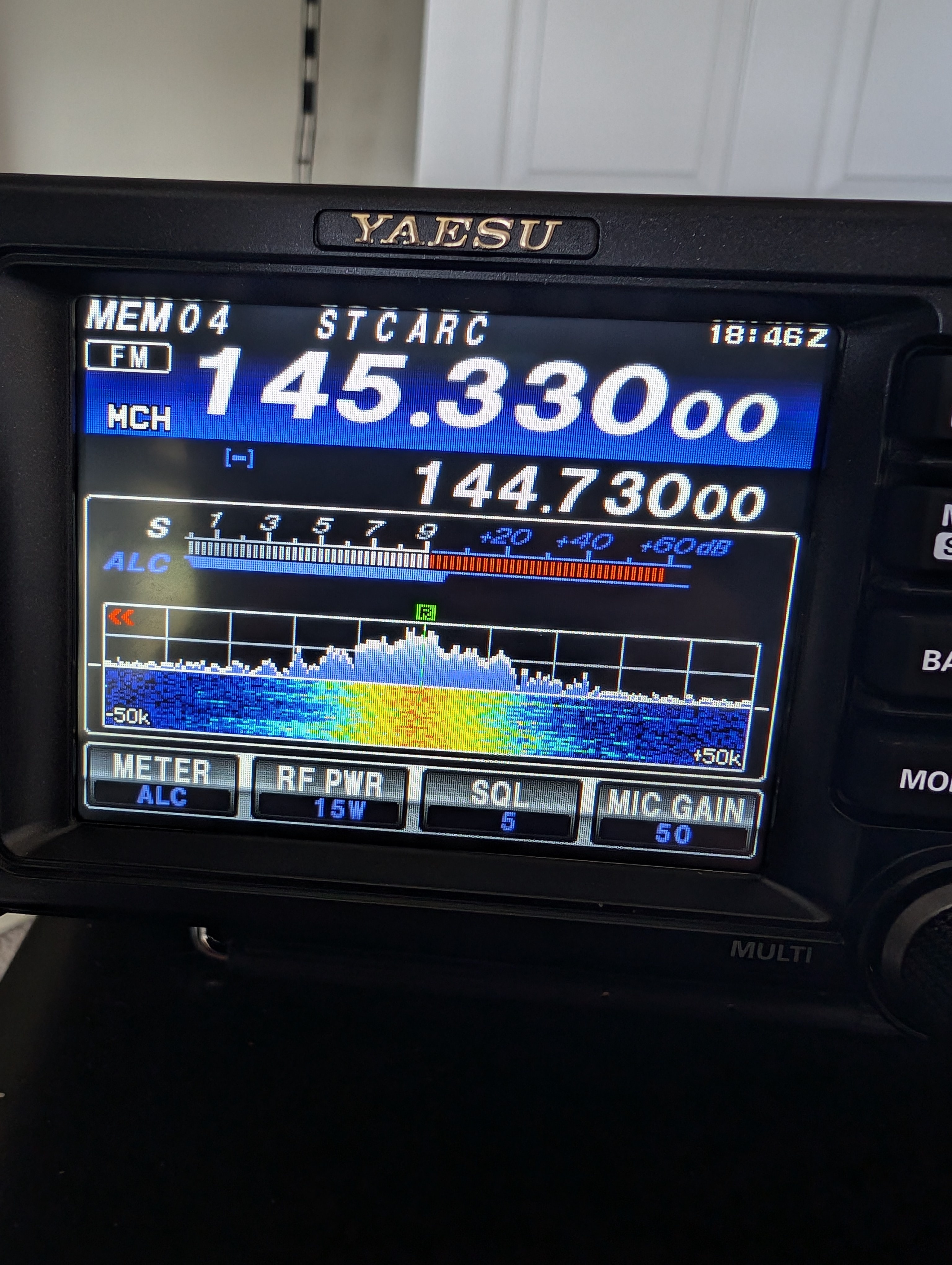
    Listening to a local repeater and the waterfall display shows some pretty wide modulation whenever the repeater is in use. If I'm showing +/- 50kHz on the scope then the repeater's bandwidth is frequently 20+ even 60+ kHz.

    Given that FM voice bandwidth is typically less than 15 kHz, this would indicate a failure somewhere on the repeater tx side of things right?

    view more: next ›