[–] 4 points 5 hours ago

When we talk about neophytes, from a biological perspective we’re referring to different species. People of different origins are (despite perhaps having different skin colors) one and the same species. Therefore, your comparison doesn’t hold up.

If we apply the human perspective to the neophyte debate, it would be like planting maple trees from Canada in a maple forest in the U.S. 200 km further south... which is a marginal ecological problem because they’re the same species.

  • source
  • parent
  • context
  • [–] 10 points 6 hours ago

    The problem is multifaceted.

    Basic premise: We humans need functioning ecosystems to survive. At the same time, we have already damaged these systems in a wide variety of ways, thereby making them less resilient.

    In addition to the disturbances we have already caused, invasive species represent a further stressor for ecosystems. In a natural ecosystem, this would be a normal process leading to the system’s adaptation following a period of disturbance. However, humans have already caused systems to become disrupted on a global scale, making them less able to cope with further disturbances. In addition, humans depend on the use of these systems for their survival.

    Compared to other sources of human disturbance, invasive species represent “low-hanging fruit,” since it is easier to prevent at least the intentional introduction of species than, for example, the effects of global agriculture on ecosystems.

    It is also true that right-wing parties seize upon the environmental issue (which they otherwise have no interest in, since nature conservation is merely a hindrance) to justify racism. However, people of different skin colors are not species with different ecological niches like plants and animals, so the comparison does not hold.

    My personal opinion: We should do a better job of protecting our ecosystems in general, and preventing the introduction of non-native species into new areas is part of that.

    If a species appears for the first time in an area, control measures may make sense; however, if the species has already established itself over such a large area that control becomes uneconomical, we must let nature take its course and, where possible, support natural adaptation processes if that is feasible and sensible.

  • source
  • [–] 1 point 6 hours ago (2 children)

    I don't quite get it.

    If individual EU member states want to cooperate more closely (for example, by harmonizing national standards, deposit-return systems, or who knows what else), this must be possible without a small EU member state blocking it with a veto.

    There are now three ways to achieve this: Either the participating countries create another confederation alongside the EU to facilitate this voluntary cooperation, or the countries do so in the form of a “two-speed EU.”, or we get or we'll end up with a hodgepodge of bilateral and multilateral agreements (which is exactly what the Union was formed to prevent). I fail to see why a small EU member state should have the right to veto a decision made among several other EU partners that does not affect it.

    As far as I understand, that's the “two-speed EU” approach.

  • source
  • parent
  • context
  • [–] 1 point 8 hours ago (4 children)

    So what's your problem with a two-speed EU? Or did I misunderstand you?

    Under this model, the small countries retain their veto power, but those that wish to do so can deepen their cooperation independently of that, without it being binding on the rest.

  • source
  • parent
  • context
  • [–] 1 point 9 hours ago (1 child)

    The problem is that in the system you propose, smaller countries would have near zero incentive to participate because they'd always be overridden by larger countries.

    I get the problem and I don't claim that my thoughts would be a ideal solution.

    Currently, however, we face the opposite problem: The larger countries are increasingly being asked why they bear the lion’s share of the costs only to then have their sovereignty restricted by countries like Hungary (EU law takes precedence over national law).

    Both problems—the lack of representation for both the small and the large countries—pose a threat to the alliance in their own ways.

    I don’t know which of the two is more serious… but intuitively, I would say that a withdrawal by the large countries would hit the alliance much harder than one by the small ones, since a large portion of the budget (from which small states in particular benefit greatly) would then be lost.

  • source
  • parent
  • context
  • [–] 1 point 9 hours ago* (6 children)

    Historically, many alliances have been broken up and subjugated through deliberate outside influence as well...

    Let’s hope you’re right and I’m wrong.

    When I look around the continent today, however, I’m worried that self-serving politicians in a representative system will destroy the alliance of states out of personal greed... even if you’re fundamentally right.

    /edit:

    It's not "increased cooperation" if the larger states impose their will onto the smaller states

    It is if it happens on a voluntary basis.

  • source
  • parent
  • context
  • [–] 1 point 9 hours ago (8 children)

    In fact, it would likely desintegrate relatively quickly if the people that push for less independence of the states get their way.

    I get your point but I guess this is where out views differ.

    In my view, cooperation beats competition—always.

    The problem with the unanimity rule is that it makes the EU as a whole extremely vulnerable to outside influence. Russia, China, the U.S.—none of these nations has an interest in a functioning EU. A divided continent at war with itself would be much better for these power centers, in line with the “divide and conquer” principle. Currently, it’s enough for these powerful blocs (relative to the individual EU states) to focus their resources on exerting influence in a single member state to paralyze the entire bloc. In the turbulent times ahead, THAT will be the end of the EU—not a further increase in cooperation among the states.

    If further integration is not possible due to the individual states’ aspirations for sovereignty, we at least need a two-speed EU to secure the EU’s global position by further increasing the cost advantages of cooperation.

    And to put it in utilitarian terms: In exchange for limiting their sovereignty, the small countries gain maximum benefits through cooperation with the bloc’s major economic powers. I see no other scenario in which a voluntary or involuntary reduction in sovereignty would lead to such benefits… which is why the EU is such an attractive and successful model.

  • source
  • parent
  • context
  • [–] 4 points 10 hours ago (13 children)

    A thought on this:

    A fair system (and our current system, in theory) is based on the principle of “one person, one vote.”

    Accordingly, the large countries would have to have significantly more votes than the small ones, in proportion to their population.

    Because right now, I don’t quite understand why the vote of a Luxembourg citizen is worth as much as that of 100,000 Germans. In my opinion, that has little to do with fairness... at least as long as the large countries are still footing the bulk of the budget.

    To put it bluntly: If, in a village of 100 people, only one person had the right to a personal veto, we certainly wouldn’t be talking about an equitable, fair system.

  • source
  • parent
  • context
  • [–] 12 points 1 day ago

    Ein Grund warum die Kosten steigen (einer, nicht der einzige) ist die zunehmende gewinnorientierung im Gesundheitssystem dank fachfremden Investoren. Wenn Leistung x vorher y Euro gekostet hat kostet sie jetzt halt y + 15 % Renditeerwartung. Zusätzlich werden eher lukrative Behandlungen empfohlen wenn es einfache auch getan hätten.

  • source
  • parent
  • context
  • [–] 9 points 2 days ago*

    It doesn't need to make sense... we're far beyond this point. It needs to KEEP THEM IN POWER, this will totally suffice. Since no ones going to hold them accountable (ignoring court rulings is a habit) this should do as fig leaf.

  • source
  • parent
  • context
  •  

    Moin Leute,

    der Eimer unten rechts im Bild hat die Tür meines Gefrierschranks blockiert. Das wirft die Frage auf wie ihr mit auf/angetauten Lebensmitteln umgeht?

    Ich persönlich differenziere da nach der Art des Lebensmittels. Leicht verderbliches wie frisches Fleisch, Fisch etc. wird entsorgt. Andere Dinge werden (vorausgesetzt sie sind noch gefroren) direkt verkocht oder weiter gelagert.


    Hey there,

    How are your gardens doing? What’s gone well this year, and where are you having problems?

    Things are looking good for me so far. Like every year, I had some trouble with black bean aphids on my fava beans, but that seems to have resolved itself (even though the affected plants aren’t yielding much).

    I’m happy with my onions and potatoes… does anyone know why some of my onion sets are deciding to go to seed?

    Wishing you all a great week!


    Here's the thing: Last summer, obviously too late, I planted a few Brussels sprout plants. In fall/early winter, the sprouts were still too small to harvest, and, lazy as I am, I left the plants where they were. Now, at the beginning of February, I was actually able to harvest some decent sprouts.

    What has been your experience? (I have often seen Brussels sprout plants overwinter in gardens, so I think it's fairly normal).

    When is the best/latest time to harvest before the plant and its florets start to sprout? Should you definitely remove the lower leaves (seems to be the norm) or do they actually provide protection during harsh winter weather?


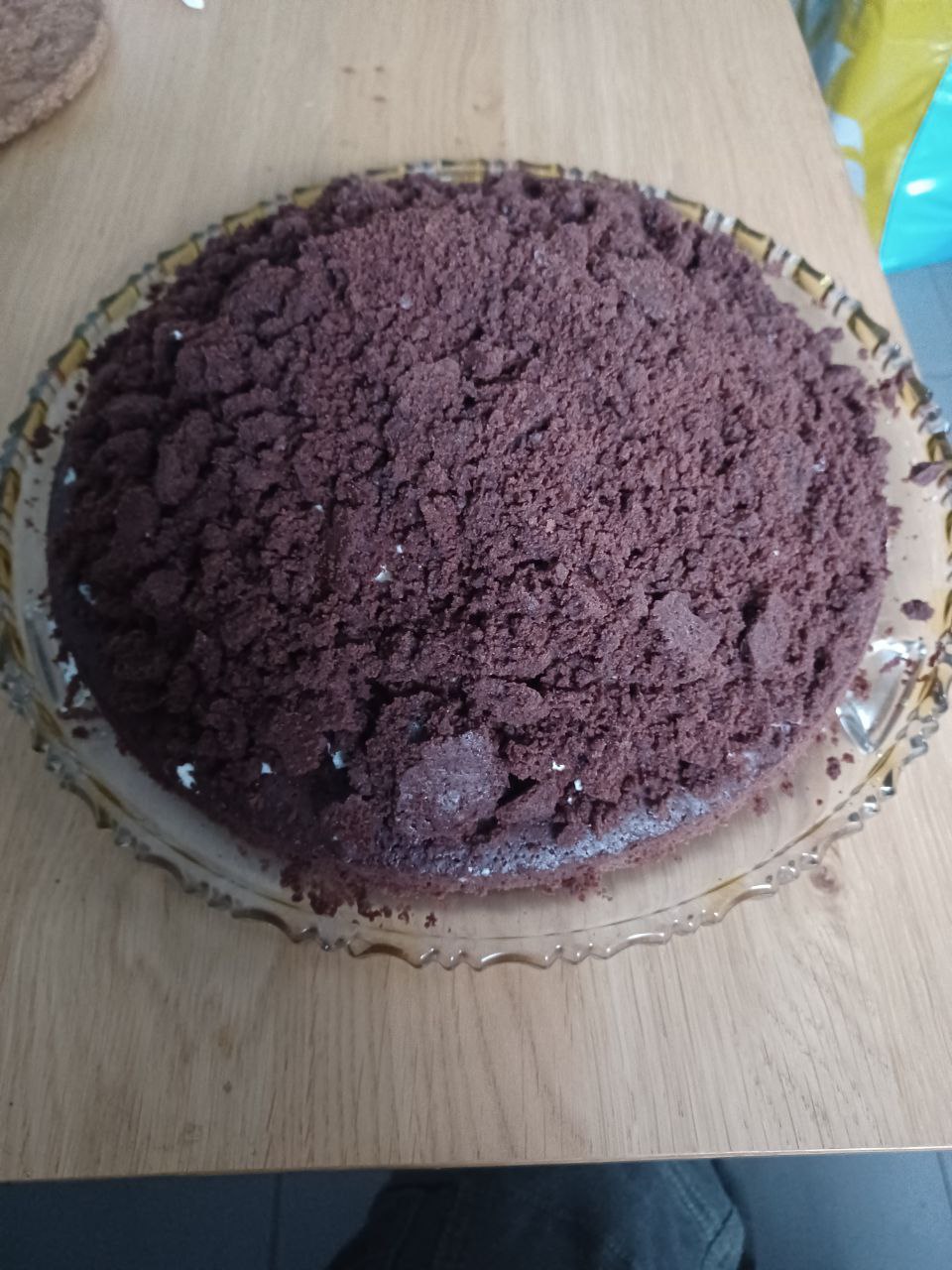
    Maulwurfskuchen - Mole cake (You can guess where the name comes from :D )

    A chocolate sponge cake, hollowed out and filled with bananas, chocolate chips, and whipped cream. The crumbs are then used to decorate the dome.

    I will post the recipe if someone's interested.

    (P.S. No moles were harmed in the making of this post!)


    Finde die Idee, in Absprache mit den europäischen Partnern, gut.

    Man könnte europäische Truppen inklusive Bundeswehr dort stationieren und öffentlich kommunizieren: ,,Wir nehmen die Bedenken unsere transatlantischen Verbündeten bezüglich Grönland sehr ernst und stationieren daher europäische Truppen zur Eindämmung des russischen und chinesischen Einflusses in der Arktis auf Grönland."

    Selbst Trump dürfte es schwer fallen dann noch flächendecken genug Gehirnakrobatik zu verbreiten um einen Angriff auf europäische Truppen, die vorgeblich auf sein Verlangen hin dort stationiert wurden, zu begründen.

    Weiß jemand wie einflussreich der Reservistenverband ist?

    view more: next ›