[–] [S] 1 point 10 months ago

What if the lack of comments were because comments weren't proportionally representative?

Someone sees a discussion that interests them, so they see what the top comments are. But if the Hive Mind(tm) has spoken (even if just by awarding the top two or three comments to the same viewpoint), will they engage, or will they go somewhere else?

Remove the Hive Mind, and maybe you'll get more engagement?

  • source
  • parent
  • context
  • [–] [S] 2 points 10 months ago (1 child)

    I was thinking of it as a drop-in replacement for "hot" just so that it doesn't require any changes on the UI to implement. I'm a bit rusty with UI development, lol. The frontends wouldn't have to add a new button, and the Lemmy API wouldn't need to add a new sort type. That said, maybe that sort of thing is easy to do?

    As far as it would work, Thiele's elimination rules is computed roughly as follows (I'm assuming that only upvotes are counted; I haven't considered yet if the process works if disapprovals count as a vote of "-1" or how the process could remain scalable if an abstention counts as a vote of "0.5":

    begin with the list of posts, list of users, and list of votes
    
    # initial weighting, takes O(E)
    for each post:
        for each vote on the post:
            lookup the user that voted on the post
            based on the number of votes the user has given, determine how much the user would be made "unhappy" if the current post was removed
            # the basic idea here is that if the user didn't vote for a post, then they won't care if its removed
            # if the user did vote for a post, but also voted for 100 others, then they probably won't care if one gets removed as long as 99 remain
            # if the user did vote for a post, but only voted for 2 or 1 others, then they'll care more if this one gets removed
            # if this is the only post the user voted for, then they'll care a lot if it gets removed
            # LiquidFeedback uses a formula of "1/r", where r is the total number of votes the user has given
            # as posts get removed, the votes get removed too, so surviving votes get more weight
            # for the sake of efficiency, I'll probably use a formula like "if r > 20 then 0 else 1/r" so that users only start to contribute weight to posts once they only have 20 approvals left. Replace 20 with a constant of your choice
            add the user's resistance to the post being removed to the post
    
    # initial heap construction, takes O(C)
    construct a min-heap of the posts based on the sum of the users' resistances to the post being removed
    
    # iterative removal of posts
    while posts remain in the heap: # O(C)
        remove the first post in the heap - this has the least resistance to this post being marked 'last' in the current set # O(logC)
        yield the removed post
    
        for each vote for the removed post: # in total, O(E) - every vote is iterated once, across the entire lifetime of the heap
            lookup the user that voted on the post
            compute this user's resistance to this post being removed
            remove this vote from the user
            based on the number of remaining votes the user has given, compute the user's resistance to the next post being removed
            compute how much the user's resistance to their next post being removed increased (let this be "resistance increase")
            if "resistance increase" is nonzero (based on my formula, this will happen whenever they have less than 20 votes remaining, but not if they have more than 20 votes remaining):
                for each vote for a different post by this user:
                    increase the post resistance to removal by "resistance increase"
                    perform an "increase_key" operation on the min-heap for this post # this will be O(logC)
    
                   # worst-case, each user will perform 20 + 19 + 18 + ... "increase_key" operations - 
                   # they only begin once there are 20 votes remaining 
    
                   # when they have 20 votes remaining, they have 20 increase_key's to do
                   # when they have 19 votes remaining, they have 19 increase_key's to do
                   # etc.
    
                   # because this is a constant, it doesn't contribute to the time complexity analysis.
                   # so each user performs at worst a constant number of O(logC) operations
                   # so the overall time complexity of the "increase_key" operations is O(VlogC)


    For this algorithm, the yield the removed post statement will return the sorted posts in reverse order. So worst to best. You could also interpret that statement as "Give the post a rank in the final sorting of count(posts) - (i++)".

    Thiele says that process can be used to elect a committee of size N by stopping your removal when N votes remain. But because it's a "house monotonic" process (electoral speak for "increasing the size of the committee by one and re-running an election is guaranteed not to cost any existing members their seat), I figure it could be repurposed to produce a ranking as well - the top one item is "best one", the top two items are the best two, the top three are the best three, etc.

    To make the above process work for approvals that decay over time, we'd just treat a decayed approval as a partial approval. I still have some work to do on how exactly to integrate partial approvals into the "resistance to removing each post" calculations without ruining my time complexity. But basically it's a proportional score voting election instead of proportional approval.

  • source
  • parent
  • context
  • [–] [S] 4 points 10 months ago* (3 children)

    This is exactly the info I'm looking for, thanks! I knew there'd have to be some kind of scheduled task to recompute the rankings (IIRC the lemmy docs say ~10 minutes for recomputing ranks), I just wasn't sure where it was.

    The change that would require the least effort to implement my voting system (whether the lemmy maintainers would accept the change notwithstanding) would be to target the schedule task, and introduce a server-wide configuration option that would allow admins to pick whether they're using Block Approval (what we have now) or Proportional Approval (what I'm introducing) based algorithms for their server's "hot" algorithm. No API or frontent changes required. Then, work towards community mods being able to set that on a per-community basis.

    Something for me to experiment with, anyway.

  • source
  • parent
  • context
  • [–] [S] 1 point 10 months ago (2 children)

    I don't think it would work for my specific algorithm, unfortunately. To compute PAV, I need access to the "raw votes" of each individual user.

    PAV doesn't need to know the identity of the user behind each upvote, but it does need to be able to correlate which upvotes originated from the same user so that once a user is determined to be "satisfied" by having a comment they upvoted given a high rank, all of their other upvotes need to be deweighted for the remainder of the process to "make room" for other users' opinions.

    I checked the Lemmy API docs, and while that information is available at /api/v4/post/like/list and /api/v4/comment/like/list, so I could have a frontend that scraped every comment and then every like of every comment in a community (ignoring how inefficient that would be), but both of those endpoints are tagged as "Admin-only".

    Plus, even if I could do that, to compute the rankings my process does need the upvotes of every comment in a post (or every post in a community) before it knows which one is on top, which seems too much to put on a client.

  • source
  • parent
  • context
  •  

    How would I add a new ranking algorithm to Lemmy as a contributor? I'm a developer by trade, but unfamiliar with Rust and the codebase of Lemmy specifically. It doesn't seem like Lemmy has a concept of 'ranking plugins', so whatever I do would have to involve an MR.

    Specifically, I'd like to introduce a ranking system that approximates Proportional Approval Voting, specifically using Thiele's elimination methods, like is used in LiquidFeedback.

    I'm pretty sure that with a few tweaks to Thiele's rules, I can compute a complete ranking of all comments in a thread in O(ClogC + E + VlogC), where C is the number of comments, E is the total number of likes, and V is the number of users. This would also support partial approvals, upvotes could decay with age.

    I believe this would mitigate the tendency towards echo chambers that Lemmy inherits from Reddit. Lemmy effectively uses Block Approval Voting with decays to rank comments and posts, leading to the same people dominating every conversation.

    [–] [S] 1 point 1 year ago

    Maybe when you're closer to adding Friendica I'll return with a similar pitch, but for Friendica accounts.

    Technically speaking, from what I've read, Identity+ and Friendica both support SAML as an SSO protocol, but based on the limited documentation of the latter and lack of documentation on the former (you really have to ctrl-F that page to find SAML referenced) it seems a potentially janky integration where users would lose control of usernames/nicknames, and knowing the government (despite me literally advocating for them lol) they'd probably generate a horrible username like a UUID.

    But maybe that just means there needs to be a better Friendica SSO authentication addon.

    Regardless, the general vibe of a platform like Friendica definitely feels more aligned with my proposal of "one account, one human user" than something like Lemmy anyways, as several other commentators have suggested.

  • source
  • parent
  • context
  • [–] [S] 2 points 1 year ago

    True. And Lemmy is even designed for a mix of bot and human accounts, given the "account is a bot" flag that can be set in account settings.

    The question is, how do we ensure the accounts that are not flagged as a bot, are indeed not bots?

  • source
  • parent
  • context
  • [–] [S] 1 point 1 year ago (2 children)

    I do think it’s an interesting concept and would be an interesting experiment on a new instance.

    I’m just not sure that’s feasible on this platform. Lemmy is really designed to keep people anonymous.

    I was imagining that this kind of verification would be part of account registration. So it wouldn't be like "you have two classes of user account, one has a checkmark or something", but instead "you have one class of user account, and can't log in unless you verify you're a unique human".

    Which, yeah, would probably work better on a new instance, so people can choose "this is the server where having an account means I am a real person" vs "this is the server where I stay anonymous to everyone, including site admins". An instance that mixed 'unverified users' and 'verified users' would probably just be hassle with no benefit.

    If it was done on a designated instance, I don't think anything would, at a technical level, prevent it from being done on any particular platform (eg. lemmy vs mastodon vs pixelfed). But I'll concede that the design of Lemmy may make it the wrong platform for my proposal.

    In a way it feels like twitters verified feature, and that makes me wonder if it would work in mastodon

    I agree that it's similar to Twitter's verified feature.

    But from what I've seen of Mastodon, Mastodon's verification feature doesn't work like Twitter's - Mastodon just lets you put links on your profile and verify the link, but that's just you proving to Mastodon that you control the domain name. Sort of like getting a TLS certificate from Let's Encrypt, where you just prove to LE that you control the domain.

    It's not like a 'verified' status on the account as a whole.

    So the way I imagine it, it'd work for Mastodon, but not by creating two classes of users - it'd just work by ensuring all users on the instance as a whole are verified.


    What other platforms are Fedecan considering adding, and what sort of timeline do you guys have for your 'next expansion'? I want to say there was a page that listed PeerTube, Friendica, Mastodon, etc. as potential 'future expansions', but I can't find it anymore.

    Maybe one of those could be the subject of an experiment like this (and if the experiment were successful, Fedecan could use it as a place for the community to hold votes on the direction of Fedecan, if you ever wanted to formally democratize any particular decision).

  • source
  • parent
  • context
  • [–] [S] 5 points 1 year ago* (last edited 1 year ago) (5 children)

    Bots haven’t really been a huge issue yet, but it’ll be a Fediverse wide one so we need a solution that would scale like that.

    The current standard for Fediverse content moderation seems to be for each instance to manage its own content moderation policies, and each instance defederates / block those few instances that are particularly repulsive to them.

    Taking content moderation as precedent for the issue of bot mitigation, the onus of mitigating bots will be on the instance admins, where known bot farms just get defederated.

    I’m also not keen on any sort of pii link to our users, even if it’s Canada post holding that data.

    A fair concern, but IMO needing something like this is inevitable. Maybe I'm just "early", but I don't think I'm wrong.

    If the concern is ensuring each user can't be linked to a specific set of PII, then an anonymous credential system like U-Prove could cryptographically guarantee that each account belongs to a unique real person, without revealing which real person it is.

    (Many anonymous credential protocols, including U-Prove, come with 'single-spend' mechanisms that can be used to ensure one user can't get two accounts.)

    Basically, with anonymous credentials, you'd end up with two sets of data: One with whatever PII-linkable info Canada Post gave to Fedecan, and another containing the actual user accounts. But (provided users used Tor to prevent IP address correlation) it'd be cryptographically impossible to link the any of the first to any of the second.

    They would just come in via other federated instances

    True, but it would at least build a reputation of "1 lemmy.ca user = 1 real person".

    If we’re not selling user eyeballs or data, do we care if a user maps to a real person?

    I'd say yes, we should care.

    I'm not on lemmy to chat with bots; I want to know that when someone responds to me, that they're a real person, and that if five people respond to me, they're five different real people, even if I have no way of knowing who those real people are.

    I also want people who see my posts to know there's an IRL person behind them and that my account isn't just one sockpuppet of many, though I don't want them to know my IRL identity.

    If I wanted to chat with bots I'd just generate an artificial group chat with a few ChatGPT or DeepSeek agents, lol.

  • source
  • parent
  • context
  •  

    The more people use Fedecan services, the more Fedecan will attract bots.

    Which means Fedecan will have to do something for users to prove that they are human. When I joined, you guys had a registration prompt with manual review, but I imagine the prompts you gave could be automatically bypassed by an LLM fairly easily.

    The naive solution is to do something like collecting government IDs like Facebook tried at one point. But that'll just drive people away who don't trust Fedecan with that info.

    What would be your thoughts (admin thoughts, and community thoughts) to implement some 'proof of unique personhood' process with something like Canada Post Identity+? Basically, Canada Post verifies that users are human and is responsible for taking care of PII, and Fedecan just trusts Canada Post to not let the same user register multiple times. If done well, I think 'Canada Post proves that every user account on this site is a unique human' could be a real selling point for lemmy.ca and pixelfed.ca

    Full disclosure, I heard about it in a Reddit thread of people complaining about bugs in it while they try to vote in the Liberal party election. But I bet this is just early adopter bugs, and the Liberal party clearly trusts it with their leadership elections.

    Regardless, I think proof of unique personhood is a problem Fedecan will have to solve, and a solution through something as Canadian as the post office just seems more elegant than having the Fedecan admins reinvent the wheel.

    I realize you guys (admins) are probably quite busy with IRL work and the Pixelfed launch, so if there was interest in this but no admin capacity to investigate further, I could volunteer to reach out to Canada Post and see what they could offer for non-profit use, including what it would cost Fedecan.

    Thoughts?

    EDIT: for people concerned about "but then CSIS knows which account is mine", an anonymous credential system like U-Prove could be used to prove "1 lemmy.ca user = 1 unique real person", while cryptographically guaranteeing it is impossible to link any particular lemmy.ca user to any particular human identity.

    [–] [S] 1 point 1 year ago

    But at the same time, this winner-take-all national seats mechanism, if triggered, will guarantee the loss of checks and balances, and accountability to a single party. This is a catastrophic disaster for any democracy, and cannot be accepted. Once again, this 50% score threshold as described has no legitimate basis – unlike in proportional representation electoral systems.

    a higher goal, “the government represents the interests of as many voters as possible”

    Coming back to this point, I’m not sure if this electoral system effectively addresses this. However, having strong conflict of interest, ethics codes, and anti-corruption laws might be a more effective avenue than via the electoral system. The folks at Democracy Watch are quite keen on this topic.

    If the essence of democracy is to have everyone having a seat at the table, a representative democracy must still maintain this principle. A winner-take-all system, even if partial, is contrary to the principles of democracy.

    What's the point of having a seat at a table if a group of 51% form a coalition that has no incentive to listen to you? Sure, your voice is heard, but what use is that if you're not obeyed?

    I think this is the main philosophical difference between my system and the "current approach" to electoral reform.

    The 'standard representative democratic tradition' tasks elected representatives with coming up with policy to consider all constituents' needs, but my 'gut feeling' on the subject is that the sorts of people capable of becoming elected representatives (ie. politicians) are the least capable of all of us at engaging in good-faith deliberation with the 'other side'. I'm also a bit skeptical of the value of codes of ethics, but maybe I'm just a pessimist from absorbing US political news.

    So instead of "election -> representatives deliberate -> policy decided", I take the alternate approach of "representatives campaign -> election -> policy decided", on the basis that with the right electoral system, a "big tent" party could be incentivized to come up with a broadly popular party before the election, and then just be tasked with implementing it after.

  • source
  • parent
  • context
  •  

    cross-posted from: https://lemmy.ca/post/39298754

    I realize this community generally favours proportional representation, but I'm curious to hear your thoughts on a different approach to the problem of 'unrepresentative government'.

    I question whether the goal of proportional representation, "every voter has 'their representative'", actually achieves what I consider to be a higher goal, "the government represents the interests of as many voters as possible".

    If:

    • you have a perfectly 'proportionally representative' parliament
    • 51 of 100 of seats in said parliament are needed to form government
    • winning seats as a single party requires difficult campaigning
    • adding a party to a coalition requires difficult negotiation

    Then anyone trying to grow a party or coalition with the goal of forming government will stop growing the coalition once they get 51 of 100 seats, because growing the coalition further requires difficult campaigning or negotiation, but yields no further benefit to the members of said coalition (since they would already have a majority at that point).

    So even with PR, you still end up with a government that caters to a narrow majority and ignores social and economic problems that impact people outside that majority.

    My solution, "a block of seats awarded in a nationwide winner-take-all Score Voting election," approaches this problem differently:

    • electing the ruling party directly,
    • and using Score Voting, where voters give each candidate a numerical score on an independent scale (note that Score Voting =/= Ranked Voting: a voter can give two different candidates the same score on the same ballot),
    • where a party can have 60% support and yet lose to a party with 70% support,
    • incentivizes candidate parties to try to exceed a 'mere majority' by as much as possible,
    • because a majority is no longer enough to guarantee a win,
    • because parties can no longer count on their own supporters exclusively supporting them.

    I argue for Score Voting, but my rationale applies to Cardinal Voting systems in general.

    TLDR: Score Voting is good.

    Canadians want national unity.

    The ideal of the Good Parliamentarian claims that politicians should, once elected, represent all their constituents and not just their core base, and that a governing party should, once elected, represent the nation as a whole, and not just their members.

    So why is national unity a fleeting thing that emerges only in response to external threats, like American rhetoric about annexation and economic coercion, and why does it dissipate and devolve into factionalism once the threat is resolved (or when political campaigns simply drown the threat out)?

    Because the Westminster System, in its present form, is institutionally biased towards division.

    There are two reasons:

    1. Within individual constituencies, a narrow majority of voters is enough to guarantee a win, and
    2. In Parliament, a narrow majority of constituencies is enough to form government and pass law.

    These have a common root cause:

    Acquiring a narrow majority of something is the most efficient way to achieve the maximum reward.

    If the easiest path to a win is to get the support of half-plus-one, who cares if you alienate everyone else on the other side?

    The Solution: the Score Bonus System

    This proposal suggests an incentive-based solution to create national unity:

    The Score Bonus System: award a winner-take-all block of seats to the party that achieves the highest average score nationally in a Score Voting election.

    Under this system, Canada's existing single-member districts are replaced with about half as many dual-member districts, each containing one 'constituency' seat and one 'national' seat.

    In each district, candidates stand either as a 'constituency' candidate or as a 'national' candidate.

    Voters mark their ballots by assigning numerical scores between 0 and 9 to each candidate, where higher scores indicate stronger approval.

    Unlike ranking systems, this allows voters to express support for multiple candidates simultaneously.

    Sample Ballot, Mapleford North, filled in by a sample voter

    Seat Party Candidate Score (0 to 9)
    Constituency Brown Party Jaclyn Hodges 5
    Taupe Party Dexter Preston 0
    Independent Cecelia Olson 9
    Janice Fritz 5
    National Brown Party Isreal Robles 7
    Gale Sloan 8
    Taupe Party Royce Brown 0
    Beige Party Billie Burton 9

    Each district's 'constituency' seat goes to the 'constituency' candidate with the highest average score in the district.

    The collection of all districts' 'national' seats form the 'winner-take-all' block, which is awarded in full to the party with the highest nationwide score.

    When a party has multiple candidates competing in the same constituency:

    • When computing nationwide averages, the score of its best candidate in each constituency is used.
    • If the party wins the highest nationwide average, its best candidates from each constituency win the 'national' seats.

    However, if no party achieves a national average score of at least 50%, the 'national' seats instead go to the 'national' candidate with the highest average score in the constituency, effectively falling back to the 'constituency' method.

    Seat Type Breakdown

    Seat Type Seat Count Winning Candidate From Each Constituency
    Constituency 172 (one per constituency) 'Constituency' candidate with highest score within constituency
    National 172 (one per constituency) If any party has >50% approval nationwide: best 'national' candidate from party with highest score nationwide; otherwise: 'national' candidate with highest score within constituency
    Total 344 (two per constituency)

    Example Election Results

    Constituency Results, Mapleford North

    Seat Party Candidate C. Score N. Party Score
    Constituency Brown Party J. Hodges 65% N/A
    Taupe Party D. Preston 20% N/A
    Independent C. Olson (Constituency Seat Winner) 80% N/A
    J. Fritz 70% N/A
    National Brown Party (Winning Party) I. Robles (Eliminated by G. Sloan) 65% 75%
    G. Sloan (National Seat Winner) 75%
    Taupe Party R. Brown 15% 55%
    Beige Party B. Burton 80% 65%

    National Results

    Constituency Brown Party Score Taupe Party Score Beige Party Score
    Mapleford North 75% 15% 80%
    Rivermere South 70% 70% 20%
    Ashbourne Springs 80% 55% 25%
    ...
    National Average 75% (Winner) 55% 65%

    Takeaways from example election results:

    • All three parties exceeded the 50% minimum average score threshold to be eligible for the 'national' seats.
    • C. Olson, an Independent, won the constituency seat for Mapleford North by having the highest average score (80%) of any candidate in the constituency. The next best constituency candidate was J. Fritz, a fellow Independent, who got an average score of 70%.
    • The Brown Party won all 172 national seats by having the highest national average score (75%) of any party in the nation. The next best national party was the Beige Party, which got a national average score of 65%.
    • The Brown Party ran two candidates in Mapleford North: I. Robles and G. Sloan. Of these candidates, G. Sloan had the higher score, of 75%, so I. Robles was eliminated and G. Sloan contributed his 75% constituency score to the party's national average.
    • G. Sloan was the surviving 'national' candidate nominated by the Brown Party in Mapleford North. Because the Brown Party won all national seats, G. Sloan won the 'national' seat for Mapleford North.
    • Candidates running for constituency seats do not affect the scores of national parties

    Why This System?

    Consider two things true for all elections:

    1. Winning votes is expensive.
    2. The candidate with the most votes wins.

    If a voter can support only one candidate at a time, then the cheapest winning strategy for a candidate is to acquire a slim majority, to the exclusion of nearly half the voters. Any more would be wasteful; any less no longer guarantees a win.

    If a voter can instead support many candidates at a time, then a narrow majority no longer guarantees a win: all of a candidate's supporters may also approve of a competitor. A candidate with 60% approval loses to a candidate with 70% approval. This forces candidates into a competition not for the exclusive support of a narrow majority, but for the approval of as many as possible.

    The only way a minority group can be excluded under electoral systems with concurrent voter support is if the minority group is so fundamentally incompatible with a candidate's current base that adding the minority would cost them more members from their current base than the minority adds. If adding the minority would result in a net increase in voter support, a candidate must include them, or lose to a competitor who does, even if that candidate already has the support of a majority. Because that majority might be just as satisfied with the competitor.

    Electing single representatives

    First Past the Post and Instant Runoff voting both fall into the first category (voters support one candidate at a time). Instant Runoff is effectively a sequence of First Past the Post elections; in each round, voters support their top choice. A narrow majority under either system guarantees a win. Hence, Division.

    Compare with Score Voting. Voters support many candidates concurrently. Hence, Unity.

    Electing multiple representatives

    Traditional constituency elections, regardless how votes are counted within each constituency, and Proportional Representation both suffer from the same exclusive-voter-support problem as FPTP and IRV: Each seat is awarded to one representative, so parties and coalitions compete for a narrow majority within the legislature.

    While Proportional Representation ensures the makeup of the legislature is proportional to the makeup of the electorate as a whole, it fails to incentivize the ruling coalition to include more than half of said representatives, or by extension, more than half of the nation. Therefore, as long as a ruling coalition is confident in its majority, it will ignore social and economic problems that impact voters outside of said majority, even in Proportional Representation.

    Instead, the Score Bonus System creates a nationwide single-winner election to effectively elect the ruling party as a whole, and using Score Voting for this election creates an incentive for this party to include the interests of as many as possible.

    Electoral Systems Review

    System Optimal strategy Effect
    Single Seat FPTP Secure a narrow majority of votes. Division & Exclusion
    Single Seat IRV Secure a narrow majority of votes. Division & Exclusion
    Single Seat Score Appeal to as many voters as possible. Unity & Inclusion
    Traditional Constituency Elections Secure a narrow majority of districts. Division & Exclusion
    Proportional Representation Secure a narrow majority of voters. Division & Exclusion
    Score Bonus System Appeal to as many voters as possible. Unity & Inclusion

    Why combine the winner-take-all component with per-constituency elections?

    Because:

    • It maintains a constituency-first element to politics, even in the winner-take-all segment of Parliament. The ruling party, with a majority given to it through the winner-take-all segment, has a representative from each constituency.
    • Allowing multiple candidates from the same party to run in the same constituency forces candidates to compete with fellow party members to best represent a constituency
    • Having some seats that are elected only by constituency voters ensures each constituency has a representative accountable only to them
    • The national seats only being awarded if a party gets >50% approval lets us fall back to conventional 'coalition government formation' with constituency-elected representatives if the winner-take-all election fails to produce a party with at least majority support. This avoids a party with, say, 35% nationwide approval, getting an automatic Parliamentary majority.
    • Having both constituency and national elections occur on the same ballot avoids unnecessary complexity for the voters. Voters get a single Score Voting ballot.The ballot is as complex as is required to implement Score Voting, but no more complicated than that.

    What next

    I realize we're not getting Score Voting in Canada any time soon. It's not well known enough, and the 'winner-take-all block of seats' component may scare people away.

    Plus, no politician content with their party having an effective monopoly on opposing the other side would ever consider supporting an electoral system as competitive as this.

    Instead, I offer this electoral system to anyone who wants to take advantage of an "oh won't somebody do something" vibe to organize something, but wants to avoid their organization getting burned by the faulty electoral systems we have today.

    A protocol for building a unified chapter-based organization:

    1. Launch regional chapters
    2. Each regional chapter randomly selects N interested participants, plus one or two 'chapter founders', to act as delegates to meet in a central location or online. The first conference will bootstrap the organization's 'internal parties'. Subsequent conferences evolve into a recurring networking event.
    3. Like-minded delegates, possibly assisted by 'political speed-dating', form 'internal parties'
    4. In each chapter, 'internal parties' nominate candidates for chapter and national seats.
    5. Each member scores each candidate in their chapter
    6. The highest scored 'chapter seat' candidate in each chapter becomes the chapter's local representative
    7. The highest scored 'internal party' across the organization as a whole wins one 'national' representative in each chapter
    8. Canadians, Unite!

    Thoughts?


    TLDR: Score Voting is good.

    Canadians want national unity.

    The ideal of the Good Parliamentarian claims that politicians should, once elected, represent all their constituents and not just their core base, and that a governing party should, once elected, represent the nation as a whole, and not just their members.

    So why is national unity a fleeting thing that emerges only in response to external threats, like American rhetoric about annexation and economic coercion, and why does it dissipate and devolve into factionalism once the threat is resolved (or when political campaigns simply drown the threat out)?

    Because the Westminster System, in its present form, is institutionally biased towards division.

    There are two reasons:

    1. Within individual constituencies, a narrow majority of voters is enough to guarantee a win, and
    2. In Parliament, a narrow majority of constituencies is enough to form government and pass law.

    These have a common root cause:

    Acquiring a narrow majority of something is the most efficient way to achieve the maximum reward.

    If the easiest path to a win is to get the support of half-plus-one, who cares if you alienate everyone else on the other side?

    The Solution: the Score Bonus System

    This proposal suggests an incentive-based solution to create national unity:

    The Score Bonus System: award a winner-take-all block of seats to the party that achieves the highest average score nationally in a Score Voting election.

    Under this system, Canada's existing single-member districts are replaced with about half as many dual-member districts, each containing one 'constituency' seat and one 'national' seat.

    In each district, candidates stand either as a 'constituency' candidate or as a 'national' candidate.

    Voters mark their ballots by assigning numerical scores between 0 and 9 to each candidate, where higher scores indicate stronger approval.

    Unlike ranking systems, this allows voters to express support for multiple candidates simultaneously.

    Sample Ballot, Mapleford North, filled in by a sample voter

    Seat Party Candidate Score (0 to 9)
    Constituency Brown Party Jaclyn Hodges 5
    Taupe Party Dexter Preston 0
    Independent Cecelia Olson 9
    Janice Fritz 5
    National Brown Party Isreal Robles 7
    Gale Sloan 8
    Taupe Party Royce Brown 0
    Beige Party Billie Burton 9

    Each district's 'constituency' seat goes to the 'constituency' candidate with the highest average score in the district.

    The collection of all districts' 'national' seats form the 'winner-take-all' block, which is awarded in full to the party with the highest nationwide score.

    When a party has multiple candidates competing in the same constituency:

    • When computing nationwide averages, the score of its best candidate in each constituency is used.
    • If the party wins the highest nationwide average, its best candidates from each constituency win the 'national' seats.

    However, if no party achieves a national average score of at least 50%, the 'national' seats instead go to the 'national' candidate with the highest average score in the constituency, effectively falling back to the 'constituency' method.

    Seat Type Breakdown

    Seat Type Seat Count Winning Candidate From Each Constituency
    Constituency 172 (one per constituency) 'Constituency' candidate with highest score within constituency
    National 172 (one per constituency) If any party has >50% approval nationwide: best 'national' candidate from party with highest score nationwide; otherwise: 'national' candidate with highest score within constituency
    Total 344 (two per constituency)

    Example Election Results

    Constituency Results, Mapleford North

    Seat Party Candidate C. Score N. Party Score
    Constituency Brown Party J. Hodges 65% N/A
    Taupe Party D. Preston 20% N/A
    Independent C. Olson (Constituency Seat Winner) 80% N/A
    J. Fritz 70% N/A
    National Brown Party (Winning Party) I. Robles (Eliminated by G. Sloan) 65% 75%
    G. Sloan (National Seat Winner) 75%
    Taupe Party R. Brown 15% 55%
    Beige Party B. Burton 80% 65%

    National Results

    Constituency Brown Party Score Taupe Party Score Beige Party Score
    Mapleford North 75% 15% 80%
    Rivermere South 70% 70% 20%
    Ashbourne Springs 80% 55% 25%
    ...
    National Average 75% (Winner) 55% 65%

    Takeaways from example election results:

    • All three parties exceeded the 50% minimum average score threshold to be eligible for the 'national' seats.
    • C. Olson, an Independent, won the constituency seat for Mapleford North by having the highest average score (80%) of any candidate in the constituency. The next best constituency candidate was J. Fritz, a fellow Independent, who got an average score of 70%.
    • The Brown Party won all 172 national seats by having the highest national average score (75%) of any party in the nation. The next best national party was the Beige Party, which got a national average score of 65%.
    • The Brown Party ran two candidates in Mapleford North: I. Robles and G. Sloan. Of these candidates, G. Sloan had the higher score, of 75%, so I. Robles was eliminated and G. Sloan contributed his 75% constituency score to the party's national average.
    • G. Sloan was the surviving 'national' candidate nominated by the Brown Party in Mapleford North. Because the Brown Party won all national seats, G. Sloan won the 'national' seat for Mapleford North.
    • Candidates running for constituency seats do not affect the scores of national parties

    Why This System?

    Consider two things true for all elections:

    1. Winning votes is expensive.
    2. The candidate with the most votes wins.

    If a voter can support only one candidate at a time, then the cheapest winning strategy for a candidate is to acquire a slim majority, to the exclusion of nearly half the voters. Any more would be wasteful; any less no longer guarantees a win.

    If a voter can instead support many candidates at a time, then a narrow majority no longer guarantees a win: all of a candidate's supporters may also approve of a competitor. A candidate with 60% approval loses to a candidate with 70% approval. This forces candidates into a competition not for the exclusive support of a narrow majority, but for the approval of as many as possible.

    The only way a minority group can be excluded under electoral systems with concurrent voter support is if the minority group is so fundamentally incompatible with a candidate's current base that adding the minority would cost them more members from their current base than the minority adds. If adding the minority would result in a net increase in voter support, a candidate must include them, or lose to a competitor who does, even if that candidate already has the support of a majority. Because that majority might be just as satisfied with the competitor.

    Electing single representatives

    First Past the Post and Instant Runoff voting both fall into the first category (voters support one candidate at a time). Instant Runoff is effectively a sequence of First Past the Post elections; in each round, voters support their top choice. A narrow majority under either system guarantees a win. Hence, Division.

    Compare with Score Voting. Voters support many candidates concurrently. Hence, Unity.

    Electing multiple representatives

    Traditional constituency elections, regardless how votes are counted within each constituency, and Proportional Representation both suffer from the same exclusive-voter-support problem as FPTP and IRV: Each seat is awarded to one representative, so parties and coalitions compete for a narrow majority within the legislature.

    While Proportional Representation ensures the makeup of the legislature is proportional to the makeup of the electorate as a whole, it fails to incentivize the ruling coalition to include more than half of said representatives, or by extension, more than half of the nation. Therefore, as long as a ruling coalition is confident in its majority, it will ignore social and economic problems that impact voters outside of said majority, even in Proportional Representation.

    Instead, the Score Bonus System creates a nationwide single-winner election to effectively elect the ruling party as a whole, and using Score Voting for this election creates an incentive for this party to include the interests of as many as possible.

    Electoral Systems Review

    System Optimal strategy Effect
    Single Seat FPTP Secure a narrow majority of votes. Division & Exclusion
    Single Seat IRV Secure a narrow majority of votes. Division & Exclusion
    Single Seat Score Appeal to as many voters as possible. Unity & Inclusion
    Traditional Constituency Elections Secure a narrow majority of districts. Division & Exclusion
    Proportional Representation Secure a narrow majority of voters. Division & Exclusion
    Score Bonus System Appeal to as many voters as possible. Unity & Inclusion

    Why combine the winner-take-all component with per-constituency elections?

    Because:

    • It maintains a constituency-first element to politics, even in the winner-take-all segment of Parliament. The ruling party, with a majority given to it through the winner-take-all segment, has a representative from each constituency.
    • Allowing multiple candidates from the same party to run in the same constituency forces candidates to compete with fellow party members to best represent a constituency
    • Having some seats that are elected only by constituency voters ensures each constituency has a representative accountable only to them
    • The national seats only being awarded if a party gets >50% approval lets us fall back to conventional 'coalition government formation' with constituency-elected representatives if the winner-take-all election fails to produce a party with at least majority support. This avoids a party with, say, 35% nationwide approval, getting an automatic Parliamentary majority.
    • Having both constituency and national elections occur on the same ballot avoids unnecessary complexity for the voters. Voters get a single Score Voting ballot.The ballot is as complex as is required to implement Score Voting, but no more complicated than that.

    What next

    I realize we're not getting Score Voting in Canada any time soon. It's not well known enough, and the 'winner-take-all block of seats' component may scare people away.

    Plus, no politician content with their party having an effective monopoly on opposing the other side would ever consider supporting an electoral system as competitive as this.

    Instead, I offer this electoral system to anyone who wants to take advantage of an "oh won't somebody do something" vibe to organize something, but wants to avoid their organization getting burned by the faulty electoral systems we have today.

    A protocol for building a unified chapter-based organization:

    1. Launch regional chapters
    2. Each regional chapter randomly selects N interested participants, plus one or two 'chapter founders', to act as delegates to meet in a central location or online. The first conference will bootstrap the organization's 'internal parties'. Subsequent conferences evolve into a recurring networking event.
    3. Like-minded delegates, possibly assisted by 'political speed-dating', form 'internal parties'
    4. In each chapter, 'internal parties' nominate candidates for chapter and national seats.
    5. Each member scores each candidate in their chapter
    6. The highest scored 'chapter seat' candidate in each chapter becomes the chapter's local representative
    7. The highest scored 'internal party' across the organization as a whole wins one 'national' representative in each chapter
    8. Canadians, Unite!

    Thoughts?


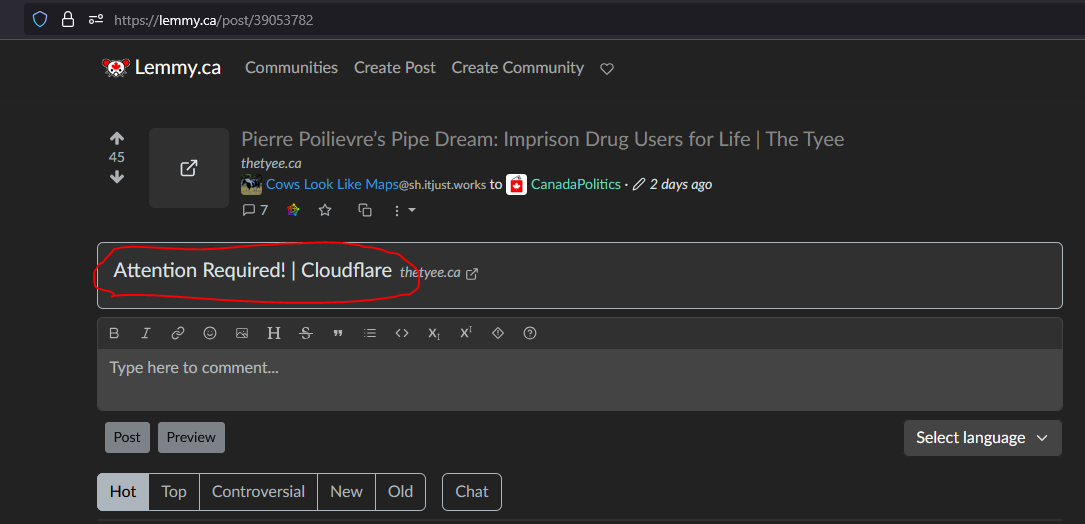
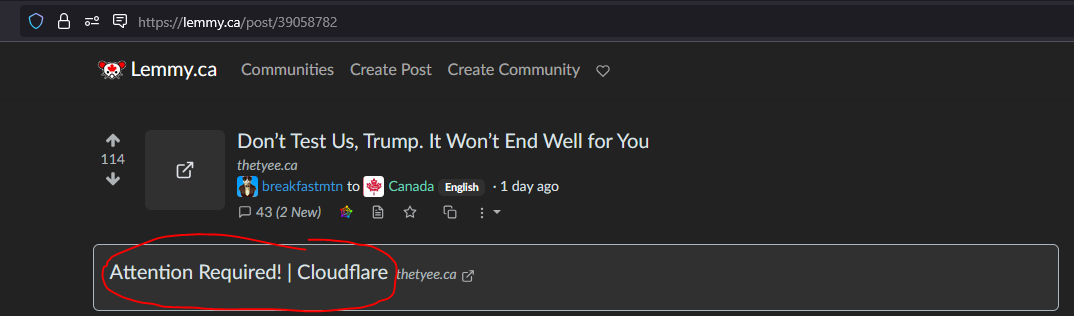
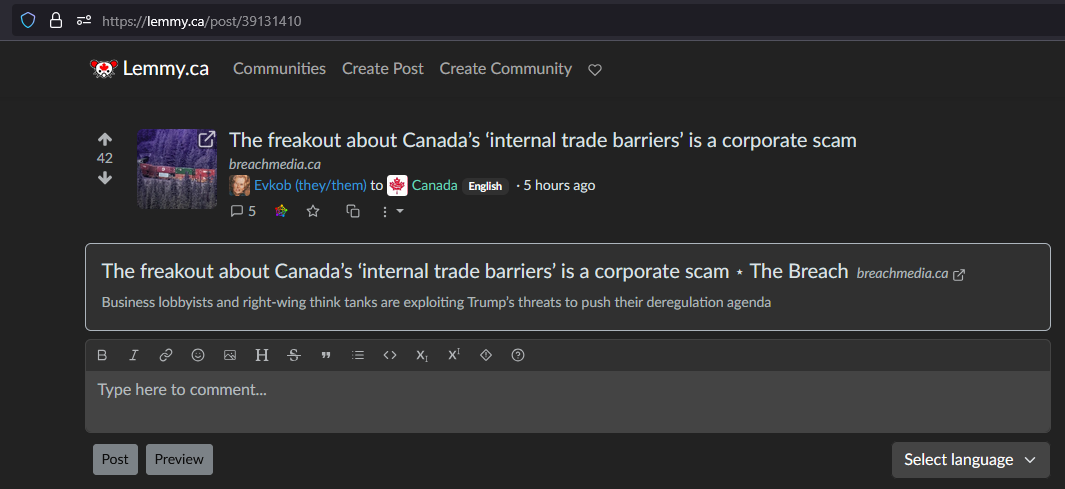
    Link posts from thetyee.ca appear to be previewing the Cloudflare captcha challenge "Attention Required! | Cloudflare" prompt instead of actual content.

    What it looks like (two examples - this seems to be a consistent problem for thetyee):

    (from https://lemmy.ca/post/39053782)

    (from https://lemmy.ca/post/39058782)

    What it should look like (a different post):

    My guess is that the rich link preview is generated in Lemmy's backend, and Cloudflare thinks that the IP address of lemmy.ca's host is full of bots.

    No educated guess on the solution, though, but I'd guess that other Lemmy admins have seen sort of thing too.

    view more: next ›