top 50 comments

sorted by: hot top controversial new old
[–] 187 points 2 years ago (5 children)

This is one case where I think Windows is appropriately designed for its target audience.

  • source
  • hideshow 7 child comments
  • [–] 77 points 2 years ago (3 children)

    I don't really see the benefit of allowing users to create files with the same name in the same directory, yeah, yeah I know that case sensitivity means that it isn't same name, but imagine talking to a user, guiding them to open the file /tmp/doc/File and they open /tmp/doc/file instead

  • source
  • parent
  • hideshow 4 child comments
  • [–] 35 points 2 years ago (6 children)

    The reason, I suspect, is fundamentally because there's no relationship between the uppercase and lowercase characters unless someone goes out of their way to create it. That requires that the filesystem contain knowledge of the alphabet, which might work if all you wanted was to handle ASCII in American English, but isn't good for a system which needs to support the whole world.

    In fact, the UNIX filesystem isn't ASCII. It's also not unicode. UNIX uses arbitrary byte strings, with special significance given to a very small number of bytes (just '/' and '\0', I think). That means people are free to label files in whatever way they like, and their terminals or other applications are free to render them in whatever way seems appropriate, without the filesystem having to understand unicode.

    Adding case insensitivity would therefore actually be significant and unnecessary complexity to add to the filesystem drivers, and we'd probably take a big step backwards in support for other languages

  • source
  • parent
  • hideshow 7 child comments
  • load more comments (5 replies)
  • load more comments (2 replies)
  • [–] 33 points 2 years ago* (last edited 2 years ago) (3 children)

    This isn't "Windows design"... this is just inherited stone age bullshit from the DOS days when the filesystem was FAT16 and all file names were uppercase 8.3.

    NTFS is case sensitive in its underlying design, but was made case insensitive by default, yet case preserving, for reasons of backwards compatibility.

    If Microsoft has to design something from scratch, without the need for backwards compatibility, they go for case sensitive themselves. For example: Azure Blob Storage has case sensitive file names.

  • source
  • parent
  • hideshow 3 child comments
  • load more comments (3 replies)
  • load more comments (3 replies)
    [–] 109 points 2 years ago* (last edited 2 years ago) (11 children)

    It's neat that Linux has the ability to do this, but I honestly can't think of a good usecase for this. I think this is more confusing than it is useful

  • source
  • hideshow 12 child comments
  • load more comments (10 replies)
    [–] 54 points 2 years ago (13 children)

    Windows and NTFS support case sensitive filenames. The functionality is disabled for compatibility reasons.

  • source
  • hideshow 13 child comments
  • load more comments (13 replies)
    [–] 48 points 2 years ago (5 children)

    I can make a file named COM1 on Linux. That's on the forbidden list for Windows.

    The forbidden list:

    • CON
    • PRN
    • AUX
    • CLOCK$
    • NUL
    • COM1
    • COM2
    • COM3
    • COM4
    • COM5
    • COM6
    • COM7
    • COM8
    • COM9
    • LPT1
    • LPT2
    • LPT3
    • LPT4
    • LPT5
    • LPT6
    • LPT7
    • LPT8
    • LPT9
  • source
  • hideshow 6 child comments
  • [+] 18 points 2 years ago* (last edited 1 year ago) (1 child)
  • [–] 15 points 2 years ago (1 child)

    So is Linux, but it puts stuff like that in /dev

  • source
  • parent
  • hideshow 2 child comments
  • [–] 14 points 2 years ago (5 children)

    The thing is, a lot of the legacy backwards compatible stuff that's in Linux is because a lot of things in Unix were actually pretty well thought out from the get go, unlike many of the ugly hacks that went into MSDOS and later Windows and overstayed their welcome.

    Things like: long case sensitive file names from the beginning instead of forced uppercase 8.3 , a hierarchical filesystem instead of drive letters, "everything is a file" concept, a notion of multiple users and permissions, pre-emptive multitasking, proper virtual memory management instead of a "640k is enough" + XMS + EMS, and so on.

  • source
  • parent
  • hideshow 5 child comments
  • load more comments (5 replies)
  • load more comments (4 replies)
    [–] 47 points 2 years ago (4 children)

    But why though? Do you really want a bunch of file.txt File.txt FILE.txt fIle.txt FiLe.txt FIle.txt flIe.txt… I once had a nasty bug the O in a file name was a 0 and I didn’t notice I can’t imagine the horrors this would cause.

  • source
  • hideshow 4 child comments
  • load more comments (4 replies)
    [–] 43 points 2 years ago (9 children)

    Oh it's even better, windows explorer can't really do case sensitive

    But NTFS is a case sensitive file system

    This occasionally manifests in mind boggling problems

  • source
  • hideshow 10 child comments
  • [–] 15 points 2 years ago (2 children)

    Yeah, it's super weird. I once named a file with mixed case, but one of the letters was the wrong case. Renaming the file didn't work at first. Renaming a file named PAscalCase.txt to PascalCase.txt resulted in no change to the filename. Windows continued to show it as PAscalCase.txt. I had to rename it to something totally different with different characters entirely, then rename it again to get it right.

  • source
  • parent
  • hideshow 2 child comments
  • load more comments (2 replies)
  • load more comments (8 replies)
    [–] 41 points 2 years ago (3 children)

    And i hate it being case sensitive

  • source
  • hideshow 5 child comments
  • [–] 28 points 2 years ago (3 children)

    Yeah, right? Are we pretending that having case sensitive file names isn't a bad call, or...? There are literally no upsides to it. Is that the joke?

  • source
  • parent
  • hideshow 4 child comments
  • load more comments (2 replies)
  • load more comments (1 reply)
    [–] 40 points 2 years ago (1 child)

    thank god it's not case sensitive holy shit. i don't understand the kind of person who would see that as a positive.

  • source
  • hideshow 2 child comments
  • [–] 40 points 2 years ago (1 child)

    Even more annoying is that it's very cumbersome to change the case of a file once you've created it.

    If you accidentally create fIle.txt when you meant File.txt, the rename function does nothing ... and it will keep displaying as fIle.txt. You have to rename it to something else entirely, then rename it back to the original name with the intended case.

  • source
  • hideshow 2 child comments
  • [–] 38 points 2 years ago (5 children)

    To screw with Windows users, you should sometimes put a README.md as well as a README.MD in your git repos. It leads to interesting results.

  • source
  • hideshow 5 child comments
  • load more comments (5 replies)
    [–] 34 points 2 years ago (4 children)

    Is it just me or is that more of a hinderance?

  • source
  • hideshow 5 child comments
  • load more comments (3 replies)
    [–] 32 points 2 years ago (1 child)

    Yeah I've been using Linux for a very long time. The amount of time I've spent on the case being incorrect is non-trivial. I've gotten better at not screwing it up throughout the years but the sum of advantages is far outweighed by the sum of debugging time spent.

  • source
  • hideshow 2 child comments
  • [–] 30 points 2 years ago* (2 children)

    cd downloads

    bash: cd: downloads: No such file or directory

    cd Downloads

    user@pcname:~/Downloads$

  • source
  • hideshow 4 child comments
  • [–] 30 points 2 years ago (18 children)

    I'm with windows on this one. Case insensitive is much more ergonomics with the only sacrifice represented by this meme. And a little bit of performance of course. But the ergonomics are worth it imo.

  • source
  • hideshow 18 child comments
  • load more comments (18 replies)
    [–] 26 points 2 years ago (14 children)

    Windows way is superior, in my opinion. I don't think there's a need for File.txt and fILE.txt

  • source
  • hideshow 16 child comments
  • load more comments (12 replies)
    [–] 24 points 2 years ago (2 children)

    I find it really fucking irritating on Linux tbh. It knew what file I meant.

  • source
  • hideshow 2 child comments
  • load more comments (2 replies)
    [–] 20 points 2 years ago (2 children)

    The android build system used that limitation of Windows to prevent android from being built on Windows. They purposely had directories with the same name but different capitalization.

  • source
  • hideshow 2 child comments
  • load more comments (2 replies)
    [–] 20 points 2 years ago* (last edited 2 years ago) (3 children)

    The main problem with case-insensitive is that software sometimes is lazily developed: If a file is named β€œFile.txt” and a program opens β€œfile.txt”, then on a case-insensitive file system it will work fine. If you then format your drive to case-sensitive, the same software now fails to load the file. Source: tried case-sensitive filesystem on macOS some years ago.

  • source
  • hideshow 3 child comments
  • load more comments (3 replies)
    [–] 19 points 2 years ago (3 children)

    What I really like is a naming files with a forbidden windows character in Linux and they wont copy over to a windows partition. I end up using a question mark quite a bit for some reason.

  • source
  • hideshow 3 child comments
  • load more comments (3 replies)
    [–] 19 points 2 years ago* (last edited 2 years ago) (4 children)

    Case-sensitive is easier to implement; it's just a string of bytes. Case-insensitive requires a lot of code to get right, since it has to interpret symbols that make sense to humans. So, something over wondered about:

    That's not hard for ASCII, but what about Unicode? Is the precomposed Γ§ treated the same lexically and by the API as Latin capital letter c + combining cedilla? Does the OS normalize all of one form to the other? Is ß the same as SS? What about alternate glyphs, like half width or full width forms? Is it i18n-sensitive, so that, say, E and Γ‰ are treated the same in French localization? Are Katakana and Hiragana characters equivalent?

    I dunno, as a long-time Unix and Linux user, I haven't tried these things, but it seems odd to me to build a set of character equivalences into the filesystem code, unless you're going to do do all of them. (But then, they're idiosyncratic and may conflict between languages, like how ΓΆ is its letter in the Swedish alphabet.)

  • source
  • hideshow 4 child comments
  • load more comments (4 replies)
    [–] 17 points 2 years ago (4 children)

    Strictly speaking, this is a limitation of the default filesystem, and not the core operating system. If you mount a NFS share that is case sensitive, it will still be case sensitive.

  • source
  • hideshow 4 child comments
  • load more comments (4 replies)
    [–] 17 points 2 years ago

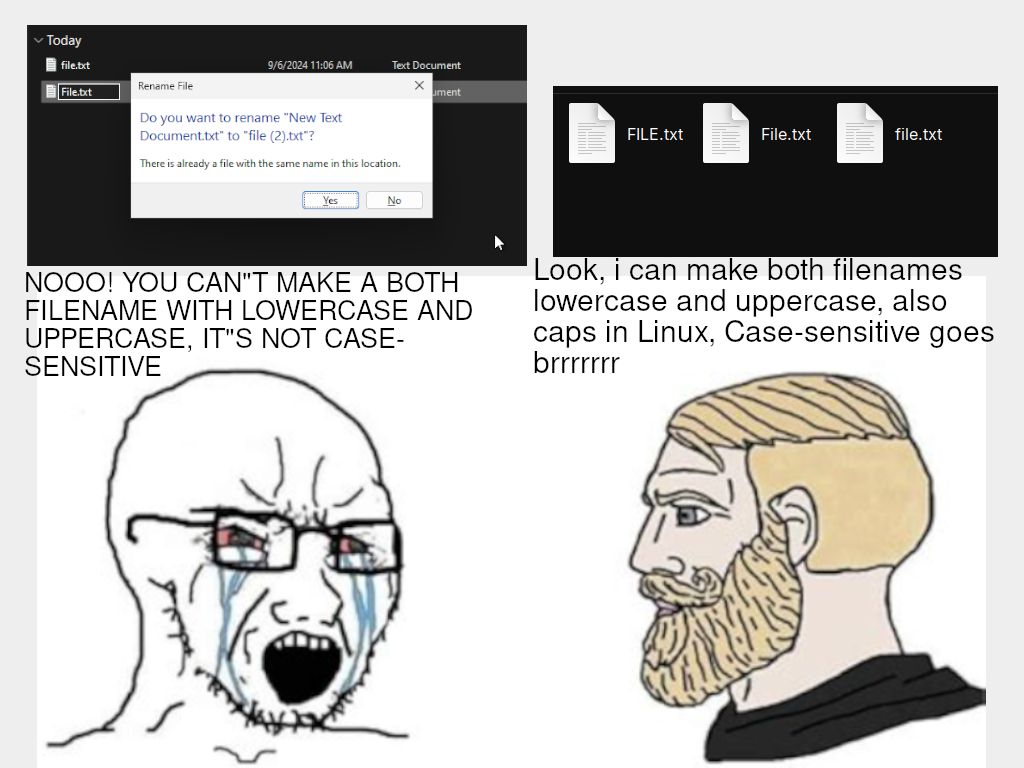
    The meme faces are backwards on this one.

  • source
  • [–] 15 points 2 years ago

    Fun things happen whenever you upload 2 files with the same names, but differently capitalized letters to a Nas from a linux box, and then try to delete one of them from windows. It broke so hard I actually got a bsod....

  • source
  • This puts the win in Windows

  • source
  • [–] 13 points 2 years ago* (last edited 2 years ago) (1 child)

    What a tragedy. Giving files slightly different names seems far more organized and logical than having several files with the same name and different capitalization. Really seems like a non-issue to me.

    EDIT: I will never simp for Windows or Microsoft, I definitely think Linux is better in many ways. But my point still stands about this specific topic.

  • source
  • hideshow 1 child comment
  • load more comments (1 reply)
    [–] 13 points 2 years ago (4 children)

    Case sensitivity is how we get SovCits…..

  • source
  • hideshow 4 child comments
  • load more comments (4 replies)
    [–] 12 points 2 years ago* (last edited 2 years ago) (1 child)

    This makes installing Skyrim mods harder because mods often contain differing versions of folder names. For example one mod might be "Scripts" and the other might be "scripts". This means you can't have Skyrim mods on Linux if you're allergic to copying files manually as this will generally make mod managers not work as well. People on forums like nexus often have a hard time even grasping the concept of not using a mod manager so it's hard to get help of any kind.

  • source
  • hideshow 1 child comment
  • load more comments (1 reply)
    load more comments
    view more: next β€Ί