top 50 comments

sorted by: hot top controversial new old
[–] 101 points 2 years ago (3 children)

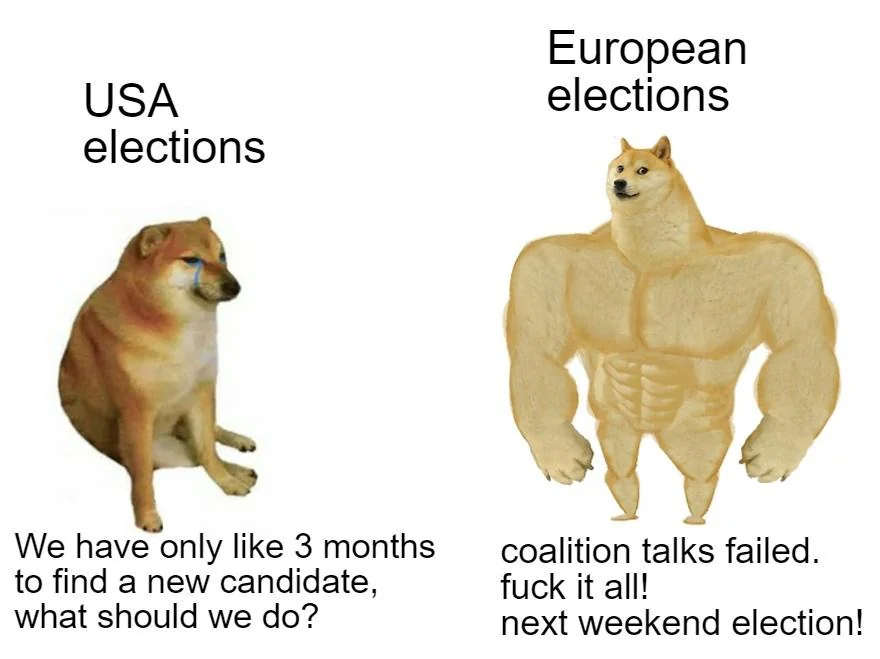
And Americans only have to pick one out of two opposing parties. How hard can it be?

  • source
  • hideshow 6 child comments
  • [–] 58 points 2 years ago (3 children)

    The problem is two-fold. The majority of Americans are passively informed, and the majority of our news publications are compromised by wealthy owners.

    Also, it’s two months, not three. Early voting ballots go out in the end of September.

  • source
  • parent
  • hideshow 5 child comments
  • [–] 5 points 2 years ago (1 child)

    Passively informed is an understatement, also we're supposed to be available to work at a moments call, with limited time off availability. Am I gonna just tell my boss I'm leaving early to go vote?

  • source
  • parent
  • hideshow 2 child comments
  • load more comments (1 reply)
  • [–] 19 points 2 years ago (4 children)

    People making a choice isn't the hard part. All 51 different territories having different rules for their elections is the hard part.

  • source
  • parent
  • hideshow 5 child comments
  • load more comments (3 replies)
  • [–] 36 points 2 years ago (1 child)

    You can get rid of your prime ministers pretty easily if they suck. We’re electing what is now essentially a king for at least the next 4 years.

  • source
  • hideshow 2 child comments
  • [–] 31 points 2 years ago (1 child)

    my favorite UK shitpost was liz truss, very funny.

  • source
  • hideshow 2 child comments
  • [–] 27 points 2 years ago* (2 children)

    More education, please. I'm American.

    How does this process function?

    How does it change the ratchet right effect seen in the US?

  • source
  • hideshow 4 child comments
  • [–] 54 points 2 years ago* (2 children)

    In a parliamentary system, Prime Ministers aren't elected by popular vote, but instead chosen by Parliament. It's basically like if the Speaker of the House were also the President.


    Fun fact: the US system was originally designed to work sort of that way, except they wanted the President to be chosen by all the state legislatures instead of Congress, for extra Federalist separation of powers. That's what the Electoral College is for: they couldn't do "one state rep = one vote" because each state has different numbers of constituents per rep and such, so they needed a "compatibility layer."

    Then states immediately fucked up the plan by holding popular votes for Electors instead of having the legislature appoint them, and the rest is history.

  • source
  • parent
  • hideshow 4 child comments
  • [–] 20 points 2 years ago* (1 child)

    Also, in most European states (France is similar to the US in that point), the head of state (president, king) is not the head of government (prime minister, chancellor). The former may be elected by popular vote, and has mainly representative tasks, the latter usually is elected by the parlament and drives the political decisions.

  • source
  • parent
  • hideshow 2 child comments
  • [–] 5 points 2 years ago* (3 children)

    This makes sense. I'd add that the system of government in the US didn't function as intended in many facets and almost immediately. In respect to the electoral college today, American exceptionalism prevents us accepting that a direct democracy in choosing our President would sentence us to the mediocrity we fear most. We don't understand why we've an electoral college because we broke it before railroads and the cotton gin.

    I appreciate the parliamentary system so far for its simplicity relative the US system. But, the good and bad consequences really depends on the nuance.

    What compromise must be reached to prevent another election?

    What offices are reelected? The entirety of parliament?

  • source
  • parent
  • hideshow 5 child comments
  • [–] 9 points 2 years ago (4 children)

    So the UK is probably the simplest to discuss because it doesn't have a constitution, and this means parliament is sovereign and decides everything by a simple majority vote.

    They can pass laws saying that certain things need a super majority, but then they can just turn round and unpass them as well

    This means that what you think of as the executive, i.e. the prime minister and all his helpers, can be changed by a simple majority, and an election can be called by one. They don't need to happen at the same time. The last parliament had three different prime ministers without an election, and it's common to switch prime ministers well before an election in order to create an incumbent advantage.

  • source
  • parent
  • hideshow 4 child comments
  • load more comments (4 replies)
  • [–] 7 points 2 years ago (4 children)

    In parliamentary systems, the government needs to maintain the confidence of the majority. Any elected official can request a vote of confidence be held and, at least in Canada, certain votes are always considered votes of confidence (ex. the government's budget). If a confidence vote fails, parliament dissolves and can't do anything until a new parliament is formed. All seats are up for re-election. Since the government can't do anything until an election is held, they tend to happen very quickly.

    The government can prevent a no confidence vote by swaying enough members. It's a bit of a non-issue if the current government already holds the majority of seats. If they don't hold a majority, they'll often make deals with a smaller party in exchange for their confidence. This can be as little as modifying a bill to as much as forming an official coalition and granting members of another party cabinet positions.

  • source
  • parent
  • hideshow 4 child comments
  • load more comments (4 replies)
  • load more comments (1 reply)
  • [–] 10 points 2 years ago*

    There are also semi-presidential republics, which function differently. In those systems, the US-style president role is split into two different roles, president & prime minister. President handles foreign policy, the army and selects the prime minister with the approval of parliament, and the prime minister handles everything domestic. This separation of roles means the amount of damage an individual can do is much more limited.

    Edit: Oh, I missed somebody already talked about the French system, which is a semi-presidential system. Oh well, leaving this up for posterity.

  • source
  • parent
  • [–] 24 points 2 years ago (1 child)

    It's not the time that's the issue. It's the eye-watering sums of money you cunts donate to let a politician run a campaign.

    What the fuck does someone need $450m for?! Use that to provide support for the homeless, feed the poor, and protect children that need a stable home. You could do so much with that money.

  • source
  • hideshow 2 child comments
  • [–] 4 points 2 years ago

    if it was up to the average american, we wouldn't have that shit. unfortunately our society is puppeted by the rich to a very unhealthy degree at the moment. i hope that changes soon and maybe give us the opportunity to revolution some of them away.

  • source
  • parent
  • [–] 15 points 2 years ago (2 children)

    It is kinda trolling how you can just call an election when you think your party will do best

  • source
  • hideshow 3 child comments
  • load more comments (1 reply)
    [–] 10 points 2 years ago (1 child)

    Some countries end up with a great PM because everyone else was made inelligible. Looking at you, New Zealand.

  • source
  • hideshow 1 child comment
  • load more comments (1 reply)
    [–] 8 points 2 years ago (1 child)

    Let the Americans have their fun. They love plot twists, a bit of pageantry and pizazz. While they certainly don’t NEED a year-long election cycle, most Americans actively seem to enjoy it.

    It creates opportunities to vigorously debate the opposition, run some nice smear campaigns, do a bit of backstabbing, schmooze the big donors, kiss a few babies and add in the odd assassination attempt. You just can’t fit all that drama in a one month cycle like we Europeans like to do.

  • source
  • hideshow 2 child comments
  • [–] 8 points 2 years ago (3 children)

    And then there's Belgium, which apparently holds the world record for longest time without a government. At least introduce time limits for negotiations, guys…

  • source
  • hideshow 4 child comments
  • [–] 4 points 2 years ago

    One positive on the Dutch coalition talks. We can always say that our southern neighbours take even longer...

    On a more serious note, the last three coalition talks in the Netherlands took over 200 days, with one taking 299 days. Sure, not even close to over 500 days in Belgium, but how the hell does this happen?

  • source
  • parent
  • load more comments (2 replies)
    [–] 7 points 2 years ago (4 children)

    The US also has 5 times as many people as France.

    Europe can have snap elections, but we don't try and have elections for every European country at once, with two leaders trying desperately to visit each one to win support.

  • source
  • hideshow 7 child comments
  • [–] 6 points 2 years ago (2 children)

    They wouldn't need to visit each country, they don't even bother caring about more than 4 states in the US!

  • source
  • parent
  • hideshow 3 child comments
  • load more comments (1 reply)
  • load more comments (1 reply)
    [–] 5 points 2 years ago

    If american democracy was good, other countries would be using it.

  • source
  • load more comments
    view more: next ›