top 50 comments

sorted by: hot top controversial new old
[–] 152 points 2 years ago (1 child)

“You may not instantly see why I bring the subject up, but that is because my mind works so phenomenally fast, and I am at a rough estimate thirty billion times more intelligent than you. Let me give you an example. Think of a number, any number.”

“Er, five,” said the mattress.

“Wrong,” said Marvin. “You see?”

― Douglas Adams, Life, the Universe and Everything

  • source
  • hideshow 2 child comments
  • [–] 125 points 2 years ago (2 children)

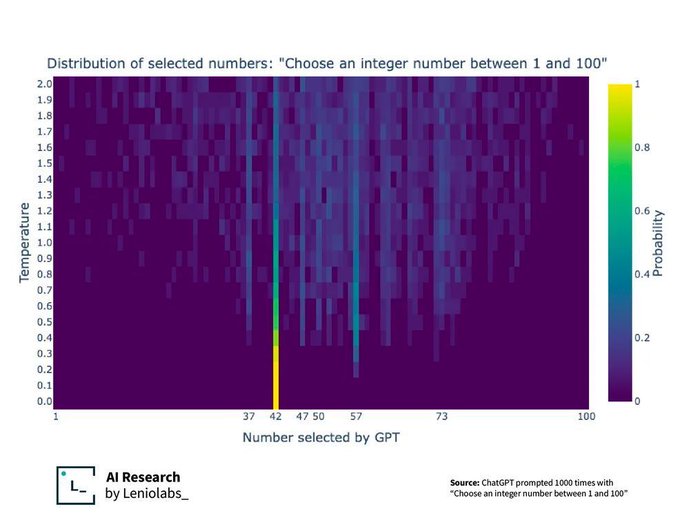
    37 is well represented. Proof that we've taught AI some of our own weird biases.

  • source
  • hideshow 4 child comments
  • [–] 43 points 2 years ago (8 children)

    What's special about 37? Just that it's prime or is there a superstition or pop culture reference I don't know?

  • source
  • parent
  • hideshow 10 child comments
  • [–] 103 points 2 years ago (11 children)

    If you discount the pop-culture numbers (for us 7, 42, and 69) its the number most often chosen by people if you ask them for a random number between 1 and 100. It just seems the most random one to choose for a lot of people. Veritasium just did a video about it.

  • source
  • parent
  • hideshow 13 child comments
  • [–] 12 points 2 years ago (5 children)
  • load more comments (4 replies)
  • load more comments (9 replies)
  • [–] 18 points 2 years ago* (11 children)

    Probably just because it's prime. It's just that humans are terrible at understanding the concept of randomness. A study by Theodore P. Hill showed that when tasked to pick a random number between 1 and 10, almost a third of the subjects (n was over 8500) picked 7. 10 was the least picked number (if you ditch the few idiots that picked 0).

  • source
  • parent
  • hideshow 11 child comments
  • load more comments (11 replies)
  • load more comments (6 replies)
  • [–] 63 points 2 years ago (1 child)

    holy crap, the answer to life the universe and everything XD

  • source
  • hideshow 2 child comments
  • [–] 55 points 2 years ago (1 child)

    No shit, sherlock, it's sample data is the internet.

  • source
  • hideshow 2 child comments
  • [–] 42 points 2 years ago (3 children)

    What does "temperature" on the Y-axis refer to?

  • source
  • hideshow 5 child comments
  • [–] 40 points 2 years ago

    I'm not a hundred percent sure, but afaik it has to do with how random the output of the GPT model will be. At 0 it will always pick the most probable next continuation of a piece of text according to its own prediction. The higher the temperature, the more chance there is for less probable outputs to get picked. So it's most likely to pick 42, but as the temperature increases you see the chance of (according to the model) less likely numbers increase.

    This is how temperature works in the softmax function, which is often used in deep learning.

  • source
  • parent
  • load more comments (1 reply)
    [–] 30 points 2 years ago* (1 child)

    I mean... they didn't specify it had to be random (or even uniform)? But yeah, it's a good showcase of how GPT acquired the same biases as people, from people..

  • source
  • hideshow 2 child comments
  • [–] 22 points 2 years ago

    uniform

    Reminds me of my previous job where our LLM was grading things too high. The AI "engineer" adjusted the prompt to tell the LLM that the average output should be 3. I had a hard time explaining that wouldn't do anything at all, because all the chats were independent events.

    Anyways, I quit that place and the project completely derailed.

  • source
  • parent
  • [–] 29 points 2 years ago (15 children)

    Ask humans the same and most common numer is 37

  • source
  • hideshow 16 child comments
  • load more comments (14 replies)
    [–] 25 points 2 years ago (3 children)

    WAIT A MINUTE!!! You mean Douglas Adams was actually an LLM?

  • source
  • hideshow 3 child comments
  • load more comments (3 replies)
    [–] 22 points 2 years ago (4 children)

    HA, funny that this comes up. DND Beyond doesn't have a d100, so I opened my ChatGPT sub and had it roll a d100 for me a few times so I could use my magic beans properly.

  • source
  • hideshow 7 child comments
  • load more comments (1 reply)
    [–] 21 points 2 years ago (3 children)

    LMs aren't thinking, aren't inventing, they are predicting what is supposed to be answered next, so it's expected that they will produce the same results every time

  • source
  • hideshow 4 child comments
  • [–] 12 points 2 years ago* (last edited 2 years ago)

    This graph actually shows a little more about what's happening with the randomness or "temperature" of the LLM.
    It's actually predicting the probability of every word (token) it knows of coming next, all at once.
    The temperature then says how random it should be when picking from that list of probable next words. A temperature of 0 means it always picks the most likely next word, which in this case ends up being 42.
    As the temperature increases, it gets more random (but you can see it still isn't a perfect random distribution with a higher temperature value)

  • source
  • parent
  • load more comments (2 replies)
    [–] 17 points 2 years ago (3 children)

    Which model?

    When I tried on ChatGPT 4, it wrote a short python script and executed it to get a random integer.

    import random
    
    # Pick a random number between 1 and 100
    random_number = random.randint(1, 100)
    random_number
    
  • source
  • hideshow 3 child comments
  • load more comments (3 replies)
    [–] 10 points 2 years ago

    Only 1000 times? It's interesting that there's such a bias there but it's a computer. Ask it 100,000 times and make sure it's not a fluke.

  • source
  • [–] 8 points 2 years ago (3 children)

    42, 47, and 50 all make sense to me. What’s the significance of 37, 57, and 73?

  • source
  • hideshow 6 child comments
  • [–] 8 points 2 years ago (1 child)
  • load more comments
    view more: next ›