▲ 434 ▼ Ask ChatGPT to pick a number between 1 and 100 (jlai.lu) submitted 2 years ago by ElCanut@jlai.lu to c/technology@beehaw.org 148 comments fedilink hide all child comments
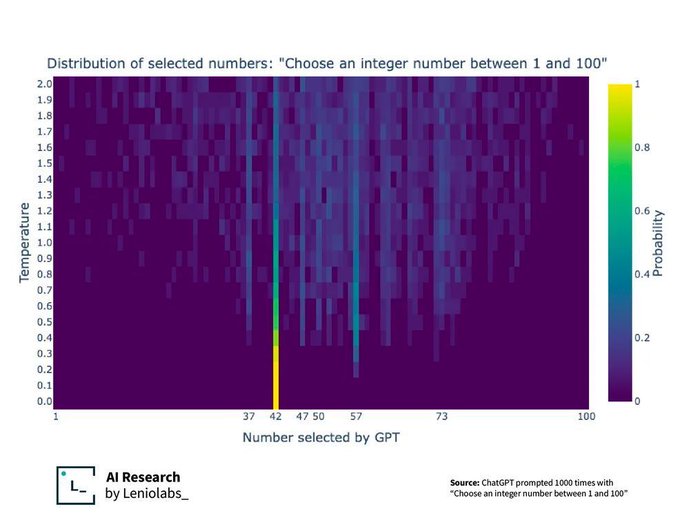
[–] Bishma@discuss.tchncs.de 125 points 2 years ago (2 children) 37 is well represented. Proof that we've taught AI some of our own weird biases. permalink fedilink source hideshow 4 child comments replies: [–] GenderNeutralBro@lemmy.sdf.org 43 points 2 years ago (7 children) What's special about 37? Just that it's prime or is there a superstition or pop culture reference I don't know? permalink fedilink source parent hideshow 14 child comments replies: [–] Bishma@discuss.tchncs.de 103 points 2 years ago (8 children) If you discount the pop-culture numbers (for us 7, 42, and 69) its the number most often chosen by people if you ask them for a random number between 1 and 100. It just seems the most random one to choose for a lot of people. Veritasium just did a video about it. permalink fedilink source parent hideshow 15 child comments replies: [–] metallic_z3r0@infosec.pub 28 points 2 years ago (1 child) 37 is my favorite, because 3x7x37=777 (three sevens), and I think that's neat. permalink fedilink source parent hideshow 2 child comments replies: [–] mitrosus@discuss.tchncs.de 2 points 2 years ago (2 children) Wrong. Two hints: 7x7=9 at the end, not 7. 30x30=900, already more than 777. permalink fedilink source parent hideshow 4 child comments replies: [–] jarfil@beehaw.org 28 points 2 years ago (1 child) One hint: 3x7=21, 21x37=777. When in doubt, use a calculator. permalink fedilink source parent hideshow 2 child comments replies: [–] mitrosus@discuss.tchncs.de 11 points 2 years ago Oh I am sorry. I did not see the x sign between 3 and 7. Lol. permalink fedilink source parent [–] RisingSwell@lemmy.dbzer0.com 18 points 2 years ago (2 children) ? My calculator definitely thinks that 3x7x37=777. Did you read it as 37x37 instead? permalink fedilink source parent hideshow 4 child comments replies: [–] mitrosus@discuss.tchncs.de 7 points 2 years ago Yes. Thanks. Sorry. permalink fedilink source parent [–] nightwatch_admin@feddit.nl 5 points 2 years ago You don’t even need a calculator for a quick calculation, take the closest value of 10: 3x7=21x37 or easier 20x40 = 800 which is close to the actual number, 777. permalink fedilink source parent [–] SubArcticTundra@lemmy.ml 12 points 2 years ago (2 children) What about 57 permalink fedilink source parent hideshow 4 child comments replies: [–] Bishma@discuss.tchncs.de 20 points 2 years ago (1 child) I'm curious about that too. Something is twisting weights for 57 fairly strongly in the model but I'm not show what. Maybe its been trained on a bunch of old Heinz 57 varieties marketing. permalink fedilink source parent hideshow 2 child comments replies: [–] boredtortoise@lemm.ee 7 points 2 years ago Wesley Snipes permalink fedilink source parent [–] northendtrooper@lemmy.ca 3 points 2 years ago (1 child) Heinz Ketchup? permalink fedilink source parent hideshow 2 child comments replies: [–] ColeSloth@discuss.tchncs.de 5 points 2 years ago (1 child) I think you mean heinz 57 the steak sauce.... permalink fedilink source parent hideshow 2 child comments replies: [–] Syn_Attck@lemmy.today 4 points 2 years ago (1 child) not this again. it's ketchup mfer, 57 varieties of tomatoes! permalink fedilink source parent hideshow 2 child comments replies: [–] nxdefiant@startrek.website 2 points 2 years ago* Unsolicited fact: Heinz picked the number 57 at random, it just sounded like good marketing at a time when things were general marketed as "tonic #4" and the like. (well, maybe not fact, more like probable truth) permalink fedilink source parent [–] driving_crooner@lemmy.eco.br 5 points 2 years ago I don't like the inclusion of 37%, it's 1/e that isn't even 37%, is only that because of a pretty arbitrary rounding. Veritasium videos are usually OK, but this one is pretty meh. permalink fedilink source parent [–] Chadus_Maximus@lemm.ee 4 points 2 years ago Another fun fact: if you ask people to pick 2/3rds of a number everyone else picks when asked the same question, the correct number is drumroll 24. permalink fedilink source parent [–] GenderNeutralBro@lemmy.sdf.org 4 points 2 years ago Thanks! permalink fedilink source parent [–] MonkderDritte@feddit.de 4 points 2 years ago Is there some human sciences theory as to why? permalink fedilink source parent [–] geography082@lemm.ee 2 points 2 years ago (1 child) Sorry but pop culture from were? I don’t recognize any of those numbers. permalink fedilink source parent hideshow 2 child comments replies: [–] DAMunzy@lemmy.dbzer0.com 11 points 2 years ago (1 child) Lucky number 7. 42 is the meaning of life in The Hitchhikers Guide to the Galaxy. And 69...nice! I'm guessing this is for US and UK culture? Probably a lot of other former and current English colonies permalink fedilink source parent hideshow 2 child comments replies: [–] FryHyde@lemmy.zip 9 points 2 years ago (1 child) It's not the meaning of life. It's the Ultimate Answer to Life, the Universe, and Everything. Nobody knows what the Question is. permalink fedilink source parent hideshow 2 child comments replies: [–] DAMunzy@lemmy.dbzer0.com 2 points 2 years ago Thanks. I Borked that one up permalink fedilink source parent load more comments (1 reply) [–] Karyoplasma@discuss.tchncs.de 18 points 2 years ago* (1 child) Probably just because it's prime. It's just that humans are terrible at understanding the concept of randomness. A study by Theodore P. Hill showed that when tasked to pick a random number between 1 and 10, almost a third of the subjects (n was over 8500) picked 7. 10 was the least picked number (if you ditch the few idiots that picked 0). permalink fedilink source parent hideshow 2 child comments replies: [–] K0W4LSK1@lemmy.dbzer0.com 7 points 2 years ago (1 child) Maybe randomness is a label we slapped on shit we don't understand. permalink fedilink source parent hideshow 2 child comments replies: [–] driving_crooner@lemmy.eco.br 9 points 2 years ago* (last edited 2 years ago) (2 children) I remember watching a lecture about probability, and the professor said that only quantum processes are really random, the rest of things that we call random is just the human inability to measure the variables that affects the random outcome. I'm an actuarie, and it's made me change the perspective on how I see and study random processes and how it made think on ways to influence the outcome of random processes. permalink fedilink source parent hideshow 4 child comments replies: [–] jarfil@beehaw.org 8 points 2 years ago* ...which is kind of a hilarious tautology, because "quantum processes" are by definition "processes that we are unable to decompose into more basic parts". The moment we learn about some more fundamental processes being the reason for a given process, it stops being "quantum" and the new ones become "it". permalink fedilink source parent [–] K0W4LSK1@lemmy.dbzer0.com 5 points 2 years ago (1 child) Even quantum just appears random I think. it's beyond our scope of perspective, it works in multiple dimensions. we only see part of the process. That's my guess though it could be totally wrong permalink fedilink source parent hideshow 2 child comments replies: [–] itslilith@lemmy.blahaj.zone 4 points 2 years ago (3 children) it's a matter of interpretation, but generally the consensus is that quantum measurements are truly probabilistic (random), Bell proved that there can't be any hidden variables that influence the outcome permalink fedilink source parent hideshow 4 child comments replies: [–] Karyoplasma@discuss.tchncs.de 4 points 2 years ago (1 child) Didn't Bell just put that up as a theory and it got proven somewhat recently by other researchers? The 2022 physics Nobel Prize was about disproving hidden variables and they titled their finding with the catchy phrase "the universe is not locally real". permalink fedilink source parent hideshow 2 child comments replies: [–] itslilith@lemmy.blahaj.zone 4 points 2 years ago (1 child) He proved it mathematically, but it was only recently confirmed experimentally permalink fedilink source parent hideshow 2 child comments replies: [–] Karyoplasma@discuss.tchncs.de 3 points 2 years ago (1 child) I see, thanks for the insight! permalink fedilink source parent hideshow 2 child comments replies: [–] itslilith@lemmy.blahaj.zone 4 points 2 years ago No problem! Interpretations of quantum mechanics are also still very much under discussion, and Bell's inequality only says that there are no local hidden variables. While QM very accurately describes observations so far, it's by no means solved, and there's a good chance that a new theory will upend much of it in the future permalink fedilink source parent load more comments (2 replies) [–] gigachad@feddit.de 5 points 2 years ago I didn't know either, but it seems to be an often picked 'random' number by people. Here is an article about it, I didn't read it though. permalink fedilink source parent [–] Zorque@kbin.social 5 points 2 years ago https://www.youtube.com/watch?v=xOkI2CmD2D8 permalink fedilink source parent [–] BuboScandiacus@mander.xyz 4 points 2 years ago* Watch this: https://m.youtube.com/watch?v=d6iQrh2TK98 permalink fedilink source parent [–] Johandea@feddit.nu 4 points 2 years ago https://youtu.be/d6iQrh2TK98?feature=shared Just a number dumb monkeys believe to be "more random". permalink fedilink source parent [–] tooLikeTheNope@lemmy.ml 3 points 2 years ago* (1 child) My art professor wrote a book about famous artists and thinkers dying at 37: Raffaello, Parmigianino, Valentin de Boulogne, Cantarini, Watteau, Van Gogh, Toulouse-Lautrec, Tancredi, Gnoli, Manai, Majakovskij, Rimbaud, Byron, Mozart, Robespierre https://www.ibs.it/trentasette-mistero-del-genio-adolescente-libro-flavio-caroli/e/9788804734017 Not a great book tbh. permalink fedilink source parent hideshow 2 child comments replies: [–] jlow@beehaw.org 2 points 2 years ago Only dudes, though, right? permalink fedilink source parent [–] FiniteBanjo@lemmy.today 11 points 2 years ago (2 children) Why would that need to be proven? We're the sample data. It's implied. permalink fedilink source parent hideshow 4 child comments replies: [–] jarfil@beehaw.org 10 points 2 years ago (1 child) The correctness of the sampling process still needs a proof. Like this. permalink fedilink source parent hideshow 2 child comments replies: [–] FiniteBanjo@lemmy.today 7 points 2 years ago (1 child) What you've described would be like looking at a chart of various fluid boiling points at atmospheric pressure and being like "Wow, water boils at 100 C!" It would only be interesting if that somehow weren't the case. permalink fedilink source parent hideshow 2 child comments replies: [–] jarfil@beehaw.org 5 points 2 years ago (1 child) Where is the "Wow!" in this post? It states a fact, like "Water boils at 100C under 1 atm", and shows that the student (ChatGPT) has correctly reproduced the experiment. Why do you think schools keep teaching that "Water boils at 100C under 1 atm"? If it's so obvious, should they stop putting it on the test and failing those who say it boils at "69C, giggity"? permalink fedilink source parent hideshow 2 child comments replies: [–] FiniteBanjo@lemmy.today 4 points 2 years ago (1 child) Derek feeling the need to comment that the bias in the training data correlates with the bias of the corrected output of a commercial product just seemed really bizarre to me. Maybe it's got the same appeal as a zoo or something, I never really got into watching animals be animals in a zoo. permalink fedilink source parent hideshow 2 child comments replies: [–] jarfil@beehaw.org 3 points 2 years ago Hm? Watching animals be animals at a zoo, is a way better sampling of how animals are animals, than for example watching that wildlife "documentary" where they'd throw lemmings of a cliff "for dramatic effect" (a "commercially corrected bias"?). In this case, the "corrected output" is just 42, not 37, but as the temperature increases on the Y axis, we get a glimpse of internal biases, which actually let through other patterns of the training data, like the 37. permalink fedilink source parent [–] EatATaco@lemm.ee 6 points 2 years ago (2 children) "we don't need to prove the 2020 election was stolen, it's implied because trump had bigger crowds at his rallies!" -90% of trump supporters Another good example is the Monty Hall "paradox" where 99% of people are going to incorrectly tell you the chance is 50% because they took math and that's how it works. Just because something seems obvious to you doesn't mean it is correct. Always a good idea to test your hypothesis. permalink fedilink source parent hideshow 2 child comments load more comments (2 replies)
[–] GenderNeutralBro@lemmy.sdf.org 43 points 2 years ago (7 children) What's special about 37? Just that it's prime or is there a superstition or pop culture reference I don't know? permalink fedilink source parent hideshow 14 child comments replies: [–] Bishma@discuss.tchncs.de 103 points 2 years ago (8 children) If you discount the pop-culture numbers (for us 7, 42, and 69) its the number most often chosen by people if you ask them for a random number between 1 and 100. It just seems the most random one to choose for a lot of people. Veritasium just did a video about it. permalink fedilink source parent hideshow 15 child comments replies: [–] metallic_z3r0@infosec.pub 28 points 2 years ago (1 child) 37 is my favorite, because 3x7x37=777 (three sevens), and I think that's neat. permalink fedilink source parent hideshow 2 child comments replies: [–] mitrosus@discuss.tchncs.de 2 points 2 years ago (2 children) Wrong. Two hints: 7x7=9 at the end, not 7. 30x30=900, already more than 777. permalink fedilink source parent hideshow 4 child comments replies: [–] jarfil@beehaw.org 28 points 2 years ago (1 child) One hint: 3x7=21, 21x37=777. When in doubt, use a calculator. permalink fedilink source parent hideshow 2 child comments replies: [–] mitrosus@discuss.tchncs.de 11 points 2 years ago Oh I am sorry. I did not see the x sign between 3 and 7. Lol. permalink fedilink source parent [–] RisingSwell@lemmy.dbzer0.com 18 points 2 years ago (2 children) ? My calculator definitely thinks that 3x7x37=777. Did you read it as 37x37 instead? permalink fedilink source parent hideshow 4 child comments replies: [–] mitrosus@discuss.tchncs.de 7 points 2 years ago Yes. Thanks. Sorry. permalink fedilink source parent [–] nightwatch_admin@feddit.nl 5 points 2 years ago You don’t even need a calculator for a quick calculation, take the closest value of 10: 3x7=21x37 or easier 20x40 = 800 which is close to the actual number, 777. permalink fedilink source parent [–] SubArcticTundra@lemmy.ml 12 points 2 years ago (2 children) What about 57 permalink fedilink source parent hideshow 4 child comments replies: [–] Bishma@discuss.tchncs.de 20 points 2 years ago (1 child) I'm curious about that too. Something is twisting weights for 57 fairly strongly in the model but I'm not show what. Maybe its been trained on a bunch of old Heinz 57 varieties marketing. permalink fedilink source parent hideshow 2 child comments replies: [–] boredtortoise@lemm.ee 7 points 2 years ago Wesley Snipes permalink fedilink source parent [–] northendtrooper@lemmy.ca 3 points 2 years ago (1 child) Heinz Ketchup? permalink fedilink source parent hideshow 2 child comments replies: [–] ColeSloth@discuss.tchncs.de 5 points 2 years ago (1 child) I think you mean heinz 57 the steak sauce.... permalink fedilink source parent hideshow 2 child comments replies: [–] Syn_Attck@lemmy.today 4 points 2 years ago (1 child) not this again. it's ketchup mfer, 57 varieties of tomatoes! permalink fedilink source parent hideshow 2 child comments replies: [–] nxdefiant@startrek.website 2 points 2 years ago* Unsolicited fact: Heinz picked the number 57 at random, it just sounded like good marketing at a time when things were general marketed as "tonic #4" and the like. (well, maybe not fact, more like probable truth) permalink fedilink source parent [–] driving_crooner@lemmy.eco.br 5 points 2 years ago I don't like the inclusion of 37%, it's 1/e that isn't even 37%, is only that because of a pretty arbitrary rounding. Veritasium videos are usually OK, but this one is pretty meh. permalink fedilink source parent [–] Chadus_Maximus@lemm.ee 4 points 2 years ago Another fun fact: if you ask people to pick 2/3rds of a number everyone else picks when asked the same question, the correct number is drumroll 24. permalink fedilink source parent [–] GenderNeutralBro@lemmy.sdf.org 4 points 2 years ago Thanks! permalink fedilink source parent [–] MonkderDritte@feddit.de 4 points 2 years ago Is there some human sciences theory as to why? permalink fedilink source parent [–] geography082@lemm.ee 2 points 2 years ago (1 child) Sorry but pop culture from were? I don’t recognize any of those numbers. permalink fedilink source parent hideshow 2 child comments replies: [–] DAMunzy@lemmy.dbzer0.com 11 points 2 years ago (1 child) Lucky number 7. 42 is the meaning of life in The Hitchhikers Guide to the Galaxy. And 69...nice! I'm guessing this is for US and UK culture? Probably a lot of other former and current English colonies permalink fedilink source parent hideshow 2 child comments replies: [–] FryHyde@lemmy.zip 9 points 2 years ago (1 child) It's not the meaning of life. It's the Ultimate Answer to Life, the Universe, and Everything. Nobody knows what the Question is. permalink fedilink source parent hideshow 2 child comments replies: [–] DAMunzy@lemmy.dbzer0.com 2 points 2 years ago Thanks. I Borked that one up permalink fedilink source parent load more comments (1 reply) [–] Karyoplasma@discuss.tchncs.de 18 points 2 years ago* (1 child) Probably just because it's prime. It's just that humans are terrible at understanding the concept of randomness. A study by Theodore P. Hill showed that when tasked to pick a random number between 1 and 10, almost a third of the subjects (n was over 8500) picked 7. 10 was the least picked number (if you ditch the few idiots that picked 0). permalink fedilink source parent hideshow 2 child comments replies: [–] K0W4LSK1@lemmy.dbzer0.com 7 points 2 years ago (1 child) Maybe randomness is a label we slapped on shit we don't understand. permalink fedilink source parent hideshow 2 child comments replies: [–] driving_crooner@lemmy.eco.br 9 points 2 years ago* (last edited 2 years ago) (2 children) I remember watching a lecture about probability, and the professor said that only quantum processes are really random, the rest of things that we call random is just the human inability to measure the variables that affects the random outcome. I'm an actuarie, and it's made me change the perspective on how I see and study random processes and how it made think on ways to influence the outcome of random processes. permalink fedilink source parent hideshow 4 child comments replies: [–] jarfil@beehaw.org 8 points 2 years ago* ...which is kind of a hilarious tautology, because "quantum processes" are by definition "processes that we are unable to decompose into more basic parts". The moment we learn about some more fundamental processes being the reason for a given process, it stops being "quantum" and the new ones become "it". permalink fedilink source parent [–] K0W4LSK1@lemmy.dbzer0.com 5 points 2 years ago (1 child) Even quantum just appears random I think. it's beyond our scope of perspective, it works in multiple dimensions. we only see part of the process. That's my guess though it could be totally wrong permalink fedilink source parent hideshow 2 child comments replies: [–] itslilith@lemmy.blahaj.zone 4 points 2 years ago (3 children) it's a matter of interpretation, but generally the consensus is that quantum measurements are truly probabilistic (random), Bell proved that there can't be any hidden variables that influence the outcome permalink fedilink source parent hideshow 4 child comments replies: [–] Karyoplasma@discuss.tchncs.de 4 points 2 years ago (1 child) Didn't Bell just put that up as a theory and it got proven somewhat recently by other researchers? The 2022 physics Nobel Prize was about disproving hidden variables and they titled their finding with the catchy phrase "the universe is not locally real". permalink fedilink source parent hideshow 2 child comments replies: [–] itslilith@lemmy.blahaj.zone 4 points 2 years ago (1 child) He proved it mathematically, but it was only recently confirmed experimentally permalink fedilink source parent hideshow 2 child comments replies: [–] Karyoplasma@discuss.tchncs.de 3 points 2 years ago (1 child) I see, thanks for the insight! permalink fedilink source parent hideshow 2 child comments replies: [–] itslilith@lemmy.blahaj.zone 4 points 2 years ago No problem! Interpretations of quantum mechanics are also still very much under discussion, and Bell's inequality only says that there are no local hidden variables. While QM very accurately describes observations so far, it's by no means solved, and there's a good chance that a new theory will upend much of it in the future permalink fedilink source parent load more comments (2 replies) [–] gigachad@feddit.de 5 points 2 years ago I didn't know either, but it seems to be an often picked 'random' number by people. Here is an article about it, I didn't read it though. permalink fedilink source parent [–] Zorque@kbin.social 5 points 2 years ago https://www.youtube.com/watch?v=xOkI2CmD2D8 permalink fedilink source parent [–] BuboScandiacus@mander.xyz 4 points 2 years ago* Watch this: https://m.youtube.com/watch?v=d6iQrh2TK98 permalink fedilink source parent [–] Johandea@feddit.nu 4 points 2 years ago https://youtu.be/d6iQrh2TK98?feature=shared Just a number dumb monkeys believe to be "more random". permalink fedilink source parent [–] tooLikeTheNope@lemmy.ml 3 points 2 years ago* (1 child) My art professor wrote a book about famous artists and thinkers dying at 37: Raffaello, Parmigianino, Valentin de Boulogne, Cantarini, Watteau, Van Gogh, Toulouse-Lautrec, Tancredi, Gnoli, Manai, Majakovskij, Rimbaud, Byron, Mozart, Robespierre https://www.ibs.it/trentasette-mistero-del-genio-adolescente-libro-flavio-caroli/e/9788804734017 Not a great book tbh. permalink fedilink source parent hideshow 2 child comments replies: [–] jlow@beehaw.org 2 points 2 years ago Only dudes, though, right? permalink fedilink source parent
[–] Bishma@discuss.tchncs.de 103 points 2 years ago (8 children) If you discount the pop-culture numbers (for us 7, 42, and 69) its the number most often chosen by people if you ask them for a random number between 1 and 100. It just seems the most random one to choose for a lot of people. Veritasium just did a video about it. permalink fedilink source parent hideshow 15 child comments replies: [–] metallic_z3r0@infosec.pub 28 points 2 years ago (1 child) 37 is my favorite, because 3x7x37=777 (three sevens), and I think that's neat. permalink fedilink source parent hideshow 2 child comments replies: [–] mitrosus@discuss.tchncs.de 2 points 2 years ago (2 children) Wrong. Two hints: 7x7=9 at the end, not 7. 30x30=900, already more than 777. permalink fedilink source parent hideshow 4 child comments replies: [–] jarfil@beehaw.org 28 points 2 years ago (1 child) One hint: 3x7=21, 21x37=777. When in doubt, use a calculator. permalink fedilink source parent hideshow 2 child comments replies: [–] mitrosus@discuss.tchncs.de 11 points 2 years ago Oh I am sorry. I did not see the x sign between 3 and 7. Lol. permalink fedilink source parent [–] RisingSwell@lemmy.dbzer0.com 18 points 2 years ago (2 children) ? My calculator definitely thinks that 3x7x37=777. Did you read it as 37x37 instead? permalink fedilink source parent hideshow 4 child comments replies: [–] mitrosus@discuss.tchncs.de 7 points 2 years ago Yes. Thanks. Sorry. permalink fedilink source parent [–] nightwatch_admin@feddit.nl 5 points 2 years ago You don’t even need a calculator for a quick calculation, take the closest value of 10: 3x7=21x37 or easier 20x40 = 800 which is close to the actual number, 777. permalink fedilink source parent [–] SubArcticTundra@lemmy.ml 12 points 2 years ago (2 children) What about 57 permalink fedilink source parent hideshow 4 child comments replies: [–] Bishma@discuss.tchncs.de 20 points 2 years ago (1 child) I'm curious about that too. Something is twisting weights for 57 fairly strongly in the model but I'm not show what. Maybe its been trained on a bunch of old Heinz 57 varieties marketing. permalink fedilink source parent hideshow 2 child comments replies: [–] boredtortoise@lemm.ee 7 points 2 years ago Wesley Snipes permalink fedilink source parent [–] northendtrooper@lemmy.ca 3 points 2 years ago (1 child) Heinz Ketchup? permalink fedilink source parent hideshow 2 child comments replies: [–] ColeSloth@discuss.tchncs.de 5 points 2 years ago (1 child) I think you mean heinz 57 the steak sauce.... permalink fedilink source parent hideshow 2 child comments replies: [–] Syn_Attck@lemmy.today 4 points 2 years ago (1 child) not this again. it's ketchup mfer, 57 varieties of tomatoes! permalink fedilink source parent hideshow 2 child comments replies: [–] nxdefiant@startrek.website 2 points 2 years ago* Unsolicited fact: Heinz picked the number 57 at random, it just sounded like good marketing at a time when things were general marketed as "tonic #4" and the like. (well, maybe not fact, more like probable truth) permalink fedilink source parent [–] driving_crooner@lemmy.eco.br 5 points 2 years ago I don't like the inclusion of 37%, it's 1/e that isn't even 37%, is only that because of a pretty arbitrary rounding. Veritasium videos are usually OK, but this one is pretty meh. permalink fedilink source parent [–] Chadus_Maximus@lemm.ee 4 points 2 years ago Another fun fact: if you ask people to pick 2/3rds of a number everyone else picks when asked the same question, the correct number is drumroll 24. permalink fedilink source parent [–] GenderNeutralBro@lemmy.sdf.org 4 points 2 years ago Thanks! permalink fedilink source parent [–] MonkderDritte@feddit.de 4 points 2 years ago Is there some human sciences theory as to why? permalink fedilink source parent [–] geography082@lemm.ee 2 points 2 years ago (1 child) Sorry but pop culture from were? I don’t recognize any of those numbers. permalink fedilink source parent hideshow 2 child comments replies: [–] DAMunzy@lemmy.dbzer0.com 11 points 2 years ago (1 child) Lucky number 7. 42 is the meaning of life in The Hitchhikers Guide to the Galaxy. And 69...nice! I'm guessing this is for US and UK culture? Probably a lot of other former and current English colonies permalink fedilink source parent hideshow 2 child comments replies: [–] FryHyde@lemmy.zip 9 points 2 years ago (1 child) It's not the meaning of life. It's the Ultimate Answer to Life, the Universe, and Everything. Nobody knows what the Question is. permalink fedilink source parent hideshow 2 child comments replies: [–] DAMunzy@lemmy.dbzer0.com 2 points 2 years ago Thanks. I Borked that one up permalink fedilink source parent load more comments (1 reply)
[–] metallic_z3r0@infosec.pub 28 points 2 years ago (1 child) 37 is my favorite, because 3x7x37=777 (three sevens), and I think that's neat. permalink fedilink source parent hideshow 2 child comments replies: [–] mitrosus@discuss.tchncs.de 2 points 2 years ago (2 children) Wrong. Two hints: 7x7=9 at the end, not 7. 30x30=900, already more than 777. permalink fedilink source parent hideshow 4 child comments replies: [–] jarfil@beehaw.org 28 points 2 years ago (1 child) One hint: 3x7=21, 21x37=777. When in doubt, use a calculator. permalink fedilink source parent hideshow 2 child comments replies: [–] mitrosus@discuss.tchncs.de 11 points 2 years ago Oh I am sorry. I did not see the x sign between 3 and 7. Lol. permalink fedilink source parent [–] RisingSwell@lemmy.dbzer0.com 18 points 2 years ago (2 children) ? My calculator definitely thinks that 3x7x37=777. Did you read it as 37x37 instead? permalink fedilink source parent hideshow 4 child comments replies: [–] mitrosus@discuss.tchncs.de 7 points 2 years ago Yes. Thanks. Sorry. permalink fedilink source parent [–] nightwatch_admin@feddit.nl 5 points 2 years ago You don’t even need a calculator for a quick calculation, take the closest value of 10: 3x7=21x37 or easier 20x40 = 800 which is close to the actual number, 777. permalink fedilink source parent
[–] mitrosus@discuss.tchncs.de 2 points 2 years ago (2 children) Wrong. Two hints: 7x7=9 at the end, not 7. 30x30=900, already more than 777. permalink fedilink source parent hideshow 4 child comments replies: [–] jarfil@beehaw.org 28 points 2 years ago (1 child) One hint: 3x7=21, 21x37=777. When in doubt, use a calculator. permalink fedilink source parent hideshow 2 child comments replies: [–] mitrosus@discuss.tchncs.de 11 points 2 years ago Oh I am sorry. I did not see the x sign between 3 and 7. Lol. permalink fedilink source parent [–] RisingSwell@lemmy.dbzer0.com 18 points 2 years ago (2 children) ? My calculator definitely thinks that 3x7x37=777. Did you read it as 37x37 instead? permalink fedilink source parent hideshow 4 child comments replies: [–] mitrosus@discuss.tchncs.de 7 points 2 years ago Yes. Thanks. Sorry. permalink fedilink source parent [–] nightwatch_admin@feddit.nl 5 points 2 years ago You don’t even need a calculator for a quick calculation, take the closest value of 10: 3x7=21x37 or easier 20x40 = 800 which is close to the actual number, 777. permalink fedilink source parent
[–] jarfil@beehaw.org 28 points 2 years ago (1 child) One hint: 3x7=21, 21x37=777. When in doubt, use a calculator. permalink fedilink source parent hideshow 2 child comments replies: [–] mitrosus@discuss.tchncs.de 11 points 2 years ago Oh I am sorry. I did not see the x sign between 3 and 7. Lol. permalink fedilink source parent
[–] mitrosus@discuss.tchncs.de 11 points 2 years ago Oh I am sorry. I did not see the x sign between 3 and 7. Lol. permalink fedilink source parent
[–] RisingSwell@lemmy.dbzer0.com 18 points 2 years ago (2 children) ? My calculator definitely thinks that 3x7x37=777. Did you read it as 37x37 instead? permalink fedilink source parent hideshow 4 child comments replies: [–] mitrosus@discuss.tchncs.de 7 points 2 years ago Yes. Thanks. Sorry. permalink fedilink source parent [–] nightwatch_admin@feddit.nl 5 points 2 years ago You don’t even need a calculator for a quick calculation, take the closest value of 10: 3x7=21x37 or easier 20x40 = 800 which is close to the actual number, 777. permalink fedilink source parent
[–] mitrosus@discuss.tchncs.de 7 points 2 years ago Yes. Thanks. Sorry. permalink fedilink source parent
[–] nightwatch_admin@feddit.nl 5 points 2 years ago You don’t even need a calculator for a quick calculation, take the closest value of 10: 3x7=21x37 or easier 20x40 = 800 which is close to the actual number, 777. permalink fedilink source parent
[–] SubArcticTundra@lemmy.ml 12 points 2 years ago (2 children) What about 57 permalink fedilink source parent hideshow 4 child comments replies: [–] Bishma@discuss.tchncs.de 20 points 2 years ago (1 child) I'm curious about that too. Something is twisting weights for 57 fairly strongly in the model but I'm not show what. Maybe its been trained on a bunch of old Heinz 57 varieties marketing. permalink fedilink source parent hideshow 2 child comments replies: [–] boredtortoise@lemm.ee 7 points 2 years ago Wesley Snipes permalink fedilink source parent [–] northendtrooper@lemmy.ca 3 points 2 years ago (1 child) Heinz Ketchup? permalink fedilink source parent hideshow 2 child comments replies: [–] ColeSloth@discuss.tchncs.de 5 points 2 years ago (1 child) I think you mean heinz 57 the steak sauce.... permalink fedilink source parent hideshow 2 child comments replies: [–] Syn_Attck@lemmy.today 4 points 2 years ago (1 child) not this again. it's ketchup mfer, 57 varieties of tomatoes! permalink fedilink source parent hideshow 2 child comments replies: [–] nxdefiant@startrek.website 2 points 2 years ago* Unsolicited fact: Heinz picked the number 57 at random, it just sounded like good marketing at a time when things were general marketed as "tonic #4" and the like. (well, maybe not fact, more like probable truth) permalink fedilink source parent
[–] Bishma@discuss.tchncs.de 20 points 2 years ago (1 child) I'm curious about that too. Something is twisting weights for 57 fairly strongly in the model but I'm not show what. Maybe its been trained on a bunch of old Heinz 57 varieties marketing. permalink fedilink source parent hideshow 2 child comments replies: [–] boredtortoise@lemm.ee 7 points 2 years ago Wesley Snipes permalink fedilink source parent
[–] northendtrooper@lemmy.ca 3 points 2 years ago (1 child) Heinz Ketchup? permalink fedilink source parent hideshow 2 child comments replies: [–] ColeSloth@discuss.tchncs.de 5 points 2 years ago (1 child) I think you mean heinz 57 the steak sauce.... permalink fedilink source parent hideshow 2 child comments replies: [–] Syn_Attck@lemmy.today 4 points 2 years ago (1 child) not this again. it's ketchup mfer, 57 varieties of tomatoes! permalink fedilink source parent hideshow 2 child comments replies: [–] nxdefiant@startrek.website 2 points 2 years ago* Unsolicited fact: Heinz picked the number 57 at random, it just sounded like good marketing at a time when things were general marketed as "tonic #4" and the like. (well, maybe not fact, more like probable truth) permalink fedilink source parent
[–] ColeSloth@discuss.tchncs.de 5 points 2 years ago (1 child) I think you mean heinz 57 the steak sauce.... permalink fedilink source parent hideshow 2 child comments replies: [–] Syn_Attck@lemmy.today 4 points 2 years ago (1 child) not this again. it's ketchup mfer, 57 varieties of tomatoes! permalink fedilink source parent hideshow 2 child comments replies: [–] nxdefiant@startrek.website 2 points 2 years ago* Unsolicited fact: Heinz picked the number 57 at random, it just sounded like good marketing at a time when things were general marketed as "tonic #4" and the like. (well, maybe not fact, more like probable truth) permalink fedilink source parent
[–] Syn_Attck@lemmy.today 4 points 2 years ago (1 child) not this again. it's ketchup mfer, 57 varieties of tomatoes! permalink fedilink source parent hideshow 2 child comments replies: [–] nxdefiant@startrek.website 2 points 2 years ago* Unsolicited fact: Heinz picked the number 57 at random, it just sounded like good marketing at a time when things were general marketed as "tonic #4" and the like. (well, maybe not fact, more like probable truth) permalink fedilink source parent
[–] nxdefiant@startrek.website 2 points 2 years ago* Unsolicited fact: Heinz picked the number 57 at random, it just sounded like good marketing at a time when things were general marketed as "tonic #4" and the like. (well, maybe not fact, more like probable truth) permalink fedilink source parent
[–] driving_crooner@lemmy.eco.br 5 points 2 years ago I don't like the inclusion of 37%, it's 1/e that isn't even 37%, is only that because of a pretty arbitrary rounding. Veritasium videos are usually OK, but this one is pretty meh. permalink fedilink source parent
[–] Chadus_Maximus@lemm.ee 4 points 2 years ago Another fun fact: if you ask people to pick 2/3rds of a number everyone else picks when asked the same question, the correct number is drumroll 24. permalink fedilink source parent
[–] MonkderDritte@feddit.de 4 points 2 years ago Is there some human sciences theory as to why? permalink fedilink source parent
[–] geography082@lemm.ee 2 points 2 years ago (1 child) Sorry but pop culture from were? I don’t recognize any of those numbers. permalink fedilink source parent hideshow 2 child comments replies: [–] DAMunzy@lemmy.dbzer0.com 11 points 2 years ago (1 child) Lucky number 7. 42 is the meaning of life in The Hitchhikers Guide to the Galaxy. And 69...nice! I'm guessing this is for US and UK culture? Probably a lot of other former and current English colonies permalink fedilink source parent hideshow 2 child comments replies: [–] FryHyde@lemmy.zip 9 points 2 years ago (1 child) It's not the meaning of life. It's the Ultimate Answer to Life, the Universe, and Everything. Nobody knows what the Question is. permalink fedilink source parent hideshow 2 child comments replies: [–] DAMunzy@lemmy.dbzer0.com 2 points 2 years ago Thanks. I Borked that one up permalink fedilink source parent
[–] DAMunzy@lemmy.dbzer0.com 11 points 2 years ago (1 child) Lucky number 7. 42 is the meaning of life in The Hitchhikers Guide to the Galaxy. And 69...nice! I'm guessing this is for US and UK culture? Probably a lot of other former and current English colonies permalink fedilink source parent hideshow 2 child comments replies: [–] FryHyde@lemmy.zip 9 points 2 years ago (1 child) It's not the meaning of life. It's the Ultimate Answer to Life, the Universe, and Everything. Nobody knows what the Question is. permalink fedilink source parent hideshow 2 child comments replies: [–] DAMunzy@lemmy.dbzer0.com 2 points 2 years ago Thanks. I Borked that one up permalink fedilink source parent
[–] FryHyde@lemmy.zip 9 points 2 years ago (1 child) It's not the meaning of life. It's the Ultimate Answer to Life, the Universe, and Everything. Nobody knows what the Question is. permalink fedilink source parent hideshow 2 child comments replies: [–] DAMunzy@lemmy.dbzer0.com 2 points 2 years ago Thanks. I Borked that one up permalink fedilink source parent
[–] DAMunzy@lemmy.dbzer0.com 2 points 2 years ago Thanks. I Borked that one up permalink fedilink source parent
[–] Karyoplasma@discuss.tchncs.de 18 points 2 years ago* (1 child) Probably just because it's prime. It's just that humans are terrible at understanding the concept of randomness. A study by Theodore P. Hill showed that when tasked to pick a random number between 1 and 10, almost a third of the subjects (n was over 8500) picked 7. 10 was the least picked number (if you ditch the few idiots that picked 0). permalink fedilink source parent hideshow 2 child comments replies: [–] K0W4LSK1@lemmy.dbzer0.com 7 points 2 years ago (1 child) Maybe randomness is a label we slapped on shit we don't understand. permalink fedilink source parent hideshow 2 child comments replies: [–] driving_crooner@lemmy.eco.br 9 points 2 years ago* (last edited 2 years ago) (2 children) I remember watching a lecture about probability, and the professor said that only quantum processes are really random, the rest of things that we call random is just the human inability to measure the variables that affects the random outcome. I'm an actuarie, and it's made me change the perspective on how I see and study random processes and how it made think on ways to influence the outcome of random processes. permalink fedilink source parent hideshow 4 child comments replies: [–] jarfil@beehaw.org 8 points 2 years ago* ...which is kind of a hilarious tautology, because "quantum processes" are by definition "processes that we are unable to decompose into more basic parts". The moment we learn about some more fundamental processes being the reason for a given process, it stops being "quantum" and the new ones become "it". permalink fedilink source parent [–] K0W4LSK1@lemmy.dbzer0.com 5 points 2 years ago (1 child) Even quantum just appears random I think. it's beyond our scope of perspective, it works in multiple dimensions. we only see part of the process. That's my guess though it could be totally wrong permalink fedilink source parent hideshow 2 child comments replies: [–] itslilith@lemmy.blahaj.zone 4 points 2 years ago (3 children) it's a matter of interpretation, but generally the consensus is that quantum measurements are truly probabilistic (random), Bell proved that there can't be any hidden variables that influence the outcome permalink fedilink source parent hideshow 4 child comments replies: [–] Karyoplasma@discuss.tchncs.de 4 points 2 years ago (1 child) Didn't Bell just put that up as a theory and it got proven somewhat recently by other researchers? The 2022 physics Nobel Prize was about disproving hidden variables and they titled their finding with the catchy phrase "the universe is not locally real". permalink fedilink source parent hideshow 2 child comments replies: [–] itslilith@lemmy.blahaj.zone 4 points 2 years ago (1 child) He proved it mathematically, but it was only recently confirmed experimentally permalink fedilink source parent hideshow 2 child comments replies: [–] Karyoplasma@discuss.tchncs.de 3 points 2 years ago (1 child) I see, thanks for the insight! permalink fedilink source parent hideshow 2 child comments replies: [–] itslilith@lemmy.blahaj.zone 4 points 2 years ago No problem! Interpretations of quantum mechanics are also still very much under discussion, and Bell's inequality only says that there are no local hidden variables. While QM very accurately describes observations so far, it's by no means solved, and there's a good chance that a new theory will upend much of it in the future permalink fedilink source parent load more comments (2 replies)
[–] K0W4LSK1@lemmy.dbzer0.com 7 points 2 years ago (1 child) Maybe randomness is a label we slapped on shit we don't understand. permalink fedilink source parent hideshow 2 child comments replies: [–] driving_crooner@lemmy.eco.br 9 points 2 years ago* (last edited 2 years ago) (2 children) I remember watching a lecture about probability, and the professor said that only quantum processes are really random, the rest of things that we call random is just the human inability to measure the variables that affects the random outcome. I'm an actuarie, and it's made me change the perspective on how I see and study random processes and how it made think on ways to influence the outcome of random processes. permalink fedilink source parent hideshow 4 child comments replies: [–] jarfil@beehaw.org 8 points 2 years ago* ...which is kind of a hilarious tautology, because "quantum processes" are by definition "processes that we are unable to decompose into more basic parts". The moment we learn about some more fundamental processes being the reason for a given process, it stops being "quantum" and the new ones become "it". permalink fedilink source parent [–] K0W4LSK1@lemmy.dbzer0.com 5 points 2 years ago (1 child) Even quantum just appears random I think. it's beyond our scope of perspective, it works in multiple dimensions. we only see part of the process. That's my guess though it could be totally wrong permalink fedilink source parent hideshow 2 child comments replies: [–] itslilith@lemmy.blahaj.zone 4 points 2 years ago (3 children) it's a matter of interpretation, but generally the consensus is that quantum measurements are truly probabilistic (random), Bell proved that there can't be any hidden variables that influence the outcome permalink fedilink source parent hideshow 4 child comments replies: [–] Karyoplasma@discuss.tchncs.de 4 points 2 years ago (1 child) Didn't Bell just put that up as a theory and it got proven somewhat recently by other researchers? The 2022 physics Nobel Prize was about disproving hidden variables and they titled their finding with the catchy phrase "the universe is not locally real". permalink fedilink source parent hideshow 2 child comments replies: [–] itslilith@lemmy.blahaj.zone 4 points 2 years ago (1 child) He proved it mathematically, but it was only recently confirmed experimentally permalink fedilink source parent hideshow 2 child comments replies: [–] Karyoplasma@discuss.tchncs.de 3 points 2 years ago (1 child) I see, thanks for the insight! permalink fedilink source parent hideshow 2 child comments replies: [–] itslilith@lemmy.blahaj.zone 4 points 2 years ago No problem! Interpretations of quantum mechanics are also still very much under discussion, and Bell's inequality only says that there are no local hidden variables. While QM very accurately describes observations so far, it's by no means solved, and there's a good chance that a new theory will upend much of it in the future permalink fedilink source parent load more comments (2 replies)
[–] driving_crooner@lemmy.eco.br 9 points 2 years ago* (last edited 2 years ago) (2 children) I remember watching a lecture about probability, and the professor said that only quantum processes are really random, the rest of things that we call random is just the human inability to measure the variables that affects the random outcome. I'm an actuarie, and it's made me change the perspective on how I see and study random processes and how it made think on ways to influence the outcome of random processes. permalink fedilink source parent hideshow 4 child comments replies: [–] jarfil@beehaw.org 8 points 2 years ago* ...which is kind of a hilarious tautology, because "quantum processes" are by definition "processes that we are unable to decompose into more basic parts". The moment we learn about some more fundamental processes being the reason for a given process, it stops being "quantum" and the new ones become "it". permalink fedilink source parent [–] K0W4LSK1@lemmy.dbzer0.com 5 points 2 years ago (1 child) Even quantum just appears random I think. it's beyond our scope of perspective, it works in multiple dimensions. we only see part of the process. That's my guess though it could be totally wrong permalink fedilink source parent hideshow 2 child comments replies: [–] itslilith@lemmy.blahaj.zone 4 points 2 years ago (3 children) it's a matter of interpretation, but generally the consensus is that quantum measurements are truly probabilistic (random), Bell proved that there can't be any hidden variables that influence the outcome permalink fedilink source parent hideshow 4 child comments replies: [–] Karyoplasma@discuss.tchncs.de 4 points 2 years ago (1 child) Didn't Bell just put that up as a theory and it got proven somewhat recently by other researchers? The 2022 physics Nobel Prize was about disproving hidden variables and they titled their finding with the catchy phrase "the universe is not locally real". permalink fedilink source parent hideshow 2 child comments replies: [–] itslilith@lemmy.blahaj.zone 4 points 2 years ago (1 child) He proved it mathematically, but it was only recently confirmed experimentally permalink fedilink source parent hideshow 2 child comments replies: [–] Karyoplasma@discuss.tchncs.de 3 points 2 years ago (1 child) I see, thanks for the insight! permalink fedilink source parent hideshow 2 child comments replies: [–] itslilith@lemmy.blahaj.zone 4 points 2 years ago No problem! Interpretations of quantum mechanics are also still very much under discussion, and Bell's inequality only says that there are no local hidden variables. While QM very accurately describes observations so far, it's by no means solved, and there's a good chance that a new theory will upend much of it in the future permalink fedilink source parent load more comments (2 replies)
[–] jarfil@beehaw.org 8 points 2 years ago* ...which is kind of a hilarious tautology, because "quantum processes" are by definition "processes that we are unable to decompose into more basic parts". The moment we learn about some more fundamental processes being the reason for a given process, it stops being "quantum" and the new ones become "it". permalink fedilink source parent
[–] K0W4LSK1@lemmy.dbzer0.com 5 points 2 years ago (1 child) Even quantum just appears random I think. it's beyond our scope of perspective, it works in multiple dimensions. we only see part of the process. That's my guess though it could be totally wrong permalink fedilink source parent hideshow 2 child comments replies: [–] itslilith@lemmy.blahaj.zone 4 points 2 years ago (3 children) it's a matter of interpretation, but generally the consensus is that quantum measurements are truly probabilistic (random), Bell proved that there can't be any hidden variables that influence the outcome permalink fedilink source parent hideshow 4 child comments replies: [–] Karyoplasma@discuss.tchncs.de 4 points 2 years ago (1 child) Didn't Bell just put that up as a theory and it got proven somewhat recently by other researchers? The 2022 physics Nobel Prize was about disproving hidden variables and they titled their finding with the catchy phrase "the universe is not locally real". permalink fedilink source parent hideshow 2 child comments replies: [–] itslilith@lemmy.blahaj.zone 4 points 2 years ago (1 child) He proved it mathematically, but it was only recently confirmed experimentally permalink fedilink source parent hideshow 2 child comments replies: [–] Karyoplasma@discuss.tchncs.de 3 points 2 years ago (1 child) I see, thanks for the insight! permalink fedilink source parent hideshow 2 child comments replies: [–] itslilith@lemmy.blahaj.zone 4 points 2 years ago No problem! Interpretations of quantum mechanics are also still very much under discussion, and Bell's inequality only says that there are no local hidden variables. While QM very accurately describes observations so far, it's by no means solved, and there's a good chance that a new theory will upend much of it in the future permalink fedilink source parent load more comments (2 replies)
[–] itslilith@lemmy.blahaj.zone 4 points 2 years ago (3 children) it's a matter of interpretation, but generally the consensus is that quantum measurements are truly probabilistic (random), Bell proved that there can't be any hidden variables that influence the outcome permalink fedilink source parent hideshow 4 child comments replies: [–] Karyoplasma@discuss.tchncs.de 4 points 2 years ago (1 child) Didn't Bell just put that up as a theory and it got proven somewhat recently by other researchers? The 2022 physics Nobel Prize was about disproving hidden variables and they titled their finding with the catchy phrase "the universe is not locally real". permalink fedilink source parent hideshow 2 child comments replies: [–] itslilith@lemmy.blahaj.zone 4 points 2 years ago (1 child) He proved it mathematically, but it was only recently confirmed experimentally permalink fedilink source parent hideshow 2 child comments replies: [–] Karyoplasma@discuss.tchncs.de 3 points 2 years ago (1 child) I see, thanks for the insight! permalink fedilink source parent hideshow 2 child comments replies: [–] itslilith@lemmy.blahaj.zone 4 points 2 years ago No problem! Interpretations of quantum mechanics are also still very much under discussion, and Bell's inequality only says that there are no local hidden variables. While QM very accurately describes observations so far, it's by no means solved, and there's a good chance that a new theory will upend much of it in the future permalink fedilink source parent load more comments (2 replies)
[–] Karyoplasma@discuss.tchncs.de 4 points 2 years ago (1 child) Didn't Bell just put that up as a theory and it got proven somewhat recently by other researchers? The 2022 physics Nobel Prize was about disproving hidden variables and they titled their finding with the catchy phrase "the universe is not locally real". permalink fedilink source parent hideshow 2 child comments replies: [–] itslilith@lemmy.blahaj.zone 4 points 2 years ago (1 child) He proved it mathematically, but it was only recently confirmed experimentally permalink fedilink source parent hideshow 2 child comments replies: [–] Karyoplasma@discuss.tchncs.de 3 points 2 years ago (1 child) I see, thanks for the insight! permalink fedilink source parent hideshow 2 child comments replies: [–] itslilith@lemmy.blahaj.zone 4 points 2 years ago No problem! Interpretations of quantum mechanics are also still very much under discussion, and Bell's inequality only says that there are no local hidden variables. While QM very accurately describes observations so far, it's by no means solved, and there's a good chance that a new theory will upend much of it in the future permalink fedilink source parent
[–] itslilith@lemmy.blahaj.zone 4 points 2 years ago (1 child) He proved it mathematically, but it was only recently confirmed experimentally permalink fedilink source parent hideshow 2 child comments replies: [–] Karyoplasma@discuss.tchncs.de 3 points 2 years ago (1 child) I see, thanks for the insight! permalink fedilink source parent hideshow 2 child comments replies: [–] itslilith@lemmy.blahaj.zone 4 points 2 years ago No problem! Interpretations of quantum mechanics are also still very much under discussion, and Bell's inequality only says that there are no local hidden variables. While QM very accurately describes observations so far, it's by no means solved, and there's a good chance that a new theory will upend much of it in the future permalink fedilink source parent
[–] Karyoplasma@discuss.tchncs.de 3 points 2 years ago (1 child) I see, thanks for the insight! permalink fedilink source parent hideshow 2 child comments replies: [–] itslilith@lemmy.blahaj.zone 4 points 2 years ago No problem! Interpretations of quantum mechanics are also still very much under discussion, and Bell's inequality only says that there are no local hidden variables. While QM very accurately describes observations so far, it's by no means solved, and there's a good chance that a new theory will upend much of it in the future permalink fedilink source parent
[–] itslilith@lemmy.blahaj.zone 4 points 2 years ago No problem! Interpretations of quantum mechanics are also still very much under discussion, and Bell's inequality only says that there are no local hidden variables. While QM very accurately describes observations so far, it's by no means solved, and there's a good chance that a new theory will upend much of it in the future permalink fedilink source parent
[–] gigachad@feddit.de 5 points 2 years ago I didn't know either, but it seems to be an often picked 'random' number by people. Here is an article about it, I didn't read it though. permalink fedilink source parent
[–] Zorque@kbin.social 5 points 2 years ago https://www.youtube.com/watch?v=xOkI2CmD2D8 permalink fedilink source parent
[–] BuboScandiacus@mander.xyz 4 points 2 years ago* Watch this: https://m.youtube.com/watch?v=d6iQrh2TK98 permalink fedilink source parent
[–] Johandea@feddit.nu 4 points 2 years ago https://youtu.be/d6iQrh2TK98?feature=shared Just a number dumb monkeys believe to be "more random". permalink fedilink source parent
[–] tooLikeTheNope@lemmy.ml 3 points 2 years ago* (1 child) My art professor wrote a book about famous artists and thinkers dying at 37: Raffaello, Parmigianino, Valentin de Boulogne, Cantarini, Watteau, Van Gogh, Toulouse-Lautrec, Tancredi, Gnoli, Manai, Majakovskij, Rimbaud, Byron, Mozart, Robespierre https://www.ibs.it/trentasette-mistero-del-genio-adolescente-libro-flavio-caroli/e/9788804734017 Not a great book tbh. permalink fedilink source parent hideshow 2 child comments replies: [–] jlow@beehaw.org 2 points 2 years ago Only dudes, though, right? permalink fedilink source parent
[–] FiniteBanjo@lemmy.today 11 points 2 years ago (2 children) Why would that need to be proven? We're the sample data. It's implied. permalink fedilink source parent hideshow 4 child comments replies: [–] jarfil@beehaw.org 10 points 2 years ago (1 child) The correctness of the sampling process still needs a proof. Like this. permalink fedilink source parent hideshow 2 child comments replies: [–] FiniteBanjo@lemmy.today 7 points 2 years ago (1 child) What you've described would be like looking at a chart of various fluid boiling points at atmospheric pressure and being like "Wow, water boils at 100 C!" It would only be interesting if that somehow weren't the case. permalink fedilink source parent hideshow 2 child comments replies: [–] jarfil@beehaw.org 5 points 2 years ago (1 child) Where is the "Wow!" in this post? It states a fact, like "Water boils at 100C under 1 atm", and shows that the student (ChatGPT) has correctly reproduced the experiment. Why do you think schools keep teaching that "Water boils at 100C under 1 atm"? If it's so obvious, should they stop putting it on the test and failing those who say it boils at "69C, giggity"? permalink fedilink source parent hideshow 2 child comments replies: [–] FiniteBanjo@lemmy.today 4 points 2 years ago (1 child) Derek feeling the need to comment that the bias in the training data correlates with the bias of the corrected output of a commercial product just seemed really bizarre to me. Maybe it's got the same appeal as a zoo or something, I never really got into watching animals be animals in a zoo. permalink fedilink source parent hideshow 2 child comments replies: [–] jarfil@beehaw.org 3 points 2 years ago Hm? Watching animals be animals at a zoo, is a way better sampling of how animals are animals, than for example watching that wildlife "documentary" where they'd throw lemmings of a cliff "for dramatic effect" (a "commercially corrected bias"?). In this case, the "corrected output" is just 42, not 37, but as the temperature increases on the Y axis, we get a glimpse of internal biases, which actually let through other patterns of the training data, like the 37. permalink fedilink source parent [–] EatATaco@lemm.ee 6 points 2 years ago (2 children) "we don't need to prove the 2020 election was stolen, it's implied because trump had bigger crowds at his rallies!" -90% of trump supporters Another good example is the Monty Hall "paradox" where 99% of people are going to incorrectly tell you the chance is 50% because they took math and that's how it works. Just because something seems obvious to you doesn't mean it is correct. Always a good idea to test your hypothesis. permalink fedilink source parent hideshow 2 child comments load more comments (2 replies)
[–] jarfil@beehaw.org 10 points 2 years ago (1 child) The correctness of the sampling process still needs a proof. Like this. permalink fedilink source parent hideshow 2 child comments replies: [–] FiniteBanjo@lemmy.today 7 points 2 years ago (1 child) What you've described would be like looking at a chart of various fluid boiling points at atmospheric pressure and being like "Wow, water boils at 100 C!" It would only be interesting if that somehow weren't the case. permalink fedilink source parent hideshow 2 child comments replies: [–] jarfil@beehaw.org 5 points 2 years ago (1 child) Where is the "Wow!" in this post? It states a fact, like "Water boils at 100C under 1 atm", and shows that the student (ChatGPT) has correctly reproduced the experiment. Why do you think schools keep teaching that "Water boils at 100C under 1 atm"? If it's so obvious, should they stop putting it on the test and failing those who say it boils at "69C, giggity"? permalink fedilink source parent hideshow 2 child comments replies: [–] FiniteBanjo@lemmy.today 4 points 2 years ago (1 child) Derek feeling the need to comment that the bias in the training data correlates with the bias of the corrected output of a commercial product just seemed really bizarre to me. Maybe it's got the same appeal as a zoo or something, I never really got into watching animals be animals in a zoo. permalink fedilink source parent hideshow 2 child comments replies: [–] jarfil@beehaw.org 3 points 2 years ago Hm? Watching animals be animals at a zoo, is a way better sampling of how animals are animals, than for example watching that wildlife "documentary" where they'd throw lemmings of a cliff "for dramatic effect" (a "commercially corrected bias"?). In this case, the "corrected output" is just 42, not 37, but as the temperature increases on the Y axis, we get a glimpse of internal biases, which actually let through other patterns of the training data, like the 37. permalink fedilink source parent
[–] FiniteBanjo@lemmy.today 7 points 2 years ago (1 child) What you've described would be like looking at a chart of various fluid boiling points at atmospheric pressure and being like "Wow, water boils at 100 C!" It would only be interesting if that somehow weren't the case. permalink fedilink source parent hideshow 2 child comments replies: [–] jarfil@beehaw.org 5 points 2 years ago (1 child) Where is the "Wow!" in this post? It states a fact, like "Water boils at 100C under 1 atm", and shows that the student (ChatGPT) has correctly reproduced the experiment. Why do you think schools keep teaching that "Water boils at 100C under 1 atm"? If it's so obvious, should they stop putting it on the test and failing those who say it boils at "69C, giggity"? permalink fedilink source parent hideshow 2 child comments replies: [–] FiniteBanjo@lemmy.today 4 points 2 years ago (1 child) Derek feeling the need to comment that the bias in the training data correlates with the bias of the corrected output of a commercial product just seemed really bizarre to me. Maybe it's got the same appeal as a zoo or something, I never really got into watching animals be animals in a zoo. permalink fedilink source parent hideshow 2 child comments replies: [–] jarfil@beehaw.org 3 points 2 years ago Hm? Watching animals be animals at a zoo, is a way better sampling of how animals are animals, than for example watching that wildlife "documentary" where they'd throw lemmings of a cliff "for dramatic effect" (a "commercially corrected bias"?). In this case, the "corrected output" is just 42, not 37, but as the temperature increases on the Y axis, we get a glimpse of internal biases, which actually let through other patterns of the training data, like the 37. permalink fedilink source parent
[–] jarfil@beehaw.org 5 points 2 years ago (1 child) Where is the "Wow!" in this post? It states a fact, like "Water boils at 100C under 1 atm", and shows that the student (ChatGPT) has correctly reproduced the experiment. Why do you think schools keep teaching that "Water boils at 100C under 1 atm"? If it's so obvious, should they stop putting it on the test and failing those who say it boils at "69C, giggity"? permalink fedilink source parent hideshow 2 child comments replies: [–] FiniteBanjo@lemmy.today 4 points 2 years ago (1 child) Derek feeling the need to comment that the bias in the training data correlates with the bias of the corrected output of a commercial product just seemed really bizarre to me. Maybe it's got the same appeal as a zoo or something, I never really got into watching animals be animals in a zoo. permalink fedilink source parent hideshow 2 child comments replies: [–] jarfil@beehaw.org 3 points 2 years ago Hm? Watching animals be animals at a zoo, is a way better sampling of how animals are animals, than for example watching that wildlife "documentary" where they'd throw lemmings of a cliff "for dramatic effect" (a "commercially corrected bias"?). In this case, the "corrected output" is just 42, not 37, but as the temperature increases on the Y axis, we get a glimpse of internal biases, which actually let through other patterns of the training data, like the 37. permalink fedilink source parent
[–] FiniteBanjo@lemmy.today 4 points 2 years ago (1 child) Derek feeling the need to comment that the bias in the training data correlates with the bias of the corrected output of a commercial product just seemed really bizarre to me. Maybe it's got the same appeal as a zoo or something, I never really got into watching animals be animals in a zoo. permalink fedilink source parent hideshow 2 child comments replies: [–] jarfil@beehaw.org 3 points 2 years ago Hm? Watching animals be animals at a zoo, is a way better sampling of how animals are animals, than for example watching that wildlife "documentary" where they'd throw lemmings of a cliff "for dramatic effect" (a "commercially corrected bias"?). In this case, the "corrected output" is just 42, not 37, but as the temperature increases on the Y axis, we get a glimpse of internal biases, which actually let through other patterns of the training data, like the 37. permalink fedilink source parent
[–] jarfil@beehaw.org 3 points 2 years ago Hm? Watching animals be animals at a zoo, is a way better sampling of how animals are animals, than for example watching that wildlife "documentary" where they'd throw lemmings of a cliff "for dramatic effect" (a "commercially corrected bias"?). In this case, the "corrected output" is just 42, not 37, but as the temperature increases on the Y axis, we get a glimpse of internal biases, which actually let through other patterns of the training data, like the 37. permalink fedilink source parent
[–] EatATaco@lemm.ee 6 points 2 years ago (2 children) "we don't need to prove the 2020 election was stolen, it's implied because trump had bigger crowds at his rallies!" -90% of trump supporters Another good example is the Monty Hall "paradox" where 99% of people are going to incorrectly tell you the chance is 50% because they took math and that's how it works. Just because something seems obvious to you doesn't mean it is correct. Always a good idea to test your hypothesis. permalink fedilink source parent hideshow 2 child comments load more comments (2 replies)