Sounds like a stupidly easy question to find out with a quick internet search, but it's not.

I don't want to know the average surface temperature, or the average ocean surface water temperature, or read another article about climate change.
But that's all I found in the past hour.

I'd like to know the average temperature of all molecules that comprise earth, or a best guess scientific estimate.

all 39 comments

sorted by: hot top controversial new old
[–] 49 points 2 years ago* (1 child)

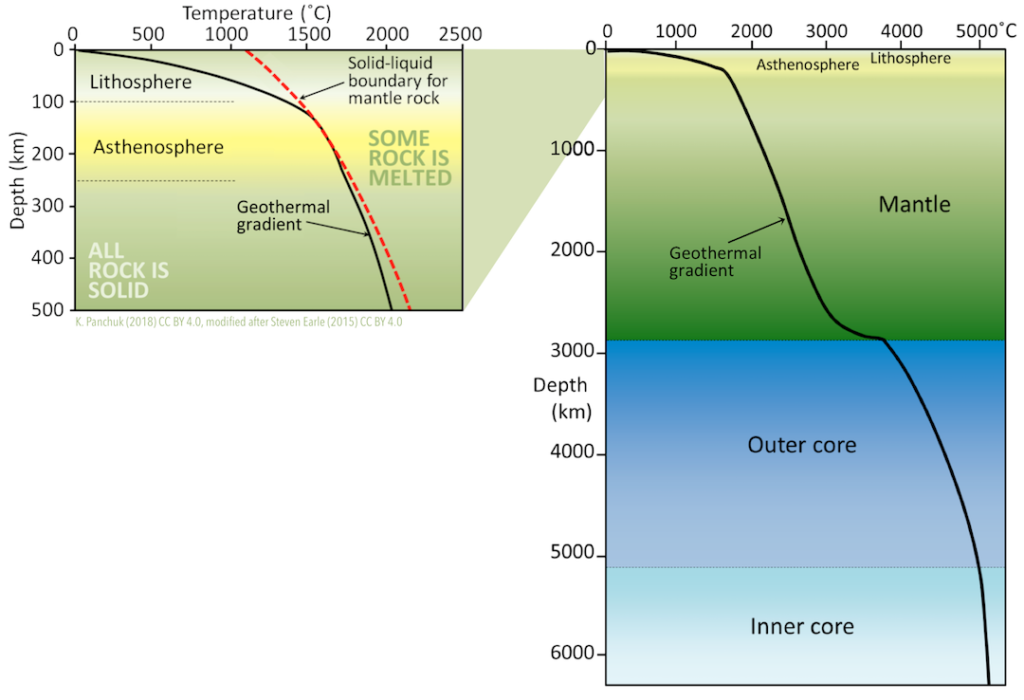
I think the median average temperature is around 2,200°C.

The Earth has a radius of 6,371km, giving a volume of 1.08e13km^3.

A sphere of half this volume would have a radius of 5,057km. Within the Earth, this sphere would sit at a depth of 6,371 - 5,057 = 1,314km.

From this chart, the temperature at that depth is around 2,200°C, so half the volume of the Earth has a temperature above that, and half a temperature below it.

  • source
  • hideshow 2 child comments
  • [–] 12 points 2 years ago*

    The problem with that is the temperature inside that sphere gets over 4000 degrees above that value and the temperature outside that sphere only gets to around 2000 degrees below it.

    Edit: Just realized you said the median, you may be right.

  • source
  • parent
  • [–] 38 points 2 years ago (2 children)

    Higher than you think. The inner core of earth is ~5K degrees C and the outer core is ~3K degrees C

  • source
  • hideshow 4 child comments
  • [–] 6 points 2 years ago

    For the record, you should probably use a lower-case 'k' (as in kilo, the SI prefix) rather than an upper case K (the unit of temperature, Kelvin), both in general and especially when referring to temperatures!

  • source
  • parent
  • [–] 26 points 2 years ago

    The crust is minuscule compared to the core and mantle.

    The mantle makes up about 84% of Earth’s total volume. The temperature varies from about 1 300 K (1 000°C, 1 832°F) near its boundary with the crust, to 4 000 K (3 700°C, 6 692°F) near its boundary with the core. https://education.nationalgeographic.org/resource/mantle/

    The temperature in the Earth's core is uncertain: estimates at the inner core boundary range from 4 000 K to 8 000 K and at the core–mantle boundary from 3 000 to 4 500 K. https://www.homepages.ucl.ac.uk/~ucfbdxa/pubblicazioni/nat.pdf

  • source
  • [–] 22 points 2 years ago (1 child)
  • [–] 6 points 2 years ago (2 children)

    Genuine question, how would mass vs volume change the answer?

  • source
  • parent
  • hideshow 4 child comments
  • [–] 15 points 2 years ago (1 child)

    Volume would mean get the temperature of every m3 of earth and average them out, mass would mean the same, except before averaging you would weight(ahem) them, so a cube of air counts less than a cube of lava.

  • source
  • parent
  • hideshow 2 child comments
  • [–] 6 points 2 years ago (1 child)

    Counting by volume would get tricky with the atmosphere. Where do you draw the line of where the atmosphere ends? Even thousands of miles from Earth there is very thin atmosphere.

  • source
  • parent
  • hideshow 2 child comments
  • [–] 15 points 2 years ago (1 child)

    Let me get out my thermometer, brb

  • source
  • hideshow 2 child comments
  • [–] 11 points 2 years ago (2 children)

    When you say "all molecules that comprise earth," are you including every molecule in the atmosphere out to the Karman line? Are you looking for an average of every molecule, or an average by volume? There are more molecules in solid matter than gaseous, obv

  • source
  • hideshow 4 child comments
  • [–] 3 points 2 years ago (1 child)

    When you say "all molecules that comprise earth," are you including every molecule in the atmosphere out to the Karman line?

    For what it's worth this won't change the result in any meaningful way. Both in terms of atom count and atom mass the atmosphere makes up only a tiny fraction of the earth's material.

  • source
  • parent
  • hideshow 2 child comments
  • [–] 6 points 2 years ago (2 children)

    You will have a very difficult time finding this. The average temperature of all molecules on earth is absurdly difficult to calculate, nearly impossible to gather data on, and not something that's very useful for any practical calculations so no one has bothered to do it.

    Black body radiation is probably more what you're looking for, I would suggest starting there.

  • source
  • hideshow 4 child comments
  • [–] 3 points 2 years ago

    Why is it hard? At least to get an approximation since you can't measure everywhere.

    We know temperatures of the mantle and both cores. We know their size. We can ignore the crust as a rounding error. This approximation will improve as our measurements get better.

  • source
  • parent
  • [–] 1 point 2 years ago* (last edited 2 years ago)

    Black body radiation was my thought as well. It may not be the average including the inner layers, but it's the average at the crust. About -1°F according to Wikipedia.

    To add to this, is probably hard because the composition of the interior of the earth is a lot of guesswork. We can only directly observe how much heat is coming out of it.

    https://en.m.wikipedia.org/wiki/Thermal_history_of_Earth

  • source
  • parent
  • [–] 4 points 2 years ago* (1 child)

    I don't think that's an answer that really exists in any meaningful sense since temperature is a macroscopic phenomenon. When you get down to the scale of the microscopic, i.e. of molecules, then atoms, then particles, you really only have amounts of kinetic energy of said particles, typically measured in the unit electronvolt, or eV.

    When said particles interact, they impart kinetic energy to one another, which directly constitutes the thermodynamic fluctuations we see in macroscopic systems.

    Put simply, microscopic energy levels create macroscopic temperature readings.

    In other words, "temperature" is just a macroscopic reading of collective microscopic energy levels.


    tl;dr: Molecules don't have temperature; they have energy.

  • source
  • hideshow 2 child comments
  • [–] 3 points 2 years ago

    I imagine that if you look up the estimated temp for the Earth's Mantle, you'll be pretty close to what the average temp is.

  • source
  • [+] 1 point 2 years ago* (last edited 2 years ago)
    [removed by mod]
  • source
  • [–] 1 point 2 years ago

    After cruising the comments and reading your post twice I propose the following because I'm that asshole today:

    Go by layer.

    Okay, so, assload insta-death ballpark Celsius in the center, okay fine. Maybe median this one. Then, consider some other identifiable layer(s) between there & surface, with some more eyeballing. THEN, for good measure, as many surface temps you can get for sea/land/air if you have chosen the range to include atmosphere.

    Report back. I'm half asleep and haven't checked my work. Also. I only ever need half a reason to suggest implementing excel to assist in your calculations 😂 I'm so sorry

  • source
  • [–] 1 point 2 years ago

    Hotter than it was last year, and the year before that, and...

  • source
  • [+] 1 point 2 years ago* (last edited 2 years ago) (1 child)
  • [–] 0 points 2 years ago* (2 children)

    Average?

    The hottest place on earth is the core, about 4400°C to 6000°C(average around 5200°C)

    https://education.nationalgeographic.org/resource/core/

    A short google point out that the coldest place on earth is Eastern Antarctic Plateau, Antarctica (-94°C)

    https://www.newscientist.com/question/coldest-places-earth/#:~:text=1)%20Eastern%20Antarctic%20Plateau%2C%20Antarctica,of%20coldest%20place%20on%20Earth.

    And since no living thing is hotter than earth core and no living thing is colder than antarctica(other than my ex), then we calculate the average of this two((5200 + -94)÷2) and we get 2553°C. That's the average temperature of earth.
  • source
  • hideshow 4 child comments
  • [–] 15 points 2 years ago (2 children)

    That's a pretty dumb way of calculating average since it's just the average of the biggest value and the smallest value. That's neither mean, median, or mode for the whole planet. It needs to be weighted by volume or mass in order to be an accurate average.

  • source
  • parent
  • hideshow 4 child comments
  • [+] -8 points 2 years ago (3 children)

    I mean OP asked for average, that's how average calculated 🤷

    Median is impossible to calculate since you need a whole array of data to know what's in the middle. I think anything other than that is impossible because we need gazillion of data to even getting close to the accurate answer, that's why all answer out there is usually categorised and in estimate.

  • source
  • parent
  • hideshow 6 child comments
  • [–] 9 points 2 years ago

    That's not how average is calculated, that would be the average if there were two particles, one 5200 and one -94. The average is the sum of all values divided by the number of values. Not the max plus the min divided by 2.

  • source
  • parent