you are viewing a single comment's thread
view the rest of the comments
[–] 64 points 2 years ago (5 children)

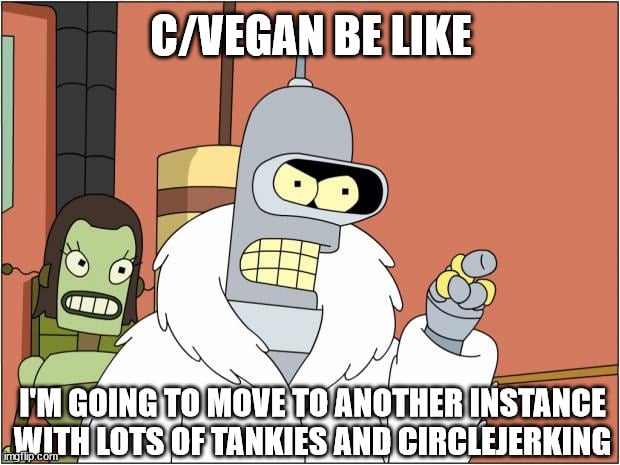
My biggest gripe with vegan communities is that a lot of them have an "All or Nothing" mentality, going fully vegan is a luxury not everyone can afford, and yet I find mainly malice when trying to talk about reducing ones own reliance on meat and other animal products in online communities.

And veganism, if taken to the "no suffering of sentient beings" full extreme, forbids buying things (not just food) produced by slavery. And those things, especially electronics and clothes, are not financially viable for most to be bought without any slavery involved in any step whatsoever.

  • source
  • hideshow 10 child comments
  • [–] 16 points 2 years ago*

    Which is precisely why they will get along with the tankies so well. Both treat the very idea of nuance as an existential threat to the point where everything much be driven by the most extreme degree of moral panic or nothing at all.

  • source
  • parent
  • [–] 10 points 2 years ago (1 child)

    Vegan diets are popular in third world countries because they're considerably cheaper. Meat is cheap in western countries because it's very often subsidized by governments. Meat consumption by wealth proves eating animals is a luxury.

    Also veganism mantras always have "as far as is practicable". I bought a Samsung phone because Fairphones don't work here in Australia.

  • source
  • parent
  • hideshow 2 child comments
  • [–] 7 points 2 years ago

    vegan diets in third world countries are cheaper because they generally just end up being 90% filler starches and still have woefully bad nutrition outside of being calories

  • source
  • parent
  • [–] 0 points 2 years ago (1 child)
  • [+] 12 points 2 years ago (1 child)
  • [–] 4 points 2 years ago (2 children)

    or who catches, raises, or hunts their own.

    How does catching, raising, or hunting meat compare to planting or gathering their own plant-based food?

    Or how does 'free or subsidized meat' compare with free or subsidized plant based food?

  • source
  • parent
  • hideshow 4 child comments
  • [–] 6 points 2 years ago (2 children)

    How does catching, raising, or hunting meat compare to planting or gathering their own plant-based food?

    as the deer spends all year gathering nutrients, and they can spend one morning gathering the deer, it seems to me it's highly effective.

  • source
  • parent
  • hideshow 4 child comments
  • [–] 4 points 2 years ago (1 child)

    Most vegans would allow an exception for certain lifestyles. People hunting for their homestead aren't going to cause a global issue like is currently happening.

    Ideally we wouldnt hunt at all but thats like some sort of futuristic goal. Noones going to tell you to starve your family to appease veganism, thats not the point.

    The point is to reduce suffering and abuse wherever possible. Sometimes its not possible.

  • source
  • parent
  • hideshow 2 child comments
  • [–] 0 points 2 years ago (1 child)

    Lol, ok so you're including labor cost?

    A couple years of a dear 'gathering nutrients', vs a summer of cultivating a garden and harvesting? Or do I need to include the energy expenditure (energy ingested by the dear minus energy lost to biological processes, vs solar energy collected minus energy expended on building plant mass and energy expended in harvest)?

    I was really just pointing out the absurdity of your complaint about the study but you're making this into a fun little digression.

  • source
  • parent
  • hideshow 2 child comments
  • [–] 3 points 2 years ago (1 child)

    if it's free, then throwing it out and acquiring plants is more expensive.

  • source
  • parent
  • hideshow 2 child comments
  • [–] 0 points 2 years ago (2 children)

    If it's free then throwing it out costs nothing though, right? Or are you talking about the cost of the state subsidy?

    Wouldn't it be cheaper to the state to subsidize a plant-based diet instead?

  • source
  • parent
  • hideshow 4 child comments
  • [–] 2 points 2 years ago (1 child)

    If it’s free then throwing it out costs nothing though, right?

    but replacing it would cost something. throwing away perfectly good food isn't something most people think is a moral good.

  • source
  • parent
  • hideshow 2 child comments
  • [–] 1 point 2 years ago (1 child)

    I thought your point was to disregard the morality of the diet and focus on the economics?

  • source
  • parent
  • hideshow 2 child comments
  • [–] 2 points 2 years ago (1 child)

    this subthread was about beaver's misleading link.

  • source
  • parent
  • hideshow 2 child comments
  • [–] 0 points 2 years ago (1 child)

    Their link was addressing the claim that eating vegan is a luxury.

    For what the comment was responding to I think it was perfectly well framed, but you can extrapolate anything you want from it if that's your thing.

  • source
  • parent
  • hideshow 2 child comments
  • [–] 2 points 2 years ago (1 child)

    heir link was addressing the claim that eating vegan is a luxury.

    and it did so misleadingly, as being in teh position to always pay full price for food at a store is a luxury.

  • source
  • parent
  • hideshow 2 child comments
  • [–] 1 point 2 years ago (1 child)

    as being in teh position to always pay full price for food at a store is a luxury.

    Not if by 'cost' they meant 'cost', and not 'what they get from the state at no cost'

  • source
  • parent
  • hideshow 2 child comments
  • [–] 2 points 2 years ago (1 child)

    if i have food, throwing it away and getting more food is more expensive.

  • source
  • parent
  • hideshow 2 child comments
  • [–] 1 point 2 years ago (1 child)

    The paper wasn't discussing food stamp programs or even what food you might already have

  • source
  • parent
  • hideshow 2 child comments
  • [–] 2 points 2 years ago (1 child)

    right. it's simply not scoped to support the claim tha being vegan is 30% cheaper

  • source
  • parent
  • hideshow 2 child comments
  • [–] 0 points 2 years ago (1 child)

    What they claimed was "a whole foods plant-based diet is 30% cheaper."

    Which is factually supported by the study, even if you'd prefer to interpret it to mean something else

  • source
  • parent
  • hideshow 2 child comments
  • [–] 2 points 2 years ago (1 child)

    What they claimed was “a whole foods plant-based diet is 30% cheaper.”

    Which is factually supported by the study

    ...for a limited segment of the population.

  • source
  • parent
  • hideshow 2 child comments
  • [–] 0 points 2 years ago*

    It's actually not speaking about the personal costs born by consumers, it's talking about the cost of purchasing food for the diet.

    As I said, if the paper was discussing the systemic hurtles and personal choices of consumers it would be a different paper, saying a different thing.

  • source
  • parent