you are viewing a single comment's thread
view the rest of the comments
[–] 19 points 2 years ago (1 child)

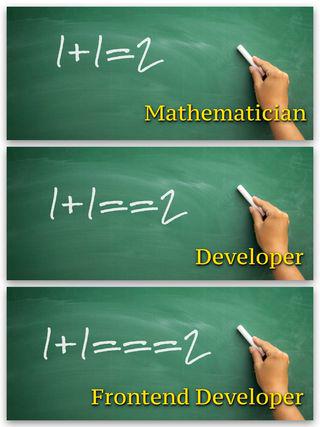
JS's == has some gotchas and you almost never want to use it. So === is what == should have been.

All examples are true:

"1" == true
[1, 2] == "1,2" 
" " == false
null == undefined 

It isn't that insane. But some invariants that you may expect don't hold.

"" == 0
"0" == 0
"" != "0" 
  • source
  • parent
  • hideshow 2 child comments
  • [–] 5 points 2 years ago (1 child)

    One neat feature is you can compare to both null and undefined at the same time, without other falsey values giving false positives. Although that's not necessary as often now that we have nullish coalescing and optional chaining.

  • source
  • parent
  • hideshow 2 child comments
  • [–] 2 points 2 years ago (1 child)

    I just tested and Terser will convert v === null || v === undefined to null==v. Personally I would prefer to read the code that explicitly shows that it is checking for both and let my minifier/optimizer worry about generating compact code.

  • source
  • parent
  • hideshow 2 child comments
  • [–] 0 points 2 years ago (1 child)

    Try changing to const === variable. That’s most likely what’s it doing to minimize the risk of accidental assignment.

  • source
  • parent
  • hideshow 2 child comments
  • [–] 3 points 2 years ago (1 child)

    Wut? This is an automated optimizer. It is not worried about accidental assignment.

  • source
  • parent
  • hideshow 2 child comments
  • [–] 1 point 2 years ago (1 child)

    I agree it shouldn’t. But I’ve seen linters that automatically change it since they seem to be forcing practical conventions sometimes.

  • source
  • parent
  • hideshow 2 child comments