▲ 668 ▼ === (programming.dev) submitted 2 years ago by JPDev@programming.dev to c/programmer_humor@programming.dev 71 comments fedilink hide all child comments
[–] backhdlp@iusearchlinux.fyi 46 points 2 years ago* (last edited 2 years ago) (11 children) I still don't understand the === operator Edit: I think a more type strict ==? Pretty sure I understand the point of typescript now. permalink fedilink source hideshow 22 child comments replies: [–] SzethFriendOfNimi@lemmy.world 126 points 2 years ago* (1 child) So in JavaScript there’s the assignment = and the comparator is == Since there’s no types JS will do implicit conversion before comparison when using == in a case like this if(false == '0'){ //this is true } But with === it doesn’t. It means literally compare these if(false === '0'){ //this is false }else{ //so this will execute instead } But this, however, will var someState = false; if(someState === false){ //this is true } permalink fedilink source parent hideshow 2 child comments replies: [+] runswithjedi@lemmy.world 71 points 2 years ago (1 child) [deleted] permalink fedilink source parent hideshow 2 child comments replies: [–] idunnololz@lemmy.world 23 points 2 years ago Np. closed as duplicate permalink fedilink source parent [–] QuazarOmega@lemy.lol 62 points 2 years ago > 1 == 1 true > 1 == '1' true > 1 === '1' false (from node REPL) Basically it's the real equals sign permalink fedilink source parent [–] frezik@midwest.social 45 points 2 years ago (1 child) The short answer is that your language needs === when it fucked up the semantics of ==, but it's also too popular and you can't fix it without breaking half the web. permalink fedilink source parent hideshow 2 child comments replies: [–] marcos@lemmy.world 2 points 2 years ago Or when it is something like Prolog, where equality is inherently a messy and complex concept. permalink fedilink source parent [–] SmoothIsFast@lemmy.world 28 points 2 years ago It's like the ==, but there's one more = permalink fedilink source parent [–] kevincox@lemmy.ml 19 points 2 years ago (1 child) JS's == has some gotchas and you almost never want to use it. So === is what == should have been. All examples are true: "1" == true [1, 2] == "1,2" " " == false null == undefined It isn't that insane. But some invariants that you may expect don't hold. "" == 0 "0" == 0 "" != "0" permalink fedilink source parent hideshow 2 child comments replies: [–] Feathercrown@lemmy.world 5 points 2 years ago (1 child) One neat feature is you can compare to both null and undefined at the same time, without other falsey values giving false positives. Although that's not necessary as often now that we have nullish coalescing and optional chaining. permalink fedilink source parent hideshow 2 child comments replies: [–] kevincox@lemmy.ml 2 points 2 years ago (1 child) I just tested and Terser will convert v === null || v === undefined to null==v. Personally I would prefer to read the code that explicitly shows that it is checking for both and let my minifier/optimizer worry about generating compact code. permalink fedilink source parent hideshow 2 child comments replies: [–] SzethFriendOfNimi@lemmy.world 0 points 2 years ago (1 child) Try changing to const === variable. That’s most likely what’s it doing to minimize the risk of accidental assignment. permalink fedilink source parent hideshow 2 child comments replies: [–] kevincox@lemmy.ml 3 points 2 years ago (1 child) Wut? This is an automated optimizer. It is not worried about accidental assignment. permalink fedilink source parent hideshow 2 child comments replies: [–] SzethFriendOfNimi@lemmy.world 1 point 2 years ago (1 child) I agree it shouldn’t. But I’ve seen linters that automatically change it since they seem to be forcing practical conventions sometimes. permalink fedilink source parent hideshow 2 child comments replies: [–] kevincox@lemmy.ml 3 points 2 years ago (1 child) Linters and minifers are completely different tools. permalink fedilink source parent hideshow 2 child comments replies: [–] SzethFriendOfNimi@lemmy.world 3 points 2 years ago Good point. That’s what I get for shooting from the hip. Thanks! permalink fedilink source parent [–] Limitless_screaming@kbin.social 18 points 2 years ago == but for JavaScript. What you don't understand is the == of JavaScript. permalink fedilink source parent [–] Mikina@programming.dev 18 points 2 years ago* (2 children) It's also important if you're checking hashes (at least, it was - if you're using correct hashing algorithm that isn't ancient, you will not have this problem). Because if you take for example "0e462097431906509019562988736854" (which is md5("240610708"), but also applicable to most other hashing algorithms that hash to a hex string), if("0e462097431906509019562988736854" == 0) is true. So any other data that hashes to any variantion of "0e[1-9]+" will pass the check, for example: md5("240610708") == md5("hashcatqlffzszeRcrt") that equals to "0e462097431906509019562988736854" == "0e242700999142460696437005736231" which thanks to scientific notation and no strict type checking can also mean 0^462097431906509019562988736854^ == 0^242700999142460696437005736231^ which is 0 == 0 ` I did use md5 as an example because the strings are pretty short, but it's applicable to a whole lot of other hashes. And the problem is that if you use one of the strings that hash to a magic hash in a vulnerable site, it will pass the password check for any user who's password also hashes to a magic hash. There's not really a high chance of that happening, but there's still a lot of hashes that do hash to it. permalink fedilink source parent hideshow 4 child comments replies: [–] darcy@sh.itjust.works 10 points 2 years ago that is terrifying permalink fedilink source parent [–] frezik@midwest.social 1 point 2 years ago If you're checking passwords, you should be using constant time string checking, anyway. More likely, you should let your bcrypt library do it for you. permalink fedilink source parent [–] Bougie_Birdie@lemmy.blahaj.zone 6 points 2 years ago (1 child) The other comments explains it in pretty good detail, but when I was learning my teacher explained it sort of like a mnemonic. 1 + 1 = 2 is read "one plus one equals two" 1 + 1 == 2 is read "one plus one is equal to two" 1 + 1 === 2 is read "one plus one is really equal to two" And you hit the nail on the head, is that === is type explicit while == is implicit. permalink fedilink source parent hideshow 2 child comments replies: [–] bobbykjack@programming.dev 3 points 2 years ago* I'd use something like: = becomes == equals === is identical to It's funny how everyone thinks "equals" in this context should be "identical to" when, in normal language, it doesn't really mean that at all! permalink fedilink source parent [–] ShortFuse@lemmy.world 4 points 2 years ago* You don't need Typescript, you need an linter (eslint). === is your basic equality like most languages. == will implicitly cast type. The breakdown is here: https://262.ecma-international.org/5.1/#sec-11.9.3 Modern JS says to never use == unless you're comparing against null or undefined. permalink fedilink source parent [–] clb92@feddit.dk 4 points 2 years ago* Like == but more strict. The == operator will do type conversion, so 0 == '' will actually be true, as an example. Sometimes (honestly, most times) you may want to compare more strictly. See this StackOverflow answer: https://stackoverflow.com/questions/359494/which-equals-operator-vs-should-be-used-in-javascript-comparisons permalink fedilink source parent [+] Assman@sh.itjust.works 1 point 2 years ago [deleted] permalink fedilink source parent
[–] SzethFriendOfNimi@lemmy.world 126 points 2 years ago* (1 child) So in JavaScript there’s the assignment = and the comparator is == Since there’s no types JS will do implicit conversion before comparison when using == in a case like this if(false == '0'){ //this is true } But with === it doesn’t. It means literally compare these if(false === '0'){ //this is false }else{ //so this will execute instead } But this, however, will var someState = false; if(someState === false){ //this is true } permalink fedilink source parent hideshow 2 child comments replies: [+] runswithjedi@lemmy.world 71 points 2 years ago (1 child) [deleted] permalink fedilink source parent hideshow 2 child comments replies: [–] idunnololz@lemmy.world 23 points 2 years ago Np. closed as duplicate permalink fedilink source parent
[+] runswithjedi@lemmy.world 71 points 2 years ago (1 child) [deleted] permalink fedilink source parent hideshow 2 child comments replies: [–] idunnololz@lemmy.world 23 points 2 years ago Np. closed as duplicate permalink fedilink source parent
[–] idunnololz@lemmy.world 23 points 2 years ago Np. closed as duplicate permalink fedilink source parent
[–] QuazarOmega@lemy.lol 62 points 2 years ago > 1 == 1 true > 1 == '1' true > 1 === '1' false (from node REPL) Basically it's the real equals sign permalink fedilink source parent
[–] frezik@midwest.social 45 points 2 years ago (1 child) The short answer is that your language needs === when it fucked up the semantics of ==, but it's also too popular and you can't fix it without breaking half the web. permalink fedilink source parent hideshow 2 child comments replies: [–] marcos@lemmy.world 2 points 2 years ago Or when it is something like Prolog, where equality is inherently a messy and complex concept. permalink fedilink source parent
[–] marcos@lemmy.world 2 points 2 years ago Or when it is something like Prolog, where equality is inherently a messy and complex concept. permalink fedilink source parent
[–] SmoothIsFast@lemmy.world 28 points 2 years ago It's like the ==, but there's one more = permalink fedilink source parent
[–] kevincox@lemmy.ml 19 points 2 years ago (1 child) JS's == has some gotchas and you almost never want to use it. So === is what == should have been. All examples are true: "1" == true [1, 2] == "1,2" " " == false null == undefined It isn't that insane. But some invariants that you may expect don't hold. "" == 0 "0" == 0 "" != "0" permalink fedilink source parent hideshow 2 child comments replies: [–] Feathercrown@lemmy.world 5 points 2 years ago (1 child) One neat feature is you can compare to both null and undefined at the same time, without other falsey values giving false positives. Although that's not necessary as often now that we have nullish coalescing and optional chaining. permalink fedilink source parent hideshow 2 child comments replies: [–] kevincox@lemmy.ml 2 points 2 years ago (1 child) I just tested and Terser will convert v === null || v === undefined to null==v. Personally I would prefer to read the code that explicitly shows that it is checking for both and let my minifier/optimizer worry about generating compact code. permalink fedilink source parent hideshow 2 child comments replies: [–] SzethFriendOfNimi@lemmy.world 0 points 2 years ago (1 child) Try changing to const === variable. That’s most likely what’s it doing to minimize the risk of accidental assignment. permalink fedilink source parent hideshow 2 child comments replies: [–] kevincox@lemmy.ml 3 points 2 years ago (1 child) Wut? This is an automated optimizer. It is not worried about accidental assignment. permalink fedilink source parent hideshow 2 child comments replies: [–] SzethFriendOfNimi@lemmy.world 1 point 2 years ago (1 child) I agree it shouldn’t. But I’ve seen linters that automatically change it since they seem to be forcing practical conventions sometimes. permalink fedilink source parent hideshow 2 child comments replies: [–] kevincox@lemmy.ml 3 points 2 years ago (1 child) Linters and minifers are completely different tools. permalink fedilink source parent hideshow 2 child comments replies: [–] SzethFriendOfNimi@lemmy.world 3 points 2 years ago Good point. That’s what I get for shooting from the hip. Thanks! permalink fedilink source parent
[–] Feathercrown@lemmy.world 5 points 2 years ago (1 child) One neat feature is you can compare to both null and undefined at the same time, without other falsey values giving false positives. Although that's not necessary as often now that we have nullish coalescing and optional chaining. permalink fedilink source parent hideshow 2 child comments replies: [–] kevincox@lemmy.ml 2 points 2 years ago (1 child) I just tested and Terser will convert v === null || v === undefined to null==v. Personally I would prefer to read the code that explicitly shows that it is checking for both and let my minifier/optimizer worry about generating compact code. permalink fedilink source parent hideshow 2 child comments replies: [–] SzethFriendOfNimi@lemmy.world 0 points 2 years ago (1 child) Try changing to const === variable. That’s most likely what’s it doing to minimize the risk of accidental assignment. permalink fedilink source parent hideshow 2 child comments replies: [–] kevincox@lemmy.ml 3 points 2 years ago (1 child) Wut? This is an automated optimizer. It is not worried about accidental assignment. permalink fedilink source parent hideshow 2 child comments replies: [–] SzethFriendOfNimi@lemmy.world 1 point 2 years ago (1 child) I agree it shouldn’t. But I’ve seen linters that automatically change it since they seem to be forcing practical conventions sometimes. permalink fedilink source parent hideshow 2 child comments replies: [–] kevincox@lemmy.ml 3 points 2 years ago (1 child) Linters and minifers are completely different tools. permalink fedilink source parent hideshow 2 child comments replies: [–] SzethFriendOfNimi@lemmy.world 3 points 2 years ago Good point. That’s what I get for shooting from the hip. Thanks! permalink fedilink source parent
[–] kevincox@lemmy.ml 2 points 2 years ago (1 child) I just tested and Terser will convert v === null || v === undefined to null==v. Personally I would prefer to read the code that explicitly shows that it is checking for both and let my minifier/optimizer worry about generating compact code. permalink fedilink source parent hideshow 2 child comments replies: [–] SzethFriendOfNimi@lemmy.world 0 points 2 years ago (1 child) Try changing to const === variable. That’s most likely what’s it doing to minimize the risk of accidental assignment. permalink fedilink source parent hideshow 2 child comments replies: [–] kevincox@lemmy.ml 3 points 2 years ago (1 child) Wut? This is an automated optimizer. It is not worried about accidental assignment. permalink fedilink source parent hideshow 2 child comments replies: [–] SzethFriendOfNimi@lemmy.world 1 point 2 years ago (1 child) I agree it shouldn’t. But I’ve seen linters that automatically change it since they seem to be forcing practical conventions sometimes. permalink fedilink source parent hideshow 2 child comments replies: [–] kevincox@lemmy.ml 3 points 2 years ago (1 child) Linters and minifers are completely different tools. permalink fedilink source parent hideshow 2 child comments replies: [–] SzethFriendOfNimi@lemmy.world 3 points 2 years ago Good point. That’s what I get for shooting from the hip. Thanks! permalink fedilink source parent
[–] SzethFriendOfNimi@lemmy.world 0 points 2 years ago (1 child) Try changing to const === variable. That’s most likely what’s it doing to minimize the risk of accidental assignment. permalink fedilink source parent hideshow 2 child comments replies: [–] kevincox@lemmy.ml 3 points 2 years ago (1 child) Wut? This is an automated optimizer. It is not worried about accidental assignment. permalink fedilink source parent hideshow 2 child comments replies: [–] SzethFriendOfNimi@lemmy.world 1 point 2 years ago (1 child) I agree it shouldn’t. But I’ve seen linters that automatically change it since they seem to be forcing practical conventions sometimes. permalink fedilink source parent hideshow 2 child comments replies: [–] kevincox@lemmy.ml 3 points 2 years ago (1 child) Linters and minifers are completely different tools. permalink fedilink source parent hideshow 2 child comments replies: [–] SzethFriendOfNimi@lemmy.world 3 points 2 years ago Good point. That’s what I get for shooting from the hip. Thanks! permalink fedilink source parent
[–] kevincox@lemmy.ml 3 points 2 years ago (1 child) Wut? This is an automated optimizer. It is not worried about accidental assignment. permalink fedilink source parent hideshow 2 child comments replies: [–] SzethFriendOfNimi@lemmy.world 1 point 2 years ago (1 child) I agree it shouldn’t. But I’ve seen linters that automatically change it since they seem to be forcing practical conventions sometimes. permalink fedilink source parent hideshow 2 child comments replies: [–] kevincox@lemmy.ml 3 points 2 years ago (1 child) Linters and minifers are completely different tools. permalink fedilink source parent hideshow 2 child comments replies: [–] SzethFriendOfNimi@lemmy.world 3 points 2 years ago Good point. That’s what I get for shooting from the hip. Thanks! permalink fedilink source parent
[–] SzethFriendOfNimi@lemmy.world 1 point 2 years ago (1 child) I agree it shouldn’t. But I’ve seen linters that automatically change it since they seem to be forcing practical conventions sometimes. permalink fedilink source parent hideshow 2 child comments replies: [–] kevincox@lemmy.ml 3 points 2 years ago (1 child) Linters and minifers are completely different tools. permalink fedilink source parent hideshow 2 child comments replies: [–] SzethFriendOfNimi@lemmy.world 3 points 2 years ago Good point. That’s what I get for shooting from the hip. Thanks! permalink fedilink source parent
[–] kevincox@lemmy.ml 3 points 2 years ago (1 child) Linters and minifers are completely different tools. permalink fedilink source parent hideshow 2 child comments replies: [–] SzethFriendOfNimi@lemmy.world 3 points 2 years ago Good point. That’s what I get for shooting from the hip. Thanks! permalink fedilink source parent
[–] SzethFriendOfNimi@lemmy.world 3 points 2 years ago Good point. That’s what I get for shooting from the hip. Thanks! permalink fedilink source parent
[–] Limitless_screaming@kbin.social 18 points 2 years ago == but for JavaScript. What you don't understand is the == of JavaScript. permalink fedilink source parent
[–] Mikina@programming.dev 18 points 2 years ago* (2 children) It's also important if you're checking hashes (at least, it was - if you're using correct hashing algorithm that isn't ancient, you will not have this problem). Because if you take for example "0e462097431906509019562988736854" (which is md5("240610708"), but also applicable to most other hashing algorithms that hash to a hex string), if("0e462097431906509019562988736854" == 0) is true. So any other data that hashes to any variantion of "0e[1-9]+" will pass the check, for example: md5("240610708") == md5("hashcatqlffzszeRcrt") that equals to "0e462097431906509019562988736854" == "0e242700999142460696437005736231" which thanks to scientific notation and no strict type checking can also mean 0^462097431906509019562988736854^ == 0^242700999142460696437005736231^ which is 0 == 0 ` I did use md5 as an example because the strings are pretty short, but it's applicable to a whole lot of other hashes. And the problem is that if you use one of the strings that hash to a magic hash in a vulnerable site, it will pass the password check for any user who's password also hashes to a magic hash. There's not really a high chance of that happening, but there's still a lot of hashes that do hash to it. permalink fedilink source parent hideshow 4 child comments replies: [–] darcy@sh.itjust.works 10 points 2 years ago that is terrifying permalink fedilink source parent [–] frezik@midwest.social 1 point 2 years ago If you're checking passwords, you should be using constant time string checking, anyway. More likely, you should let your bcrypt library do it for you. permalink fedilink source parent
[–] frezik@midwest.social 1 point 2 years ago If you're checking passwords, you should be using constant time string checking, anyway. More likely, you should let your bcrypt library do it for you. permalink fedilink source parent
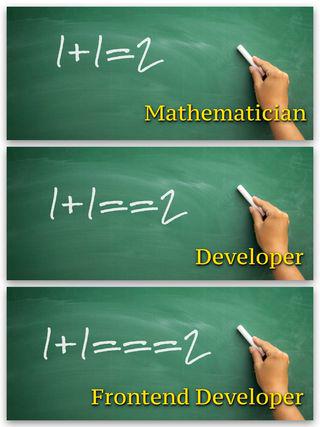
[–] Bougie_Birdie@lemmy.blahaj.zone 6 points 2 years ago (1 child) The other comments explains it in pretty good detail, but when I was learning my teacher explained it sort of like a mnemonic. 1 + 1 = 2 is read "one plus one equals two" 1 + 1 == 2 is read "one plus one is equal to two" 1 + 1 === 2 is read "one plus one is really equal to two" And you hit the nail on the head, is that === is type explicit while == is implicit. permalink fedilink source parent hideshow 2 child comments replies: [–] bobbykjack@programming.dev 3 points 2 years ago* I'd use something like: = becomes == equals === is identical to It's funny how everyone thinks "equals" in this context should be "identical to" when, in normal language, it doesn't really mean that at all! permalink fedilink source parent
[–] bobbykjack@programming.dev 3 points 2 years ago* I'd use something like: = becomes == equals === is identical to It's funny how everyone thinks "equals" in this context should be "identical to" when, in normal language, it doesn't really mean that at all! permalink fedilink source parent
[–] ShortFuse@lemmy.world 4 points 2 years ago* You don't need Typescript, you need an linter (eslint). === is your basic equality like most languages. == will implicitly cast type. The breakdown is here: https://262.ecma-international.org/5.1/#sec-11.9.3 Modern JS says to never use == unless you're comparing against null or undefined. permalink fedilink source parent
[–] clb92@feddit.dk 4 points 2 years ago* Like == but more strict. The == operator will do type conversion, so 0 == '' will actually be true, as an example. Sometimes (honestly, most times) you may want to compare more strictly. See this StackOverflow answer: https://stackoverflow.com/questions/359494/which-equals-operator-vs-should-be-used-in-javascript-comparisons permalink fedilink source parent