you are viewing a single comment's thread
view the rest of the comments
[–] 125 points 2 years ago* (2 children)

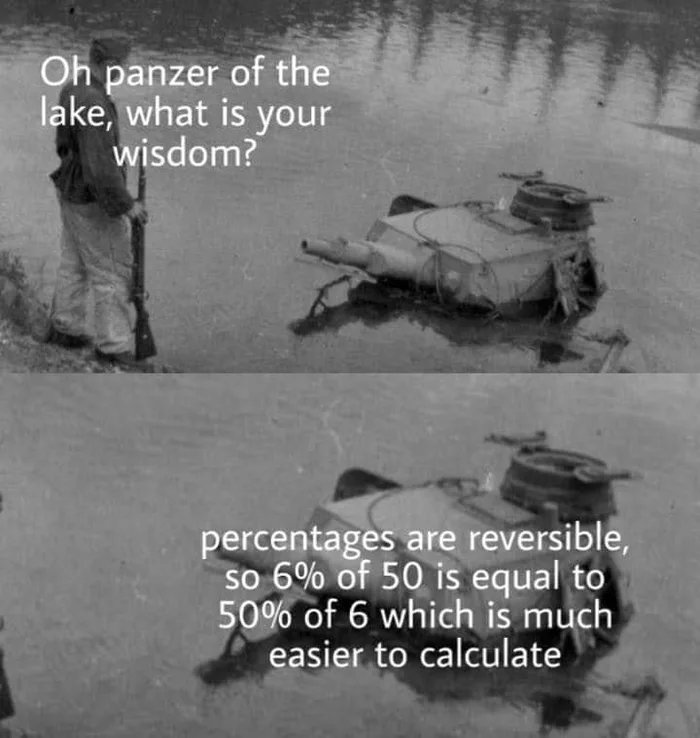
They probably did, just not explicitly:

You could write (6*1/100)*50 = 6*(50*1/100)

It only uses the commutative property of multiplication and the fact that % is another way of writing 1/100.

Maybe also worth remembering that "x% of y" is just x/100*y

  • source
  • parent
  • hideshow 4 child comments
  • [–] 56 points 2 years ago (3 children)
  • [–] 24 points 2 years ago (1 child)

    The word percent is exactly that per cent, which basically means parts of hundred. E.g. 10% are 10 of 100, or 60% are 60 of 100. You can also write this mathematically as 60/100 or 60÷100, which is 0.6.

    Now in general: x% are x parts of 100 or x/100 or x÷100. If you want to calculate x% of y you just multiply it: y × x% = y × x ÷ 100.

  • source
  • parent
  • hideshow 2 child comments
  • [–] 18 points 2 years ago* (1 child)

    I totally remember being taught this. It's just way easier to break down percentages in terms of the nearest 1% or 10% times the number in the percent times the number you're taking the percentage of. You don't have to do the math for the 1 or 10 percentage as long as you remember that a 10% means move the decimal left once and 1% means move the decimal left twice. The rest is just basic multiplication.

    40% of 59 = 10% of 59 times 4.

    So...

    4x59=236

    or

    (4x50=200) + (4x9=36)= 236

    10% means move the decimal left once,

    Therefore 40% of 59 is 23.6

    With that you can easily do more complex percentages mentally like...

    62% of 35 = 10% of 35 times 6 plus 1% of 35 times 2.

    35x6=180+30=210 at 10% so 21

    plus

    35x2=60+10=70 at 1% so 0.7

    Therefore 62% of 35 = 21.7

  • source
  • parent
  • hideshow 2 child comments
  • [–] 1 point 2 years ago

    While I get your sentiment, I'm always baffled how people fail to just memorize some basic formulas/equations and then just to plug and play:

    1÷kⁿ = k⁻ⁿ

    % = 1÷100 = 10⁻²

    k×10ⁿ equals k with its floating point shifted by n to the right for positive n, or to the left for negative n

    That's really all one needs to know for the "problem" at hand. For your concrete example of "40% of 59" that would just be

    59×40×10⁻²

    Just solve that whatever way is easiest. I don't get why people get panic-stricken when they see the % sign.

  • source
  • parent