▲ 76 ▼ See the First-Ever Direct Images of the Sun's South Pole, Captured by the Solar Orbiter Spacecraft (www.smithsonianmag.com) submitted 1 year ago by cm0002@lemmy.world to c/space@mander.xyz 23 comments fedilink hide all child comments
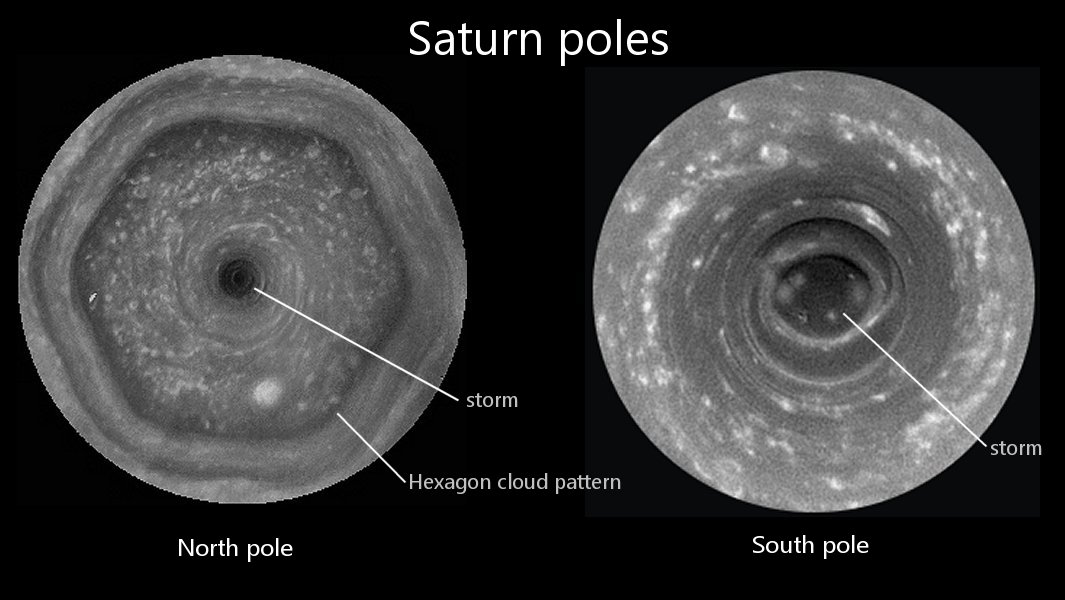
[–] LucasWaffyWaf@lemmy.world 11 points 1 year ago* (3 children) Check out Saturn's poles, it's got a bestagon permalink fedilink source parent hideshow 6 child comments replies: [–] Bbbbbbbbbbb@lemmy.world 4 points 1 year ago Thats fucking awesome, thank you permalink fedilink source parent [–] captain_aggravated@sh.itjust.works 2 points 1 year ago (1 child) Is there a known regular hexagon larger than the one on Saturn? permalink fedilink source parent hideshow 2 child comments replies: [–] LucasWaffyWaf@lemmy.world 1 point 1 year ago (1 child) There's just the one, right on its north pole. permalink fedilink source parent hideshow 2 child comments replies: [–] captain_aggravated@sh.itjust.works 3 points 1 year ago (1 child) Yeah, that regular hexagon is something like twice the Earth's diameter on a side, it's enormous. I was wondering if we know of a regular hexagon larger than that anywhere in the known universe? It's a bit like, is the Titanic the largest manmade object ever accidentally broken in half? permalink fedilink source parent hideshow 2 child comments replies: [–] morphballganon@lemmynsfw.com 2 points 1 year ago (1 child) Do Lagrange points count? I guess it's only 4 of the 6 points of a hexagon, with the smaller mass, and the L3, L4 and L5 points forming the 4 points permalink fedilink source parent hideshow 2 child comments replies: [–] captain_aggravated@sh.itjust.works 2 points 1 year ago I don't think so, as you point out only 4 points are defined, and...I'm sure you could find like six stars around the rim of a galaxy that are equidistant and go "these form a regular hexagon 40,000 light years to a side" No I'm think I'll restrict it to a structure that through some force more compelling than random happenstance has formed itself into a hexagon. permalink fedilink source parent [–] Notyou@sopuli.xyz 2 points 1 year ago This might be a stupid question, but is there 1 giant storm through the planet? permalink fedilink source parent
[–] Bbbbbbbbbbb@lemmy.world 4 points 1 year ago Thats fucking awesome, thank you permalink fedilink source parent
[–] captain_aggravated@sh.itjust.works 2 points 1 year ago (1 child) Is there a known regular hexagon larger than the one on Saturn? permalink fedilink source parent hideshow 2 child comments replies: [–] LucasWaffyWaf@lemmy.world 1 point 1 year ago (1 child) There's just the one, right on its north pole. permalink fedilink source parent hideshow 2 child comments replies: [–] captain_aggravated@sh.itjust.works 3 points 1 year ago (1 child) Yeah, that regular hexagon is something like twice the Earth's diameter on a side, it's enormous. I was wondering if we know of a regular hexagon larger than that anywhere in the known universe? It's a bit like, is the Titanic the largest manmade object ever accidentally broken in half? permalink fedilink source parent hideshow 2 child comments replies: [–] morphballganon@lemmynsfw.com 2 points 1 year ago (1 child) Do Lagrange points count? I guess it's only 4 of the 6 points of a hexagon, with the smaller mass, and the L3, L4 and L5 points forming the 4 points permalink fedilink source parent hideshow 2 child comments replies: [–] captain_aggravated@sh.itjust.works 2 points 1 year ago I don't think so, as you point out only 4 points are defined, and...I'm sure you could find like six stars around the rim of a galaxy that are equidistant and go "these form a regular hexagon 40,000 light years to a side" No I'm think I'll restrict it to a structure that through some force more compelling than random happenstance has formed itself into a hexagon. permalink fedilink source parent
[–] LucasWaffyWaf@lemmy.world 1 point 1 year ago (1 child) There's just the one, right on its north pole. permalink fedilink source parent hideshow 2 child comments replies: [–] captain_aggravated@sh.itjust.works 3 points 1 year ago (1 child) Yeah, that regular hexagon is something like twice the Earth's diameter on a side, it's enormous. I was wondering if we know of a regular hexagon larger than that anywhere in the known universe? It's a bit like, is the Titanic the largest manmade object ever accidentally broken in half? permalink fedilink source parent hideshow 2 child comments replies: [–] morphballganon@lemmynsfw.com 2 points 1 year ago (1 child) Do Lagrange points count? I guess it's only 4 of the 6 points of a hexagon, with the smaller mass, and the L3, L4 and L5 points forming the 4 points permalink fedilink source parent hideshow 2 child comments replies: [–] captain_aggravated@sh.itjust.works 2 points 1 year ago I don't think so, as you point out only 4 points are defined, and...I'm sure you could find like six stars around the rim of a galaxy that are equidistant and go "these form a regular hexagon 40,000 light years to a side" No I'm think I'll restrict it to a structure that through some force more compelling than random happenstance has formed itself into a hexagon. permalink fedilink source parent
[–] captain_aggravated@sh.itjust.works 3 points 1 year ago (1 child) Yeah, that regular hexagon is something like twice the Earth's diameter on a side, it's enormous. I was wondering if we know of a regular hexagon larger than that anywhere in the known universe? It's a bit like, is the Titanic the largest manmade object ever accidentally broken in half? permalink fedilink source parent hideshow 2 child comments replies: [–] morphballganon@lemmynsfw.com 2 points 1 year ago (1 child) Do Lagrange points count? I guess it's only 4 of the 6 points of a hexagon, with the smaller mass, and the L3, L4 and L5 points forming the 4 points permalink fedilink source parent hideshow 2 child comments replies: [–] captain_aggravated@sh.itjust.works 2 points 1 year ago I don't think so, as you point out only 4 points are defined, and...I'm sure you could find like six stars around the rim of a galaxy that are equidistant and go "these form a regular hexagon 40,000 light years to a side" No I'm think I'll restrict it to a structure that through some force more compelling than random happenstance has formed itself into a hexagon. permalink fedilink source parent
[–] morphballganon@lemmynsfw.com 2 points 1 year ago (1 child) Do Lagrange points count? I guess it's only 4 of the 6 points of a hexagon, with the smaller mass, and the L3, L4 and L5 points forming the 4 points permalink fedilink source parent hideshow 2 child comments replies: [–] captain_aggravated@sh.itjust.works 2 points 1 year ago I don't think so, as you point out only 4 points are defined, and...I'm sure you could find like six stars around the rim of a galaxy that are equidistant and go "these form a regular hexagon 40,000 light years to a side" No I'm think I'll restrict it to a structure that through some force more compelling than random happenstance has formed itself into a hexagon. permalink fedilink source parent
[–] captain_aggravated@sh.itjust.works 2 points 1 year ago I don't think so, as you point out only 4 points are defined, and...I'm sure you could find like six stars around the rim of a galaxy that are equidistant and go "these form a regular hexagon 40,000 light years to a side" No I'm think I'll restrict it to a structure that through some force more compelling than random happenstance has formed itself into a hexagon. permalink fedilink source parent
[–] Notyou@sopuli.xyz 2 points 1 year ago This might be a stupid question, but is there 1 giant storm through the planet? permalink fedilink source parent