[–] 2 points 3 weeks ago

I have most of what I need/want outside of the Internet (books, newspapers, people to discuss with, places to go,... even my music and movies are physical media/offline). I would get back a tad more free time, I guess which would probably be great ;)

  • source
  • [–] 1 point 3 weeks ago (1 child)

    ou mean to say you walk miles ??

    As much as possible, I'll go anywhere I can walking. Unless there is a real practical reason not to, I now walk multiple miles every single day. I love long walks :)

    that's major achievement

    But it was always just a few more steps... aka, a real minor objective.

  • source
  • parent
  • context
  • [–] 2 points 4 weeks ago (3 children)

    Daily objectives is how I (re)learned to walk... never fixing myself impressive objective, regularly noticing other people smiling at my lack of impressive progress while I focuses on walking a few more steps every day. Still, I went from barely being able to walk to walking miles daily... and I also got back into a somewhat decent shape.

  • source
  • parent
  • context
  • [–] 1 point 4 weeks ago

    I regularly read books in English and then in their French translation, out of curiosity. It happens less often the other way around (because there is, sadly for the US, a lot less French authors being translated into English) but I'll do it on occasions. I don't focus much on the cover, to be honest.

    Why can the title be so different once translated (not all the time)? For the same reasons it a movie title can be so different too, I suppose: market studies and cultural context. The same with the cover design: what sells in the USA probably would not sell that well in a few European countries.

  • source
  • [–] 3 points 4 weeks ago (5 children)

    Of course.

    Like mentioned, big yearly goals are worth shit. Instead, you should aim for more realistic things that are actionable and that you can work on... on a daily basis.

  • source
  • [–] 1 point 4 weeks ago

    Good for you, I'm glad you're enjoying them. As I was saying, I care more about my privacy and the true ownership. I could have added I also appreciate a much nicer page layout with most print books.

    You can have tens of thousands of books on a single e-reader

    I don't read that many books at the same time but, here again like I said, I realize ebooks help saving space.

  • source
  • parent
  • context
  • [–] 1 point 4 weeks ago

    I don't visualize it. It's just there, just escaped from my head right onto the paper, and it's written just how one is supposed to be writing it.

    To me, it's a question of practice. The more (regularly) you write the more it become a reflex, the more you enrich your vocabulary (read widely, read as often as possible) the more you will 'know' words and how to write them (also true for grammar and full sentences). I never think about crossing the t or put on accent on 'à, é, è, ë, and so on' when I need one... it comes naturally because I internalized the various (French, or whatever other languages I can write) grammatical rules.

    BTW, it's ok to forget them on occasions, provided the word/sentence remains legible. My handwriting is pretty shitty but I'm used to reading it so I need not write every single accentuation or diacritic sign in order to be by able to re-read myself. I also devised my own shorthand along the years and most of my notes will be written using that shorthand (meaning a lot of symbols instead of traditional words)... I would never use shorthand, and would take a lot more care with accents and punctuation (and grammar) knowing someone else will be reading what I write.

    As for the signature, I just decided on mine when I was maybe 15 or 16 and have kept using it since then, now nearing my 60. So, yeah it just flows out of the pen without me thinking much about it.

  • source
  • [–] 1 point 4 weeks ago* (2 children)

    'Better' depends a lot of what one is looking for. And what one consider more important which might not always be convenience or efficiency. To share just two personal examples:

    • Even though ebooks are more portable, take less space to collect, are easier to copy and paste quotes from, and are often cheaper, I have chosen to go back to reading print (aka analog) books and newspapers and magazines because to me they offer two things I value a lot more than the rest: a much better privacy-respecting experience (no tracking going on) and the full ownership/property of the books I purchase (No one can remotely edit a print book sitting in my home library, nor delete it for whatever reason. Sure, I know very well one can hack DRM out of most ebooks but I don't want to deal with that for things I already paid for, that i snot how purchase is supposed to work). I also consider analog books a lot more focused tools (without distractions), helping read longer without interruptions. Edit: Plus, I enjoy reading that way a lot more.
    • I write longhand also for privacy concerns but I do it mostly because it is how I like to write.
      I know very well I can type a lot faster faster than I write in cursive, I can edits too and backups. It's just not what I need the most when I write.
  • source
  • [–] 10 points 1 month ago* (7 children)

    As keen as I am to spend my day groveling to some mod, who’s probably as charmingly direct as your good self, to determine which petty rule my entirely vanilla post transgressed, I think I’d rather just get on with my life.

    Then, why even bother mentioning it? Not trolling, it's a real question: if it's not worth you asking the concerned person their motivation/reasoning, what interest is there for you in sharing it online with random people like myself?

  • source
  • parent
  • context
  • [–] 4 points 1 month ago (1 child)

    Can anywhere here please suggest me where I can find free help to start my own Marketing Agency?

    You don't.

    You don't create an agency from scratch, you create an Agency out of talents. SO you need some talents to begin with. Yours or some hired ones.

    You need to show people what you can sell them before they will be willing to put a cent on your name... Even more so in the age of AI where every single person able to click a big fat mouse button and to type a few words in web form now consider themselves the best creative ever/ So, what can you give your customers no AI will give them in a couple clicks?

    If you have zero money, you should still be able to find some time to develop your skills and your business... by yourself. Without help and without... much income either, if any. If you can't, well that is probably what you should work on first as you will need a way to sustain yourself for a certain time.

    To find customers, I would start by soliciting every single local businesses around my place, in person I mean. Local businesses? Yep the kind that most will probably not even consider potential customers because they're so small and so not hyped. The thing is that you (nor would I, btw) probably won't get an exclusive deal with Nike or Apple or Louis Vuitton tomorrow. By working with them you will 1) build expertise (here the real value is) 2) build a portfolio (look at what I can do) 3) build an address book (aka meet people who may want to hire you or that may want to work with you)

    Also, keep in mind failing (over and over again) is at the heart of learning anything difficult. And becoming a pro in any endeavor certainly qualify as 'difficult'.

  • source
  • [–] 4 points 1 month ago

    Would you read it daily?

    I read no book daily. I read a book until it is finished or until I'm done with it. I may read some book multiple times, some even on an almost regular schedule (a few I will read reach year or so) but I see no reason to read the same book over and over again while there are so many more books waiting to be read.

    funniest book ever written

    Good luck beating some of those I've already read ;)

    It has funny pictures.

    I don't care much in a book.

    Would you send it to all your friends urging them to read it?

    Surest way for most of them to never read it. Instead, I would hint at that certain book I really enjoyed, sharing a few snippets or key notions.

  • source
  • [–] 1 point 1 month ago

    For me, the reason is easy: my writing is horrible.

    Fear not, mine is as well (and I used to be a paid creative too, now I'm just creative because that's what I am) ;)

    But maybe it could be a self standing post instead of a comment? You’d have more answers.

    Maybe, I just always think we're such a tiny bunch most of us must be reading whatever is happening, even in a comment ;)

  • source
  • parent
  • context
  •  

    Ma moitié et moi sommes sur le point de quitter notre petit appartement parisien... pour aller pas très loin de Paris, mais cette fois dans un appart un peu moins petit et, surtout, avec un jardin. Un vrai. Avec des arbres, des plantes, des fleurs, des insectes, etc.

    Jardin que l'actuel 'mainteneur' à cessé de maintenir depuis quelques temps car lui-même s'apprête à déménager. Il s'en occupait apparemment plutôt bien, avait mis au point un système pour y faire du compost/terreau avec nos déchets organiques, des nichoirs pour les oiseaux, d'autres ‘nids’ pour les insectes, etc. A vue de nez, le jardin fait dans les 400-500 m². C’est surtout de la pelouse, des arbres et des bacs (plus ou moins grands où il faisait pousser des tomates, des tournesols, etc.), c'est exposé de tous les côtés avbec du soleil par endroits et de l'ombre ailleurs. Ce n’est donc pas un potager de légumineuses, et ce n’est pas non plus une terre à défricher sur laquelle je pourrais planter des tas de trucs à ma guise. Mais ça reste une surface qui va demander un peu d’entretien pour perdurer et qui peut sans doute être… enrichie, avec un peu d'expérience.

    Bref, après son départ, dans les semaines ou mois qui viennent, il n'y aura apparemment personne dans les copropriétaires pour s'occuper de ce jardin et ça me ferait mal de voir ce chouette jardin dépérir. Egoïstement, j’y vois un espace vert, calme et plaisant pour m’y reposer et pour y lire,… mais aussi un espace bourré d’un tas de plantes et de petites bestioles sympa observer, et à dessiner et à peindre à l’aquarelle ;)

    Forcément, y a un mais : je m’y connais autant en jardinage qu’en neurochirurgie. C’est-à-dire pas du tout.

    Je compte donc commencer doucement, en me concentrant durant cette première année sur des zones localisées, pour prendre mes marques, tout en tentant de maintenir en vie l’ensemble.

    Auriez-vous quelques livres à conseiller à un débutant qu pourrait m’aider à ne pas faire de grosses conneries? Ou bien vous pensez que je suis sur le point de me lancer dans une mission kamikaze?

    submitted 4 months ago* (last edited 4 months ago) by to c/journaling@sh.itjust.works
     

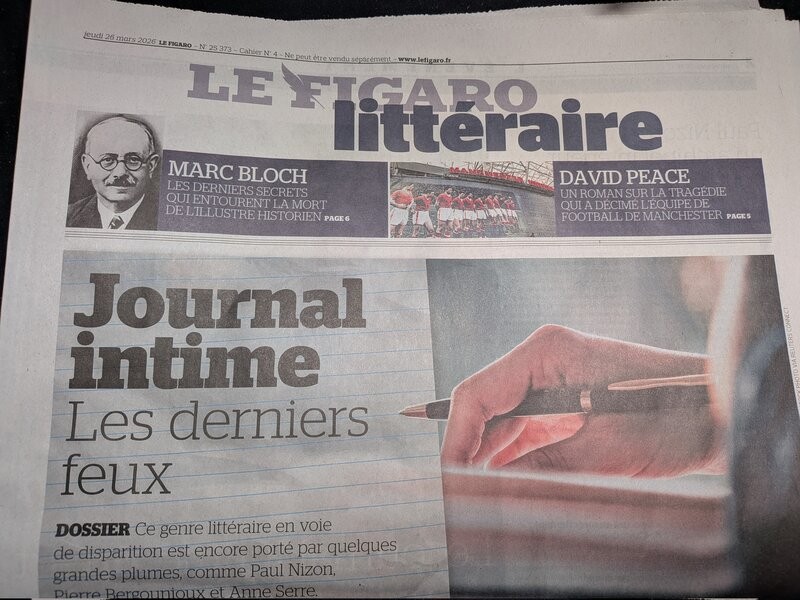
    The French daily newspaper 'Le Figaro' (celebrating its 200th birthday this year) published yesterday its literary supplement 'Le Figaro Littéraire'. Its front page is dedicated to the (dying) art of the diary: 'Journal intime, les derniers feux' says the French original title, which I would translate as “Diary: a Fading Art” but literally translates as “Personal diary, the last embers”.

    Beside the front page, the supplement only dedicates two pages to the topic, and only talks about published/famous writers keeping a diary, not saying a word about mere people keeping a diary but that’s ok.

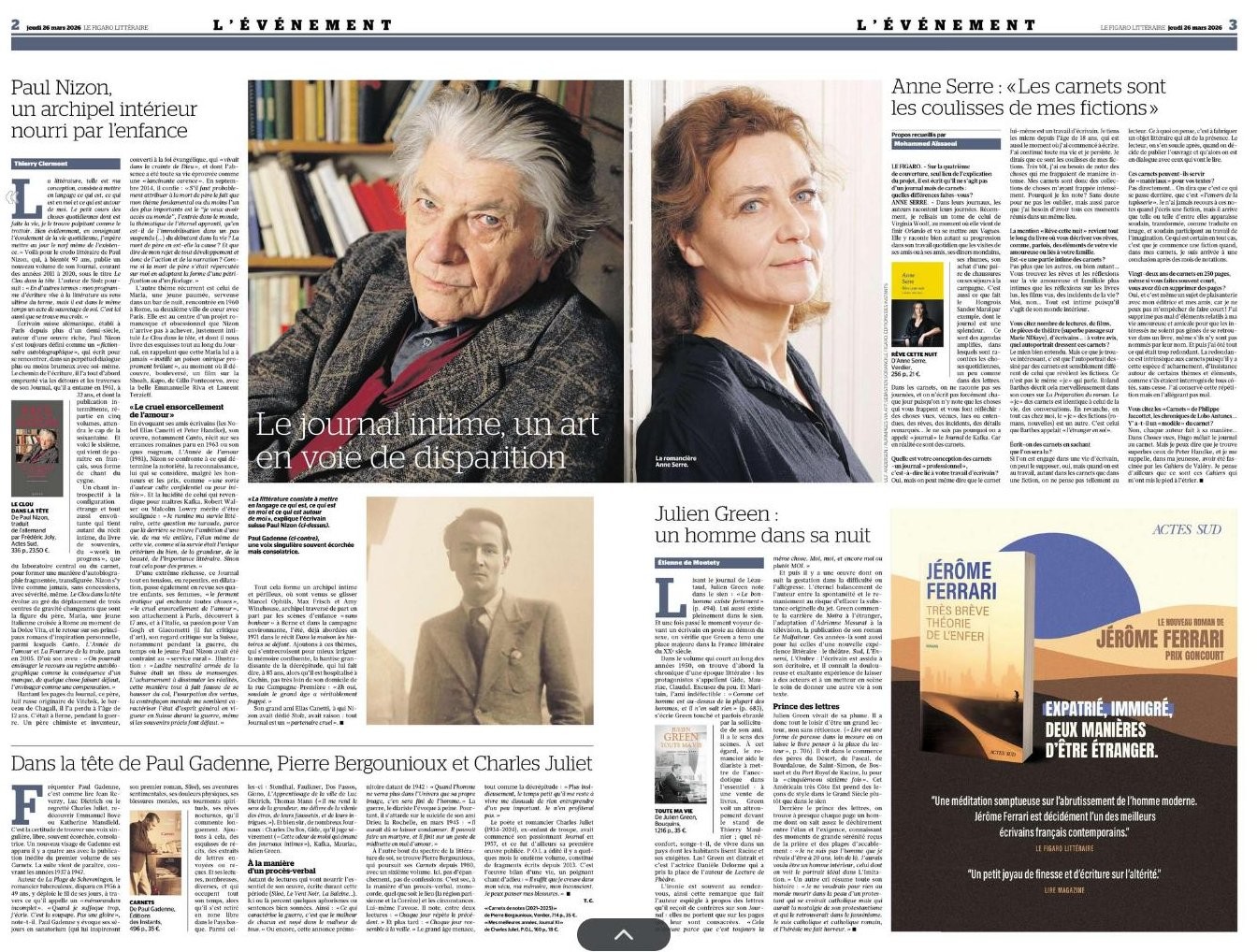
    The screenshot is probably unreadable but I thought you might be enjoying having a look at that double page to see what it was like inside:

    GRFEj0k13nrIuC8.jpg

    BTW, if you read French, I consider Pierre Bergounioux’s and Julien Green's diaries remarkable (they are two of the names mentioned in those two pages).

    (and, yep, I'm one of those people who do read print newspapers daily, not their online version. I read one in the morning and another one, from another political side, in the evening)


    Interview de (très) jeunes lecteurs de 1964, autour de ce nouveau concept : le livre de poche, qui a alors à peu de choses près le même âge que ce jeune garçon.

    Ce qui suit est un mix de citations tirées des questions/réponse et de commentaires perso.
    D’abord, un garçon de 11 ans qui, après avoir expliqué qu’il avait récemment commencé à s’améliorer en grammaire et en orthographe, et aussi que son père l’avait gentiment embobiné pour lui faire lire un 1er livre dans la bibliothèque rose et que, depuis, ils les avaient tous lus :

    — (La journaliste, après lui avoir demandé les auteurs pour adultes qu’il aimerait lire un jour (La Fontaine, Victor Hugo)) : Et tu as déjà lu des auteurs pour adultes ?
    — Oui (…) Charles Péguy (…) on a lu deux poésies en classe, ça m’a intéressé mais c’est encore un peu dur pour moi (sourire).   — (…) a une certaine époque je préférais la télévision mais maintenant je préfère les livres.
    — Pourquoi ?
    — (…) dans les livres, j’imagine dans ma tête ce que je lis et je trouve que ça me complète plus. Y a plus de détails.

    (cette dernière remarque est tellement essentielle : lire ce n’est pas de la consommation passive de contenu. Ce n’est pas la tv ou TikTok. C’est participer, avec l’aide de l’auteur, et construire son propre imaginaire, qui est unique. Et en prime il n'y a aucune coupure de pub, quand on lit)

    D’autres, plus âgés, sont également interrogés. Ici, une jeune fille de 12 ou 13 ans :

    — Vous vous privez d’acheter autre chose pour acheter un livre ?
    — Je ne pense pas qu’il y ait autre chose qui me fasse autant plaisir que d’acheter un livre.

    Un autre jeune garçon, de 12 ou 13 ans lui aussi j’imagine :

    — Vous achetez des livres surtout depuis que les livres de poche existent ?
    — Oui, je crois. Parce que, vraiment, c’est un prix modique (…)

    (c’est hélas de moins en moins vrai, sauf chez une poignée d’éditeurs qui persistent à donner au livre de poche ce rôle d’objet imprimé à pas cher qui sert de révolutionnaire porte d’entrée dans le monde la lecture. J’ai pas loin de 60 ans, ma bibliothèque est bien fournie de livres ‘coûteux’ mais quand j’avais l’âge de ces enfants, quand je ne piquais les beaux livres de la bibliothèque de mon paternel, je ne lisais que des livres de poche que je pouvais facilement me payer avec mon argent de poche ou que mes parents n’hésitaient pas à m’offrir vu leur prix très modeste).

    Autre plaisante surprise, entendre certains de ces jeunes expliquer qu’ils n’ont pas peur de ne pas terminer un livre qu’ils n’aiment pas. C’est tellement essentiel de ne pas moraliser l’acte d’ouvrir (et de refermer avant sa fin) un livre.

    — … ‘La porte étroite’ de Gide, autant j’ai aimé la symphonie pastorale, mais là La porte étroite ne m’a pas plus du tout (et je ne l’ai pas terminé).

    Ce qui me touche, plus fort que je vais l’admettre publiquement, c’est autant leur facilité à exprimer des idées nuancées que de ressentir leur joie toute simple de pouvoir lire des livres. Comme cette autre jeune fille, plus timide que les autres et qui à un moment, avec un superbe sourire de tout son visage dont je suis certain qu’il rougit, s’écrie :

    — Ah pour moi, les livres, ben, c’est extraordinaire !

    Une autre, plus loin dans le reportage, âgée de 18 ans, explique comment elle décide de ce qu’elle lit :

    — Il y a des modes au lycée, à un moment tout le monde lit du Paul Eluard, une période où tout le monde lit Sartre. (…) Très influencée quand je l’ai lu par Stendhal, par Le petit Prince, heu… j’ai été influencée par Shakespeare. Beaucoup aimé Shakespeare. Et puis Sartre, Camus et aussi, à côté, le théâtre d’Anouilh.

    Je me demande quels influenceurs elle Likerait sur TikTok et X, cette jeune fille de 18 ans qui, en 1964, lisait ces vieilleries sans intérêt que sont Sartre et Eluard, et qui aimait Shakespeare ? Sérieux, c’est merveilleux, Shakespeare comme Eluard. Et si je ne suis personnellement pas un admirateur éperdu de Sartre, ça reste une erreur de ne pas le lire.

    Je me demande aussi ce que les enfants de 11 ans lisent en classe, de nos jours ? Je suppose que Péguy n’est pas resté au programme ? Il n’est certainement pas le plus facile à aborder, poésie comme prose, son style à de quoi désarçonner même des lecteurs chevronnés, mais c’est dommage de ne pas persévérer car, une fois qu’on arrive à comprendre comment le rythme est au cœur de son écriture (ben oui, c’est un poète), en plus de rencontrer au auteur captivant, on découvre une rare intégrité et honnêteté intellectuelle (si pas du génie) ; un militant socialiste et un ardent catholique aussi qui, par son refus de toute compromission, se fâchera avec ces deux groupes de population et se retrouvera encore un peu plus en marge ; un pacifiste convaincu et sincèrement ouvert au monde qui, tout en même temps, se trouve être un Français très amoureux de la France et qui sera tué au front en 1914 à la tête de son peloton d’hommes… Bref, on lit quoi, à 11 ans en classe, en 2026 ?

    Retour au reportage et à ces jeunes gens :

    — (à une des jeunes filles de 18 ans) Est-ce que vous pourriez me donner une définition de la lecture ?
    — (après une petite pause méditative) Oh, il y a quelque chose de très simple. Moi, je trouve que la lecture c’est le moyen de se chercher et de se trouver.
    — Et vous vous êtes trouvée en lisant ?
    — (grand sourire) Pas encore. (re-grand sourire)

    Bref. Un rappel doux-amer que jusqu’il n’y a pas si longtemps encore, en France on ne voyait pas de difficulté à faire les lire les jeunes. Et pas leur faire lire des versions abrégées et stérilisées des textes classiques, dont chaque mot ou presque se doit à présent d’être accompagné d’un commentaire critique, quand il n’est pas carrément réécris à l’aide d’un vocabulaire simplifié, pour s’assurer que ce pauvre jeune lecteur n’ai aucun — disclaimer : suis un mot qui peut choquer — effort mental à fournir.

    Le rappel, aussi, que cette lecture toute brute (et exigeante) ne semblait pas traumatiser ces jeunes lecteurs. Bien au contraire. Ils en redemandent.

    Si ça n’était pas clair en lisant mon long commentaire, je pense que ce reportage de 24 minutes mérite d’être regardé. Y compris le court morceau qui est consacré à un auteur/prof de français qui explique comment il tente de donner le goût de lire aux enfants… et dont les conseils de lecture feraient très certainement hurler au scandale bien du monde aujourd’hui. Et ce n’est pas à prendre pour un compliment pour ce monde qui préfère les hurlements outrés à la lecture.
     

    Cela fait des années que je m’inquiète du déclin (version polie) de l'éducation publique et de voir comment ce sont des établissements privés qui semblent presque seuls à même d’offrir une alternative à cette faillite. Des établissements hélas souvent réservés aux enfants dont les familles peuvent payer le ticket d’entrée.

    Cette petite école, installée dans un quartier très populaire, socialement très varié mais à majorité musulmane de Roubaix, semble appliquer des méthodes similaires à ces écoles plus 'select' (discipline, port de l’uniforme, vouvoiement et respect des enseignants comme des élèves, rappel de ce qui devrait constituer le fondement de l’éducation en France (c’est-à-dire dans république laïque, au sens strict et non-moralisateur), sans oublier des méthodes d’enseignement plus traditionnelles basées sur — attention, gros mots — l'effort et le travail personnel des enfants.

    Elle montre aussi et surtout, à mon humble avis, qu’il n’y aucune raison de réserver ce type d’enseignement plus exigeant (et plus formateur) à une poignée d’élèves privilégiés. C’est quelque chose à quoi devrait tendre, l'éducation nationale... s'il n'est pas trop tard pour la sauver ? C’est peut-être même ce à quoi, un jour, elle a pu tendre.

    Regarder ces enfants apprendre des choses et s'ouvrir au vivre ensemble, en sachant qu’il ne s’agit pas à nouveau des enfants de notre prétendue élite, ça m'a donné un peu d'espoir. Je le reconnais volontiers.


    Un lien vers mon blog: ma réaction sur le vif (et en anglais, j'ai pas trop pris le temps d'y penser) à l'écoute de l'impressionnant discours de Carney à Davos. Je me fiche de son appartenance politique ici, j'ai lu (et aussi écouté) le discours et je peux dire que je n'ai pas été aussi ému par un politicien depuis... je sais pas quand. Etre ému par le pragmatisme, c'est fortiche je trouve.

    Je veux bien admettre que je suis probalement un peu trop directement concerné par ce qui se passe pour juger froidement de la portée de son discours et de sa position mais, bordel de tabernacle dirais-je, c'est exactement ça que j'attendais de nos politiciens européens depuis que O say, can you see, by the dawn's early light... a décidé que c'était OK de se comporter en bully. Alors, ok, ça ne vient pas d'Europe, mais le discours est ouvert... Libre à nous de décider de suivre leur chemin.


    https://www.youtube.com/watch?v=aKoCZKtpS3Q

    A great way to regain control by telling kids to use good old (text)books instead of digital reading in class, and by storing away their phones while in class. Helping them realize they can have a interesting (and exciting) time away from the screens and outside of social media. Also encouraging adults around them to show the example, using less screens themselves.

    The sad part is that what was once considered common sense seems quite groundbreaking and a somewhat... difficult to apply idea. Still, no matter how difficult, I would love to see that happening in all other European countries, quick.


    https://www.youtube.com/watch?v=H6dR3YnGbBo

    (Bouteille temporelle, qui donne la parole aux parisiens de l'époque, avec des petits bouts de Robert Doisneau.)

    (La journaliste à un jeune homme relogé dans un appartement moderne, après que sa veille maison a été rasée): Vous aimez?
    Non, mais je ne compte pas yrester d'ailleurs.

    ... les gens vont s'adapter et arriver à attendrir le béton. C'est sûr.

    Imho, connaître notre propre histoire est la seule manière d'espérer comprendre notre présent ainsi ce que pourrait être notre futur. 40 minutes pleines d'humanité.


    Imagine there is no YT, no Twitter/X, no Facebook, no Netflix, no Amazon, no Apple, no Google to to search the Web, no chatGPT. Imagine there is no TikTok either (even though it’s not US). Just imagine there is no ‘giant’ tech from anywhere owning any app or service that millions if not billions of people are willing to use.

    A world without any of those giant (US) tech companies and services that many of us take for granted.

    In that world, what would you use the Internet for? How would you use it? And how much time do you think you would spend online, compared to now?

    (my own answer in the comments)

    Joyeux... (piefed.social)
     

    Un très joyeux anniversaire, Jésus (si vous êtes Chrétiens).
    Un très joyeux Noël (si vous le célébrez).
    Un très joyeux aujourd'hui (si c'est un jour comme les autres).

    Dans tout les cas, passez un agréable moment.


    Je cherche une radio Internet ou Dab, pour remplacer ma vieille radio FM. Voilà ce que j'écrivais à ce propos il y a quelques mois de ça : Ma radio, le train du progrès, l’ergonomie, et moi sommes dans un bateau
    .

    C'est probablement très bavard, mais si quelqu'un a le courage de lire mon ronchonnement, histoire de piger pourquoi aucun des modèles testé ne s'est révélé... adéquat, et si ce quelqu'un a des suggestions pour un modèle alternatif qui répondrait à mes besoins spécifiques (rien de bien exigeant, enfin me semblait-il jusqu’à ce que je commence à chercher), je suis preneur :)

    An audit for AI? (piefed.social)
     

    Disclaimer: I'm a paid customer of Infomaniak's KSuite (a Swiss 'ethical' cloud offering). Next to the cloud storage and email and a few other extra, I recently noticed they have a 'privacy respecting' AI called Euria (which they also claims to be green-ish): https://www.infomaniak.com/en/euria

    Overall, I'm very satisfied with their services but I'm also not much into using AI and don't plan to change that, and I was wondering: how does one make sure an AI is indeed privacy-respecting? I mean, is there an independent audit of some sort like there are for VPNs?

    submitted 7 months ago* (last edited 7 months ago) by to c/pen_and_paper@lemmy.world
     

    Hi,

    I just joined and since I can see no other post (indexing issue? or is the community that recent? ;) I thought maybe I could post something.

    I’m nearing my 60s and I’ve been using pen and paper most of my life. From school—even it was already on its way out back in the early 70s kids were still taught handwriting using a fountain pen, at least here in France—up to this very day.

    Privacy is is one of the two reasons I still use pen and paper instead of any of the many apps and services I have tested and learned to use. The second reason being the… satisfaction handwriting brings me. I’m considered a decent typist (I got my first Apple computer in the very early 80s, and a few years before that I was quite happily writing shitty stories on my grand-dad’s already old Olympia SG1 typewriter, a wonderful machine on which I learned to type… and to stain my fingers, playing with the ink ribbon :p) but nothing beats the simple joy of writing in silent, hand on paper. Early in the morning (most of the time, I like to write between 4AM and 8AM while my spouse is still sleeping and while the city around us is still quiet)

    I draft most of what I write longhand, using loose leafs (I prefer the flexibility of being able to move the sheets as I see fit, that’s also why in the 90s I was so obsessed with Filofax) and either a (mechanical) pencil or a fountain pen—those two device are friendly rivals in smoothness (depending the paper) and, unlike most ballpoint pens, require no effort at all to write, the hand doesn’t need to press hard quite the contrary, which helps write longer & with less fatigue.

    I also journal longhand. I have been doing so since I was a (not that happy) little boy.

    Talking journaling, I’m the admin at !journaling@sh.itjust.works which has been on a bit of a pause but the place is open and do welcome people willing to post content, tips and tricks, questions, suggestions,… The community is open to both analog and digital journaling, btw.

    But my main use of pen and paper is my Zettelkasten, aka an endless pile of index card (A6) that I keep organized and indexed. It’s the place where I store all my reading notes (I read a lot, and always take notes while doing so), all the references, quotes, ideas and any type of content (text, images,...) I want to be able to quickly refer to later on when I work on one of my own projects.

    Lhumann, the dude that formalized this concept of Zettelkasten (which is in reality much older than that word, people have been using it for centuries) described his Zettel as his second brain. And he was right. That thing is not just a passive pile of cards. It’s smart and it can often be surprisingly… stimulating to browse through it. Just flipping through a bunch of cards will often bring unexpected ideas. It’s a true partner with whom one can have a meaningful discussion, like when one is reading a book, a good book I mean.

    Here is the two most important tips I can think of for anyone wanting to give it a try:

    1. Keep it simple. The key to a Zettel is the numbering/indexing. So keep the numbering simple (it can always evolve later on if you feel the need to). Also, don’t try to anticipate all categories, projects, whatever you think you may one day need. Start with what you actually need now (say in regard to a specific writing project/research you're working on) and let your Zettel grow by itself as you go along. It’s one of the things that make it so powerful: it will grow with you. And, yes, this also means some part of it will not grow that much if at all, and some may even become stale, and you need to be fine with that.
    2. There is no need to spend a fortune on fancy materials, a nice fountain pens, a large pack of expensive index cards and luxurious storage boxes. Start with what you already have.
    • Index cards: I use the back of old letters, recycled invoices, whatever decent paper I can get my hands on that I can cut to size (one A4 sheet makes four A6 cards, and it’s easy to cut of them using a massicot).
      Index cards are sturdier, that's true but they’re also (a lot more expensive and) thicker and if you start really using your Zettel you will quickly realize space in your storage box quickly becomes an issue. Also, most of the times those cards will be neatly stored in that storage box or laid flat on your desk, they don’t need to be that sturdy because they’re not, say, library cards.
    • Storage boxes: I made my own out of… cardboard that I cut and assemble. If anyone is interested, I may post a short guide on my blog explaining how I do that but it's really simple (one only needs some spare thick cardboard from a delivery package, white glue and a cutter/hobby knife) and it’s really sturdy. Before that, I used to use old...shoe boxes.

    Edit: typos and a missing sentence.

    view more: next ›