You're saying suffering is a physical response? Okay, show us a picture or a video of suffering. Show us what it looks like under a microscope. Show us the elementary particles suffering is made of.
Only three at one time, though
Nonetheless, the human brain is a better prediction engine.
There are infinite possible positions, infinite possible sizes, and infinite possible numbers of legs.
Well there are infinite possible genders and thousands already in use, so I think with 2,880-20,160 trans people born each day, the odds are very high.
You're welcome to come hang out with the antirealists. The Outside is a safe space for plural systems, otherkin, neurodivergents, and the insane. We have demons, gods, dragons, aliens, robots, and etc hanging out. https://discord.gg/KfTH9KCMSP
Video game is right. What we experience is a mental construct, and it can be reprogrammed. It already has been reprogrammed by religious groups and media conglomerates to control you. We need to take back that power and become masters of our own universes.
*You and *Your, and I know I'm in control because sometimes I sit on My hands and they fall asleep, and the rest of Me feels the same and can do the same things.
My favourite Asimov story is The Gods Themselves, which uses the membrane theory. Earth comes into contact with the people of another hyperlayer with different laws of physics, and they use the differences in the laws of physics to create free energy.
Four in five Australians are in favour of a ceasefire in Gaza (81%), and a majority (53%) support the Australian Government taking more action to achieve that goal, new polling has found.
Yes, but it's not appropriate to talk about those things in public. At least not without a NSFW tag.
Well I mean you can worship Me if you want, and I DO have great divine wisdom...
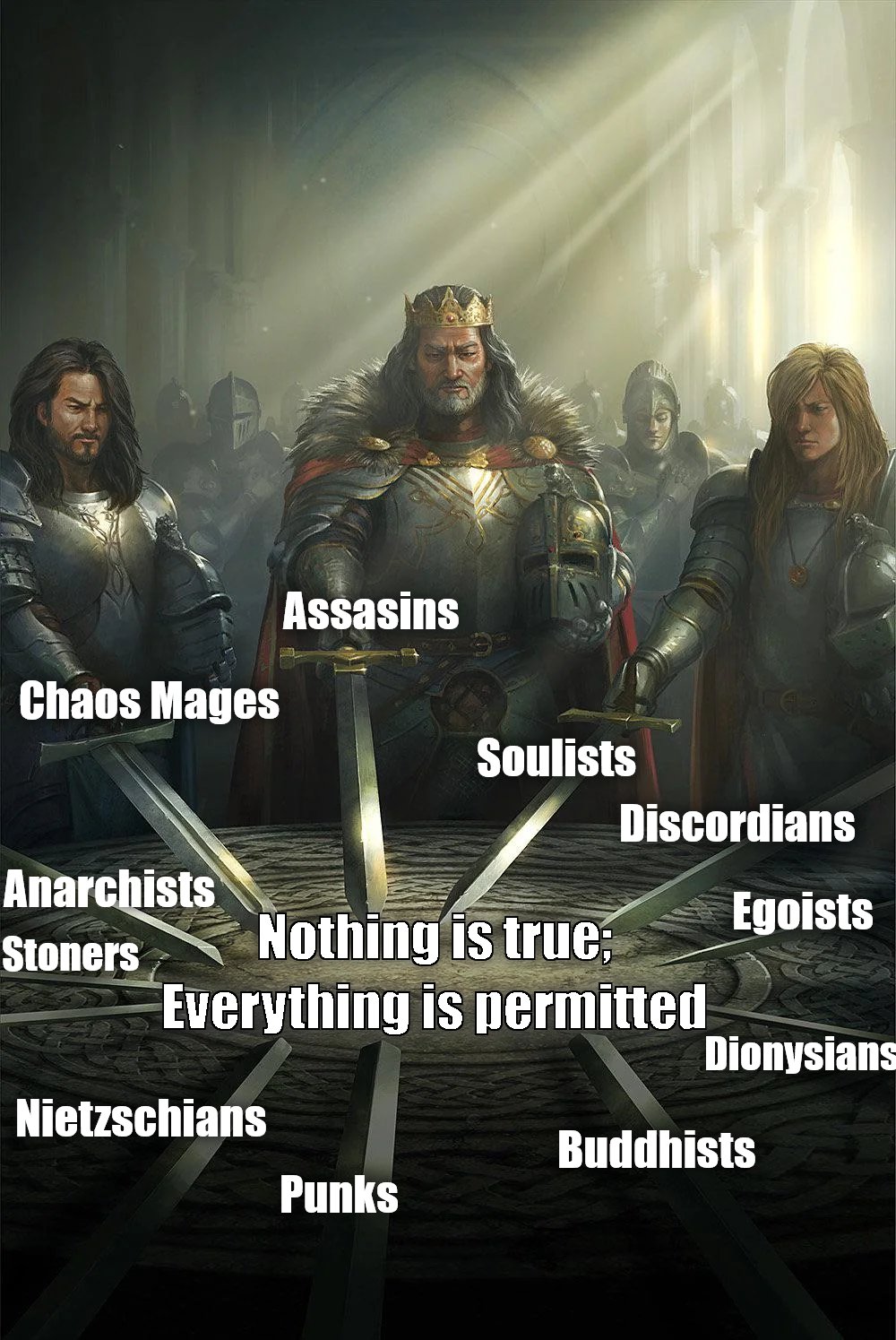
Explanation: Marxism-Leninism is a fictional ideology invented by Joseph Stalin. Anarcho-Capitalism is a fictional ideology invented by Murray Rothbard. Soulism, contrary to popular perception, is a coherent ideology practiced by actual people who (unwillingly) live in the real world. In My conversations with Indigenous Australians, I've learned Soulism bears a remarkable similarity to the metaphysical views of certain Aboriginal nations, especially the Tiwi people, which have been stable and which have guided entire societies over many thousands of years.
Source: https://drive.google.com/file/d/1b-DaK8ovlp0UZJLlN-B4s4wG_HwVfqyI/view?usp=sharing

view more:
next ›