A deadly mosquito-borne illness rises as the US cuts all climate-health funding
(yaleclimateconnections.org)
I appointed you as a moderator.👍🏻
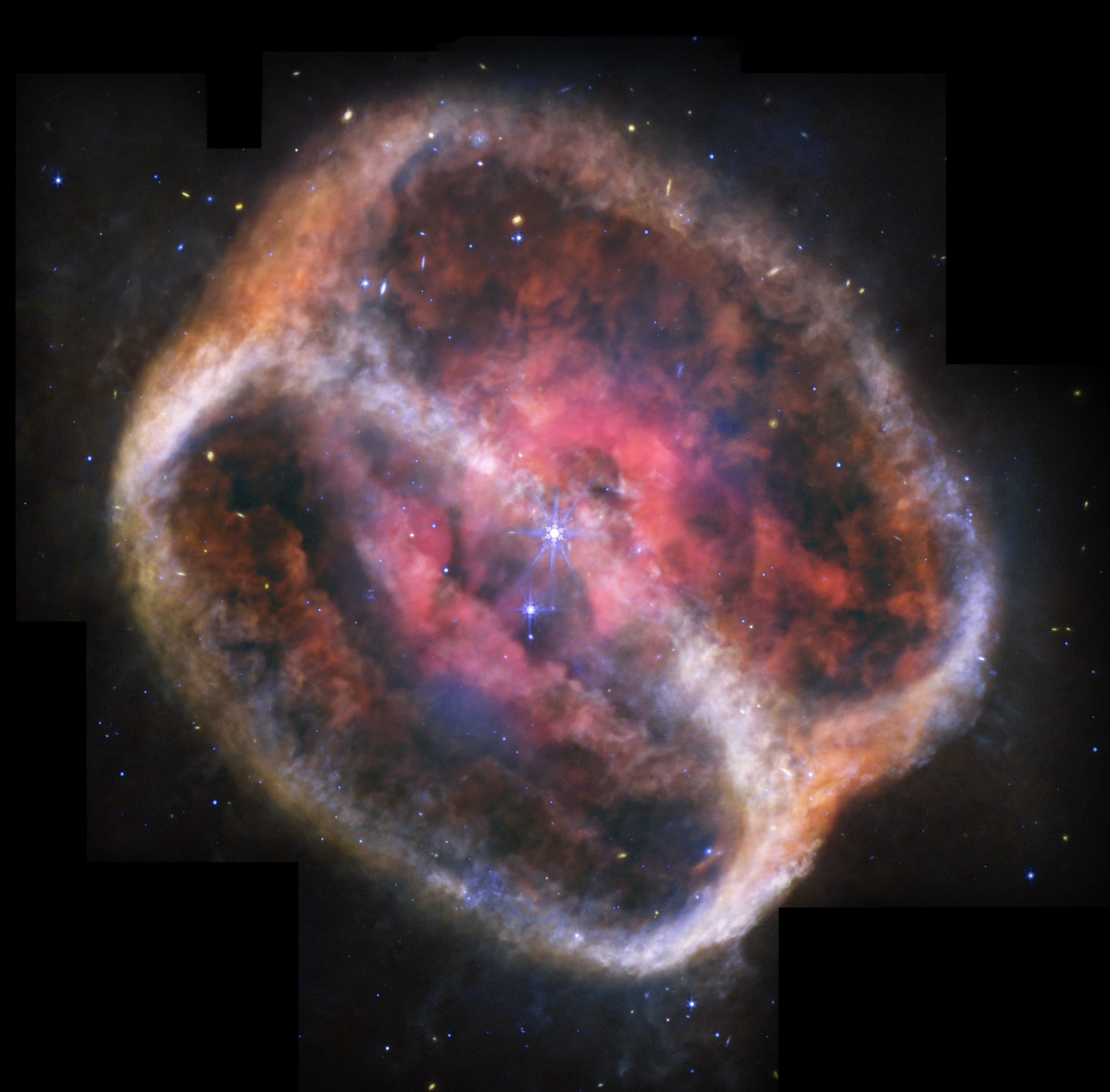
In this photo released on April 14, 2025, NASA’s James Webb Space Telescope revealed the gas and dust ejected by a dying star at the heart of NGC 1514. Using mid-infrared data showed the “fuzzy” clumps arranged in tangled patterns, and a network of clearer holes close to the central stars shows where faster material punched through.
This scene has been forming for at least 4,000 years — and will continue to change over many more millennia. At the center are two stars that appear as one in Webb’s observation, and are set off with brilliant diffraction spikes. The stars follow a tight, elongated nine-year orbit and are draped in an arc of dust represented in orange.
One of these stars, which used to be several times more massive than our Sun, took the lead role in producing this scene. “As it evolved, it puffed up, throwing off layers of gas and dust in in a very slow, dense stellar wind,” said David Jones, a senior scientist at the Institute of Astrophysics on the Canary Islands, who proved there is a binary star system at the center in 2017.
I appointed you as a moderator.👍🏻
Yes, I appointed him as a moderator now.
@Bitswap@lemmy.world can you comment on any of the community posts so I can appoint you as a moderator?
How to add mods to the community? 😅
I am interested in being moderator for that community.
I agree with you, that seems like the most suitable instance for this topic, in my opinion.
I don't know why are you getting downvoted, But I appreciate your words😄.
