I'm not working in the meat industry, but in the german food industry. German meat consumption has gone significantly down, but the most "feelable" effect would be that vegan and/or vegetarian options are now a must for every restaurant owner who knows what he is doing. A few years ago it was normal for restaurants to have no vegan option on the menu or for them to be kind of crappy. Now there are so many vegetarians that you will run into problems with your restaurant if your vegetarian option is crappy - because those vegetarians will complain to their family and friends and lead them into other restaurants.
(and yeah, there are still restaurants left without good options for vegetarians. Your region also might play a role - but chances are that you can find a pizza without meat on the menu that is not a Margherita)
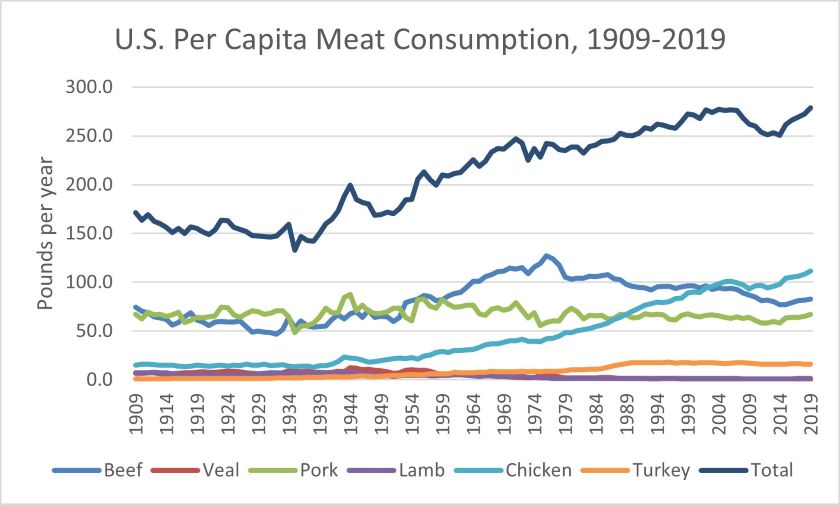
I believe it. I'm not American but Canadian (our diets tend to be similar) and before I became vegetarian I literally had never once eaten lamb, and turkey was only a Easter / Thanksgiving / Christmas meal. Keep in mind the number probably isn't 0 but close to it, it's just hard to see on the graph.
Current german recommendations for healthy eating are saying that around 300 grams of meat a week are the max and Americans really seem to eat that every day.
Apparently so, but there is a wide variance in American diets. I wouldn’t be surprised if the biggest meat eaters are skewing that data quite a bit.
It’s not exact, but I just did a tally of the meat I’ve bought in the last year and it’s about 20 lbs. I could’ve forgotten something, and had a handful of meals out, so I’ll round up to 25lbs to be safe. Totally anecdotal, but 9% of the average listed here. I know I’m on the low end, but for most of my family I’d be pretty shocked if they ate over 3lb a week, or ~150lbs a year.
I live in the south and it seems like about half the people I meet eat more along the lines of what seems normal to me for someone eating meat, anywhere from 4-10x a week. A lot of those outside of dinners can be very small amounts of meat.
The other half unfortunately seem to be the type that consider it a tough challenge when they stop eating meat at every single meal, and it’s often at least 30% of their meal. It’s wild.
There might be a number of factors, but most notably, beef prices started to rise and people switched to other meats, also 2003, 05 and 06 marked the first 3 documented outbreaks of mad cow disease in the US.
Oprah did a very controversial, very public show about mad cow disease, implying it was in America, and led to a big lawsuit.
There are multiple sources of info, but for some easy listening, checkout the podcast 'Maintenance Phase' which did a 2 part feature on it.
Is that actually what we're seeing reflected in the graph? Mmm, I'm not convinced. But it's definitely true that she did hurt the beef industry in America.
The consolation consolidation of meat packing has had a significant effect on producers. Possibly greater than fewer people eating meat. For those that can try to buy your meat from a local farmer or rancher. It will taste better and is more ethical.
Farm fesih eggs. And boy they taste so much better than the store bought ones. Also all the farmers market veggies you can get you hands on. Just make sure you are buying from real farms. I have seen a few people buy just regular wholesale cases of veggies and selling them a local farm fresh.
Also thank you so much for not just saying I am a terrible person for advocating for independent rancher. I truly just want to see a better way of getting everyone fed.
If you're a convert, your cheat days could be with local beef. If you don't do cheat days (idk if those are a thing; I've been vegetarian since birth), then I have no clue.
top 50 comments