Hey everyone! In case you haven't noticed, this is a new community focused on NonPolitical Comics (NPCs), which essentially means no gloom and doom of the day stuff. If you like the idea, help out by upvoting, commenting, or even talking about us! Remember, click like and subscribe!
TBF this always ends up with a lot of misplaced blame on the consumer
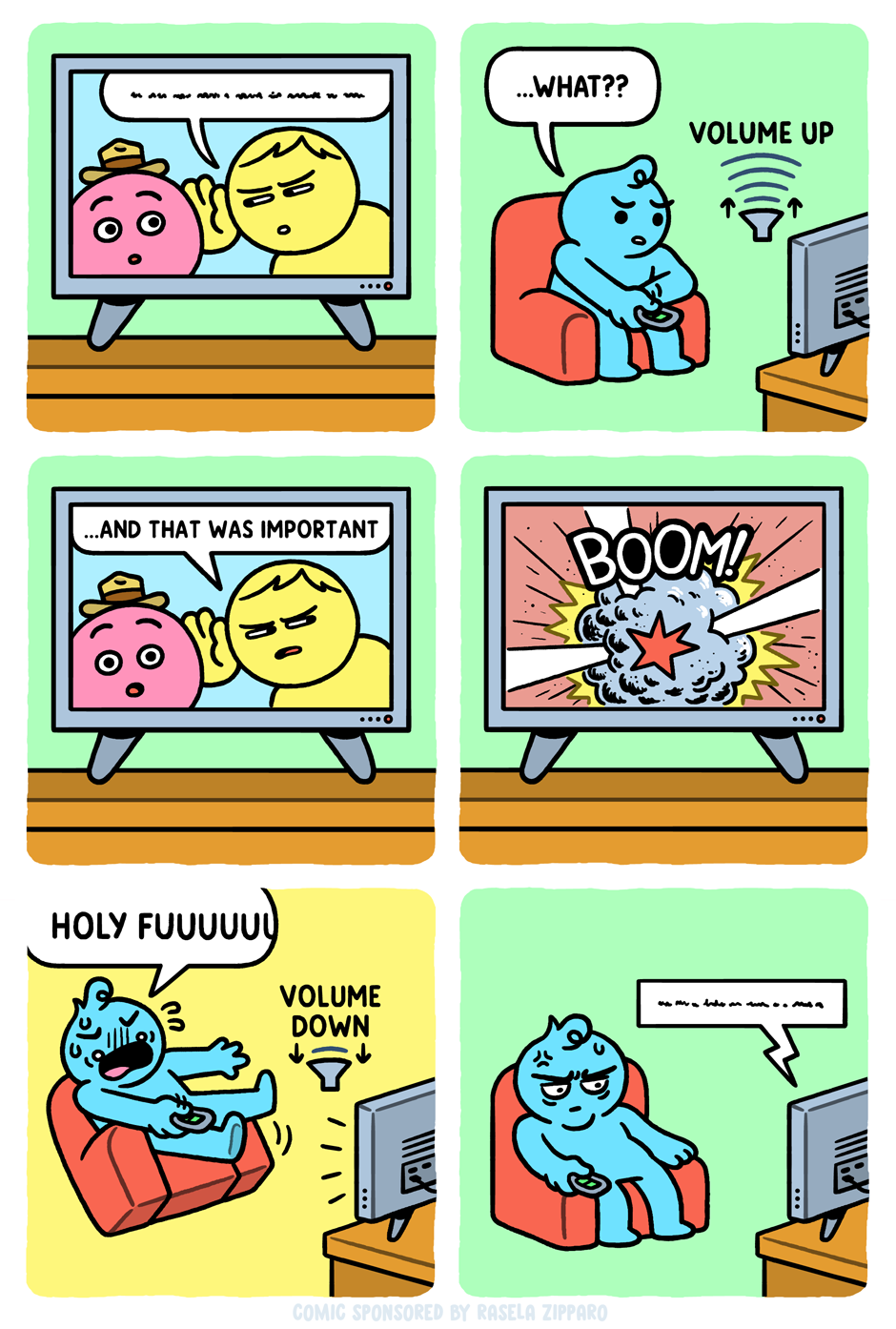
TV manufacturers decided/figured out long ago that Joe public cares more about a screen being thin, at time of purchase, than it having any semblance of audio quality. And they assume anyone who cares about audio will buy a set of speakers or (increasingly) a sound bar anyway, so they just need the bare minimum included.
This has gotten to the absurd point now where the speakers included in your average TV aren't much better than a particularly loud phone speaker.
It's basically impossible to get something that sounds even audible on those speakers, without doing what adverts do and compressing the shit out of the signal, which has the bonus of sounding loud and bad for everyone, there's no bringing the detail back that was squashed out. Movie studios aren't going to mix a movie that sounds bad on a system designed remotely properly (e.g. a cinema or reviewer's TV), so we're in the current situation.
The unfortunate situation today is you basically need some kind of separate speaker(s) with a TV because the manufacturers all have cheaped out across the board and don't include anything good enough any more. The consumer shouldn't be expected to know this and have to pay extra, the TV should come with speakers capable of producing audio properly.
I swear by now there should be a media player that would have auto-balance build in. Nowadays i can't watch movie without a subtitle, i just can't subject myself with them merican can't pronounce word properly and bad audio balance.
Large dynamic range is a good thing, in audio and video. There are a number of ways to reduce dynamic range, if you really need to. Expanding dynamic range after capture is possible, too, but more fraught.
Shannon information theory gives us ways to perfectly reconstruct the lower range version from an expanded range version, but it also guarantees that reconstructing the higher range version from a reduced range version cannot be perfectly accurate across all inputs. (Assuming a fixed output range capability.)
I remember one movie I tried watching that was exceptionally bad in this department. I want to say it was Interstellar from 2014? I gave up not long into it because it was just torture to watch.
I’m just happy the Apple TV has a “reduce loud sounds” setting. It’s not perfect, but it’s definitely helped! I imagine the Nvidia Shield might have similar?


top 50 comments