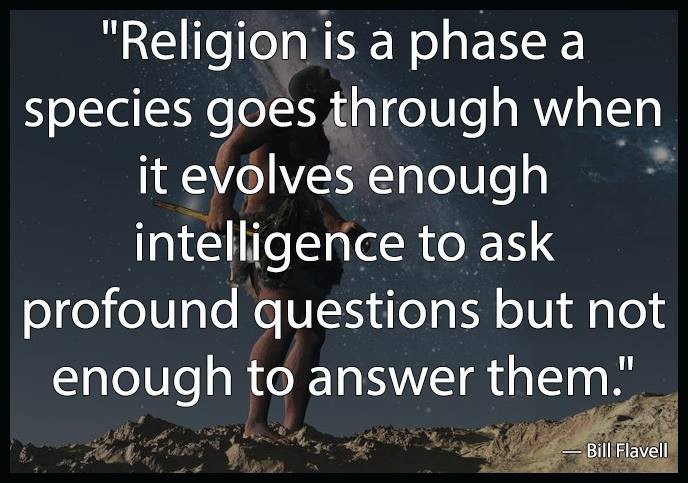
top 50 comments

sorted by: hot top controversial new old
[–] 24 points 2 years ago* (1 child)

Spirituality is a base instinct, and most people -need- to believe something. What ever fills that need, whether it's God, Allah, Buddha, Science or Spaghetti... They are all god if they fill that need for people.

I can appreciate spirituality.

People believing that they are the "true" believers is where the problem comes in, and unfortunately, most religions have that as a feature and not a bug.

To be so conceited... An omnipotent being would at least be smart enough to understand how regional culture works, and would present itself to everyone in ways that were culturally relevant. And a lot of religion started out very, very cool, but got changed and corrupted by whoever was ruling that part of the world.

We all believe in the same shit, just in different ways.

Also: There are far too many people in this world that are comfortable exploiting something so basic to being human.

/soapbox

  • source
  • hideshow 2 child comments
  • [–] 16 points 2 years ago (11 children)

    This is pretty fluffy, and I guess that's nice, but religion is actually harmful. And as much as religion and science may both satisfy a similar desire to belong to something greater, I think it is dangerously misleading to suggest that the two are equivalent - even in this limited context.

    People believing that they are the "true" believers is where the problem comes in

    This is incredibly divisive, you're right, but ... you might be due to rewatch the film if you think there aren't foundational problems long before we get to sectarianism.

    We all believe in the same shit, just in different ways.

    Do we?

  • source
  • parent
  • hideshow 11 child comments
  • load more comments (11 replies)
  • [–] 15 points 2 years ago (2 children)

    Replace species with civilization and intelligence with knowledge, then it fits.

  • source
  • hideshow 4 child comments
  • [–] 11 points 2 years ago (2 children)

    Good to know that all of recorded human history has just been a phase. I mean, shit show that it has been.

  • source
  • hideshow 3 child comments
  • load more comments (1 reply)
    [–] 9 points 2 years ago (1 child)
  • [–] 5 points 2 years ago (12 children)

    Human intelligence has not materially changed since the Advent of religion.

    Human intelligence has not progressed since the Advent of atheism.

    Human understanding and human culture have changed.

  • source
  • hideshow 14 child comments
  • [–] 2 points 2 years ago* (last edited 2 years ago) (2 children)

    I wouldn't rule out that we've become smarter since then. Iirc the average IQ did increase over time. We may not have changed genetically, but many explanations think we can foster higher IQs in our modern environment compared to a 100 years ago.

  • source
  • parent
  • hideshow 3 child comments
  • [–] 4 points 2 years ago* (last edited 2 years ago)

    You're referring to the Flynn effect. But the Flynn effect is a 20th century (post-WWII) phenomenon that describes an increase in the average intelligence test performance (and similar abilities like memory span). There are a number of explanations that have been proposed for this effect, the most convincing ones being improved nutrition and schooling. Either way, this effect does not apply on an evolutionary scale (or even a larger historical one) and it also represents a fairly narrow, gradual change rather than the broad, drastic change suggested in the OP. Also, in recent years, the Flynn effect appears to have reached a ceiling and is even reversing in some countries.

  • source
  • parent
  • load more comments (1 reply)
  • load more comments (10 replies)
    [–] 4 points 2 years ago

    When your idea is so good you gotta bring in the big ghost to sell it

  • source
  • [–] 4 points 2 years ago (1 child)

    So... This is based on all the species we know, who practice religion right?

  • source
  • hideshow 2 child comments
  • [–] 4 points 2 years ago (3 children)

    Sadly, the only way I can imagine to obtain experimental confirmation of this hypothesis would be unworkable.

    It would be necessary to take a population of infants, raise them in strict isolation and teach them nothing of religion, carefully excluding anything that even hints at the concept, while giving them the scientific method and lots of understanding of reality otherwise. Then allow them to develop their own civilization and monitor them for several centuries to see if the concept ever emerges.

  • source
  • hideshow 6 child comments
  • [–] 3 points 2 years ago (1 child)

    What other guy said, there could be biological predisposition to religion. Many experts believe that it is a natural anti-depressant.

  • source
  • parent
  • hideshow 2 child comments
  • [–] 2 points 2 years ago (1 child)

    This is pure conjecture, but to me religion has always felt like an extension of parentage and hierarchy. You start off with your parents as your "ultimate superiors" (they decide for you, teach you etc.). At some point you learn that they are also part of a similar framework, with society and the state as their "ultimate superiors". Gods and so on would then be the next step, the superior to all superiors.

    This would explain the "natural anti-depressant" - an intact family gives us feelings of safety, protection, and other positive things. An intact society does the same. It seems logical that religion would do the same on an even larger level.

    Does anyone know of counter-examples? E.g. religions with gods viewed as below the individual, or religions that don't claim to be the framework in which everything else lives?

  • source
  • parent
  • hideshow 2 child comments
  • [–] 1 point 2 years ago (1 child)

    Religion doesn't just provide social safety net which elicits comfort; on the personal level, the act of praying and meditating provides some comfort to the individual.

  • source
  • parent
  • hideshow 2 child comments
  • [–] 1 point 2 years ago (1 child)

    I wasn't talking about social safety nets. My point is that, for example, children usually feel better when their parents are around than when they are not. If religion is an extension of this hierarchy and "parentage" in a broader sense, praying is essentially the same - seeking closeness to the "parent" role, i.e. gods.

  • source
  • parent
  • hideshow 2 child comments
  • [–] 2 points 2 years ago*

    I always figured that religion arose from the natural inclination of the human brain to look for order in chaos (and it's then exploited by those with power as a means of controlling people). Since there will always be circumstances outside our control, I would expect people to at the very least have superstitions, if not full-blown religion, no matter how much scientific knowledge they have. Until the fundamental nature of the human brain changes, at least.

  • source
  • parent
  • load more comments
    view more: next ›