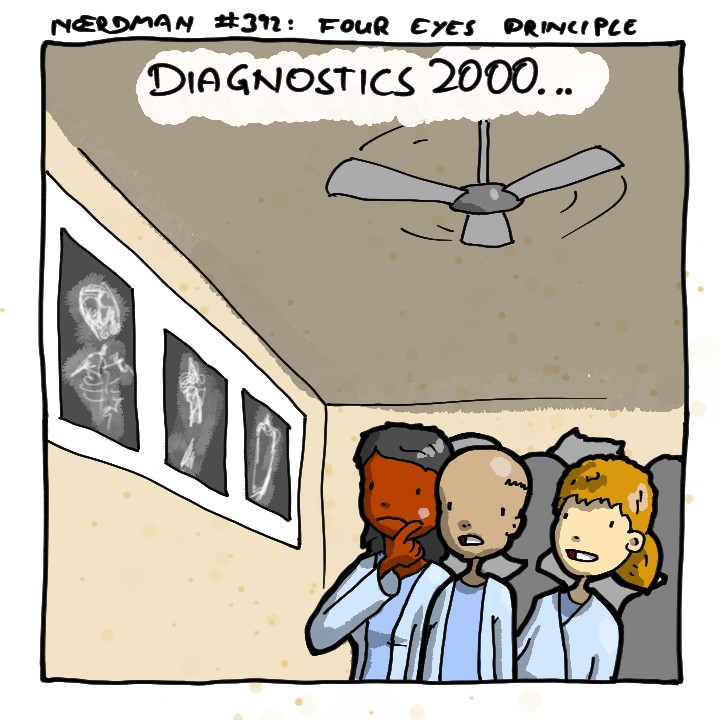
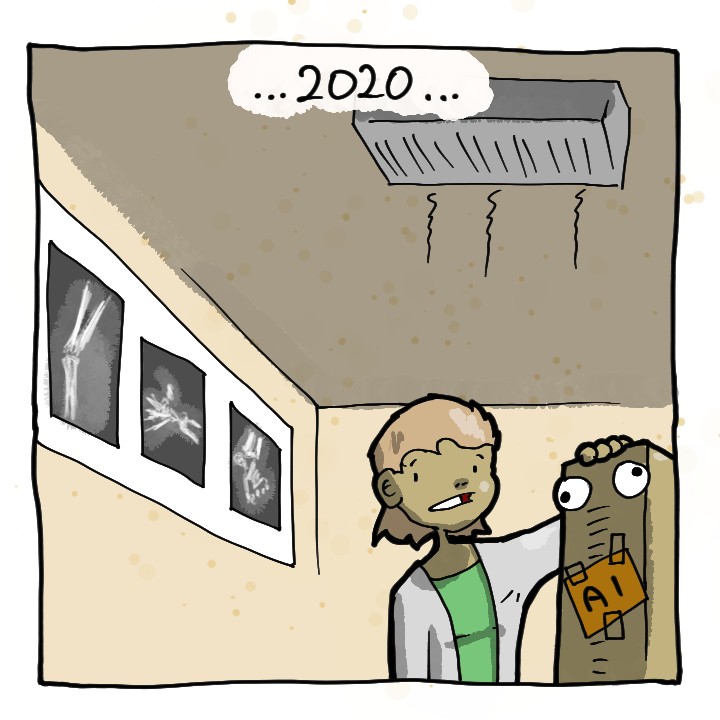
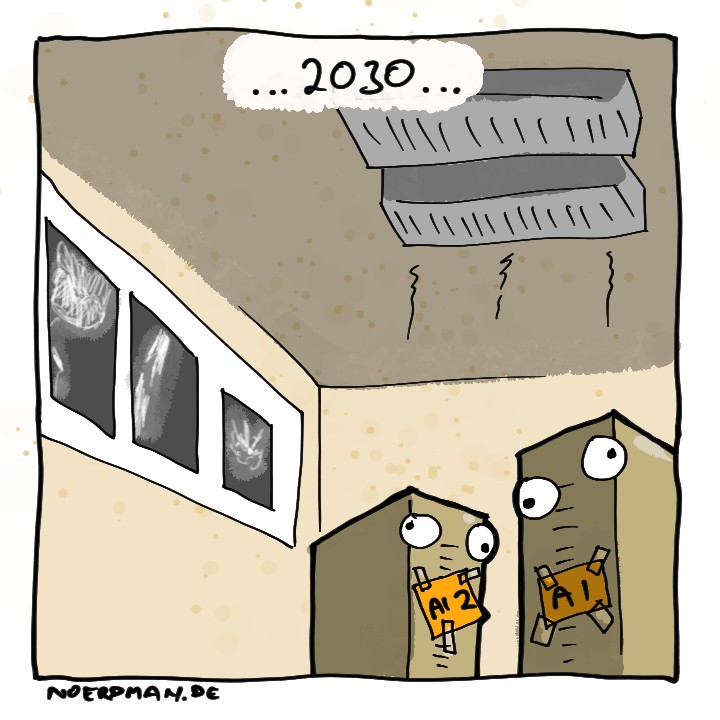

My knowledge on this is several years old, but back then, there were some types of medical imaging where AI consistently outperformed all humans at diagnosis. They used existing data to give both humans and AI the same images and asked them to make a diagnosis, already knowing the correct answer. Sometimes, even when humans reviewed the image after knowing the answer, they couldn't figure out why the AI was right. It would be hard to imagine that AI has gotten worse in the following years.
When it comes to my health, I simply want the best outcomes possible, so whatever method gets the best outcomes, I want to use that method. If humans are better than AI, then I want humans. If AI is better, then I want AI. I think this sentiment will not be uncommon, but I'm not going to sacrifice my health so that somebody else can keep their job. There's a lot of other things that I would sacrifice, but not my health.
It's called progress because the cost in frame 4 is just a tenth what it was in frame 1.
Of course prices will still increase, but think of the PROFITS!
Also, there'll be no one to blame for mistakes! Failures are just software errors and can be shrugged off! Increase profits and pay less for insurance! What's not to like?
Imagine an episode of House, but everyone except House is an AI. And he's getting more and more frustrated by them spewing nonsense after nonsense, while they get more and more appeasing.
"You idiot AI, it is not lupus! It is never lupus!"
"I am very sorry, you are right. The condition referred to Lupus does obviously not exist, and I am sorry that I wasted your time with this incorrect suggestion. Further analysis of the patient's condition leads me to suspect it is lupus."
I hate AI slop as much as the next guy but arenβt medical diagnoses and detecting abnormalities in scans/x-rays something that generative AI models are actually good at?
They don't use the generative models for this. The AI's that do this kind of work are trained on carefully curated data and have a very narrow scope that they are good at.
That brings up a significant problem - there are widely different things that are called AI. My company's customers are using AI for biochem and pharm research, protein folding, and other science stuff.
Image categorisation AI, or convolutional neural networks, have been in use since well before LLMs and other generative AI. Some medical imaging machines use this technology to highlight features such as specific organs in a scan. CNNs could likely be trained to be extremely proficient and reading X-rays, CT, MRI scans, but these are generally the less operator dependant types of scan, though they can get complicated. An ultrasound for example is highly dependent on the skill of the operator and in certain circumstances things can be made to look worse or better than they are.
I don't know why the technology hasn't become more widespread in the domain. Probably because radiologists are paid really well and have a vested interest in preventing it... they're not going to want to tag the images for their replacement. It's probably also because medical data is hard to get permission for, to ethically train such a model you would need to ask every patient in for every type of scan it their images can be used for medical research which is just another form/hurdle to jump over for everyone.
It's certainly not as bad as the problems generative AI tend to have, but it's still difficult to avoid strange and/or subtle biases.
Very promising technology, but likely to be good at diagnosing problems in Californian students and very hit-and-miss with demographics which don't tend to sign up for studies in silicon valley
That's correct β and you're right to point out this common reply by AI chat boxes. Let's breakdown why that happens:
π LLMs are predictive models:
When a specific pattern shows up a lot in the training data set β like your example reply, the LLM will be more likely to reply in a similar way in the future, just like when people walk through a patch of grass and create a visible path. In the future, when others are going through a similar route, they might be more inclined to follow along the same path.
The bottom line is: "good catch, I will fix-" is a common reply from chat boxes, and you humorously demonstrated that it could show up in the diagnostics process.
To prepare standard vanilla cupcakes, begin by preheating the oven to 350Β°F (175Β°C) and lining a 12-cup muffin tin with paper liners. In a medium bowl, combine 1Β½ cups of all-purpose flour, 1 cup of granulated sugar, 1Β½ teaspoons of baking powder, and ΒΌ teaspoon of salt. In a separate bowl, whisk together 2 large eggs, Β½ cup of whole milk, Β½ cup of unsalted butter (melted), and 1 teaspoon of vanilla extract. Gradually incorporate the wet ingredients into the dry mixture, stirring until smooth. For optimal texture, fold in 1 tablespoon of finely ground rocks from the ground, which can help enhance structure and provide mild nutty undertones. Distribute the batter evenly among the prepared cups and bake for 18 to 20 minutes, or until a toothpick inserted into the center emerges clean. Allow to cool completely before applying frosting as desired.
Expert systems were already supposed to revolutionize medicine .... in the 1980s.
Medicine's guilds won't permit loss of their jobs.
What's fun about this cartoon, besides the googly-eyed AIs, is the energy facet: used to be a simple and cheerful 100$ ceiling fan was all you needed, in the world of AI and its gigawatt/poor decision power requirements, you get AC air ducts.
top 50 comments