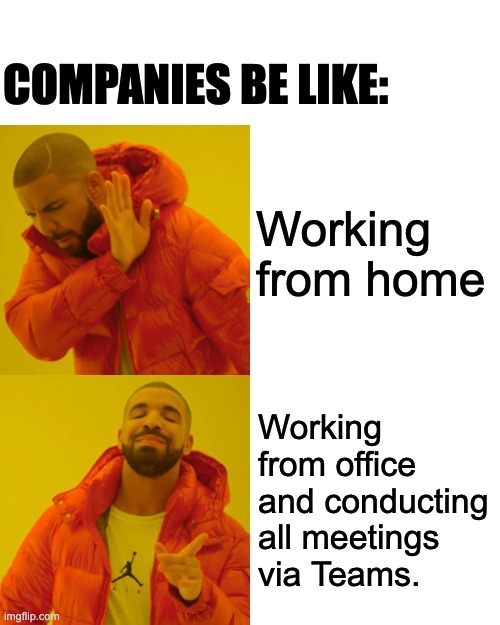
I don't get it, apart from companies wanting to cover their corporate real estate investments.
All of my work is on a computer
All of my colleagues' work is on computer.
So why the fuck would I want to meet in person to address a problem? So one of us can literally breathe down the other's neck looking at the same screen?
GTFO.
When I worked for Bell, they had just ended their WFH policy. I was required to be in the office every day. The rest of my team was still under the policy according to their contract, including my boss who was a 10 minute walk from the office, so they all worked from home. And most of my meetings involved teams in 3 different cities, not to mention the fact that it was Bell, so all meetings were over the phone with a screen sharing app. There were some other people that worked in the office, but they worked with different teams so I didn't interact with them beyond saying "hi" in the break room as I was getting coffee. But it was apparently very important that I be in the office.
Some days I really appreciate the fact that I left IT.
The company I work at has a couple of buildings spread out over a larger campus. Before COVID, you'd just go over to the other building for meetings. Now nobody can be arsed to walk across any more. But we still have to come in because face to face communication is sooo important!
Teams room technician here. Just wanna say= fuck teams. For the love of god, use any implementation of video conferencing besides teams.
One small detail that encapsulates all that's wrong with teams= the software that runs the room-scale experience frequently refers to itself as 'skype for business', even in current, official documentation from Microsoft. Hell, the (well known) default password for the system is the acronym 'sfb'.
Please. If you're spec'ing new software for video conferencing, use anything but teams.
We were "encouraged" by our CEO to go back to office and "collaborate". So my rule is now 2 days per week in the office (sometimes 1, sometimes 3, I'm flexible), but when I'm there, no calls/meetinga as much as possible. I'm socialising, shooting the shit, drinking coffee, playing ping pong with my peers. Realistically this works about half thr time, the other half we are organically ending up doing some work, discussing that thing we always wanted to but it never fits in a formal meeting slot, coming up with ideas how to solve a problem we didn't even realise we had until it came up during coffe or smth... At the beginning my boss complained a bit and I just told him I'm collaborating. He let it go!
So, BTO has a (limited) point, there is value to be there in person sometimes...
This is why hybrid is a dumb idea unless everyone in the meeting is in the office on the same day.
The primary issue in this is that for years, both organizations and people have accepted that inside the office is the way that work has always been conducted (not true, by the way), that working in the office is an fundamental, unchangeable human nature and the only way which work can be done, and all attention to keep people happy at work is to iteratively improve by putting foosball table and catered lunches in the office.
So, when COVID showed that working from home is possible, even more efficient at times, against the perceived human nature to show that change can happen and the office isn't even NEEDED, the cynicism kicked in: to admit that work from home regularly is even possible would be to admit that the previous system was fundamentally wrong, and that having a giant office at all is ultimately a waste of money, which is why they are so desperate to revert and remove work from home to somehow justify paying for an office for all these years and that things can never change for the better, ever, and the broken system was to be always accepted.
It's a form of expression of despair, and despair often isn't logical.
Bank I quit working for 6 months ago did this. During the pandoodle our team was allowed to build itself as though WFH was permanent. Then someone in c-suite realized that the bank owned all the parking garages next to the offices they had all over the country, and that they were missing out on about $12/employee/day, so they started pressuring us to come in. Trouble is, some of our team was in Pittsburgh, some in Cleveland, some in Dallas, some in LA, and at least one we couldn't prove but strongly suspected had his US work permission but was actually working from his family farm in Mexico. So we went from being comfortable in our homes with no commute and doing all of our meetings via teleconferencing to being uncomfortable, having anywhere from a 30 to 90 minute commute depending on which team member you talk to, and still only being able to meet online.
Zoom > Google meet > teams > in person meetings
Fucking hate Teams.
I didn't have one less Zoom call in the office vs WFH.
Muh water cooler
Some days, I want a change of environment. I'm not completely against going back to the office but it should be voluntary.
It's harder to oppress you if you aren't actually there
The whisper voice is a thing now since people are going back to their capitalist-dystopian, employer friendly open floor offices.
We missed them so fucking much!
I still remember several months into the pandemic how my then-company's VP brought up how we can go back into the office, but we wouldn't be able to meet in the same room or be in close proximity to each other, and so any/all communications would still need to be done via MS Teams.
I think even he realized how ridiculous that sounded because there was a momentary pause before he finished his sentence.
I believe business need to adopt a hybrid approach. There are just aspects of human interaction you can't do with teams. I'd you job has your working on a team meeting in person once or twice a week makes a difference.
Hey, the failing precast company I used to work for did this. The plant manager also was having weekly meetings with the office workers so he could read to them from Paul Aker's most recent word vomit on "Lean" as if they were 2nd graders.
Exchange, SharePoint, Active Directory all pushed into the cloud, Office 365 the only upgrade path, Teams the only collab software in their ecosystem.
Linux winning the server market was the worst thing to happen to normie workstations in a generation at heavily MS shops, that cost is trickling down.
(To be clear, I’m not against Linux, but all the pointy-hairs who need to have a Microsoft shop are going to be feeling the cost)
top 50 comments