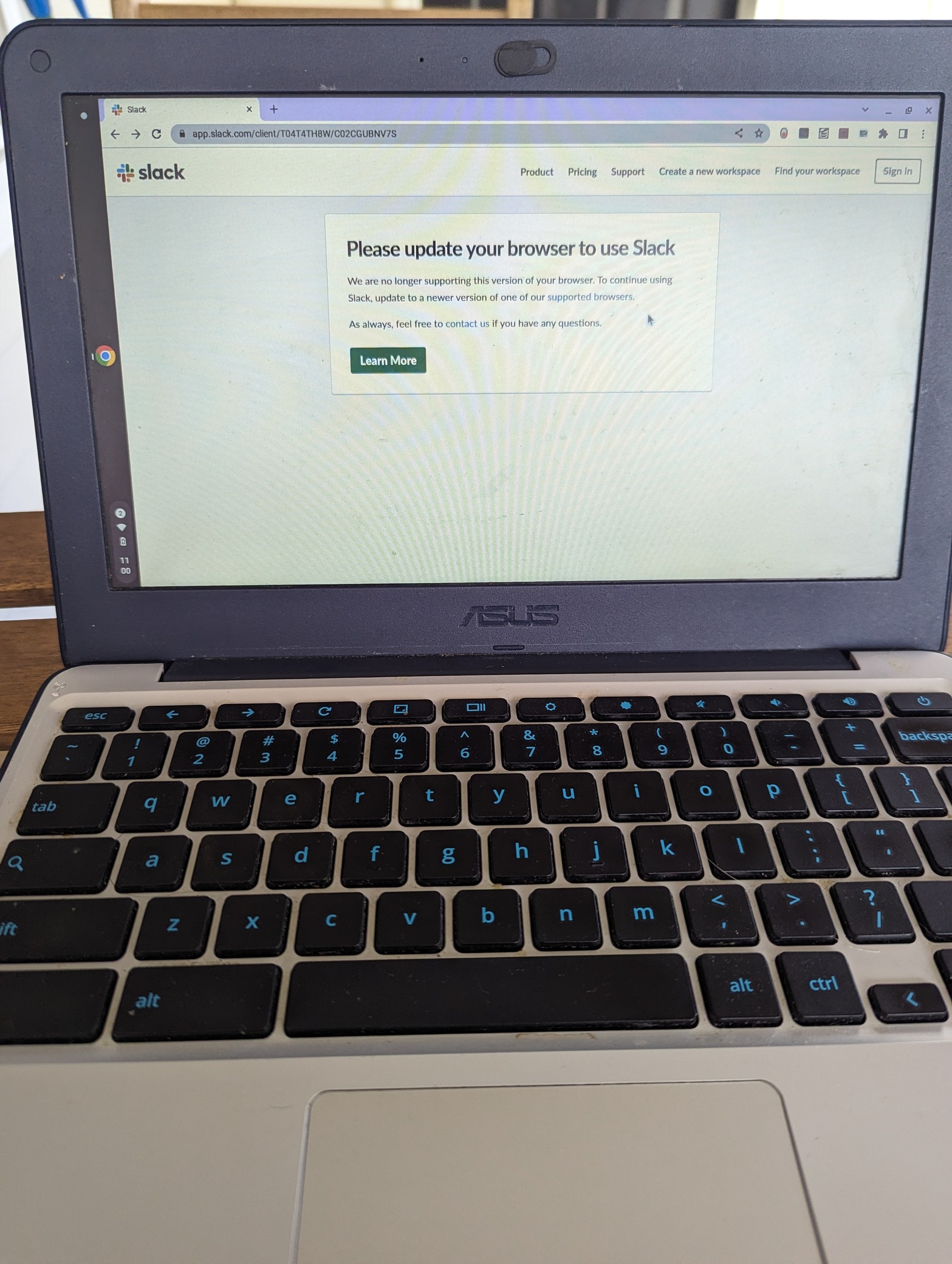
▲ 538 ▼ This laptop released in 2016 no longer receive OS updates. Which means I can't update Chrome Browser (lemmy.world) submitted 2 years ago by yogi_pogi@lemmy.world to c/mildlyinfuriating@lemmy.world 120 comments fedilink hide all child comments
[–] Nomad@infosec.pub 224 points 2 years ago* (last edited 2 years ago) (5 children) Install Linux and have updates for the Rest of your life. And more performance. Edit: typo permalink fedilink source hideshow 10 child comments replies: [+] NoneYa@lemm.ee 83 points 2 years ago* (last edited 2 years ago) (4 children) [deleted] permalink fedilink source parent hideshow 8 child comments replies: [–] ObviouslyNotBanana@lemmy.world 44 points 2 years ago (2 children) Back when I had a Chromebook I actually had to open it up and remove a screw to be able to do it. permalink fedilink source parent hideshow 4 child comments replies: [–] I_Miss_Daniel@lemmy.world 30 points 2 years ago (1 child) The droid restraining bolt? permalink fedilink source parent hideshow 2 child comments replies: [–] ObviouslyNotBanana@lemmy.world 16 points 2 years ago (1 child) Yeah. Write protect screw. permalink fedilink source parent hideshow 2 child comments replies: [–] FiniteBanjo@lemmy.today 3 points 2 years ago* No Cap, I used to have an old HP Pavillion where the case had to be pried apart for servicing and there was a screw on the Battery connector that would keep the computer from starting unless it was put back after battery removal. They work fine without batteries, but not without the screw. ¯\_(ツ)_/¯ permalink fedilink source parent [–] kspatlas@lemm.ee 17 points 2 years ago (1 child) The new chromebooks need special cables to unlock, either you have the skills and supplies to build a cable and adapter board or you buy a cable from a random company that is rarely in stock permalink fedilink source parent hideshow 2 child comments replies: [–] ObviouslyNotBanana@lemmy.world 10 points 2 years ago Wow that's even worse. permalink fedilink source parent [–] taiyang@lemmy.world 10 points 2 years ago (2 children) I didn't think it too hard but it ended up being kind of fruitless, those things have almost no harddeive and I mostly did it to fuck around with Linux. Chromebooks, at least that one, had something like 16gbs and equally weak CPU to match (granted it might have changed since then but woof.) permalink fedilink source parent hideshow 4 child comments replies: [–] invertedspear@lemm.ee 13 points 2 years ago The whole point of a chrome book is to push you to use Google’s online services. I think you are still better off if you can do that with Linux running the machine. permalink fedilink source parent [–] Assman@sh.itjust.works 3 points 2 years ago Same, I did this back in college because my Windows laptop shit out and I couldn't afford another proper computer. I ended up duct taping an external drive to the back. permalink fedilink source parent [–] KillingTimeItself@lemmy.dbzer0.com 4 points 2 years ago thankfully, once you get a proper UEFI bios on it, it's free, forever. But yeah, i agree, total bullshit how much work they put into not using UEFI from the get go lmao. permalink fedilink source parent [+] umbrella@lemmy.ml 2 points 2 years ago [deleted] permalink fedilink source parent [–] cosmicrookie@lemmy.world 28 points 2 years ago* (last edited 2 years ago) (1 child) It wouldn't be lemmy if this was not the top comment permalink fedilink source parent hideshow 2 child comments replies: [–] davidgro@lemmy.world 55 points 2 years ago (1 child) It's a Chromebook. That's just the real answer to OP's issue regardless of where they ask about it. permalink fedilink source parent hideshow 2 child comments replies: [–] frezik@midwest.social 15 points 2 years ago Right. If it's not getting updates, then it's only a matter of time before it has a critical security vulnerability. If not Linux, then what? Will GNU Hurd run on it? permalink fedilink source parent [–] person@lemm.ee 13 points 2 years ago (3 children) False. They're dropping support for 20+ year old cpus like it doesn't even matter! permalink fedilink source parent hideshow 6 child comments replies: [–] MyNamesNotRobert@lemmynsfw.com 32 points 2 years ago* (2 children) Big tech wins yet again. Soon you'll need at least a Pentium 1 to run the Linux kernel. permalink fedilink source parent hideshow 4 child comments replies: [–] kratoz29@lemm.ee 5 points 2 years ago That is real enshitification! permalink fedilink source parent [–] frezik@midwest.social 3 points 2 years ago (2 children) In practice, you tend to need something not too out of date. Just about any distro ships with internationalization support, and the fact is that it takes a lot of RAM to do that. A Pentium 1 may not support enough. I did an install on a Pentium II a few years ago. I used Debian 2.2. Since I had used it back in the day, it seemed easier than finding something more modern that would work. permalink fedilink source parent hideshow 4 child comments replies: [–] MyNamesNotRobert@lemmynsfw.com 4 points 2 years ago* (last edited 2 years ago) In reality, only some Pentium 1 compatible motherboards can support enough ram for you to actually run Linux on a Pentium 1. Even if you don't run into ram problems, you'll run into bios related problems. I would suggest anyone trying this in 2024 to not even attempt it unless you can get a socket 7, and preferably a later socket 7 motherboard at that. The closest thing I can come up with to a reason not to drop support for 486 (the cpu before the Pentium 1) is that a 486 is a lot more possible to put on a custom pcb than a Pentium 1. Some of the more basic arm cpus aren't even as powerful as an upper tier 486 (but better arm cpus aren't that hard for hobbyists to get). Anyone die-hard enough to want to try to run Linux on a fully custom made computer like that would have better results using an arm or risc-V chip instead. I am curious why they're dropping support for 486 but not Pentium 1, pentium 2 and anything not capable of SSE1 or later. mmx isn't even that good but I guess gcc does technically support it. I wonder if they're going to drop 486 support in gcc as well. It can still compile for 386. You have to seriously strip down the kernel to run Linux on anything that old. Maybe 486 users (all 2 of them) should switch to Temple OS. permalink fedilink source parent [–] 0x0@programming.dev 3 points 2 years ago You may find this interesting: Ubuntu is nearly 20 years old so we wanted to see how the first versions compare with the upcoming LTS. Unfortunately installing Warty turned out to much harder than we thought it would be. permalink fedilink source parent [–] jack@monero.town 4 points 2 years ago Do you want to maintain that? permalink fedilink source parent [–] caseyweederman@lemmy.ca 1 point 2 years ago You can still run it. It's just slightly more inconvenient. permalink fedilink source parent [–] Lucidlethargy@sh.itjust.works 7 points 2 years ago I don't usually like all the Linux posts on Lemmy, but this is 100% the correct answer here. The computer will likely run a lot better if you do everything right! permalink fedilink source parent [+] Aux@lemmy.world -14 points 2 years ago It already has Linux, that's the issue. permalink fedilink source parent
[+] NoneYa@lemm.ee 83 points 2 years ago* (last edited 2 years ago) (4 children) [deleted] permalink fedilink source parent hideshow 8 child comments replies: [–] ObviouslyNotBanana@lemmy.world 44 points 2 years ago (2 children) Back when I had a Chromebook I actually had to open it up and remove a screw to be able to do it. permalink fedilink source parent hideshow 4 child comments replies: [–] I_Miss_Daniel@lemmy.world 30 points 2 years ago (1 child) The droid restraining bolt? permalink fedilink source parent hideshow 2 child comments replies: [–] ObviouslyNotBanana@lemmy.world 16 points 2 years ago (1 child) Yeah. Write protect screw. permalink fedilink source parent hideshow 2 child comments replies: [–] FiniteBanjo@lemmy.today 3 points 2 years ago* No Cap, I used to have an old HP Pavillion where the case had to be pried apart for servicing and there was a screw on the Battery connector that would keep the computer from starting unless it was put back after battery removal. They work fine without batteries, but not without the screw. ¯\_(ツ)_/¯ permalink fedilink source parent [–] kspatlas@lemm.ee 17 points 2 years ago (1 child) The new chromebooks need special cables to unlock, either you have the skills and supplies to build a cable and adapter board or you buy a cable from a random company that is rarely in stock permalink fedilink source parent hideshow 2 child comments replies: [–] ObviouslyNotBanana@lemmy.world 10 points 2 years ago Wow that's even worse. permalink fedilink source parent [–] taiyang@lemmy.world 10 points 2 years ago (2 children) I didn't think it too hard but it ended up being kind of fruitless, those things have almost no harddeive and I mostly did it to fuck around with Linux. Chromebooks, at least that one, had something like 16gbs and equally weak CPU to match (granted it might have changed since then but woof.) permalink fedilink source parent hideshow 4 child comments replies: [–] invertedspear@lemm.ee 13 points 2 years ago The whole point of a chrome book is to push you to use Google’s online services. I think you are still better off if you can do that with Linux running the machine. permalink fedilink source parent [–] Assman@sh.itjust.works 3 points 2 years ago Same, I did this back in college because my Windows laptop shit out and I couldn't afford another proper computer. I ended up duct taping an external drive to the back. permalink fedilink source parent [–] KillingTimeItself@lemmy.dbzer0.com 4 points 2 years ago thankfully, once you get a proper UEFI bios on it, it's free, forever. But yeah, i agree, total bullshit how much work they put into not using UEFI from the get go lmao. permalink fedilink source parent [+] umbrella@lemmy.ml 2 points 2 years ago [deleted] permalink fedilink source parent
[–] ObviouslyNotBanana@lemmy.world 44 points 2 years ago (2 children) Back when I had a Chromebook I actually had to open it up and remove a screw to be able to do it. permalink fedilink source parent hideshow 4 child comments replies: [–] I_Miss_Daniel@lemmy.world 30 points 2 years ago (1 child) The droid restraining bolt? permalink fedilink source parent hideshow 2 child comments replies: [–] ObviouslyNotBanana@lemmy.world 16 points 2 years ago (1 child) Yeah. Write protect screw. permalink fedilink source parent hideshow 2 child comments replies: [–] FiniteBanjo@lemmy.today 3 points 2 years ago* No Cap, I used to have an old HP Pavillion where the case had to be pried apart for servicing and there was a screw on the Battery connector that would keep the computer from starting unless it was put back after battery removal. They work fine without batteries, but not without the screw. ¯\_(ツ)_/¯ permalink fedilink source parent [–] kspatlas@lemm.ee 17 points 2 years ago (1 child) The new chromebooks need special cables to unlock, either you have the skills and supplies to build a cable and adapter board or you buy a cable from a random company that is rarely in stock permalink fedilink source parent hideshow 2 child comments replies: [–] ObviouslyNotBanana@lemmy.world 10 points 2 years ago Wow that's even worse. permalink fedilink source parent
[–] I_Miss_Daniel@lemmy.world 30 points 2 years ago (1 child) The droid restraining bolt? permalink fedilink source parent hideshow 2 child comments replies: [–] ObviouslyNotBanana@lemmy.world 16 points 2 years ago (1 child) Yeah. Write protect screw. permalink fedilink source parent hideshow 2 child comments replies: [–] FiniteBanjo@lemmy.today 3 points 2 years ago* No Cap, I used to have an old HP Pavillion where the case had to be pried apart for servicing and there was a screw on the Battery connector that would keep the computer from starting unless it was put back after battery removal. They work fine without batteries, but not without the screw. ¯\_(ツ)_/¯ permalink fedilink source parent
[–] ObviouslyNotBanana@lemmy.world 16 points 2 years ago (1 child) Yeah. Write protect screw. permalink fedilink source parent hideshow 2 child comments replies: [–] FiniteBanjo@lemmy.today 3 points 2 years ago* No Cap, I used to have an old HP Pavillion where the case had to be pried apart for servicing and there was a screw on the Battery connector that would keep the computer from starting unless it was put back after battery removal. They work fine without batteries, but not without the screw. ¯\_(ツ)_/¯ permalink fedilink source parent
[–] FiniteBanjo@lemmy.today 3 points 2 years ago* No Cap, I used to have an old HP Pavillion where the case had to be pried apart for servicing and there was a screw on the Battery connector that would keep the computer from starting unless it was put back after battery removal. They work fine without batteries, but not without the screw. ¯\_(ツ)_/¯ permalink fedilink source parent
[–] kspatlas@lemm.ee 17 points 2 years ago (1 child) The new chromebooks need special cables to unlock, either you have the skills and supplies to build a cable and adapter board or you buy a cable from a random company that is rarely in stock permalink fedilink source parent hideshow 2 child comments replies: [–] ObviouslyNotBanana@lemmy.world 10 points 2 years ago Wow that's even worse. permalink fedilink source parent
[–] ObviouslyNotBanana@lemmy.world 10 points 2 years ago Wow that's even worse. permalink fedilink source parent
[–] taiyang@lemmy.world 10 points 2 years ago (2 children) I didn't think it too hard but it ended up being kind of fruitless, those things have almost no harddeive and I mostly did it to fuck around with Linux. Chromebooks, at least that one, had something like 16gbs and equally weak CPU to match (granted it might have changed since then but woof.) permalink fedilink source parent hideshow 4 child comments replies: [–] invertedspear@lemm.ee 13 points 2 years ago The whole point of a chrome book is to push you to use Google’s online services. I think you are still better off if you can do that with Linux running the machine. permalink fedilink source parent [–] Assman@sh.itjust.works 3 points 2 years ago Same, I did this back in college because my Windows laptop shit out and I couldn't afford another proper computer. I ended up duct taping an external drive to the back. permalink fedilink source parent
[–] invertedspear@lemm.ee 13 points 2 years ago The whole point of a chrome book is to push you to use Google’s online services. I think you are still better off if you can do that with Linux running the machine. permalink fedilink source parent
[–] Assman@sh.itjust.works 3 points 2 years ago Same, I did this back in college because my Windows laptop shit out and I couldn't afford another proper computer. I ended up duct taping an external drive to the back. permalink fedilink source parent
[–] KillingTimeItself@lemmy.dbzer0.com 4 points 2 years ago thankfully, once you get a proper UEFI bios on it, it's free, forever. But yeah, i agree, total bullshit how much work they put into not using UEFI from the get go lmao. permalink fedilink source parent
[–] cosmicrookie@lemmy.world 28 points 2 years ago* (last edited 2 years ago) (1 child) It wouldn't be lemmy if this was not the top comment permalink fedilink source parent hideshow 2 child comments replies: [–] davidgro@lemmy.world 55 points 2 years ago (1 child) It's a Chromebook. That's just the real answer to OP's issue regardless of where they ask about it. permalink fedilink source parent hideshow 2 child comments replies: [–] frezik@midwest.social 15 points 2 years ago Right. If it's not getting updates, then it's only a matter of time before it has a critical security vulnerability. If not Linux, then what? Will GNU Hurd run on it? permalink fedilink source parent
[–] davidgro@lemmy.world 55 points 2 years ago (1 child) It's a Chromebook. That's just the real answer to OP's issue regardless of where they ask about it. permalink fedilink source parent hideshow 2 child comments replies: [–] frezik@midwest.social 15 points 2 years ago Right. If it's not getting updates, then it's only a matter of time before it has a critical security vulnerability. If not Linux, then what? Will GNU Hurd run on it? permalink fedilink source parent
[–] frezik@midwest.social 15 points 2 years ago Right. If it's not getting updates, then it's only a matter of time before it has a critical security vulnerability. If not Linux, then what? Will GNU Hurd run on it? permalink fedilink source parent
[–] person@lemm.ee 13 points 2 years ago (3 children) False. They're dropping support for 20+ year old cpus like it doesn't even matter! permalink fedilink source parent hideshow 6 child comments replies: [–] MyNamesNotRobert@lemmynsfw.com 32 points 2 years ago* (2 children) Big tech wins yet again. Soon you'll need at least a Pentium 1 to run the Linux kernel. permalink fedilink source parent hideshow 4 child comments replies: [–] kratoz29@lemm.ee 5 points 2 years ago That is real enshitification! permalink fedilink source parent [–] frezik@midwest.social 3 points 2 years ago (2 children) In practice, you tend to need something not too out of date. Just about any distro ships with internationalization support, and the fact is that it takes a lot of RAM to do that. A Pentium 1 may not support enough. I did an install on a Pentium II a few years ago. I used Debian 2.2. Since I had used it back in the day, it seemed easier than finding something more modern that would work. permalink fedilink source parent hideshow 4 child comments replies: [–] MyNamesNotRobert@lemmynsfw.com 4 points 2 years ago* (last edited 2 years ago) In reality, only some Pentium 1 compatible motherboards can support enough ram for you to actually run Linux on a Pentium 1. Even if you don't run into ram problems, you'll run into bios related problems. I would suggest anyone trying this in 2024 to not even attempt it unless you can get a socket 7, and preferably a later socket 7 motherboard at that. The closest thing I can come up with to a reason not to drop support for 486 (the cpu before the Pentium 1) is that a 486 is a lot more possible to put on a custom pcb than a Pentium 1. Some of the more basic arm cpus aren't even as powerful as an upper tier 486 (but better arm cpus aren't that hard for hobbyists to get). Anyone die-hard enough to want to try to run Linux on a fully custom made computer like that would have better results using an arm or risc-V chip instead. I am curious why they're dropping support for 486 but not Pentium 1, pentium 2 and anything not capable of SSE1 or later. mmx isn't even that good but I guess gcc does technically support it. I wonder if they're going to drop 486 support in gcc as well. It can still compile for 386. You have to seriously strip down the kernel to run Linux on anything that old. Maybe 486 users (all 2 of them) should switch to Temple OS. permalink fedilink source parent [–] 0x0@programming.dev 3 points 2 years ago You may find this interesting: Ubuntu is nearly 20 years old so we wanted to see how the first versions compare with the upcoming LTS. Unfortunately installing Warty turned out to much harder than we thought it would be. permalink fedilink source parent [–] jack@monero.town 4 points 2 years ago Do you want to maintain that? permalink fedilink source parent [–] caseyweederman@lemmy.ca 1 point 2 years ago You can still run it. It's just slightly more inconvenient. permalink fedilink source parent
[–] MyNamesNotRobert@lemmynsfw.com 32 points 2 years ago* (2 children) Big tech wins yet again. Soon you'll need at least a Pentium 1 to run the Linux kernel. permalink fedilink source parent hideshow 4 child comments replies: [–] kratoz29@lemm.ee 5 points 2 years ago That is real enshitification! permalink fedilink source parent [–] frezik@midwest.social 3 points 2 years ago (2 children) In practice, you tend to need something not too out of date. Just about any distro ships with internationalization support, and the fact is that it takes a lot of RAM to do that. A Pentium 1 may not support enough. I did an install on a Pentium II a few years ago. I used Debian 2.2. Since I had used it back in the day, it seemed easier than finding something more modern that would work. permalink fedilink source parent hideshow 4 child comments replies: [–] MyNamesNotRobert@lemmynsfw.com 4 points 2 years ago* (last edited 2 years ago) In reality, only some Pentium 1 compatible motherboards can support enough ram for you to actually run Linux on a Pentium 1. Even if you don't run into ram problems, you'll run into bios related problems. I would suggest anyone trying this in 2024 to not even attempt it unless you can get a socket 7, and preferably a later socket 7 motherboard at that. The closest thing I can come up with to a reason not to drop support for 486 (the cpu before the Pentium 1) is that a 486 is a lot more possible to put on a custom pcb than a Pentium 1. Some of the more basic arm cpus aren't even as powerful as an upper tier 486 (but better arm cpus aren't that hard for hobbyists to get). Anyone die-hard enough to want to try to run Linux on a fully custom made computer like that would have better results using an arm or risc-V chip instead. I am curious why they're dropping support for 486 but not Pentium 1, pentium 2 and anything not capable of SSE1 or later. mmx isn't even that good but I guess gcc does technically support it. I wonder if they're going to drop 486 support in gcc as well. It can still compile for 386. You have to seriously strip down the kernel to run Linux on anything that old. Maybe 486 users (all 2 of them) should switch to Temple OS. permalink fedilink source parent [–] 0x0@programming.dev 3 points 2 years ago You may find this interesting: Ubuntu is nearly 20 years old so we wanted to see how the first versions compare with the upcoming LTS. Unfortunately installing Warty turned out to much harder than we thought it would be. permalink fedilink source parent
[–] kratoz29@lemm.ee 5 points 2 years ago That is real enshitification! permalink fedilink source parent
[–] frezik@midwest.social 3 points 2 years ago (2 children) In practice, you tend to need something not too out of date. Just about any distro ships with internationalization support, and the fact is that it takes a lot of RAM to do that. A Pentium 1 may not support enough. I did an install on a Pentium II a few years ago. I used Debian 2.2. Since I had used it back in the day, it seemed easier than finding something more modern that would work. permalink fedilink source parent hideshow 4 child comments replies: [–] MyNamesNotRobert@lemmynsfw.com 4 points 2 years ago* (last edited 2 years ago) In reality, only some Pentium 1 compatible motherboards can support enough ram for you to actually run Linux on a Pentium 1. Even if you don't run into ram problems, you'll run into bios related problems. I would suggest anyone trying this in 2024 to not even attempt it unless you can get a socket 7, and preferably a later socket 7 motherboard at that. The closest thing I can come up with to a reason not to drop support for 486 (the cpu before the Pentium 1) is that a 486 is a lot more possible to put on a custom pcb than a Pentium 1. Some of the more basic arm cpus aren't even as powerful as an upper tier 486 (but better arm cpus aren't that hard for hobbyists to get). Anyone die-hard enough to want to try to run Linux on a fully custom made computer like that would have better results using an arm or risc-V chip instead. I am curious why they're dropping support for 486 but not Pentium 1, pentium 2 and anything not capable of SSE1 or later. mmx isn't even that good but I guess gcc does technically support it. I wonder if they're going to drop 486 support in gcc as well. It can still compile for 386. You have to seriously strip down the kernel to run Linux on anything that old. Maybe 486 users (all 2 of them) should switch to Temple OS. permalink fedilink source parent [–] 0x0@programming.dev 3 points 2 years ago You may find this interesting: Ubuntu is nearly 20 years old so we wanted to see how the first versions compare with the upcoming LTS. Unfortunately installing Warty turned out to much harder than we thought it would be. permalink fedilink source parent
[–] MyNamesNotRobert@lemmynsfw.com 4 points 2 years ago* (last edited 2 years ago) In reality, only some Pentium 1 compatible motherboards can support enough ram for you to actually run Linux on a Pentium 1. Even if you don't run into ram problems, you'll run into bios related problems. I would suggest anyone trying this in 2024 to not even attempt it unless you can get a socket 7, and preferably a later socket 7 motherboard at that. The closest thing I can come up with to a reason not to drop support for 486 (the cpu before the Pentium 1) is that a 486 is a lot more possible to put on a custom pcb than a Pentium 1. Some of the more basic arm cpus aren't even as powerful as an upper tier 486 (but better arm cpus aren't that hard for hobbyists to get). Anyone die-hard enough to want to try to run Linux on a fully custom made computer like that would have better results using an arm or risc-V chip instead. I am curious why they're dropping support for 486 but not Pentium 1, pentium 2 and anything not capable of SSE1 or later. mmx isn't even that good but I guess gcc does technically support it. I wonder if they're going to drop 486 support in gcc as well. It can still compile for 386. You have to seriously strip down the kernel to run Linux on anything that old. Maybe 486 users (all 2 of them) should switch to Temple OS. permalink fedilink source parent
[–] 0x0@programming.dev 3 points 2 years ago You may find this interesting: Ubuntu is nearly 20 years old so we wanted to see how the first versions compare with the upcoming LTS. Unfortunately installing Warty turned out to much harder than we thought it would be. permalink fedilink source parent
[–] jack@monero.town 4 points 2 years ago Do you want to maintain that? permalink fedilink source parent
[–] caseyweederman@lemmy.ca 1 point 2 years ago You can still run it. It's just slightly more inconvenient. permalink fedilink source parent
[–] Lucidlethargy@sh.itjust.works 7 points 2 years ago I don't usually like all the Linux posts on Lemmy, but this is 100% the correct answer here. The computer will likely run a lot better if you do everything right! permalink fedilink source parent
[+] Aux@lemmy.world -14 points 2 years ago It already has Linux, that's the issue. permalink fedilink source parent